Your Own Facts

‘Everyone is entitled to his own opinion, but not his own facts.’  Attributed to Daniel Patrick Moynihan

Once debate was a contest of opinions. There may have been disputes around the edges about the facts but the common ground was clearly agreed.

Increasingly we see the facts themselves as the subject of a debate. Each side girds itself with its own view of the world and the facts. Read the paper, listen to the radio, watch the television or study social media and you will see people put forward the facts that justify their position and deny all others. Without common context, any hope of agreement or resolution is slim.

‘Lies, damn lies and statistics’ 19 Century British Political Phrase

The growing availability of data in our world and the increasing ability to connect a niche audience for your data is only likely to make this an increasing challenge. Even if we put aside the patently false, selective use of data can tell almost any story. Fact checking can only go so far before it meets differing references periods, unclear definitions, crossed purposes and misinterpretation.

Our focus on science, political science, economics and scientific management has been part of creating an intense focus on the idea that the answer is in the data. However, data confirms hypotheses and arguments. We cling to data as the trump card in debate. A wide choice of data enables many competing approaches to be confirmed. As we deal with ever more complex and more global systems, we are reaching a point where a single data story can no longer be the simple answer.

“I would not give a fig for the simplicity this side of complexity, But I would give my life for the simplicity on the other side of complexity.” Attributed to Oliver Wendell Holmes Snr

We need to accept that no argument will be won with a data point or a trend, however appealing that simple approach may be. As reassuring as they are our own facts are useless in society. Allowing ourselves to be divided into tribes with their own facts is far too unproductive and dangerous to our future. Civil debate begins by finding the common ground and creating a growing shared context. That takes leaders who can explore what is shared rather than focus on differences of facts.

We also need to embrace a greater share of the complexity of life in our global interconnected world. We can no longer rely on the simple answers. That trend may lead only to a local maximum or miss some wider ramifications of the decision. We need to go hunting together in the complexity, experimenting and genuinely debating the paths forward together. Continuing open dialogue that builds a shared common ground is the path to a new contest of ideas on the other side of complexity.

What is the Opportunity Cost of Your Time?

Opportunity cost is the value you give up by making a choice. Every moment of your life has an opportunity cost. What you decide to do with that moment is a choice. Every moment offers other choices that can create new value and opportunities for you.

If you don’t make choices, there is a good chance opportunity costs are accumulating against you. The paths you haven’t considered and the choices you have deferred might be more rewarding. These choices are rarely as difficult as you think.

If you don’t insist on reciprocity for your relationships and your efforts, then you will likely find that you will rue the opportunity cost of your choice. Work, relationships and other opportunities tend to be like buses. They all come at once. Take the first one on unfavourable terms and you might rue the missed opportunities later.

Consider the opportunity cost of your time. You will make better choices.

Slow Motion Disasters

In a competitive global economy, organisations want to improve their execution. With manufacturing paradigms, organisations often choose to focus on improving the teams doing the work of delivery. Management literature is full of processes and approaches to improve project and other forms of delivery.  However, organisations often fail to diagnose that the causes of poor execution can also lie around the teams and processes of the work.

Story: A Slow Motion Disaster

Yesterday I decided casually to make some sourdough bread because I thought I needed to use my starter again. My starter wasn’t quite ready but I thought it was close enough and I would push on. I was distracted when starting because I had a bit going on in the kitchen and I accidentally added a little too much water. I tried to fix that upfront with more flour and I thought I had it under control. The excess water made the dough loose and sticky and hard to knead.  I convinced myself it would work. When I finally had some shape to the dough, I left it to prove. As the dough proved, I found that it became too sloppy again and I took some steps to fix it but mostly failed.  

Now deep in the process, I tried to push on shaping a loaf into a basket and leaving it to prove overnight. When I turned that loaf out of the basket I no longer had a loaf. I loaded a collapsing mound of sticky dough into the oven hoping against hope it might rise a little in the oven. What came out of the oven was a flat mess. The entire process was a slow motion disaster from the beginning.

The output – half flat and half rounded. Tastes fine.

There are many points in that process where my execution of the sourdough bread failed. However, the bigger challenges were not my techniques of delivery but in the environment and mindsets surrounding the work:

  • I didn’t have a clear reason to start
  • I didn’t get ready to execute properly
  • I didn’t focus exclusively on getting the job done well
  • I was distracted by other goals
  • I kept convincing myself it would work out OK if I kept going
  • I tried to make late changes to fix earlier errors
  • I didn’t have any help, other viewpoints or external checkpoints to make me review my decisions
  • I fell into the sunk cost fallacy trying to finish when I should have seen the failure and started again
  • I felt the need to get the job done, rather than the pressure to do the job well.

Avoiding Slow Motion Disasters

Having been involved in many corporate projects, I have seen organisations experience many of the issues of delivery that I experienced above. These issues shape the ability of the team doing the delivery to manage the project and to succeed.

Talents are variable. Circumstances change. Mistakes will happen. Obstacles will get in the way. The challenge of effective delivery is how to design work so that the job gets done despite the skills, mistakes and the obstacles. That takes organisations to think through the goals, the support and the environment of the project to help those doing the delivery to best adapt to what happens. Process and talent won’t get you there alone.

Effectively delivery demands an environment where:

  • Clear outcomes are set and the outcomes matter most to the team and the stakeholders of the work
  • Work is put into preparation and clearing the path for the team doing the delivery to focus on their work
  • Hard conversations are had and clear choices are made to start, stop or continue based on progress towards the outcomes
  • Accountabilities are clear and teams are supported with autonomy, trust and support to achieve their outcomes around and through challenges
  • Issues are addressed properly as they arise
  • The environment, support and collaboration enables the project to work through issues, to make the needed changes and to pursue the agreed outcomes that define success. 

Poor execution is not a mystery and it is not always the fault of the team’s at work on delivery. Often organisations need to take a hard look at the contributions of leadership, debate, decision making and collaboration in achieving effective execution. Execution is as much an artefact of the culture of an organisation as any other activity.

Choices

We have them. Every moment presents a new choice. Every moment gives us the chance to choose our work, to pick our way or to better fulfil a purpose.

We have more than we want but never the ones we need. Choices are always with us but the big ones are too quick and the small ones seem too slow dragging us back and distracting us from the next big step.

We are more likely to fail from a small choice than a big one. We do every day. That’s what small choices are for, ways we test explore and shape our world incrementally.

Choices come in hard and soft and a myriad of variations in between like the cheeses. The difficulty of the choice is simply a flavour. It plays no part in the significance. All the effort we put into our decisions is process not outcome.

The most satisfying choices are created like sculptures carved out of solid blocks with a hammer, chisel, polishing tools and lots of perspiration. When made these choices look so perfect that they were always there ready made.

Our choices are our life, our work and our purpose. Abandoning choice leaves these outcomes to others.

So what do you choose now?

Who is that exactly?

One of the most important questions to ask in any leadership conversation is “Who is that exactly?” Getting beneath the opaque references to people is important to bring real human impacts to the foreground in decision making. Human behaviour is richer and more complex than segmentation and averages can show. Importantly, a specific conversation about people can also surface other impacts, alternative approaches and bias hidden in decisions. 

The Opaque Other

Politicians love opaque phrases to refer to their opponents: ‘the 1%’, ‘big business’, ‘immigrants’, ‘refugees’, ‘special interests’, ‘leaners’, ‘those people’, and so on.  The value of an opaque phrase is that avoids the risk of conflict with the current audience and builds a sense of conflict with an Other that they use to unite that audience. Demagogues have been threatening audiences with an Other since politics began. In an age when sexism, racism and overt discrimination have become less acceptable, the Other needs to take on a more opaque form. Usually when confronted with specific examples or challenged to name who exactly they mean, politicians duck and weave to avoid being more specific. Who they actually mean can be quite surprising to the audience. 

The Opaque Other at Work

The same opaque conversations have drifted into business and social conversations too. It is not unusual to hear that a particular decision will have an adverse impact on ‘retention’, ‘a small segment of customers’, ‘stakeholders’, ‘some performance indicators’, ‘poor performers’ or even just ‘employees’. Behind each of those opaque phrases are real human impacts often on a scale that is far larger and far more important than the phrase indicates.

Asking “who is that exactly?” lifts the curtain on that obscurity and enables a better quality decision. Understanding specific individuals impacted can reveal unintended consequences beneath the averages. Percentages and other statistics are driven by real human decisions by specific customers. I have seen examples where organisations have approved decisions like changes to customer loyalty programs that have a forecast of a minor uptick in customer churn, only to discover later that it adverse impacted the most loyal and most profitable customers. The business impact was far worse than expected. 

Equally changes to organisational structures, processes, performance management, leave, flexible working and other HR policies rarely impact employees equally. While they may looks so in the data used for business decisions, real human employees are rarely fungible. To consider one example, a decision to ‘spill and fill’ a management role in a restructure had a devastating consequence on the business because of the experience that was lost as employees took their talents to market and the market lacked of talent to fill a sudden large demand for lost experience. Had people considered individuals in both the roles and the market first a better decision could have been made.

If you want greater collaboration and innovation at work then you need to get beneath consideration of the opaque bucket called ‘our employees’. Innovation and collaboration are different for specific employee.  They have different meanings, benefits and costs to different people. A successful strategy focuses on real individual employee needs to achieve the organisational outcome.

Turning your conversation to consider the specific people impacted and ensuring that you understand them well before making a decision is important in any conversation. Importantly this is also a key step to make sure the decision is inclusive and not divisive. The consideration may not change the decision but it will make everyone more aware of the risks and impacts. The consideration will also improve the quality of any engagement you have with impacted people as discussions move into implementation.

Asking the simple question “who is that exactly?” will help you to consider the complexity of real people.

Returning to Autonomy

Ubiquitous communication is taking us back to approaches to organisation of work that predated modern communications. The challenge now is not lack of communication. The challenge is the complexity of ubiquitous communication.

image

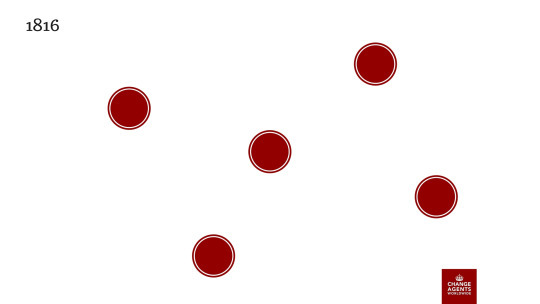
If you were setting up a business in 1816 and you were going to operate over any distance, you needed to rely on your people to operate autonomously. Through much of the 19th Century as the telegraph, railroads and eventually automobiles arrived, communication and transportation remained slow and costly.  If you relied on instructing a distant workforce through more than an occasional letter or shipment, you were in danger of losing your business. Bureaucracy had been created to enable management on merit and talents and to provide consistent decision making to the management of local autonomy. People hired for trust, autonomy and the creative talents to manage a business because there was no other way to manage local affairs in a volatile changing world.

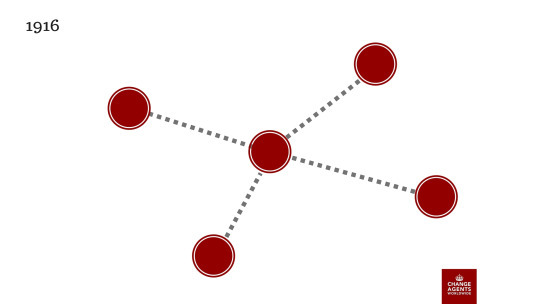
image

By 1916, the cost of communications and transport had fallen significantly. The technology of management responded by leveraging the communications technology to measure, simplify, standardise and organise. Risk, discretion and variation were eliminated to achieve economies of scale and consistency of quality. Communication technologies enabled the end of autonomy, replacing it with policy, process, hierarchy and management. Bureaucracy enabled by communication took over the art of management in a fast global world. People hired for experience, organisational fit and ability to execute.

image

In 2016, digital communications are ubiquitous, logistic networks cover the world and through technology like 3D printing and digital services we are even beginning to explore options to avoid transportation costs entirely. We have passed beyond exchanging, measuring and recording enough information to manage the business. Now there is too much information for everyone.  Employees, managers, customers and stakeholders are overwhelmed and unable to properly understand and respond to the system of interconnected processes that exist across organisations. 

In this complex adaptive system, we can no longer expect an all powerful centre to see and manage the processes, policies and business. We have returned to autonomy. People are hired for trust, autonomy and the creative talents to manage a business because there is no other way to manage complex affairs in a volatile connected and rapidly changing world.

The organisations that succeed in an interconnected world will be those who enable their people to respond autonomously to their environment, to lead experimentation and adaptation and to apply creative human intelligence to improving the system. New models of management are being developed now to create these responsive organisations

Factlets

Factlets aren’t facts. Factlets are far more useful. Factlets are the fragments we keep to reassure ourselves we are right. They are the parts of facts that suit your argument.

Truth is irrelevant to a Factlets. All that matters is your argument.

Factlets are quotes from sources we have never checked. Factlets are theories we picked up in conversation. Factlets are opinions that ‘sound right.’ Factlets are that phrase everyone thinks they know without reading the book. Factlets are reassuring statistics devoid of source, method or context. Factlets are history that now has new meaning because new stories suit us better. Factlets are trends from a single data point. Factlets are the simple answer in a complex world. Factlets are easy, comfortable and quick.

Reality is hard, uncomfortable and slow.

Every time you see an argument that depends on one piece of information you will find a factlet. Factlets are bias, distortion and deceit. They dominate our thinking but thrive on a lack of attention. Factlets avoid the effort and inconvenience of real facts and actual knowledge.

Factlets couldn’t be more dangerous to our health, wealth and wellbeing.

Small Changes Accumulate

1 – Make a small change today.

2 – Do it again tomorrow. You have doubled your influence.

4 (2 to the power 2)- The next day invite 3 people to join with you in the next change. You have doubled your influence again.

8 (2 to the power of 3)- The following day ask everyone to bring 1 people to make the next day’s change. 

16 (to the power of 4) – From day five ask everyone to keep adding one person each time you make a change. Spread the message far and wide in your network.

1,073, 741, 824 (2 to the power of 30) – If you can double your influence for 31 days, only one month, you will have over a billion people carrying out that change. 

Most changes you want to make don’t need that many people or that cumulative power for change.  You might not get to double every day for a month, but the further you get down the path of small changes powered by a network, the greater your influence.

Of course, you have no influence until you start making change. Today.

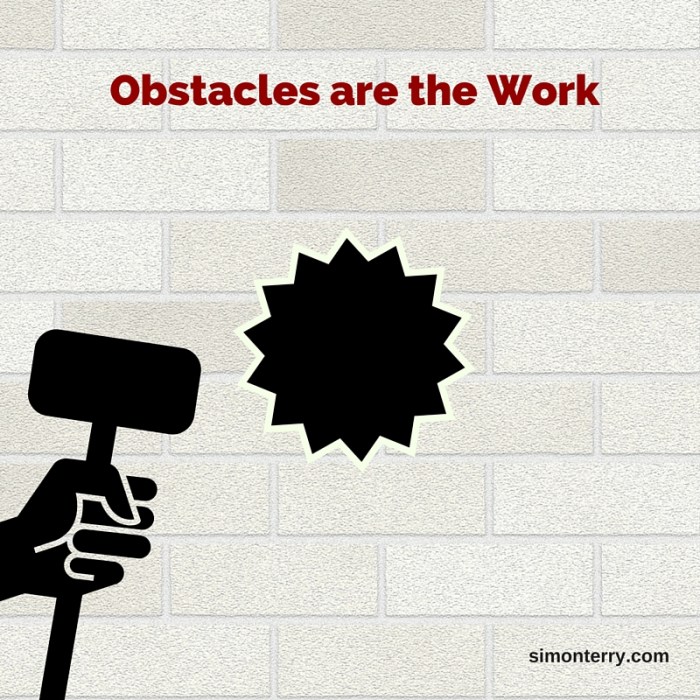
Obstacles are the Work

Obstacles are not constraints. Obstacles are not limits to possibility. Obstacles aren’t disappointments.
Obstacles are the work.
Obstacles are a creative challenge. Obstacles are an opportunity to learn. Obstacles are a reminder to improve.
Obstacles are the work.
Obstacles are the reason they need you. Obstacles are the best test of your potential. Obstacles are the challenge.
Obstacles are the work.
Obstacles are why you need others. Obstacles are where process breaks down. Obstacles demand purposeful change.
Obstacles are the work.
Ranting doesn’t remove obstacles. Hope doesn’t remove obstacles. Work removes obstacles.
Obstacles are the work.