Do one thing

Just one action is enough to make a difference. It helps you learn.

When we want to improve things or make a change, the opportunities can be overwhelming.  

All at once we want to change everything simultaneously. We can become a whirlwind trying to make everything happen now. Usually, that results in a lot of confusion and a mess of partially completed plans.

Alternatively, we can get stuck trying to make the best choice among the options.  We can go looking for that one perfect thing that will make the biggest difference.  Paralysis by analysis will result. There are too many choices and too much analysis to pick the right option with the fewest risks. 

Just do one thing. Today. 

How do you choose? Do what feels most right. Go with your best hunch. Back your judgement. You are immersed in the problem.

Do one thing well.

But, and this is a big but…

Measure your action.  Learn and do one new thing again based on what you learn.

Over time the actions will build. You will build momentum too. You might find others join you. The purpose and the answer is in the work

So do.

Never Give Up Your Dream

Keep up the daily effort and keep your dream alive.

Recently, I saw the excellent Trinitas program from Melbourne Chamber Orchestra. Performing among the many talented artists that night was Shane Chen. Shane impressed the audience with his playing, energy and enthusiasm of his performance of the Schubert Rondo in A Major for Violin and Strings D438.

I was surprised to hear that it is only in the last three years Shane has pursued a career as a professional musician. When he approached ANAM 3 years ago looking to restart a musical career, he was working in a shipping company having given up his dreams of a musical career for a more remunerative pursuit of commerce. Importantly, he had kept up his passion and practice and remained ready to take risks for his dream. Those risks were very real given his path was unconventional for a classical musician. The teachers at ANAM saw his potential and after 3 years of hard work, Shane talent & passion shines in his performance.

If you face a challenging career dream, follow Shane Chen’s example:

  • Keep up the work towards your goal. Daily practice of some kind creates options. Surrender guarantees your option is lost.
  • Take risks to do what you want. The path to success is not easy, sure or straight.
  • Find great people to help.

The last point is why I believe organisations like ANAM and MCO and teachers like Bill Hennessy are critical to the careers of artists in Melbourne. Stories like Shane’s show the support talented artists need to pursue their careers and brave the risks involved. Without someone to nurture talent and and providing support & opportunities, fewer artists will pursue their career dreams and produce great work.

So as you pursue your career dreams, what can you do to help the dreams of others be realized?

P.S. if you need a suggestion, MCO would love your help to continue to realise dreams and create great music

Be Human 2: Telstra Digital Summit 2013 Takeaways

The Telstra Digital Summit 2013 had a group of exceptional speakers with Robert Scoble, Shel Israel, Brian Solis and Tapan Bhat all sharing their perspectives on digital transformation facilitated by Monty Hamilton and Gerd Schenkel of Telstra Digital.  In addition there were panels on Telstra’s digital journey and the experience of a group of Pollenizer start-ups.

What did I take away?

Be Human 2

Just like the recent Products are Hard Conference, the key theme of the day was a need to deeply understand human behaviour. Whether it was the impact of sensors on our understanding of customer action, big data, focusing on design for customer journeys or building communities, better performance depends on better understanding of human behaviour.  

We are reaching a point where the opportunity of technology to enable us will offer wide choice, our understanding of human behaviour will enable us to design our responses. Ultimately our ability to build and leverage human relationships with technology will be key to our success.

Be Relevant

Robert Scoble reminded us all that 3% response or click rates are 97% irrelevance rates. That 97% irrelevance is a large drag in a real human experience and our businesses.  We need to leverage our understanding and relationships with our customers to do better by being more relevant – personal, timely, trusted, insightful and offering valuable choices

Be Responsive

How we want to offer our product no longer matters.  We are no longer in a broadcast or distribution world. We are in a personal, engaging and much more human one.

Customers will have the ability to pull and to choose.  We will be designing our paths of choices that will be triggered by customer actions.  Instead of pushing out to customers, the questions is what paths we offer to lure them in informed by our understanding of their customer behaviour. When they come in, we will need to deliver to them the best of our network of capabilities. That requires a fundamentally more responsive organisation

Trust matters

Human nature revolves around trust assessments.  It came up again and again during the day.  Businesses need to see building deep and trusting relationships internally and externally as a key part of competitive success. Remember trust demands internal and external alignment, real capabilities and consistent delivery.

Design and Learn for Scale

Fixed mindsets, static knowledge and narrow focus may offer comfort but run high risk in times of volatile change.  Leverage the scale opportunities of the new global network economy.  Most of all design your activities to learn and grow at scale. Australia is a small market and Australian businesses have the talent and potential to reach far.

We don’t know where we are going

From big companies to little startups, the comment was the same.  The outcome cannot be predicted: Jump off a cliff and build the plane on the way down.  That will demand a significant improvement in your organisations agility, engagement and trust in people to deliver before you hit the ground. Command and control, hierarchy and meetings won’t save you.  To borrow a Telstra phrase used in the day, you may need to invest early in ‘a few long poles’ to establish connections and options to accelerate your responses later.

Disclosure: I received a free ticket to the summit and a copy of The Age of Context by Robert Scoble and Shel Israel thanks to Telstra Digital.

Fair Weather Talent

When times are tough is when talent matters most.

Many organisations invest in talent. They understand the importance of investment in and engagement of great people to the success of a business.

Looking after people is easy when times are good. However, we all know the true test of character is what happens when times are tough, there is a crisis, or a decision needs to be made that impacts one’s own interests. These are often the moments when you need your talent most engaged to help lead change.

The impression you create for the talented people in your business will depend on your behaviour in these times of adversity. They will judge your commitment to people and your character on how you make decisions in these moments.

Your decisions probably won’t be the same. Nobody should expect consistency of decisions when things change. However, it is important to be consistent with the approaches and the values of the good times, no matter how hard it is.

If you can remain consistent in your approaches and values, then your people will reward your commitment to talent with greater engagement. Be a fair weather manager of talent and your people will remember.

Joining Sidekicker

I recently joined Sidekicker as an advisor, spending a little of my time helping this exciting startup grow their business. Sidekicker’s vision is to make it simple for businesses to be connected to local, talented individuals for short term jobs or projects. They supply the flexible and on-demand talent to help businesses grow.

Here’s a walk through why I am keen to spend time with Sidekicker:

Future of Work

I passionately believe we are reaching a turning point in the future of work. People are increasingly interested in new agile and flexible models of work, both businesses and individuals. Many people are more connected to their work than they are the organisation that offers a job.

Sidekicker is an important experiment in how Sidekicks can build portfolio careers that enable them to earn a living working on the projects that they choose and also pursue other projects.

Helping with Agility of Growing Businesses

The local businesses that I meet all struggle with workload. Work comes in peaks and troughs. The volatile nature of business confidence and market changes makes this more dramatic. Opportunities and crises arise at short notice. For safety’s sake growing businesses often hire behind the growth curve.


Adding another person as a full time hire is often a big deal. Most temporary agencies are structured for larger engagements. A casual workforce needs to be maintained. Having an easy ability to bring in talented people for a job or a task offers real solution to an urgent needs. Usually, these opportunities enable a business to realise a growth opportunity or solve a longstanding issue that current people don’t have the time or bandwith to solve.

Opportunities abound

The demand for the better streamlined digital service Sidekicker offers is already evident. A great pool of talented Sidekicks has been built. Local businesses are already taking up the service and seeing the value of jobs done. That’s a great platform on which to build Sidekicker, experimenting with new ways to streamline the processes and build value for all concerned.

Talent matters

Businesses run on talent. Talent is what enables a business to advance, close its opportunities and pivot when required. I’m impressed with the Sidekicks and the quality and diversity of the skills in the team at Sidekicker. You only have to see some of the recent media on Sidekicker to get a sense of the nous & hustle of the co-founders, Jacqui Bull & Tom Amos.

Making a difference

I am confident I can help make a difference for the talented Sidekicker team by sharing my experience in business and my networks. We have already had some really valuable conversations to accelerate growth.
In my experience, a frenetically busy & focused startup team needs the ability to call on others to provide perspective, help shape their thinking or to suggest other options. Of course, it doesn’t hurt that I learn a little from each of those conversations and some of these lessons will find the way to this blog.

Your Organisation. Your Movement.

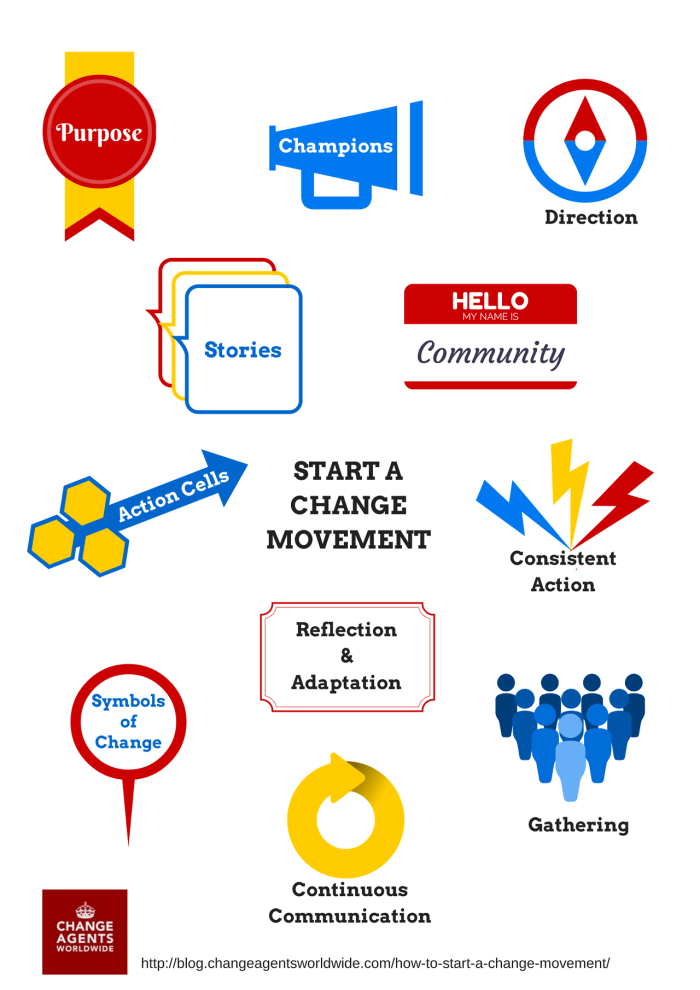
One of the busiest posts on this blog is How to Start a Change Movement. People are increasingly recognising and preparing to adjust to the increasing pace of change in the world.

However, there is a bigger issue that is also surfaces when we reflect on the need for people to collaborate to bring about change:

Our organisations only exist to drive change.

Organisations exist to fulfil a purpose, to make a difference, to better meet a need, to help customers and communities and to make more from less. These are all change.

There is no successful product or service that does not deliver change for the customer. The bigger the changes created for customers and the community the more likely the organisation will succeed.

We can lose the change focus of our organisations in the complexity of our goals, processes, structures, budgets and day-to-day challenges. We can assume that doing our job, doing the same things and surviving to the weekend is the point of the organisation.

Every organisation must be a change movement. We need to use the elements of great change movements to make our organisations more responsive. Without continuously creating some better form of change for its customers and community, an organisation quickly loses its reason to exist.

Next time someone suggests that an organisation doesn’t need to change, ask them to reflect on what it is that the organisation does in the world.

Don’t just describe the problem

Describing the problem is a beginning

Most people believe change begins when you describe the problem. Describing the problem clearly is the beginning. David Whyte described it well:

See, even if you’re stuck in life, if you can describe just exactly the way you’re stuck, then you will immediately recognise that you can’t go on that way anymore. So, just saying precisely, writing precisely how you’re stuck, or how you’re alienated, opens up a door of freedom for you.- David Whyte

Beginnings aren’t endings

Then again, there is Dilbert.

image

Scott Adam’s strip has been ruthlessly skewering corporate life for years. We see these moments and recognise them immediately.  We share them and discuss them. The appeal of the scenarios are that we know they still happen every day in organisations just like our own. In fact, Adams is overwhelmed with suggestions by email for new strips.

So we look at Dilbert, know change is needed in our organisations and do what exactly?

Describing the problem, gossiping about it quietly or complaining to one’s friends over a beer is a small start.  Too many small starts become false starts, repeated over and over with no progress.

From false starts to progress

Once you have described the problem, you need to act to make it different. Act. Make one little thing different. Today.

Don’t do it alone. Start or join a movement.