Be Human 2: Telstra Digital Summit 2013 Takeaways

The Telstra Digital Summit 2013 had a group of exceptional speakers with Robert Scoble, Shel Israel, Brian Solis and Tapan Bhat all sharing their perspectives on digital transformation facilitated by Monty Hamilton and Gerd Schenkel of Telstra Digital.  In addition there were panels on Telstra’s digital journey and the experience of a group of Pollenizer start-ups.

What did I take away?

Be Human 2

Just like the recent Products are Hard Conference, the key theme of the day was a need to deeply understand human behaviour. Whether it was the impact of sensors on our understanding of customer action, big data, focusing on design for customer journeys or building communities, better performance depends on better understanding of human behaviour.  

We are reaching a point where the opportunity of technology to enable us will offer wide choice, our understanding of human behaviour will enable us to design our responses. Ultimately our ability to build and leverage human relationships with technology will be key to our success.

Be Relevant

Robert Scoble reminded us all that 3% response or click rates are 97% irrelevance rates. That 97% irrelevance is a large drag in a real human experience and our businesses.  We need to leverage our understanding and relationships with our customers to do better by being more relevant – personal, timely, trusted, insightful and offering valuable choices

Be Responsive

How we want to offer our product no longer matters.  We are no longer in a broadcast or distribution world. We are in a personal, engaging and much more human one.

Customers will have the ability to pull and to choose.  We will be designing our paths of choices that will be triggered by customer actions.  Instead of pushing out to customers, the questions is what paths we offer to lure them in informed by our understanding of their customer behaviour. When they come in, we will need to deliver to them the best of our network of capabilities. That requires a fundamentally more responsive organisation

Trust matters

Human nature revolves around trust assessments.  It came up again and again during the day.  Businesses need to see building deep and trusting relationships internally and externally as a key part of competitive success. Remember trust demands internal and external alignment, real capabilities and consistent delivery.

Design and Learn for Scale

Fixed mindsets, static knowledge and narrow focus may offer comfort but run high risk in times of volatile change.  Leverage the scale opportunities of the new global network economy.  Most of all design your activities to learn and grow at scale. Australia is a small market and Australian businesses have the talent and potential to reach far.

We don’t know where we are going

From big companies to little startups, the comment was the same.  The outcome cannot be predicted: Jump off a cliff and build the plane on the way down.  That will demand a significant improvement in your organisations agility, engagement and trust in people to deliver before you hit the ground. Command and control, hierarchy and meetings won’t save you.  To borrow a Telstra phrase used in the day, you may need to invest early in ‘a few long poles’ to establish connections and options to accelerate your responses later.

Disclosure: I received a free ticket to the summit and a copy of The Age of Context by Robert Scoble and Shel Israel thanks to Telstra Digital.
Fair Weather Talent

When times are tough is when talent matters most.

Many organisations invest in talent. They understand the importance of investment in and engagement of great people to the success of a business.

Looking after people is easy when times are good. However, we all know the true test of character is what happens when times are tough, there is a crisis, or a decision needs to be made that impacts one’s own interests. These are often the moments when you need your talent most engaged to help lead change.

The impression you create for the talented people in your business will depend on your behaviour in these times of adversity. They will judge your commitment to people and your character on how you make decisions in these moments.

Your decisions probably won’t be the same. Nobody should expect consistency of decisions when things change. However, it is important to be consistent with the approaches and the values of the good times, no matter how hard it is.

If you can remain consistent in your approaches and values, then your people will reward your commitment to talent with greater engagement. Be a fair weather manager of talent and your people will remember.

Joining Sidekicker

I recently joined Sidekicker as an advisor, spending a little of my time helping this exciting startup grow their business. Sidekicker’s vision is to make it simple for businesses to be connected to local, talented individuals for short term jobs or projects. They supply the flexible and on-demand talent to help businesses grow.

Here’s a walk through why I am keen to spend time with Sidekicker:

Future of Work

I passionately believe we are reaching a turning point in the future of work. People are increasingly interested in new agile and flexible models of work, both businesses and individuals. Many people are more connected to their work than they are the organisation that offers a job.

Sidekicker is an important experiment in how Sidekicks can build portfolio careers that enable them to earn a living working on the projects that they choose and also pursue other projects.

Helping with Agility of Growing Businesses

The local businesses that I meet all struggle with workload. Work comes in peaks and troughs. The volatile nature of business confidence and market changes makes this more dramatic. Opportunities and crises arise at short notice. For safety’s sake growing businesses often hire behind the growth curve.


Adding another person as a full time hire is often a big deal. Most temporary agencies are structured for larger engagements. A casual workforce needs to be maintained. Having an easy ability to bring in talented people for a job or a task offers real solution to an urgent needs. Usually, these opportunities enable a business to realise a growth opportunity or solve a longstanding issue that current people don’t have the time or bandwith to solve.

Opportunities abound

The demand for the better streamlined digital service Sidekicker offers is already evident. A great pool of talented Sidekicks has been built. Local businesses are already taking up the service and seeing the value of jobs done. That’s a great platform on which to build Sidekicker, experimenting with new ways to streamline the processes and build value for all concerned.

Talent matters

Businesses run on talent. Talent is what enables a business to advance, close its opportunities and pivot when required. I’m impressed with the Sidekicks and the quality and diversity of the skills in the team at Sidekicker. You only have to see some of the recent media on Sidekicker to get a sense of the nous & hustle of the co-founders, Jacqui Bull & Tom Amos.

Making a difference

I am confident I can help make a difference for the talented Sidekicker team by sharing my experience in business and my networks. We have already had some really valuable conversations to accelerate growth.
In my experience, a frenetically busy & focused startup team needs the ability to call on others to provide perspective, help shape their thinking or to suggest other options. Of course, it doesn’t hurt that I learn a little from each of those conversations and some of these lessons will find the way to this blog.

Your Organisation. Your Movement.

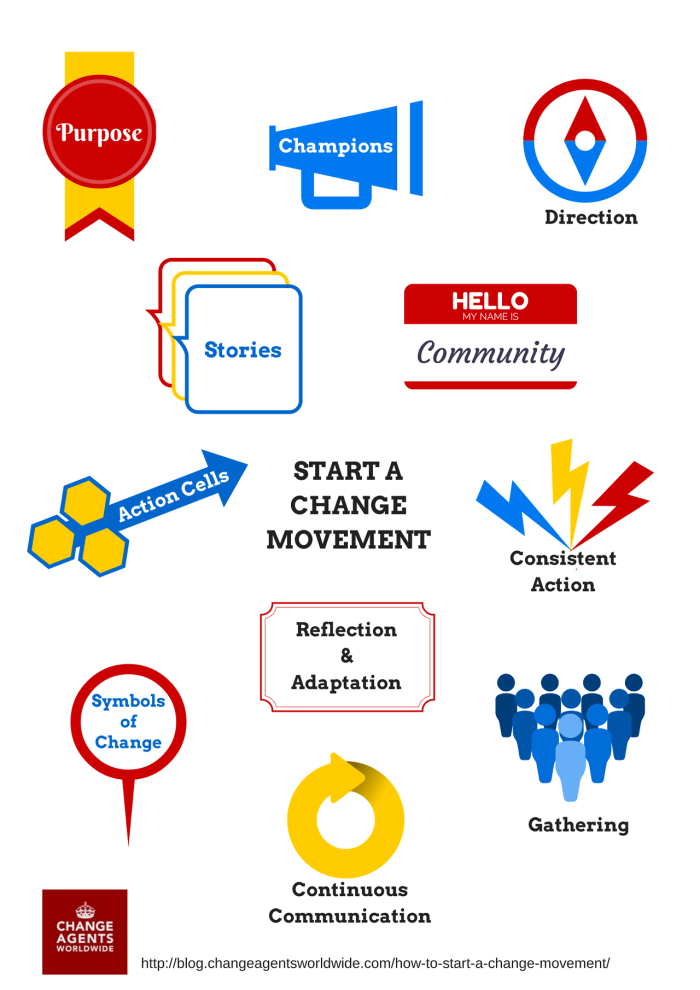
One of the busiest posts on this blog is How to Start a Change Movement. People are increasingly recognising and preparing to adjust to the increasing pace of change in the world.

However, there is a bigger issue that is also surfaces when we reflect on the need for people to collaborate to bring about change:

Our organisations only exist to drive change.

Organisations exist to fulfil a purpose, to make a difference, to better meet a need, to help customers and communities and to make more from less. These are all change.

There is no successful product or service that does not deliver change for the customer. The bigger the changes created for customers and the community the more likely the organisation will succeed.

We can lose the change focus of our organisations in the complexity of our goals, processes, structures, budgets and day-to-day challenges. We can assume that doing our job, doing the same things and surviving to the weekend is the point of the organisation.

Every organisation must be a change movement. We need to use the elements of great change movements to make our organisations more responsive. Without continuously creating some better form of change for its customers and community, an organisation quickly loses its reason to exist.

Next time someone suggests that an organisation doesn’t need to change, ask them to reflect on what it is that the organisation does in the world.

Don’t just describe the problem

Describing the problem is a beginning

Most people believe change begins when you describe the problem. Describing the problem clearly is the beginning. David Whyte described it well:

See, even if you’re stuck in life, if you can describe just exactly the way you’re stuck, then you will immediately recognise that you can’t go on that way anymore. So, just saying precisely, writing precisely how you’re stuck, or how you’re alienated, opens up a door of freedom for you.- David Whyte

Beginnings aren’t endings

Then again, there is Dilbert.

image

Scott Adam’s strip has been ruthlessly skewering corporate life for years. We see these moments and recognise them immediately.  We share them and discuss them. The appeal of the scenarios are that we know they still happen every day in organisations just like our own. In fact, Adams is overwhelmed with suggestions by email for new strips.

So we look at Dilbert, know change is needed in our organisations and do what exactly?

Describing the problem, gossiping about it quietly or complaining to one’s friends over a beer is a small start.  Too many small starts become false starts, repeated over and over with no progress.

From false starts to progress

Once you have described the problem, you need to act to make it different. Act. Make one little thing different. Today.

Don’t do it alone. Start or join a movement.

Having social fun (at work)

Remember fun?

image

Those little activities that bring a smile to your face and connect you more deeply with colleagues over a laugh or a giggle.

It is not too late. You too can be responsible for bringing the fun back to your workplace. The perfect place to start is your organisation’s enterprise social network. Everyone’s there. Waiting for fun to break out. Your audience is crying out for something a little more engaging than the latest link to a compliance policy update.

I recently saw this call for help

Here’s a few ideas that I shared with Jakkii and a few more to pad out the list. They just might help get you started with your own fun. Be inspired:

  1. Offer free steak knives: Marketers do it for a reason. People go silly for steak knives. Start a fun competition today with steak knives as a prize. Your local supermarket has really cheap steak knives. 
  2. Do introductions: Ask everyone to introduce themselves in 140 characters or less. Ask people to describe their worst job, most embarrassing moment, best day, etc.  Offer prizes (see steak knives above) for the most likes, most creative, funniest, etc
  3. Memes: They work on the web for a reason. Search for a meme generator. Send your next serious message in an amusing meme image. You will be surprised how much attention it gets. You might even start a trend of posting more memes, gifs, cat pictures, etc.
  4. Pictures: The sillier the better. Yes, including cat pictures.
  5. Baking competitions:  If two people in your office bake, then have a competition. If you don’t have two, make someone senior bake as a challenge. You might inspire a few more cupcake makers. Who doesn’t like fun that you also get to eat for morning tea?  Photos & reviews go on the network
  6. Event themes: Does your ESN dress up for cup carnival, sporting events or the holiday season? If not, why not? 
  7. Create groups for water cooler conversations, movies, television programs, jokes or any other topic that might engage people.  Most radically of all, let people create their own groups. To have fun (at work)
  8. Set challenges: A quiz, a treasure hunt, a challenge, a target, a quest, etc. Design activities that engage with a smile and preferably generate photos and stories.
  9. Recruit champions of fun: If someone has previously created a smile, invite them to an offline meeting of funsters. Plan your next attacks.
  10. Lists: I got to ten. So can you. I could go on, but where’s the fun in that?

The power of social networking at work is the opportunity for people to engage socially while working. Rapport building involves the little stuff as well as the serious stuff.  If you take the lead, others will follow. Post in line with your company’s culture and you will be fine. Don’t try to do standup. Start small and it will grow.

If your organisation will not allow any fun: Then absolutely make sure that you don’t have any. Deprive others of fun (and try not to have fun doing that). Most importantly ask yourself how long you will last.

The point of all this fun: Aside from the obvious, you will engage a lot more people and give them an opportunity to try their first post or first like.

PS: Forgot this when writing the original post. Don’t forget #funhashtags. #needisaymore ?

On Sound Bites

Complexity is increasing. People demand simpler messages. How can leaders deliver?

Jacob Burckhardt, a Swiss historian of the 19th century, described the paradox that as material conditions improve, complexity increases, but so does that demand for simplicity. Increasing complexity creates a growing social appeal of simple messages and solutions.  Society is exposed to the risk of increasing appeal in the messages of demagogues who promise simplicity often at the cost of tyranny, ‘terrible simplifiers’. We need only look to the ideologies of last century or our current politics and media to see the pull of overly simple messages.

Modern leaders face this challenge daily. Easy jobs get done. The challenges leaders face are complex, networked and moving rapidly. All stakeholders want simple easy solutions. Deliver a sound bite and the leader’s work is done.

We should all communicate as simply and concisely as possible. We also know overly simple messages can mislead, be disengaging or be counterproductive. When simplicity does not deliver solutions or when the stakeholders craves a simplicity that is not yet possible, how does a leader progress?

Converse, Don’t Communicate: Politicians speak in sound bites to fit a traditional media broadcast mentality. Leaders can use a range of tools to foster a richer and ongoing conversation. Encourage questions, debate and engagement. Conversations cover complexity more efficiently than any prepared speech.

Talk Purpose, Not Plan: A purpose can and should be simpler than a plan of action. A key role of a leader is to connect stakeholders in a common & worthwhile purpose. People united in purpose are more engaged and more collaborative. Purpose helps people work through complexity. Use your leadership communication to engage people in a simple common purpose.  Better to let the group build a plan together and address the many complexities when united around a simple purpose.

Use Immersion, Not Information: Complex scenarios can be hard to express and share.  Resist the temptation to cut the problem down to a soundbite of fact or a single measure to improve. Show people the situation and let them immerse themselves in the experience. The action is simple but people’s takeaways will be far more complex.

Offer Confidence, Not Certainty: Confidence and certainty are often confused. Leaders can be confident in the capabilities of a group, but uncertain as to the path or the outcome. Offering certainty where it cannot exist is a path of disappointment and deceit. If you cannot express confidence, then the first task is to do what is necessary to do so.

Be Credible, Not Consistent: Complex systems change. Solutions and conversations need to iterate. Conversations should involve learning. Holding to a consistent position in the light of changing facts is likely to be inflexible at best and damaging to credibility at worst. Building trust by building your credibility & capability as a leader is more important than holding to a consistent position for the sake of simplicity. Bear in mind that if you have engaged others in conversation, they will understand the rationale for the change in position for they will have experienced the debate.

We can all communicate more simply. We should. However, we must not trade simplicity for effectiveness as leaders. Even these simple approaches are likely to fail in some circumstances. Leaders must continue the challenge of finding simple ways to engage people in solving the most complex problems.

Trust

Trust is critical to successful organizations. While it may be an example of our ability to acquiesce in functional stupidity, trust accelerates decision making and reduces transaction costs in teams and organisations. Arguably the boundaries of trust shape the size and structure of our organisations. Without trust there can be no effective engagement of employees, the community or other stakeholders.

A recent insightful analysis on trust in organisations highlights three elements of internal trust in organisations:
– vertical interpersonal trust – trust in direct superiors
– lateral interpersonal trust – trust in peers
– impersonal trust – trust in processes and systems

As we consider changes to the shape of our organisations and their systems to leverage disruption and create more responsive organisations, we must remember to balance the demands of each of these forms of trust. A shift from hierarchical autocratic management may reduce the demand for vertical interpersonal trust, but it will increase the need for the other two forms. Agile team based work can increase lateral interpersonal trust, but will also place demands on impersonal trust through changes required in systems and processes.

Changing the way we work will require us to strike a new balance between these three forms of trust with all the participants in the system. It will have ramifications for trust externally as these three models are reflected in our relations externally as well. Trust can’t be imposed. It must be earned in action, capability and credible intent.

As we adjust our organisation models, we will need to take our whole system into a new balance of trust. Impersonal trust, trust in the systems and processes we use, will be the critical component to that process of engagement and adjustment.