Networks connect. Communities mature.

Connection = Network

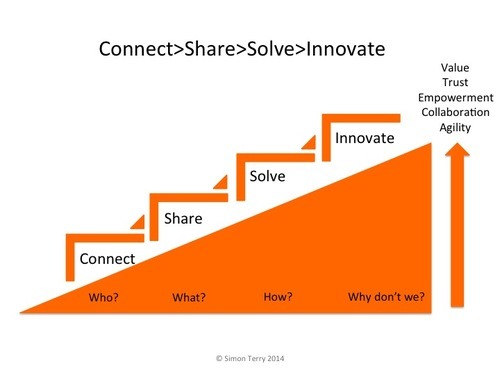
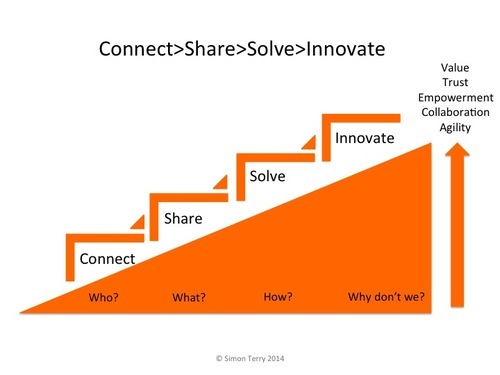
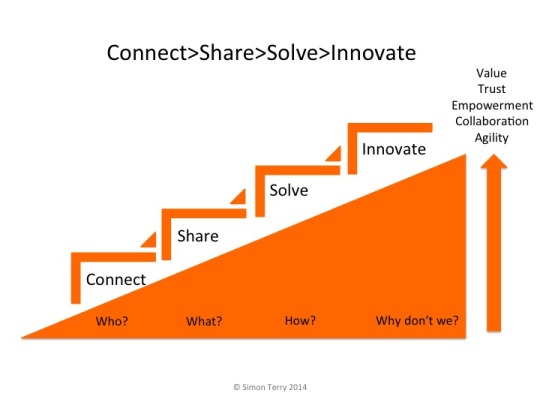
Connect is the first stage of the Value Maturity Model of collaboration because connection is what creates a network. Until people are connected together you don’t have any ability for someone to exceed their individual potential.

Connection only gets you a network. One of the reasons many people have been disappointed by their enterprise social network or their social media strategy is that they have not seen beyond creating the connections. A network has no vision.  A network has no purpose. A network is neutral in creating value.

Community = Value

Community creates the value. Community is how people come together to share their talents and create greater value together. Communities can create visions, realise the shared purposes of individuals and work together to achieve more.

Network connection happens immediately. Community develops over time as people learn to trust others and as people learn the new interactions that create value for themselves and others. Sharing, solving problems and innovating together deepens the community and enables individuals to grow in their potential. These communities also always exist within larger communities, like companies and society, that are often more important in shaping the way people act.

People = Potential

Focus on the potential of human communities. Remember that bringing people together in a network is just the beginning of the potential that people can create. Communities will mature with common goals, leadership and action over time.

Value creation in networks

The old way industrial of creating value is well understood and commonly implemented. Develop a unique proposition with a discrete market. Create a simple linear process to deliver the proposition by turning inputs into outputs with value creation at each carefully delineated step. Maximise control at the choke points in the process to maximise returns. Manage efficiency and throughput of the process to minimise waste. Reduce risk. As easy as that sounds we have spent over 200 years perfecting the process and still have much to learn.

We know far less about creating value in the massively scaled digital networks that we face today. Mostly we know what doesn’t work. Failure is accelerating. A focus on efficiency will kill a company competing with disruptive competitors. Networks specialise in routing around control points. Parallel disaggregated processes disrupt the linear, particularly if relentlessly focused on key opportunities to create value. Transparency across the process and rapid exchange of information changes the organisation-customer-employers-supplier- community dynamic in radical ways.

Value creation in networks to date has defaulted to the nearest analogies of the industrial model. Build a platform with a unique global scale that you can control. Strip the value creating process back to customer acquisition and platform development. Control advertising revenues ( or less commonly enterprise sales) as the principal form of monetisation. Experiment and acquire relentlessly. Be transparent internally and leverage networked models of organisation internally, but behave like industrial peers to the external market, except for carefully structured communities of co-creation and innovation.

The latest clues in the Cluetrain Manifesto are a reminder that this model is not guaranteed. At the same time, the lessons of the last Dotcom bust documented in Seely-Brown and Duguid’s ‘The Social Life of Information’ are a reminder that we have not yet reached our disaggregated and disinter mediated ‘markets are conversations’ utopia.

What is clear is that we need new ways of working. We will build new practices using our new global networks and relationships to exchange what works and to discard what does not. The key to success will be effectiveness. Effective organisations will mobilise their potential, connections and capabilities to pursue the ever-changing network opportunities, to learn together with their customers and community to realise a meaningful purpose. Embracing the new network economy and networked ways of working is fundamental for any organisation seeking to make this shift. Any organisation that takes this leap is on the path to becoming a Responsive Organisation.

Value has never been created around a board table. That is where value and the resources to create value have historically been acquired or allocated, often poorly. Value has never been created by data alone. People transform the data into hypotheses, insight, decisions and actions. Value has always been created by that action in networks, even if those networks are the crippled relationships of hierarchy. Those are network of people, not data. The organisations that reap the potential will be led by Network Navigators who can help their organisations through the journey.

The network must do the work to create value led by Network Navigators. As Esko Kilpi put it ‘the time for reductionism as a sense making mechanism is over’. The way forward will emerge through practice, interaction and learning in the network. We will need Network Navigators to help us to work on the whole system.

Harold Jarche reminds us ‘the work is learning and learning is the work’. We have entirely new systems and practices of organisations to develop, to test and to share. Like our efforts to date we will begin with fixes and variants to the systems we have. Over time we will make more new sense of the future of work. We will need to learn to trust and enable people to leverage their networks and experiment. Then we have the journey of change advocacy to spread the successful practices. The widespread use of enterprise social networks is just one such step and even it has not addressed the potential of adoption, let alone value.

The fun of value creation in networks has only just begun. Our job is to make that fun a very human and purposeful experience.

Leadership in Transformation

A common topic of debate in the Responsive Organization movement is whether an organization can become responsive or it must be born that way.

Undoubtedly many of the leading case studies of future of work organizations are organizations created or rebirthed from near death by charismatic founders. Some use this as evidence that the elements of a responsive organization must be present from the beginning. In a previous post, I pointed out that we cannot rely on transparency alone to make change occur for us. The power structures in a traditional organisation will prevent most radical change.

I am unambiguously in the optimist camp. I am not alone and the company in the optimist camp inspires me. I have seen organizations change enough to not recognise their former selves. Change to more responsive ways of working is possible. The question is how.

What gets in the way

Chris Argyris’ classic article Teaching Smart People to Learn is a rich source of observations of what gets in the way of a Responsive Organization transformation.  In particular, Argyris notes that:

… There seems to be a universal human tendency to design one’s actions consistently according to four basic values:

1. To remain in unilateral control;

2. To maximize “winning” and minimize “losing”;

3. To suppress negative feelings; and

4. To be as “rational” as possible—by which people mean defining clear objectives and evaluating their behavior in terms of whether or not they have achieved them.

The purpose of all these values is to avoid embarrassment or threat, feeling vulnerable or incompetent. In this respect, the master program that most people use is profoundly defensive. Defensive reasoning encourages individuals to keep private the premises, inferences, and conclusions that shape their behavior and to avoid testing them in a truly independent, objective fashion.

These hidden values in most organisation get in the way of the transparency-led transformation that many hope to see. The Responsive Organization poses a threat to control, a threat of losing and negative feelings. Importantly the delegation of authority in a Responsive Organization may cause people anxiety as to objectives and rationale for action.

The role of leadership is to act as a counterbalance these natural human values and shift the behaviours to that of a Responsive Organization. We need to create rationales for action more powerful than embarrassment. We need to create community to generate trust, support and connection. We need to enable learning through conflict and experimentation. 

Purpose:

Leaders must create a strong rationale for the transformation. In cases of crisis, startup or near death of organizations, this rationale can often be imposed by a charismatic individual. The external circumstances enable a threat based narrative to bind people together in a defensive rationale for change.

However, most organizations are successful to their own terms. As Argyris notes, we want to feel successful even if our results don’t pass external muster.  

Leaders need to leverage two elements to create a strong rationale for change in this context:  

  • The Purpose of the organization: a purpose is the ultimate rationale for why people come together in an endeavour. It defines the common impact the group of people wish to have on the world.  As a higher agenda, it is the perfect rationale for change for even the most successful organisations.  Purpose is a mastery quest. Very few organizations have the capability to completely fulfil their purpose. They can however strive to better realise it.
  • External orientation: No closed system will find a rationale for change. External orientation is where organizations find the challenges and opportunities that define the purpose into specific improvement opportunities. Leaders need to relentlessly focus the organization on its customers and community to see transparently the challenges and opportunities that exist for change. Well defined external impacts in this community will be what can drive the autonomy of teams in the organization.  Using customer and community data in line with Purpose, also enables change agents to overcome embarrassment-based resistance in the organization.

Community:

Individuals will need support to take on the risks of a Responsive Organization. The role of leaders is to create the sense of community that will support an individual through that change. At the heart of that community will be engagement with others and a growing sense of mutual trust.  Leaders set the tone for any community. They must also work hard to reinforce these key community behaviours

  • Engagement: Engagement begins with transparency and connection. I cannot truly care about the others in my community until I know who they are and understand their purposes, concerns and circumstances. Leaders need to create the conditions to enable people to be more social, to connect, to solve and to share their work challenges together.
  • Trust: Engagement will build trust as it builds understanding. Transparency will reinforce trust. However, leaders need to take on the role of fostering responsibility and accountability as engines of growing trust in the organization.  When people see that individuals and teams are accountable for driving change then they will have greater trust in the change agenda.

Learning:

This post is deliberately not titled like a listicle e.g. ’The 3 or 6 things to transform an organisation’. Even a basic familiarity with change highlights that formulas will work only up to a point. Leadership needs to be adaptive to enable any system to change in a sustainable way.

To be true to their purpose and stakeholders, to leverage the potential of their community, each organization will take an unique path through change.  The role of leaders is facilitate the individual and organizational learning required:

  • Experimentation: creating a culture of rapid iteration to address challenges and opportunities will accelerate the cycle of learning in the organization. Leaders must help this experimentation culture to overcome the resistance identified by Argyris and also to spread and have a wider influence in the organization. Lessons learned must become new truths which will take a sense-making role for leaders in the wider organization and mean leaders must champion new ways of working when they arise, whatever the personal costs.
  • Conflict: The biggest reason that organizational transformations fail is an unwillingness of the leadership of the organisation to allow uncertainty and conflict. Conflict will happen. The uncertainty associated with conflict is inevitable. Efforts to suppress this will either undermine transparency, the rationale for change, engagement or learning. Failure to embrace conflict takes many names: politeness, bureaucracy, politics, corporate speak, history, culture, etc. Failure to embrace conflict is an unwillingness to learn and improve. There will always be resistance when change comes and it must be addressed. Leaders need to create and sustain the right kinds of constructive conflict – driven by purpose, based in facts from an external orientation & experimentation, mediated through an engaged community. 

Change is Coming. Lead.

I have seen the potential of purpose, external orientation, engagement, trust experimentation and conflict to drive change. Supported by leadership these are the elements of each organization’s transformation. These elements are critical to a Responsive Organization.

Throughout this post I have referred to leaders and leadership. This need not be hierarchical leadership. Clearly it helps if leadership and power are aligned in an organization in reinforcing the need for change. However, the changes described above are not capable of being implemented by top-down edicts. These changes must come as individuals and groups discover their power and are influenced as a result, This kind of leadership relies on influence and can begin bottom up or even from the middle management so often scorned in organizations.

Change is possible. Change is coming. Smart people can learn. Your people and your organisation can better realise their potential and their purpose. A Responsive Organization transformation will occur if you are prepared to lead the change.

Lead.
Start small. Start now.

Each journey of a thousand miles, begins with a single step – Lao Tsu

If you have time to email, then you have time to work out loud. Find one email to reply out loud instead. Repeat.

If you have time to talk, then you have time to lead. Find one person to influence. Repeat.

If you have time to do, then you have time to experiment. Find one hypothesis to test in action. Repeat.

If you have time for a meeting, then you have time to start a movement. Find a group to engage in a purpose and action. Repeat

If you have time for a coffee, then you have time to learn. Find one moment to reflect on how to do better. Repeat.

If you have time to fix, then you have time to make change. Find one way to make the system better. Repeat.

Small scale changes accumulate given the time. Small interactions reinforce change and build community.

You have the time and the work. Start now. Start small. Repeat.

To Shape Change, Start Leading Change

image

“If we want things to stay as they are, things will have to change.” (spoken by Tancredi) from ‘The Leopard’ by Giuseppe Tomasi di Lampedusa

Times of disruptive change are difficult for those in power and those who benefit most from the current way of things. Many of these people prefer to ignore the rising changes in society. In effect, they abandon their leadership role in shaping change in the system.

Enduring disruptive change demands an engaged form of leadership. The future in disruption is not written. Leaders should seek to engage, lead and shape change to the benefit of their organisations. 

The Networked Economy is Here to Stay.

Many leaders of organisations have a lot of power, status and wealth tied up in the way things are now.  They are the masters of the current system, adept in its ways and confident in managing the current model of work and the organisation.  They have both personal and professional reasons for hoping that nothing changes.

Change doesn’t work that way. We are now part of a global ecosystem of actors connected in digital networks.  Access, visibility and transparency have increased driven by the new connectivity.  Change that enters this new system is magnified, spread and developed by the action of agents all around the world.

Lead or Let others Decide The Future

The connected digital networks of global actors means the future of work won’t be ignored, stopped or reversed. Others will go on to develop better ways of working whether you and your organisation participate or not. The less you participate, the more you appear a candidate for disruption by one of these actors.

Organisations face a leadership challenge in this environment.  Effective leadership, continuous learning and a vibrant culture is required to take effect of the advantages of the new approaches.  Senior managers need to play a critical role helping organisations adjust and maximise the benefits from these changes.

However, managers face changes in the future of work that change their power, status and potentially their financial position.  Networks can operate with less layers of management and roles that were once managements prerogative are being delegated to frontline employees or automated in systems. New two-way conversations with engaged and enabled employees, customers and other staked holders can require leaders to deal with new complexity. In this case, it can be tempting for a senior leader to sit on the sidelines hoping the changes are a fad or that they might pass over the organisation.

You Can’t Lead a Community if You are Not Engaged

A simple case study of this mindset comes when you consider the level of management attention to stakeholder activism in social and digital media. Because this activism is now more visible and empowered by digital and social networks, management can see resentment that once was hidden. Bear in mind the resentment is not new.  It just has a bigger audience and influence than before.

Many of these social activist activities have large impacts on organisations because the activist have a community and the organisation has only a network.  

The critical difference between a network and a community is how engaged the participants are. That engagement arises as a result of acts of leadership to create common purpose, to shape an agenda of action and to influence others to act. Leaders who ignore the burgeoning networks around the organisation allow others to shape the communities, their purposes and their influence.

Senior leaders of organisations need to engage with the networks around their organisation.  The opportunity to create productive communities far exceeds the risks. Listening and acting on feedback of networks of stakeholders is one of the better mitigants of risk. Failure to engage and to understand the needs of the networks creates an opportunity for others to lead. 

Networks have Feelings Too!

In enthusiasm for our ability to connect people in networks and to see the potential of new ways of working, we can lose sight of an important element. Networks are composed of human beings.  The rules of human relationships still apply and there is no magical technology that allows us to escape these fundamental rules.

Networks need to Form, Storm & Norm to Perform too

The process of forming a group dynamic in a networked community follows that of a team. Because a network is a mix of strong and weak ties the process of reaching community norms may well be a difficult and extended one.  

In a network, each individual forms a sense of the community, its purpose and the practices that prevail. At times for some individuals or groups in the community this sense of meaning can be quite out of alignment with the broader consensus.  However, in some cases the interactions in the community do not surface the differences or do not make that misalignment obvious to those in the community.

If each participant proceeds on and does not meet a conflict with their sense of meaning, then they will not discover the need to revisit their view. Often this failure to develop common meaning and norms will create major challenges for the network later when conflicts arise. People who feel that their sense of the norms ‘are obvious’ and have been acting on expectations of the same from others may experience a deep breach in trust at this moment. 

A key role of social leaders is to foster the meaning in a network and alignment of norms and value creation.  Leading these conversations early in a network’s life will help accelerate the community development and avoid later issues.

Remember weak ties means limits

One danger of the weak ties found in large networks is weak accountability. Without a strong connection to you, I can easily engage in the avoidance of conflict and the hard work of leadership. Rather than deal with a difficult situation it is human nature to see if we can’t ignore it or pretend that it is someone else’s responsibility to respond. See a conversation in a network that disturbs you and you can let it go or worse filter it out, if there is no accountability to engage.

Equally weak ties can mean that there is little cost to me for the snide remark, the cutting comment or even troll activity. Personal accountability for our actions through strong ties to others cuts down on this behaviour. I may not have accountability to the individual but I have a reputation to maintain with others and so I moderate my behaviour.

Leaders need to foster an environment of accountability in networks. Encouraging all participants to engage, to challenge and to clarify understanding helps accelerate the value in the network.

Build a network up from a single conversation

In this wonderful video on innovation by Sylvain Carle from Creative Mornings Montreal, there is a description of Unix and the need to build up complex systems from smaller systems that work beforehand. Networks are complex systems composed of smaller connected systems. 

The smallest systems of a network is two people in conversation. The conversations in your networks should work as great stand alone conversations.  If those conversations don’t work the way they work in the rest of your life, then something is wrong.

This week I was asked ‘why can’t we just let the network do its job to create a community virally?’ Networks don’t create a community. They only connect people. Conversations create communities. Conversations help people understand the purpose of the network and the personal and collective value that will be created. Those conversations are the work of leaders. Engaging movements of people in sharing and spreading ideas is the work of leaders through stories and conversations, not the networks themselves.

Start your leadership work by focusing on creating effective, valuable and engaging conversations.  Build your network back from there.

Value is a fractal

image

Enterprise social networks are made up of individuals who form their own groups and networks and the community is an aggregation of each of these components. We need to remember this structure when we start to think of value in enterprise social networks.

From Top-Down to Every Scale

One resulting characteristic of value in enterprise social networks is that they resemble a fractal, a mathematical shape that shows similar characteristics at any scale. Value in an enterprise social network does not only occur at the aggregate level.

Smaller scale activities are more important to sustain and grow the development of value across the whole network. There is less opportunity to order or impose value creation in a network than in traditional hierarchies where top down value is the priority and individual value is rarely considered.

Value For Users and Groups Makes a Network

Individual and group practices that create value are the underpinning of value for the whole network. Value comes from connection, sharing information, solving problems and innovating for an individual or the whole community. Without this value to the individual or group, no value creation at the network level will sustain itself.

Individuals and groups must understand and see the value being created to continue to work in new ways in the network. Developing the maturity of a network means building this sense of how value is created and how it aligns to strategic goals.

Create a Sense of Value at Every Scale

The power of the Value Maturity Model is that it is designed to take advantage of this characteristic. The method can be shared with users, with groups and with the whole community to help them make sense of how value is created for them and for the network.

Secret tools of community managers or organisational leaders won’t help individual users and groups find their own path forward to value. The power of value creation in an enterprise social network is the ability to leverage people’s potential to help

If you would like to create greater value in your enterprise social network or discuss how the Value Maturity Model applies to assist your organisation to create strategic value through enterprise social networking and collaboration, please get in contact. I am available through @simongterry or Linkedin or www.simonterry.com

Working Out Loud Creates Value

image

Working Out Loud is one of the most crucial practices for value creation in an enterprise social network. For many, it is also the least comfortable. We need to work at this new practice to deliver value.

Working out loud is the core new practice as sharing grows in an enterprise social network. When the conversation moves from sharing personal information to sharing work, value for the individual and organisation rises dramatically. That sharing is critical to the maturity of value creation in an enterprise social network. Without sharing of work, you hold back the benefits from other forms of work collaboration.

Working out loud creates great value in a network because:

  • working out loud gives a work purpose to the connection that has been formed in the network
  • working out loud invites community to form around people and their work enabling others to help, share knowledge and make work easier.
  • working out loud is not natural to many in the traditional workplace, but when people overcome hesitation and practice it they start to see the benefits of new forms of collaboration, that it makes work much easier & the culture much richer – a core driver of personal adoption
  • working out loud is the transition point to much wider collaboration across the organisation and particularly collaborative sharing and problem solving – work that is open is work that can be made better 
  • working out loud exposes the work which allows for better strategic alignment, reduced duplication and importantly recognition of the great work underway.
  • working out loud enables role modelling of transparency, vulnerability, learning, agility and experimentation.
  • working out loud by leaders can change the leadership dynamic from one based in control and expertise to one that leverages networks and collaboration.

Some great resources are available to help you with working out loud:

If you would like to create greater value in your enterprise social network or discuss how the Value Maturity Model applies to assist your organisation to create strategic value, please get in contact. I am available through @simongterry or Linkedin or www.simonterry.com

One minute video on How to Build a Responsive Organization

The Slides used in this video are available here: http://www.slideshare.net/simon_g_terry/building-the-responsive-organization

Credits:

Hacked from The Responsive Organization slideshare: http://www.slideshare.net/responsiveorg/the-responsive-organisation-a-framework-for-changing-how-your-organisation-works

Book: http://pixabay.com/en/open-book-page-pages-books-163975/

Music: B-roll by Kevin Macleod http://incompetech.com/music/royalty-free/