Reflections on Mastery & MCO

image

photo credit: Melbourne Chamber Orchestra Photo of Bill Hennessy, Artistic Director

Tonight was the Melbourne Chamber Orchestra’s celebration of a wonderful year. I was honoured to join the event as a board member. 2014 was a year in which the orchestra performed more than the prior two years combined, covered the distance from Melbourne to Mackay in its regional touring program inside the state of Victoria and entertained over 10,000 people with the artistry of their music. 

Mastery

Discussing the year with Bill Hennessy, the Artistic Director, and the other artists, I was not surprised that the conversations often turned to a discussion of mastery of one form or another. To choose a career in music is to choose a quest for mastery with the associated joys and frustrations. 

This is a group that knows well that mastery is not a designation or a destination, but endless determination. Artists understand that they must practice, rehearse, find more new ways to perform, share their expertise and constantly push themselves to better their art. The Melbourne Chamber Orchestra is only one vehicle in their quest but an important opportunity to perform, to explore the chamber music repertoire and to learn from others.

Mastery & Flow

The most remarkable rewards of this effort are the experience of flow. That moment when a greater challenge matches rising skills and pushes them further forward. The struggles drop away and there is an intensity of focus on performance itself. 

Sharing that experience with others, both artists and audience, is a remarkable event. The music generated makes the hair on your neck stand with its artistry, passion, energy and intimacy. An MCO concert or any chamber music concert is an opportunity to see, hear and feel this in action.

Mastery & Community

In pursuit of mastery and a life, Musicians are freelancers in a global economy of talent. Artist there tonight will be performing around Australia and the world before the next MCO performance begins the 2015 season. Their success depends on patrons, networks but above all the ever growing quality of their performances. We are lucky that they choose to base themselves in Melbourne to share their talents with us and to contribute to Melbourne’s rich musical community.

As the world of work changes, there is much we can learn from these artists on the importance of the quest for mastery. Our work is never done. We can get better. We must practice, learn and work. We need greater challenges to perform better. Our work can flow. Most of all we need communities who support us to perform at our best.

To learn more about MCO and its 2015 season, see mco.org.au

We are Us

We are Us.

We lose this simple truth too often. We see groups of people as having inherent characteristics that create forces external to the individuals involved. From time to time, we begin to believe that our companies, groups and organisations make us into something we don’t want to be. These forces in groups are those we choose to accept. Power, history, culture, ideologies, politics, values and the way we do things around here only persist because we are not working to change them.

We are Us.

If we want our organisation to care for us, we need to care for each other. If we want our organisations to be more aware, we must be more self-aware and share what we see. If we want to find the purpose of an organisation, we must start looking at our own purposes and how they are shared with others. If we want an organisation to learn better, faster or more, then we must change our own approaches to learning and work. If we want an organisation to change, it begins with changes in our actions.

We are Us.

If we don’t change our organisations when needed, they will fail. We will no longer be a group that shares a future together. The impacts of that failure will fall not on some abstract organisation but on each the individuals involved.

We are Us.

Every individual has a role to play to help the group change. Every individual has a right to shape the group through their participation. The influences in a group are a sum of individual interactions. There is nobody else to do the work of change.

Share the delta

Knowledge grows & iterates. Share the changes.

Imagine you could write a blog post that perfectly encapsulates all that you know. You would need to write it again tomorrow. In each day there are learnings and insights that shift your knowledge, experience, skills and perspectives. 

We can’t write that one perfect post. There is no point when it is immediately out of date. Besides the short attention spans of blog audiences indicate nobody but your biggest fan would read it. 

However, there is another way to share what you know. Share the changes in your knowledge, the delta. Work out loud on how your knowledge grows. Sharing this delta consistently will draw all that you know into the conversation over time. Build a new discipline. This process of sharing will accelerate your learning and iteration. You won’t have one perfect post, but over time you will build a web of interwoven posts. 

Share the delta. 

Transparency is a Disinfectant

image

‘Sunlight is said to be the best of disinfectants’ Louis Brandeis

Transparency is a disinfectant. Openness highlights the need for change. Just as hygiene enables but does not deliver good health, transparency alone will not change the behaviours in an organisation. 

From Transparency to Transformation

Many people hoped the transparency of social business would transform organisations. We are now in an era when an organisation is more transparent internally and externally than ever. Networks & conversations reach across organisational boundaries. Opportunities exist to connect, to share information about opportunities and issues and solve problems together.

Many hoped that with this new transparency would mean organisations followed a path that looked something like this:

Transparency > Greater awareness of issues> Experiments towards a Solution > Autonomous leadership

In this model, increasing the transparency and connection across the organisation highlights the problems. The visibility of problems enables individuals to experiment with new models to address the issues. Those experiments foster the evidence and the leadership to complete the transformation. 

This model has the appeal that people need do little. Simply add technology to make the organisations more transparent and change begins. However we have learned that organisations are communities of humans and that greater transparency is a positive, but it not enough to catalyse transformation. There are real human forces like power holding us back from this change.

Transparency is a Prerequisite not a Solution 

Speak to any change agent and you will hear a common refrain: ‘My organisation can see the problem but it still won’t do anything’. 

Transparency is essential to highlight problems & opportunities. Transparency in networks is good at finding new issues that have been hidden by historical ways of seeing things. Customers and community can raise their issues directly, often for the first time. Employees can share frustrations.  People can use the new transparent organisation to find those with the ability to make a difference to the issue. What transparency doesn’t do is guarantee that person does anything.

Brandeis is right that transparency is a wonderful disinfectant. Transparency also changes behaviours. When people are aware that their actions are transparent they are more likely to consider others and feel the accountability of the community. The rarity of bad behaviour in enterprise social networks is a case in point.

However, more likely does not mean a guarantee. Transparency will not overcome the wilfully blind leader, the resort to arguments, justifications and excuses or the use of power to enforce an exception. Each of these may be seen by all but they also might be accepted in the culture of the organisation.  When organisations have strong cultural or power forces that resist the issues, people may see something but still refuse to acknowledge, to discuss or act on it. 

Transformation takes Transparency, Accountability and Leadership

Organisations need transparency. Effective organisations thrive on it and particularly on the most difficult forms of opening their organisation up to external parties like partners, customers and the community. These organisations make accountability to respond to what flows from transparency part of their leadership conversation.

The sunshine of transparency helps create safer and more human organisations. Accountability and leadership leverage that transparency to complete the transformation.

A future post will describe the characteristics of an organisation’s leadership conversation that leverage transparency to foster transformation of organisations.

Give Purpose, Autonomy & Mastery, Not Direction

image

Last night I came across a reference to A Message to Garcia by Elbert Hubbard, which was once an influential essay describing a model of personal leadership. The essay reflects its origins at the turn of the 19th century, particularly in its description of manager & employee relations. However, a determined & talented employee who displays personal leadership and asks no questions is the goal for many organisations.

The essay contrasts between Rowan’s personal leadership & responses of other hypothetical examples. In describing these examples there is one difference that Elbert Hubbard missed. This missed difference highlights why so many employees might still disappoint when assigned tasks. The difference is the leadership involved in assigning the task.

President McKinley’s request is not the assignment of a mere task. His actions are far more powerful as acts of a leader than Hubbard’s own examples. McKinley allows Rowan to complete the task with purpose, autonomy and mastery:

  • McKinley assigns Rowan a whole & heroic task to deliver a message to an uncontactable General in unknown terrain. This is done where the purpose of this task is extremely clear to all involved – his country needs his unique talents to achieve an important goal in a difficult war.
  • Rowan is given autonomy. There is no direction on how to achieve the task, because he knows he is best placed to achieve it. There is no request for progress updates and no expectation that Rowan do more than achieve it. Once Rowan accepts the message, the outcome it is his to achieve (or to fail). 
  • Mastery is inherent in the selection of Rowan. He knows he has been chosen for his talents, his ability to improvise, to perserve and to improve to achieve a purpose beyond the capabilities of others. Rowan asks no questions because he knows it is his mastery that the others need.

Consider in contrast, Elbert Hubbard’s example of asking a clerk to write a memorandum on the life of Correggio. The task is arbitrary and hence purposeless. The only reason it is being done is that the employer asked for it. The lack of purpose also limits the autonomy. The memorandum fits in some plan not shared with the employee, rightly creating an expectation that further instruction or steps will be forthcoming. Unless the clerk is a scholar of Italian Renaissance painters, of writing or of biography, the memorandum is unlikely to match some arena of personal mastery.

Leadership in every role is a key refrain in the future of work. The world cries out for someone who can ‘get a message to Garcia’. More importantly, the world cries out for leaders who knows how to ask in ways that allow purpose, autonomy and mastery.

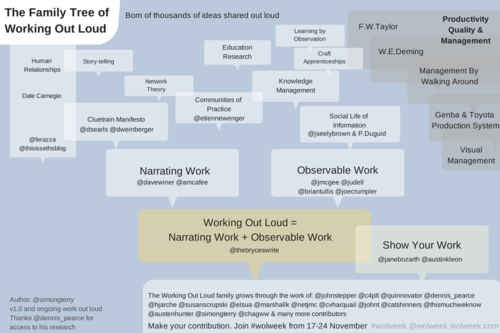
17-24 November 2014 is International Working Out Loud Week

Work out loud. 

Let others in to the mysteries of your work. Let others find out what you know and how you do it. Let others learn from your expertise, your tips and your tricks. Let others know so that they can guide, connect, help and accelerate you.

Share your work on a post it note on your office door. Write on a whiteboard. Post a note to the enterprise social network. Give a talk. Share with the world in communities, and other social tools. However you can, share your work visibly for others to find.

Show interest in the now more visible work of others. Help others to achieve their goals. Share your networks to build theirs. Recognise their achievements and their efforts. Share your insights, advice and expertise.

Work is not a secret mystery of private talents with sudden successful outcome. Work is a long iterative and collaborative process of learning together. Working out loud facilitates better outcomes and a more effective and human process.

Work out loud. There’s an adventure ahead.


Collaboration is Work. Not Meetings

One reason many organisations are hesitant to embrace future of work collaboration practices is that they perceive collaboration as slow, cumbersome and ineffectual. What these organisations are doing is associating collaboration with the meetings that they run.

We collaborate every day. We just don’t call it that. People get together through the work day and work together. They share ideas, answer questions, solve problems together and create new innovative approaches to business.  People making things happen is collaboration.  This kind of collaboration is across a wide diversity of channels and runs from a quick hallway conversation to a design thinking workshop.

Future of work practices are about accelerating these valuable forms of collaboration. We can all do more to connect, share, solve and innovate. Collaboration like this is rapid, engaging, efficient, asynchronous and incredibly valuable. This kind of collaboration can be anywhere and happens only when needed. It makes business work better.

The erroneous perception of collaboration sounds like a bad meeting. Action must wait until we have collaborated. Our conversation will be purposeless. Accountabilities are unclear. We need to get everyone involved together, preferably in the one space. We must discuss everything and listen to everyone’s views. We will make decisions by consensus or perhaps not at all. There will be politics, confusion and much wasted time. Nothing meaningful will be learned, created or done by the process of collaboration.

That sounds like a bad meeting because it is one. Don’t frame collaboration as a meeting process.

When you want to embrace future of work practices in your organisation, don’t try to replicate your worst meetings. Multiply your best examples of people working effectively together.

Running or dancing?

We talk about how companies run. We rarely discuss how they dance.

Our machine metaphor for the organisation leads us to talk of how companies run. Running was an apt metaphor for the industrial organisation with hierarchical management, process orientation, and efficiency as its goal.

Running is domination of a single dimension, distance. Runners maximise efficiency to get the best speed over the distance for their effort. Running is ultimately an individual effort. Running together involves parallel tasks. Running is about individual performance.

The network economy demands Responsive Organisations. We are starting to challenge organisations to be more human, to be more agile, to be more innovative, to learn and ultimately to be more effective. We start to sound like we need an organisation to dance.

Dancing involves exploration of three dimensions. Dancers explore those dimensions for the beauty of the experience. Dancing is a response to changing external stimuli, particularly the movements of others and the music. Dancing is far more interactive and collaborative. Dancing is a performance for the individual and the collective.

We run machines. Humans dance.

What would be different if you asked how well your company danced?

Who says elephants can’t dance? – Lou V Gerstner Jnr