Day 2 of International Working Out Loud week is drawing to a close for me, though there is great energy in the western hemisphere to go. Today for me was a day of reflecting on new reach of #wolweek and on the spread of influence.
Today leaves me pondering: How can we influence more widely and more effectively?
The big surprises for me today were conversations offline that took a discussion about working out loud into new audiences, new domains and new organisations. The reception was as enthusiastic as that in public social media. I have seen examples of others at work in the same advocacy. We should compare notes. We need more offline advocacy to continue to grow the community, to diversify ideas and learn together of the potential of working out loud.
We must remember that working out loud just has to be sharing. It doesn’t have to involve the whole wide world loud. There are many who can benefit without feeling comfortable enough to go that far. Circles are a great way to start small and start now.
Challenging Work Itself
Ayelet Baron raised a great question tonight that our lack of clarity on what ‘work’ is might just be getting in the way. WOL can become broadcast easily if we are still in our email-driven input/output manufacturing model of work.
How do we help people to consider what really constitutes the work that creates value? How do we better surface and strengthen purpose? How do we focus on helping people to work the obstacles in the system and work in between?
I know that WOL will be part of the answer.
Ongoing Questions
How can we take the conversation to the places where people are at work and would benefit from the practices of more open and more generous approach to their work?
How can we better reinforce the messages that influence others to trial working out loud?
I will keep reflecting on this and I would value your thoughts.
Our third International Working Out Loud week from 15-21 June 2015 is raising some familiar questions. This post is to share the current work to address these questions and invite some help in making sure that we are helping everyone get the most value out of #wolweek and the practice of working out loud. I would love your input because I think there is more we can do.
Here are the five commonest questions and the current attempts at answers:
How do I work out loud or get involved with #wolweek?
If you want to understand the history, there is a family tree of #wol which is built from Dennis Pearce’s PHD dissertation that supplies all the details. Because the working out loud movement is focused on sharing and aren’t big on doctrinal disputes, nobody is claiming ownership and we embrace all related movements, especially #showyourwork.
You may already be sharing your work which is great. Just make sure it is work in progress and your intent is a generous community oriented one – helping others to learn and to help you. Self-promotion might be valuable but it is not working out loud (& is much more likely to be treated as unhelpful noise)
To get involved, share some work in progress any way you want with others for them to learn or to help.
You don’t need to use technology, a hashtag or even be that public. Share with at least one other person and you are involved.
Why is there a week? Shouldn’t people do this every day?
The week is to promote the sense of community that comes from working out loud.
People can experience that community in a week and can learn more about working out loud. Hopefully people try it ongoing.
Who is behind #wolweek? And who is making money from this?
International Working Out Loud Week is not officially aligned with any organisation and is the barest network collaboration itself.
International Working Out Loud Week is a collaboration of Austen Hunter, Jonathan Anthony and I. We loosely coordinate our activities by working out loud. We started with a conversation in a public forum and we still haven’t had a meeting or used email. We are each authorised to act to advance the organisation. We chat occasionally. That’s all the organisation we need.
So far the only money involved over 3 International Working Out Loud weeks is the sub $80 budget spent on supporting the wolweek site. Nobody gets a salary as we are all volunteers just like our passionate community. There is no income because no money changes hands. No profits were harmed in the making of #wolweek.
If other people can benefit from wolweek because they have a product or services to sell, that’s fantastic because it all reinforces working out loud.
The big opportunity is to help spread the word by helping us achieve our goal of 1000 #wolcircles by November’s #wolweek.
To make #wolweek valuable in its goals in promoting working out loud, we need to address these and other issues well. We also need to ensure that we are giving people confidence to act on their new practice and advocate for the movement. The best International Working Out Loud week is one where the movement develops ways to engage others and create ever greater value from learning & collaboration.
What else can we do or say? How can we create greater value from this and any future #wolweek? Work out loud with us in the comments or on a social media network.
Being on the board of Melbourne Chamber Orchestra gives me a few insights into the life & careers of classical musicians. There are some interesting parallels and hints for the potential future of work.
Responding to Disruption
By no stretch of the imagination is classical music a growth industry. Largely a creation of the late 19th century, public orchestras face a challenging & disruptive environment. The economics of this art form and cultural practice are dependant on ticket sales, the work of philanthropists and shifting government support. The predictable upfront income of subscriptions are harder to sell in an immediate world. Ticket sales can be a challenge when there are many competing sources of cultural and popular entertainment. Sources of revenue from music recordings have declined with digital media, if not vanished. Classical music that was once sold at a premium is now a budget category.
Melbourne Chamber Orchestra is itself a response to these conditions. The orchestra is not a full-time orchestra like many of the state and international orchestras. The organisation depends on its agility, its creativity, its exceptional talent, the support of its community and its ability to attract support to artistic projects. Every season is a delicate balance of private philanthropy, ticket sales, subscriptions and some government support for projects. Essential to the ability of the organisation to fulfil its purpose are innovations, like the Australian Octet, and collaborations, whether with local arts organisations in MCO’s extensive Regional touring program or in performances with other arts organisations.
A Work Life of Gigs
For the musicians in MCO this means that their working life has a range of facets that may be more common for everyone in the future of work:
Work for Purpose: You don’t choose an artist career for its financial returns. You become an artist to fulfil a personal purpose and to share your art with others. There is little reason to stay around for the money if you are disengaged and certainly no reason for that to be your only artistic endeavour.
Gigs: When jobs are few and far between and highly competitive, then work becomes a series of gigs. The diversity of gigs is something that appeals to even those who have a steady job because it offers the chance to play new or different works or develop new skills with new teams of people.
Specialists and Generalists: Musicians need a specialisation in an instrument and often a style of music because there is usually a focus to their practice and their purpose. However many will have a general range of other instruments and styles to support themselves and adapt. A few will compose or conduct to add to their opportunities. Musicians may well back up their music with even more general talents from media to administration to an unrelated day job that helps support a life.
Constantly learning: Musicians are constantly learning. They practice to improve. They work to improve. They want to challenge themselves to better their art. The demanding and competitive nature of the industry means that you must keep learning.
Global: Australia is a small market. Creative talent operates in a global economy. To learn, many artists travel overseas to work or to study. With global connection, they can collaborate and learn from people all around the world. Artist can build international reputations through collaborations, teaching, performing or winning competitions.
Entrepreneurs: Many musicians need to be entrepreneurs to survive. They have to run their own small chamber groups, orchestras, programs, festivals or events to get the diversity of performance opportunities that they want and to expand their opportunities.
Agile organisations: Because of the dynamic opportunities available to talent in a global economy, the organisations need to be agile shifting and reshaping as things change. If your best artists leave or are unavailable due to other gigs, you may need to hire new talent but you might even need a new repertoire or organisations. These agile organisations can be project based or short lived.
Teaching: When everyone is always learning, many people earn a living from sharing their expertise and teaching.
Community Matters
One of the key reasons that Melbourne Chamber Orchestra exists is to enable chamber musicians to practice their art in Melbourne and to help create a rich and deep community dedicated to fine music in this city. Melbourne has great music schools, halls and many performance opportunities. Young and experienced musicians need a diversity of opportunities to practice their art. I am very proud MCO can support artists at the beginning of their career but also allow experienced artists to return home from overseas or interstate and make a career in Melbourne.
With the support of the Melbourne community, MCO can provide artistic and commercial support to talented musicians to learn, connect and work in the city and help take great music to new and existing audiences in Victoria and beyond. At the end of the day, the quality of the music and the growing talents of the artists are the surest measure of success for any chamber orchestra.
Working out loud can be an agent of change. Leaders can leverage working out loud to make change.
Here’s a story I heard last week of a leader using working out loud for change. Unfortunately I need to make the story anonymous which robs it of a little detail.
A new leader took over a team with average performance. Halfway through his first conversation with the team he realised they weren’t receptive to his introduction of the changes of a new leader’s agenda.
So midway through the first team talk, his strategy changed. The leader transparently outlined the team’s strengths and weaknesses and how they contributed to performance. Importantly he led with his own performance pointing out how he needed the help of other’s in the team to address gaps in his own skills and approaches. The team was paired up to balance out strengths and weaknesses and enable shared learning.
In the first year, using this approach, results doubled. Suddenly an average team was performing well. After four years of openness, collaboration and shared learning, the team has energy, new approaches and on track for best in industry performance within five years.
The results that have been achieved engaged the team in the value of new approaches. Because people felt supported to change, they came up with a new vision for the team, new ways of working and new energy. Working and sharing learning together helped accelerate change.
Leaders can use working out loud to drive change. They need to start by being transparent and open on their own needs to learn, to grow and to collaborate. The results and engagement from working out loud are worth the effort.
‘If I have seen further, it is by standing on the shoulders of Giants’ – Isaac Newton
On The Shoulders
My best work builds on the ideas of others. I am supported in my work by networks of people who give generously of their ideas their time and their networks.
Working out loud helps me to better leverage these networks and leverage their boost up to see just a little further. Sharing work in progress makes it open to the contributions of my network of giants.
#wolweek is a chance to share that experience with others. This wolweek we begin a campaign to create 1000 working out loud circles so that 5000 people can benefit from the lift of others in their network in achieving a goal that matters.
Of Giants
If you depend on giants for your view, you need to remember to feed them. If you only take from the giants, they will walk away leaving you alone.
When working out loud is practiced with generosity, you give back to others. The network gets its return and the giants will stay around to hold you up.
#wolweek is for me a chance to give back to all those who have supported me. Some of these are the inspirations and thought leaders that I try to recognise in the social streams. Others are the leaders and contributors who advocate and make change happen.
Hopefully as #wolweek grows we can give back to a wider global community too.
Spreading the practice of working out loud will foster a mindset of making contributions to networks. That’s why spreading #wolcircles is important. A #wolcircle participant can’t be selfish in working out loud. They must give and take.
In a globally connected world we all stand on the shoulders of giants if we work out loud with generosity.
1000 Cranes bring peace. 1000 #WolCircles connect people in purpose.
Great things happen when people embrace a bold dream. For some time John Stepper and I have been discussing how we make his wonderful work enabling others to work out loud available to more people. John has developed a great facilitation process using circles of 4-5 people to support each other as they work out loud. I have led a circle and the outcomes were invaluable. At a recent event, John’s talk on the value of working out loud inspired the establishment of 18 circles.
It is time to dream big. We want to create a 1000 circles so that over 5000 people can fulfil some important personal goal with the support of a circle of peers. The circle process is free and publicly available. These circles share the practices of working out loud in a purposeful way. They also give people an opportunity to reflect on what matters to them, what relationships they need to foster and how to give generously to others.
So our plan is to create 1000 working out loud circles between the International Working Out Loud Week next week from 15-21 June to one we will hold in November this year.
Photo: Shannon Tipton (@stipton) votes to change the status quo at #EdutechAU.
As our organisations look to adapt to a connected world, learning will need to play a far more strategic role. Learning functions need to move from being order takers to change agents in the transformation of leadership, culture, work and organisational structures. After all, we won’t achieve our strategic goals if people don’t have the capabilities we need.
Changing the Learning Game
Change was at the forefront of the agenda of the EdutechAU workplace learning congress this week. There wasn’t a speaker or a panel that did not seek to address how organisations were using learning to manage change. These changes were hardly minor. For example, in the case studies alone we had examples of:
Medibank building capability for workplace culture and wellness issues in an activity based workplace through experiential & mobile learning
the Australian Electoral Commission rethinking its entire employee development cycle between elections with a goal of focusing more on the why and how than the what.
Coca Cola Amatil building the capability of its operations teams to learn for themselves and from each other without training
AT&T using the scale of MOOCs to retrain its global workforce into strategic capabilities and out of declining roles
using learning and the learning function to change culture at Northern Lights
In all the talks were the key drivers of transformation for businesses and that learning is seeking to better leverage. All our work is becoming:
more connected and social
more open and transparent
more automated
more flexible
more complex
more knowledge based
more dependant on culture
more demanding in terms of speed, quality, efficiency, effectiveness, etc
These changes present an opportunity and a threat to learning function everywhere. Learning has opportunities to be more strategically valuable, reach more people than every and in far more engaging ways. Learning has the potential to do and control less but achieve far more by moving from design and delivery to facilitating learners to pull what they need. At the same time, the threat to learning is that both learners and management has far more available from social channels external to the organisation and the participatory culture available in those networks often more agile and even more engaging.
To leverage these challenges for opportunity, learning needs to move from an order taker for training programs to a strategic agent of change. The new challenge for learning is to rethink how they set about enabling the network of people in the organisation to build key capabilities, to help people build constructive culture and to change the way managers manage and leaders lead. The answer will be less about control and specific training programs and tools and more about how learning works in a system of capability building that reinforces the organisation’s goals and uses the best of what is available in learning, in the social capital of the organisation and its networks.
Becoming More Human
Speaker after speaker highlighted another key element of this transformation. As work becomes more personal and more human, there is also a need for learning to lead that change too. Learning functions need to consider how they design human experiences, faciltitate human networks and realise human potential, even anticipate human emotions. The future of work puts a greater demand on design mindsets, systemic approaches and the ability to weave together networks of experiences and people in support of capability building in the organisation.
This human approach extends also to how learning works. These kinds of programs need experimentation, learning from failure and adaptation over time as the people and the organisation changes. Learning will need to role model and shape leadership as a vehicle for realising the human potential of each individual, organisation and each network.
The Obstacles are The Work
EdutechAU was not an event where people walked away with only a technique to try on a new project. There were undoubtedly many such ideas and examples from social learning, to MOOCs, to experience design & gamification, to networked business models, to simulations and other tools. However, the speakers also challenged the audience to consider the whole learning system in and around their people. That presents immediate challenges of the capability of the learning team and their support to work in new ways. However, those very challenges are part of helping the system in their organisation to learn and adapt. The obstacles are the work.
Thanks to Harold Jarche, Alec Couros, Marigo Raftopoulos, David Price, Ryan Tracey, Shannon Tipton, Emma Deutrom, Joyce Seitzinger, Con Ongarezos, Peter Baines, Amy Rouse, Mark L Sheppard and Michelle Ockers for their contributions to a great event.
Harold Jarche and I before the Edutech Workplace Learning Congress began. Photo by Shannon Tipton (@stipton)
Over the last two days, I chaired the EdutechAU Workplace Learning Congress in Brisbane. In the spirit of working out loud, I wanted to share a little bit of the process of preparing and managing that experience. I will also share a separate post shortly on the conference itself.
Part 1 – Preparation
Any time you are presenting or facilitating, the work needs to be done before the event. Preparation is critical to put you in the best possible position to do a good job but also to manage the likely eventualities. The goal of preparation is not to enable you to follow the plan. The goal is to give you the capability to adjust to whatever happens on the day.
Clarity of expectations
That preparation began when I was asked to take on the role of Chair. The first step was to answer the question “What do they expect from this role?”. Upfront I wanted to understand how I came to be offered the position and what they had been told by those who had suggested me. Understanding the role expectations involved a number of conversations with the conference organisers to understand the event, the audience, the experience that they were seeking to create, the speakers and how they saw the role of a chair. Making sure the expectations are clear up front helps both parties in the lead up to the event.
Understand the Speakers
Bios & topics help you with the what and sometimes the how of speakers. Mostly the audience wants to know why they are listening to someone. The more time you can spend understanding the speakers the better. I didn’t have an opportunity to brief with speakers before the event which would have been ideal. However, I devoted a weekend to reviewing the work of speakers and their accessible profiles on social channels and the internet. That was very useful in helping develop ways to introduce the speakers with some consistency, to enrich their bios and also to anticipate the messages that speakers were likely to be reinforcing in their talks.
Plan any Panels
Planning a panel is more than putting together a list of questions on the chosen topic. You need to understand panellists’ positions, likely areas of conflict, any areas of expertise and areas where there is none. There is nothing more dull than asking a series of questions of the entire panel and running down panellist by panellist until time expires. The goal is to get the value of collaboration from the panel. Work out where discussion, conflict and collaboration will add value to the audience’s understanding of the topic. Facilitate that debate and try to make it a cumulative and seamless experience with the design of your questions.
If your panel is going to involve a mix of questions from the chair and the audience you need to be prepared for all eventualities. How many questions is the audience likely to have? How much time do they need? To whom will you direct undirected questions from the audience? Work out when to give the audience a warning to get their questions ready. Prepare back up questions in case the audience is meek.
It is also important to think through how you will move on from audience members who want to dominate discussion and change topics when required.
Create Tools to Help
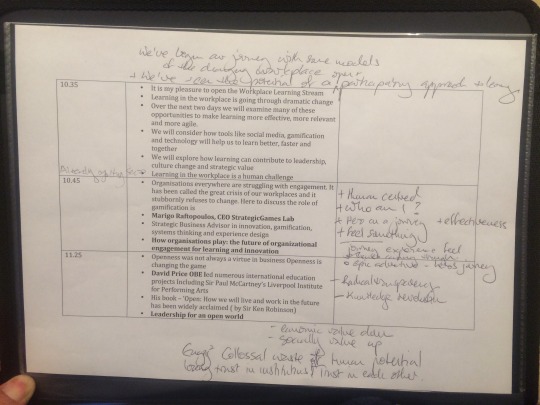
The conference organisers had supplied me with bios and a detailed runsheet. However, I needed to create a tool that I could use to guide me through the event. I settled on a simple landscape format document with three columns – times, comments and notes. The document used bullet points because I normally work to create any talk from a few guiding points of structure.
I typed the information from the bios and the runsheet into this integrated document. I didn’t cut and paste. I typed. I retyped it manually for two reasons
To make sure I put understood things in my own words and could express them simply
To help me to remember the key facts so that I could more easily speak without notes
This process of recreating my own tool helped me to sort out a few ambiguities that I needed to check with the organisers. It also enabled me to see all the speaker information in a consistent format and work on balance and integration of the story of the event.
The advantage of a simple document was also redundancy. I had the document in the cloud, printed and available on two back up devices. I also made sure I had all the key source materials with me as well. That way I was covered for power failures, late changes and any nasty technology surprises.
Understand What You Want to Say
A chair is there to facilitate the event, not to star in it. My role models were some great chairs and masters of ceremony that I had seen at similar events, particularly Colin James, Anne Bartlett-Bragg, James Dellow and the MC of DoLectures Australia in 2014 Col Duthie. You aren’t hired to draw attention to yourself or deliver long speeches. However as someone who is a continuous voice through the event, there is a chance to tell a story across the two days by drawing connections and framing the speakers. I spent some time considering how what the speakers were addressing related to key themes that I address in my work and this blog. That helped me see that there were consistent themes of transformational change, culture, leadership and a new role for learning in the future of work running through the event. I wanted to share some of my personal purpose & stories of making work more human through drawing out these connections
Part 2 – Creating the Experience
A good chair will help create a great experience for the speakers and the participants at the event. Not everything will go to plan. Nothing will go to time. The role of chair to to help smooth the experience and also to help the participants to weave it together into one learning and collaborative experience.
Stay in Contact with Everyone: Everyone means everyone: the organisers, the AV team, the next speaker, future speakers and audience members. Check-in at breaks and use what you learn to think ahead. Check everyone’s understanding. Get feedback. Make sure everyone is on the same page as to what is happening next. Over communicate. When I had issues with the experience, it was because I didn’t follow this simple rule.
Pay attention: There can be a lot going on. You need to be concentrating for the whole journey of the event. A speaker might make a single comment that helps you to draw together the theme of the event. Time can quickly get away from you. Paying attention helps you to anticipate the speakers who are running behind and those that are ahead. That gives you ways that you can help them and the audience.
Roll with the Issues: We lost the time for opening remarks due to late arrivals. I accidentally spoke over an introductory video. Technical issues happened. Changes & corrections were needed throughout the event. Realise that this is all part of the live theatre that is a conference event. Adapt and move on. Whatever you do, don’t panic.
Adapt the Plan: My tool above had room for notes. As you can see there were lots of scrawls. I knew I would need to change what I had to say as I heard the full presentations from the speakers. I knew that if we got behind or ahead then timelines would need to be tweaked to adjust. Some times you will have time to do this in advance and other times you will need to adapt on the fly.
Make connections: Connect ideas. Connect people. Use the social streams around the event to share relevant information to help the speakers and the participants. Help audience members to connect to the speakers. There’s a lot that a Chair can do to assist the event to be a successful one just by bringing people together.
Help Make Sense: Two days of talks, discussions and panels can be overwhelming. However, your role as chair is to help everyone to take away some insight and some themes from the event. Take notes. Digest those notes into themes and share them back to foster further discussion.
These are my notes. What else would you add? I am keen to learn more. Please feel free to comment on twitter or in the comments below.