The OODA Loop of Blogging

Work out loud and accelerate the benefits of blogging.

The OODA loop is one of my favourite strategic tools because it highlights the competitive advantage in speed and learning in a Responsive Organisation. I have also found OODA a useful mindset for my blogging and a way to ship posts consistently.

What is the OODA Loop?

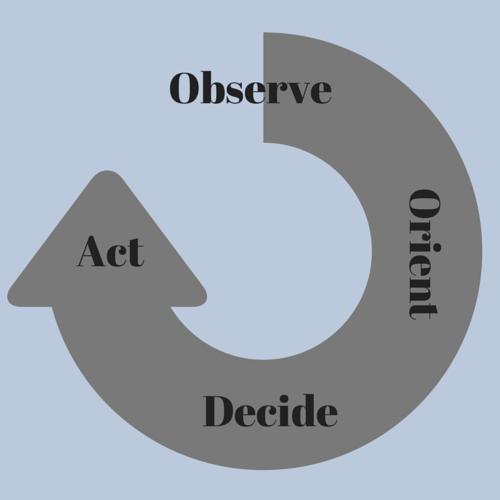
Developed by a U.S. Airforce strategist Col. John Boyd the OODA Loop is the concept that strategic advantage goes to the party who can best navigate the decision loop through observing the situation, orienting themselves, deciding what to do next and translating that decision into action. Through transparency, autonomy and experimentation, a responsive organisation moves decisions to the edge of the organisation accelerating its OODA loop to deliver better business value.

How does OODA accelerate my blogging?

Observe: My blogging is built on a foundation of being constantly on the look out for insights. Every day as we work we are exposed to great ideas, wonderful learning and exciting conversations that challenge our thinking. The more I capture the more I learn and the more I have to share. Are you tuned to observe and capture these opportunities to share through a blog? Managing your attention to observe these moments and building a system to capture notes at the moment helps.

Orient: A blog is an expression of your cumulative knowledge and experience. Finding a way to orient a new observation against your current knowledge matters to building a consistent philosophy. You need to know how a new post fits into your blog. Once I have an insight I try to quickly connect it to other ideas on the blog and elsewhere that extend the thinking. Building this system of links helps reassure you of the value of a new post. Ultimately I would like these links to provide an ever evolving network structure to the ideas on my blog.

Decide: Struggled with a white screen? Found your 500 word post is 2000 words long? These are challenges of deciding what you are writing about. Decide to share one small simple idea. Keep it simple. Stop when it is done. If the idea gets complicated break it into a series. If you have oriented well then the decision on the role and scope of a post is a little easier.

Act: Write. Just start. The best way to solve a problem in a post is to write. You can always throw out and start again later. Only by writing and posting do you generate the interactions that create new insights. Embrace permanently beta. Ship the post and let others help you learn more. This focus on action in blogging is the power of working out loud.

Accelerating the OODA cycle on your blog reduces the risk of a writer’s block or a monster post that can be finished. Work out loud one idea at a time and invite others to share and accelerate your learning.

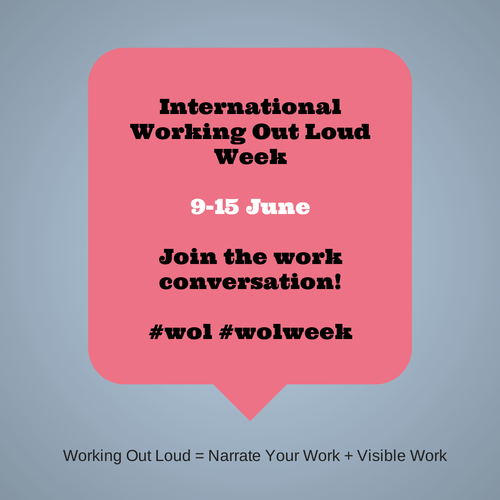
International Working Out Loud week is from 17-24 November 2014. For more on #wolweek check out wolweek.com. International Working Out Loud week is a great time to put OODA into action in your working out loud.
Leaders Can Authorise Debate by Working Out Loud

A key role for leaders is to authorise discussion in organisations. Leaders need to foster frank and authentic discussions by all employees. The best way to signal willingness to discuss the real issues is to start that conversation yourself and to show you will take action on the outcomes.

How do you invite questions?

I was recently asked what was my favourite aspect of a YamJam was. A YamJam is a Q&A session in Yammer usually by a leader or other authority figure. My answer was that my favourite element is that a YamJam authorises employees to question leaders and role models. This starts to create the kind of leadership that employees want: open, authentic and responsive.

Working out loud by leaders has the same positive impact. By openly sharing the work in progress with all its doubts, flaws and uncertainties, leaders invite others to engage them on that work. They make transparent their personal work processes for the benefit of others. The sharing authorises others to engage and respond to the leader’s work. This is a powerful tool to cut through hierarchy and change leadership interactions in an organisation.  Change the interactions and you change the culture.

Authorise the debate

The greatest barriers to human potential are the things we think we cannot do. Too often we look for others to authorise us to act. For many people and organisations, questioning leaders falls into the category of some we can’t do without permission. The role of leaders in realising potential is to release this constraint and authorise the kinds of generative conversations that enable organisations to be responsive.

You Can’t Predict the Value of Working Out Loud

Working Out Loud is a key practice for learning in networks.  Working Out loud creates value by surfacing opportunities to collaborate and to exchange information around work. Sharing work creates value for both the person sharing their work and others who observe. However, it can be a challenge to convince someone upfront that the value exists.

What is Working Out Loud?

Bryce Willams initially proposed the concept of Working Out Loud as:   

Narrating Your Work + Observable Work

The concept has been developed by a number of others, particularly John Stepper, and there are many related concepts, such as Jane Bozarth’s Show Your Work. With the increased transparency, access and visibility of networks in the digital era, working out loud is a much easier and much more productive practice.  Working out loud enables others to see, understand and contribute to your work.  That delivers benefits for both workers and observers and can play a critical role in shortening the time cycles of feedback, learning and collaboration.

You Can’t Predict the Value of Working Out Loud

Many people are reluctant to share their work for fear of negative feedback or fear of others’ perceptions.  People look to overcome their uncertainty by clarifying the benefits.

However the benefits of working out loud are as unique as the approaches of each individual and the diversity of their networks. Like many forms of social collaboration, there aren’t guaranteed outcomes in terms of benefits and the benefits are tailored to an individual’s situation and needs. Importantly benefits can flow far from the individual who is working out loud.  This latter point is important in corporate context’s where working out loud can play a key role in improving alignment, reducing duplication and facilitating learning on the job.

I have learned to work out loud in a number of ways.  My blog is an ongoing meditation on lessons from my work. I leverage twitter, public and private groups and social streams to share work in progress with others and get feedback. As someone who is relatively new to working out loud I have found that the benefits of working out loud are always a surprise and exceedingly diverse:

  • Making new connections with people doing similar or potentially related work around the world
  • Developing new knowledge using lean start up approaches to the demand and with the input of clients
  • Receiving feedback, ideas and other input into my work from many diverse sources that helps me better understand how it needs to develop and where it will have best impact.
  • Drawing of innovative connections between streams of work that I had not yet seen
  • Feedback from others on their leverage of my work in their own learning and the value that they create.
  • An enhanced understanding of my own strengths and the potential of my networks
  • Business & collaboration opportunities driven from people coming to understand and value my work.

Working Out Loud Requires Experimentation

The form of working out loud will differ for each individual depending on their work, their comfort in sharing, their expertise in social tools and their network. There are few formulas that can be prescribed that are generally applicable.

The best advice for an individual seeking to benefit from working out loud is to experiment with what works for them. A process of adaptation and experimentation will help each individual to develop a set of practices which enables them to be most productive.

If you are looking for a place to start, start by trying to form a new habit and adapt your practice to what suits you and delivers you & your network the best benefits. Consider forming a working out loud circle to help accelerate & share your learning with others. Look out for the next International Working Out Loud Week, a great opportunity to develop your practice of working out loud in the company of a network of global peers.

What I learned from Global Day 1 of #wolweek

image

Lessons are already coming in from International Working Out Loud Week (#wolweek) even though it has only just begun.

While it is the end of Tuesday in Australia, Monday was a holiday and most of the world is only now starting day 2 of #wolweek. Here’s what I have experienced so far:

  • Just do it: #wolweek began as a conversation with Jonathan Anthony and Austen Hunter. Somewhere along the way the idea of a week working out loud had a date assigned and became International Working Out Loud Week. The idea clearly resonates with over 200 tweets alone on day 1. If your idea is good enough put it to test in the market without further ado. We could have spent a year planning the event and got less traction.

//platform.twitter.com/widgets.js

  • Sharing magnifies: The conversation that started #wolweek was public. We discussed our plans everywhere we could. Ideas and encouragement helped us continue. People jumped in to push the momentum up on this because they believed a week celebrating working out loud was worthwhile. As there is no organisation behind International Working Out Loud week and there has yet to be a meeting, enthusiasm and participation driven by sharing sustains the activity.
  • Networks explode: I wondered if #wolweek would be a phenomenon of a few chatty people at first. However when we saw major influencers (Thanks Helen Bevan, Gloria Lombardi, Helen Blunden, Rachel Miller, Jane Hart, Miguel Zlot and many more) and brands with big reach ( Thanks Change Agents Worldwide, NHS, Yammer and more) join the conversation it was clear that the sharing of #wolweek would be magnified by networks. Networks explode the potential of sharing. As Jonathan Anthony likes to say, we discovered the BOOM! moment.
  • You are the person: Bryce Williams first described working out loud. There are many other advocates who are probably better placed have spent more time promoting working out loud than the instigators of #wolweek (for example John Stepper, Jane Bozarth, Harold Jarche, Luis Suarez, Austin Kleon, etc to name only a few). If we had worried about support, their engagement or permissions, it would not have happened. Many of the above have jumped in enthusiastically as supporters of #wolweek.  

//platform.twitter.com/widgets.js

  • Change takes time: I have learned to enjoy the fruits of working out loud in networks, but I have always biased this working out loud to networks that have a common purpose and people I know even, if it may be part of  much larger community. It is still uncomfortable for me to use twitter or another totally public forum for this sharing. #wolweek has already shown me the benefits of being a little more open and a little less final in my sharing in this public forum. I can start to see what Luis Suarez and others have gained from moving beyond email into open conversations.
  • Less noise:  I expected to see a lot of noise (apologies if I am inflicting some, but then adjust your filters). I have been searching for posts with the tags #wol, #wolweek and #wolyo. I expected to find at least some noise. Perhaps it is my purpose in learning about #wolweek, but I have found almost all the posts fascinating, a great insight into other’s work. I am not alone.

//platform.twitter.com/widgets.js

Four more days to go globally.  Let’s see what magic all this sharing can bring.

International Working Out Loud Week 9-15 June

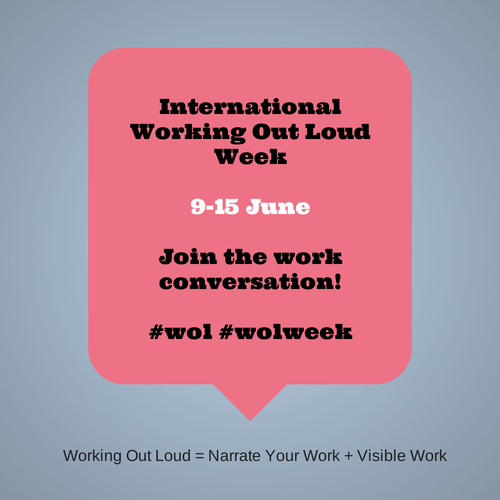
International Working Out Loud week begins Monday 9 June.  The week is an effort to build awareness of the power of working out loud through asking people to participate in a week’s practice of working out loud.

Join a growing community of practitioners working out loud to create better ways of working and build community in their work.

Here’s what you need to know:

  • What it means to Work out loud: The 5 elements by John Stepper
  • How do I get involved: Start sharing your work in what ever means seems appropriate to you. It doesn’t have to be social. It just needs to be public. Make sure you tag your sharing with #wolweek so that others can follow along the broader conversation.

If you need a procedure

1) do something
2) write what you did on an unfeasibly large post-it note
3) attach to your office wall
4) take a photo of it
5) tweet it with the hashtags #wolyo #wolweek

  • Encourage others to Work Out Loud too Working out loud works for everyone.

Thanks to Austen Hunter and Jonathan Anthony for leading the way on the creation of International Working Out Loud Week

Working Out Loud Creates Value

image

Working Out Loud is one of the most crucial practices for value creation in an enterprise social network. For many, it is also the least comfortable. We need to work at this new practice to deliver value.

Working out loud is the core new practice as sharing grows in an enterprise social network. When the conversation moves from sharing personal information to sharing work, value for the individual and organisation rises dramatically. That sharing is critical to the maturity of value creation in an enterprise social network. Without sharing of work, you hold back the benefits from other forms of work collaboration.

Working out loud creates great value in a network because:

  • working out loud gives a work purpose to the connection that has been formed in the network
  • working out loud invites community to form around people and their work enabling others to help, share knowledge and make work easier.
  • working out loud is not natural to many in the traditional workplace, but when people overcome hesitation and practice it they start to see the benefits of new forms of collaboration, that it makes work much easier & the culture much richer – a core driver of personal adoption
  • working out loud is the transition point to much wider collaboration across the organisation and particularly collaborative sharing and problem solving – work that is open is work that can be made better 
  • working out loud exposes the work which allows for better strategic alignment, reduced duplication and importantly recognition of the great work underway.
  • working out loud enables role modelling of transparency, vulnerability, learning, agility and experimentation.
  • working out loud by leaders can change the leadership dynamic from one based in control and expertise to one that leverages networks and collaboration.

Some great resources are available to help you with working out loud:

If you would like to create greater value in your enterprise social network or discuss how the Value Maturity Model applies to assist your organisation to create strategic value, please get in contact. I am available through @simongterry or Linkedin or www.simonterry.com

When Circumstances Change, Change Your Approach

image

Changing circumstances demand changes in approach. Clinging to the old ways can be dangerous.

The Praying Mantis in the Schoolyard

When confronted with a threat, a praying mantis has a set program of responses to take advantage of the advantages of excellent camouflage: freeze & blend in, sway like a leaf, run to the nearest tree. All these strategies work well in the normal circumstances of a praying mantis, the leafy greenery of trees.

However when the wind is blowing strongly and a praying mantis finds itself blown to the unfamiliar circumstances of schoolyard asphalt, none of these strategies work. It can’t blend in. Freezing exposes it to risk of being stomped. What it runs towards is not a tree. It is the leg of a small curious boy. In the end, it need a generous young girl to carry it back to the bushes to escape the growing crowd.

Change Your Approach

A praying mantis can’t change its approach immediately. Evolution will take a while to catch up with asphalt. It will eventually adapt as a species, but that doesn’t help any individual insect.

Your organisation isn’t programmed by genetics. When circumstances change, your organisation and its people can adopt new approaches, experiment to find new ways and learn how to succeed in the new environment. If your organisation is still responding to the new network economy with the same approaches and practices that worked in the industrial era, it can be as dangerous as outdated practices were to the mantis. Nobody will be generous enough to return your organisation to its preferred environment.

There is No Formula – Just Learning

Many managers find this discussion deeply unsettling. Advocates of the future of work are calling for change, but they are often either highly conceptual or discussing concepts that seem very alien to the circumstances in an organisation.

The abstraction has a reason. The future of work is being driven by a network economy where the right strategies are often emergent and adaptive. Adopting a new fixed formula is as dangerous as the last one. While we would like a formula (and many offer to sell one), the future strategies need to be learned for each organisation in its own circumstances in the network.  Change can’t be imposed it needs to be led one conversation at a time.

Creating a responsive organisation that can leverage the human potential to learn and experiment a way forward will take new techniques and new ways of organising.  Many of these techniques that are rising to the fore in discussion of the future of work and responsive organisations are ways to foster the emergence of a new better approaches for organisation using networks, rather than fighting them.  That’s why much of the conversation comes back to enabling people to learn and act in new ways:

  • Leadership: fostering the leadership capabilities of each person to leverage their insights and their potential to lead change from their unique position
  • Experimentation: Moving from exercising the power and expertise of a few to experimenting to learn together
  • Learning: improving the ability to understand the environment by focusing on tools to better seek out, share and make sense of information.
  • Work out Loud: aligning the organisation and bringing out latent human capabilities using techniques like ‘working out loud
  • Collaboration & Community: Networks route around barriers. Therefore you need to bring down the barriers within and around your organisation. Isolation is not a winning strategy in a period of rapid change.