What are the Ethics of Work?

A great discussion on the ethics of working out loud broke out yesterday across my social streams prompted by a thoughtful blog post by Kandy Woodfield. The post and the many discussions it prompted have been insightful and a few key points have arisen for clarification in my strong advocacy of the benefits of working out loud:

  • While I have not been explicit on this, like other forms of social collaboration, working out loud is in my view a voluntary practice. It is not meaningful to describe an activity that involves forcing someone to work out loud as a learning experience or as social collaboration.  
  • Kandy’s call for support for learners through the vulnerability of the learning experience is critical. The objective is to better realise people’s potential and that takes a supportive culture, the right systems and the focus of leadership.

This last point for me was the clue to a broader issue that began to be discussed with many colleagues: 

What are the ethics of work?

If we are right to subject working out loud to an ethical investigation, then perhaps we should extend the same challenge to work. Many of the risks and vulnerabilities that occur in learning experiences are magnified in daily work, but occur with little consideration of the impact on the individual. Worse still work experiences are often designed by managers to exaggerate these vulnerabilities in the name of motivation or performance.

Culture creates an Environment of Support or of Risk

As young children we learn and we make mistakes freely and publicly. It is our approach to the world. As children, we mostly laugh as we learn. At times this process may be frustrating for child and parent.  Either might experience the odd temper tantrum but this learning process is expected of children. As a result, they are supported and encouraged in learning by a family and social environment. Their pace of learning is phenomenal becuse they are free to make sense, to experiment, to observe, to ask questions, to get into new environments and to try.

By the time we reach the workplace, things are not always as supportive. Mistakes are frowned on. Questions can be discouraged. Experimentation is dangerous. People have a status, a job and a place. Failure to learn adequately fast and accurately is treated a performance issue. Public sharing of shortcomings is common with leader boards, rankings, status and accreditation levels, gamification, etc. None of this has anything to do with working out loud or even learning. These practices are widely adopted as best practices from our traditional industrial management model. It is how we work.

Many of the dangers that Kandy raises for working out loud arise not because of the work is out loud, but because it is work. Traditional workplaces using industrial management thinking are often unsupportive of learning and the learner. 

To extend the argument of the blogpost, the way we work presents ethical issues. The danger comes not because of the visibility of working out loud. Mistakes will always happen. People will always be vulnerable if they are doing. The danger comes from the lack of a supportive work environment that encourages learning.

When the majority of learning is unstructured and on the job, this is a much more dangerous situation.  Everyday on the job individuals are trying to improve their performance by learning to work better.  The organisation must be hoping to see the growing benefits of an employee’s work. If we don’t support learning, all of this is at risk.  

Professional learning managers are ensuring that the 10% and the 20% of learning is managed ethically. Who is responsible for the 70% on-the-job learning? 

Leadership is the Technology of Human Potential

We need to ensure our approaches to learning and the development of the potential of people are effective and ethical wherever they occur.  Leaders at all levels in organisations need to work to create an environment that supports learning and supports learners.

We don’t need more of empty platitudes of declaring a learning organisation. The leadership hard work is considering how all the systems in the organisation support or encourage learners, learning, the sharing of knowledge and the development of personal & community potential. That is a great and highly rewarding ethical challenge for leaders in organisations everywhere.

We can start simply:

  • we can support people to learn and discuss the value of learning
  • we can coach people through the challenges of learning
  • we can encourage people to experiment with new and better ways of working
  • we create a voluntary community that shares the vulnerability of the learning experience and supports the learner with peers
  • we can support all of this with fun

A key to the rapidly changing environment of our networked economy is that organisations need to get better at learning and leveraging the potential of our people.  If we take Kandy’s query to heart in respect of on-the-job learning & the very nature of our work, organisations will be better at managing this challenge.

Our organisations will be more responsive.
Leaders Can Authorise Debate by Working Out Loud

A key role for leaders is to authorise discussion in organisations. Leaders need to foster frank and authentic discussions by all employees. The best way to signal willingness to discuss the real issues is to start that conversation yourself and to show you will take action on the outcomes.

How do you invite questions?

I was recently asked what was my favourite aspect of a YamJam was. A YamJam is a Q&A session in Yammer usually by a leader or other authority figure. My answer was that my favourite element is that a YamJam authorises employees to question leaders and role models. This starts to create the kind of leadership that employees want: open, authentic and responsive.

Working out loud by leaders has the same positive impact. By openly sharing the work in progress with all its doubts, flaws and uncertainties, leaders invite others to engage them on that work. They make transparent their personal work processes for the benefit of others. The sharing authorises others to engage and respond to the leader’s work. This is a powerful tool to cut through hierarchy and change leadership interactions in an organisation.  Change the interactions and you change the culture.

Authorise the debate

The greatest barriers to human potential are the things we think we cannot do. Too often we look for others to authorise us to act. For many people and organisations, questioning leaders falls into the category of some we can’t do without permission. The role of leaders in realising potential is to release this constraint and authorise the kinds of generative conversations that enable organisations to be responsive.

You Can’t Predict the Value of Working Out Loud

Working Out Loud is a key practice for learning in networks.  Working Out loud creates value by surfacing opportunities to collaborate and to exchange information around work. Sharing work creates value for both the person sharing their work and others who observe. However, it can be a challenge to convince someone upfront that the value exists.

What is Working Out Loud?

Bryce Willams initially proposed the concept of Working Out Loud as:   

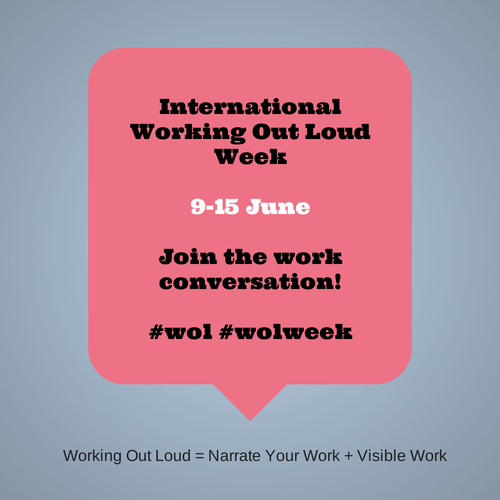
Narrating Your Work + Observable Work

The concept has been developed by a number of others, particularly John Stepper, and there are many related concepts, such as Jane Bozarth’s Show Your Work. With the increased transparency, access and visibility of networks in the digital era, working out loud is a much easier and much more productive practice.  Working out loud enables others to see, understand and contribute to your work.  That delivers benefits for both workers and observers and can play a critical role in shortening the time cycles of feedback, learning and collaboration.

You Can’t Predict the Value of Working Out Loud

Many people are reluctant to share their work for fear of negative feedback or fear of others’ perceptions.  People look to overcome their uncertainty by clarifying the benefits.

However the benefits of working out loud are as unique as the approaches of each individual and the diversity of their networks. Like many forms of social collaboration, there aren’t guaranteed outcomes in terms of benefits and the benefits are tailored to an individual’s situation and needs. Importantly benefits can flow far from the individual who is working out loud.  This latter point is important in corporate context’s where working out loud can play a key role in improving alignment, reducing duplication and facilitating learning on the job.

I have learned to work out loud in a number of ways.  My blog is an ongoing meditation on lessons from my work. I leverage twitter, public and private groups and social streams to share work in progress with others and get feedback. As someone who is relatively new to working out loud I have found that the benefits of working out loud are always a surprise and exceedingly diverse:

  • Making new connections with people doing similar or potentially related work around the world
  • Developing new knowledge using lean start up approaches to the demand and with the input of clients
  • Receiving feedback, ideas and other input into my work from many diverse sources that helps me better understand how it needs to develop and where it will have best impact.
  • Drawing of innovative connections between streams of work that I had not yet seen
  • Feedback from others on their leverage of my work in their own learning and the value that they create.
  • An enhanced understanding of my own strengths and the potential of my networks
  • Business & collaboration opportunities driven from people coming to understand and value my work.

Working Out Loud Requires Experimentation

The form of working out loud will differ for each individual depending on their work, their comfort in sharing, their expertise in social tools and their network. There are few formulas that can be prescribed that are generally applicable.

The best advice for an individual seeking to benefit from working out loud is to experiment with what works for them. A process of adaptation and experimentation will help each individual to develop a set of practices which enables them to be most productive.

If you are looking for a place to start, start by trying to form a new habit and adapt your practice to what suits you and delivers you & your network the best benefits. Consider forming a working out loud circle to help accelerate & share your learning with others. Look out for the next International Working Out Loud Week, a great opportunity to develop your practice of working out loud in the company of a network of global peers.

International Working Out Loud Week 9-15 June

International Working Out Loud week begins Monday 9 June.  The week is an effort to build awareness of the power of working out loud through asking people to participate in a week’s practice of working out loud.

Join a growing community of practitioners working out loud to create better ways of working and build community in their work.

Here’s what you need to know:

  • What it means to Work out loud: The 5 elements by John Stepper
  • How do I get involved: Start sharing your work in what ever means seems appropriate to you. It doesn’t have to be social. It just needs to be public. Make sure you tag your sharing with #wolweek so that others can follow along the broader conversation.

If you need a procedure

1) do something
2) write what you did on an unfeasibly large post-it note
3) attach to your office wall
4) take a photo of it
5) tweet it with the hashtags #wolyo #wolweek

  • Encourage others to Work Out Loud too Working out loud works for everyone.

Thanks to Austen Hunter and Jonathan Anthony for leading the way on the creation of International Working Out Loud Week

You Can’t Take Your Cat to the Park! So #WOL

Working out loud is a way to share work that might otherwise be missed By sharing this work you create new valuable interactions around that work.

You Can’t Take Your Cat to the Park

The internet loves cats. We share more photos of cats than dogs and even selfies. There have been attempts to explain cat photos as an projection of internet neuroses, for their cuteness, their lack of cuteness, or simply unexplainable.

Rick Wingfield has an elegant hypothesis based in human behaviour for why cats might feature so prominently in internet sharing. Dog owners get to take their pet on walks to the park. They get to interact and receive praise for their dog in a social context.

You can’t take a cat to the park.  If you want interaction around your ownership of a cat, you have to share a photo or video. Other cat owners have the same need for interaction around their cats. Could this be the basis for our cat sharing passion? The hypothesis demands research but it also highlights a common challenge at work that is solved by working out loud.

Most of Your Work Isn’t Known to Others.

Working is more like owning a cat than owning a dog (& just as frustrating at times). Just as you can’t take a cat to the park, much of the work that you do is not known to those around you. This is a major cause of frustration in the performance management process and a cause of loss of employee engagement.

Other people may see some outputs and the few achievements that are celebrated by others. However, the majority of the work and the challenges each of us face are achieved quietly without fanfare or recognition. Like cat owners, the joy & frustrations of this work are a private experience.

Many people want more help, recognition and interaction around the work that they do. We crave the ability to connect with and learn from others doing similar work and facing similar challenges. However, most of the time there is no way for others to see the work that we do.  That work never leaves the small circles in which we operate and the closed systems like emails and hard drives in which we share it.

Working Out Loud = Cat Pictures

Adopting working out loud as a practice enables others to engage us about our work.  

Working out loud facilitates others to guide, help, praise, reuse and share our work. Working out loud also fosters a sense of community around work that encourages better value creation, better alignment and the development of communities of practice.

Don’t forget the sharing of your work can create value for others far from your work place.  Enabling others to reuse, learn from or improve on your experience is an incredibly powerful outcome of the sharing from working out loud.  What seemed to you a small piece of work can create value widely. You may even discover your work is more valuable than you or your boss ever realised. As John Stepper has pointed out, working out loud can add a new dimension to your next performance conversation.

You can’t take a cat for a walk. However, you can share your daily work and start new sharing & interaction around that work. You will be surprised by the rewards.

Working Out Loud Creates Value

image

Working Out Loud is one of the most crucial practices for value creation in an enterprise social network. For many, it is also the least comfortable. We need to work at this new practice to deliver value.

Working out loud is the core new practice as sharing grows in an enterprise social network. When the conversation moves from sharing personal information to sharing work, value for the individual and organisation rises dramatically. That sharing is critical to the maturity of value creation in an enterprise social network. Without sharing of work, you hold back the benefits from other forms of work collaboration.

Working out loud creates great value in a network because:

  • working out loud gives a work purpose to the connection that has been formed in the network
  • working out loud invites community to form around people and their work enabling others to help, share knowledge and make work easier.
  • working out loud is not natural to many in the traditional workplace, but when people overcome hesitation and practice it they start to see the benefits of new forms of collaboration, that it makes work much easier & the culture much richer – a core driver of personal adoption
  • working out loud is the transition point to much wider collaboration across the organisation and particularly collaborative sharing and problem solving – work that is open is work that can be made better 
  • working out loud exposes the work which allows for better strategic alignment, reduced duplication and importantly recognition of the great work underway.
  • working out loud enables role modelling of transparency, vulnerability, learning, agility and experimentation.
  • working out loud by leaders can change the leadership dynamic from one based in control and expertise to one that leverages networks and collaboration.

Some great resources are available to help you with working out loud:

If you would like to create greater value in your enterprise social network or discuss how the Value Maturity Model applies to assist your organisation to create strategic value, please get in contact. I am available through @simongterry or Linkedin or www.simonterry.com

When Circumstances Change, Change Your Approach

image

Changing circumstances demand changes in approach. Clinging to the old ways can be dangerous.

The Praying Mantis in the Schoolyard

When confronted with a threat, a praying mantis has a set program of responses to take advantage of the advantages of excellent camouflage: freeze & blend in, sway like a leaf, run to the nearest tree. All these strategies work well in the normal circumstances of a praying mantis, the leafy greenery of trees.

However when the wind is blowing strongly and a praying mantis finds itself blown to the unfamiliar circumstances of schoolyard asphalt, none of these strategies work. It can’t blend in. Freezing exposes it to risk of being stomped. What it runs towards is not a tree. It is the leg of a small curious boy. In the end, it need a generous young girl to carry it back to the bushes to escape the growing crowd.

Change Your Approach

A praying mantis can’t change its approach immediately. Evolution will take a while to catch up with asphalt. It will eventually adapt as a species, but that doesn’t help any individual insect.

Your organisation isn’t programmed by genetics. When circumstances change, your organisation and its people can adopt new approaches, experiment to find new ways and learn how to succeed in the new environment. If your organisation is still responding to the new network economy with the same approaches and practices that worked in the industrial era, it can be as dangerous as outdated practices were to the mantis. Nobody will be generous enough to return your organisation to its preferred environment.

There is No Formula – Just Learning

Many managers find this discussion deeply unsettling. Advocates of the future of work are calling for change, but they are often either highly conceptual or discussing concepts that seem very alien to the circumstances in an organisation.

The abstraction has a reason. The future of work is being driven by a network economy where the right strategies are often emergent and adaptive. Adopting a new fixed formula is as dangerous as the last one. While we would like a formula (and many offer to sell one), the future strategies need to be learned for each organisation in its own circumstances in the network.  Change can’t be imposed it needs to be led one conversation at a time.

Creating a responsive organisation that can leverage the human potential to learn and experiment a way forward will take new techniques and new ways of organising.  Many of these techniques that are rising to the fore in discussion of the future of work and responsive organisations are ways to foster the emergence of a new better approaches for organisation using networks, rather than fighting them.  That’s why much of the conversation comes back to enabling people to learn and act in new ways:

  • Leadership: fostering the leadership capabilities of each person to leverage their insights and their potential to lead change from their unique position
  • Experimentation: Moving from exercising the power and expertise of a few to experimenting to learn together
  • Learning: improving the ability to understand the environment by focusing on tools to better seek out, share and make sense of information.
  • Work out Loud: aligning the organisation and bringing out latent human capabilities using techniques like ‘working out loud
  • Collaboration & Community: Networks route around barriers. Therefore you need to bring down the barriers within and around your organisation. Isolation is not a winning strategy in a period of rapid change.

Working Out Loud is the Lean Start-up of Knowledge

image

Working out loud enables early validation and engagement of others in ideas. By putting ideas to the test early when formed only to a minimum viable level wasted effort is avoided and the ideas move to fruition quicker. In this way working out loud reflects the value creation approaches of lean start-up.

Working out loud on Minimum Viable Ideas

One of the exercises in Harold Jarche’s PKM in 40 days program is around Narration of your work. I am a huge fan of working out loud and initially I wasn’t sure that I had much to learn. However, I took a risk and learned something new.

My experiment was to apply some lean start-up thinking to a concept that I am developing and put it out in a minimum viable form and seek feedback on how to develop that idea further in a relevant community. In this case, the idea was represented in minimum viable form as a single diagram and a story of where I was headed. Minimum viability in this case is just enough information to convey the information and test the key hypotheses that I wished to explore. 

We are used to fully thinking things through before sharing them. I am especially cautious around this. We are told that sharing something incomplete might be dangerous as people might form an incorrect impression or might copy the idea. I’d hate to miss an opportunity around something that seems important to my work. We are not use to putting minimum viable ideas forward for debate. 

However, perfecting ideas beyond that point in the quiet of our own workplace often means that when they are delivered they fall flat, miss the mark or need further work. How often have you worked long and hard on an idea that you believe in to have the “is that all?” response? I know it too well.

Working out loud brings Validation

My experience of narration was really powerful validation.  The diagram has drawn a great deal of support and feedback.  People have encouraged me to flesh out the tools behind the work.  They have suggested next steps, connections and applications that I can leverage further.  I have even had volunteers offer to work with me and someone offering to coach me in the lean start-up of this concept.

Working out loud clarifies Hypotheses

The other aspect of this experience was that working out loud enabled me to better understand the hypotheses that were a part of the work that I was doing. Had I gone on alone, I would have just buried these assumptions in the work.

Framing up my engagement of others as a test of the ideas pushed me to understand what were the key hypotheses that I needed others to confirm. Testing the assumptions reduces the risk of investing more time in the idea.

Working out loud reinforces Learning (Permanently Beta)

Because I and others know the idea is in development, improvement is part and parcel of sharing the work out loud. I don’t feel obliged to defend the work as I have less invested. I can be more dispassionate about the feedback of others as to how to improve the work. I learn more faster.

Work out loud to create value

Working out Loud with a Lean Start-up mindset can deliver powerful value in the creation and sharing of knowledge. As knowledge work becomes more important in the future of work, we need to be more effective and faster in our creation and sharing of knowledge. Practices like working out loud will drive real value the productivity, effectiveness and engagement of knowledge workers.