Paul Woods and I discuss strategic value, leadership, authority, executive engagement and working out loud on the Yaminade podcast.
Tag: wol
The OODA Loop of Blogging
Work out loud and accelerate the benefits of blogging.
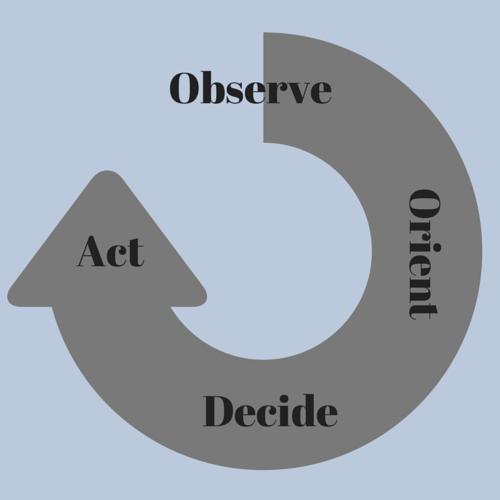
The OODA loop is one of my favourite strategic tools because it highlights the competitive advantage in speed and learning in a Responsive Organisation. I have also found OODA a useful mindset for my blogging and a way to ship posts consistently.
What is the OODA Loop?
Developed by a U.S. Airforce strategist Col. John Boyd the OODA Loop is the concept that strategic advantage goes to the party who can best navigate the decision loop through observing the situation, orienting themselves, deciding what to do next and translating that decision into action. Through transparency, autonomy and experimentation, a responsive organisation moves decisions to the edge of the organisation accelerating its OODA loop to deliver better business value.
How does OODA accelerate my blogging?
Observe: My blogging is built on a foundation of being constantly on the look out for insights. Every day as we work we are exposed to great ideas, wonderful learning and exciting conversations that challenge our thinking. The more I capture the more I learn and the more I have to share. Are you tuned to observe and capture these opportunities to share through a blog? Managing your attention to observe these moments and building a system to capture notes at the moment helps.
Orient: A blog is an expression of your cumulative knowledge and experience. Finding a way to orient a new observation against your current knowledge matters to building a consistent philosophy. You need to know how a new post fits into your blog. Once I have an insight I try to quickly connect it to other ideas on the blog and elsewhere that extend the thinking. Building this system of links helps reassure you of the value of a new post. Ultimately I would like these links to provide an ever evolving network structure to the ideas on my blog.
Decide: Struggled with a white screen? Found your 500 word post is 2000 words long? These are challenges of deciding what you are writing about. Decide to share one small simple idea. Keep it simple. Stop when it is done. If the idea gets complicated break it into a series. If you have oriented well then the decision on the role and scope of a post is a little easier.
Act: Write. Just start. The best way to solve a problem in a post is to write. You can always throw out and start again later. Only by writing and posting do you generate the interactions that create new insights. Embrace permanently beta. Ship the post and let others help you learn more. This focus on action in blogging is the power of working out loud.
Accelerating the OODA cycle on your blog reduces the risk of a writer’s block or a monster post that can be finished. Work out loud one idea at a time and invite others to share and accelerate your learning.
International Working Out Loud week is from 17-24 November 2014. For more on #wolweek check out wolweek.com. International Working Out Loud week is a great time to put OODA into action in your working out loud.
International Working Out Loud Week
The new home for International Working Out Loud week is live at http://wolweek.com.
#wolweek will be 17-24 November 2014. Follow the adventures @wolweek
Lonely ideas have hidden friends
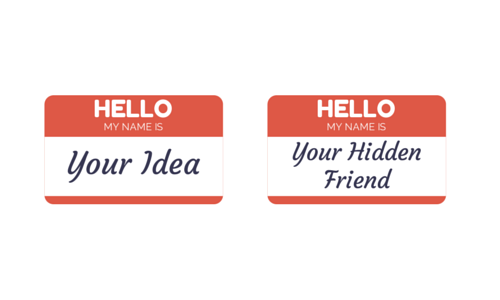
Lonely ideas have hidden friends. Working out loud and sharing the ideas draws out the hidden friends.
Draw Out The Hidden Friends
An example of discovering hidden friends came after yesterday’s post on the power of sharing lonely ideas.
Anne Marie McEwan saw my post through a share by Richard Martin (@indalogenesis) on twitter and responded sharing her lonely idea.
@simongterry @IndaloGenesis @tipalemar Here’s my lonely idea, Simon http://t.co/AcG31kOQu8 #BizEd4All
— Anne Marie McEwan (@smartco) October 11, 2014
//platform.twitter.com/widgets.js
In one of life’s moments of serendipity, I had just been advised through twitter of the launch of peeracademy.org so I knew the hidden friend for Anne Marie’s idea:
@smartco great one! @HelloOnur just introduced me to http://t.co/lrBrB5zyws Seems a effort at #BizEd4All @IndaloGenesis @tipalemar
— Simon Terry (@simongterry) October 11, 2014
All of sudden an idea isn’t so lonely anymore.
Every Idea has Friends Somewhere
If you have an idea, there is a good chance someone else has had the same idea, a similar idea or an aligned idea. If you let your idea be lonely, you will never know how their thoughts and actions might help your agenda.
We manufacture serendipity when we put ideas out in networks to be found, engaged and used. The networks supply the capability but sharing our idea creates the moment of opportunity. Knowledge in flight has somewhere to go.
Working out loud let’s others connect the dots between our ideas and others. Share an idea and it is rarely lonely any more.
See if you can’t draw out a few friends for your lonely idea.
International Working Out Loud Week is from 17-24 November and is an opportunity to experiment for a week with sharing of your work. Join in the movement of people working out loud.
Share the Lonely Ideas

Put your ideas in circulation. Ideas don’t deserve to be lonely. Share them in conversation. Watch them grow. Discover you do more.
Ideas start in conversation
We are surrounded by wonderful ideas. We have many every day. Too many are born and die lonely and unloved.
Almost all the ideas explored in this blog come from conversations. These posts are the insights and reflections on a flow of daily interactions. Many come from working out loud and the comments others make in reply to my work.
Over time, I have learned to watch for those wonderful ideas that pop up in conversation. Teasing them out in conversation enriches them. Noting them down supplies a ready source of inspiration for future posts (Evernote is a blessing). Without others to share those conversations, there would be far fewer quality ideas.
Ideas are better in action.
All of the ideas that become posts are further improved by being shared further, refined, tested, challenged and built upon. The really good ideas grow most through use by others.
Ideas get lonely if they have only one brain to occupy. Lonely ideas wither, lose their power and are forgotten. Sharing an idea increases its value. You still have the idea but now it has been shared elsewhere. Not only do you still have it but the process of sharing enables others to help you improve your once lonely idea.
Even better, a lonely idea shared is a call for collaboration. So many of the best projects I have been involved in arise when an idea shared becomes a common cause.
Share your lonely ideas. Connect with others to create, share and improve your ideas.
You will discover you do more by working out loud.
International Working Out Loud Week is from 17-24 November and is an opportunity to experiment for a week with sharing of your work. Join in the movement of people working out loud.
Fragments of Human Stories
Even fragments of human stories engage us deeply. We don’t need to see the finished story. We only need to share enough to engage the imagination of others and draw the humanity out in our consideration of life.
A Fragment of a Richer Story
Browsing the poetry section of a second-hand bookstore in regional Victoria, I came across a volume of the poetry of Matthew Arnold, the 19th century poet, bound in dark green leather with gold leaf. The spine showed the volume had been well read.
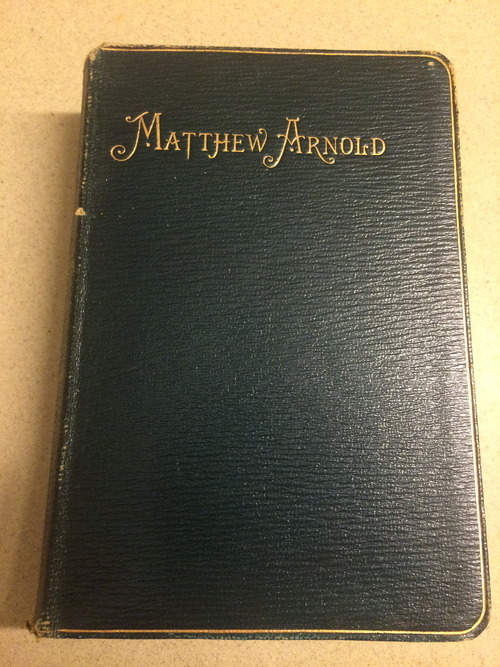
Opening the book I found a dedication which stopped me, brought a rush of emotions and made me reflect on the story of those who had handled the book before.
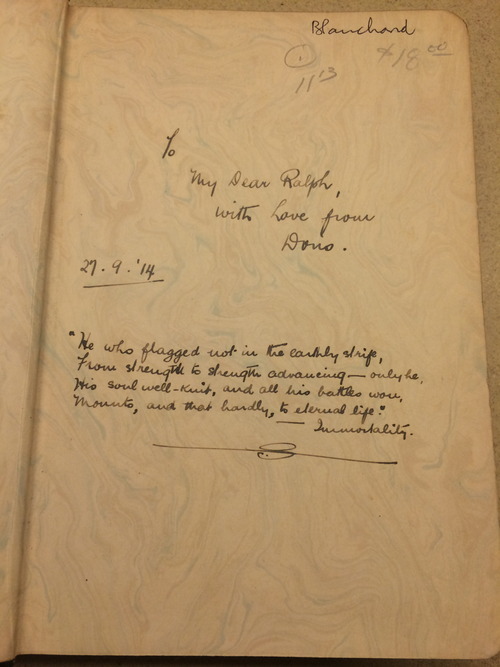
Just over a century ago, as the world descended into the Great War, Ralph received this gift and the love of Doris. We don’t know their story or their relationship. The author of this dedication might well have been be a mother, a sister, a friend or a lover. What happened to Ralph and Doris is currently a mystery to us but the inscription and that date soon after the start of WWI engages our imagination, our emotions and our concern.
From the short fragment of Arnold’s poem Immortality we gain a brief insight into the mind of the author of the inscription. This fragment of a message 100 years later engages us in the rich challenges of human life. It confronts us to reflect on a world torn with strife, obligations of honour and duty, the need for effort and for faith, the love between two people and the real fears of mortality that confronted them. This message transmitted through the inside cover of a book engages us in the turmoil of the Great War and asks us to reflect on the human fears and costs that surrounded it.
Create & Share Human Stories
Perhaps another hint to us lies in the line immediately before the text chosen for inscription in Arnold’s poem:
“…the energy of life may be
Kept on after the grave, but not begun;”
We can start, we can take on challenges and we can share our rich human stories in our one life, but only then. We often forget to reflect on this human detail.
Abstractions like life, success, history, war and work are comprised of these individual human stories, can be aggregated to a level where the humanity is lost in numbers, events and outcomes. We must remember as we deal with the abstractions to make an effort to bring forward the fragments of human stories and consider them each in their unique light.
Our stories engage others deeply, even as uncompleted fragments. They speak to our time, our place, our relationships, our conflicts and our challenges. As an experience that is real and tangible, stories like these help us to reflect and to learn. These are needed skills when we are learning what it is to be human struggling with the challenges of our unique moment in time.
We may never know more of the story. However encountering a fragment of a story like this makes it harder to forget the human efforts & sacrifice of others.
Lest we forget.
Standing In: The Future of Work
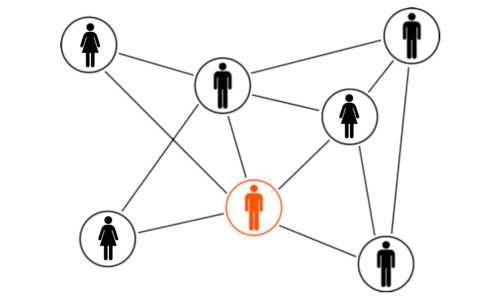
What are you doing to cut through the challenges of attention in the future of work?
Attention Discriminates
Yesterday a client found me in a busy activity-based workspace by my colourful socks. There were too many dark suited males sitting at desks but only one was wearing loud socks. A distinctive trademark cut through the challenges of attention.
Our attention discriminates. We deliberately focus to exclude distractions. When humans lived on the African savannah there was already too much information and attention was a way to economise.
When we enter the future of work that issue of attention explodes. Streams of updates, flat networks of relationships to follow and complex rapidly changing environments create a load on our attention. If you want to be recognised for your efforts in this environment you will need to stand out.
Wearing colourful socks won’t cut it. Socks don’t scale. The traditional response of the extroverts among us just adds to the noise. One pair of colourful socks is a discriminator. Many are noise. We see the same with the ‘look at me’ cries on social media.
The future of work might not be about standing out. Perhaps it is about standing in.
Standing in
The way to get noticed in a network is to be a valuable node. Your goal is not to push yourself to isolation at the edges, it is to contribute to value creation at the core. In short, you need to stand in (networks).
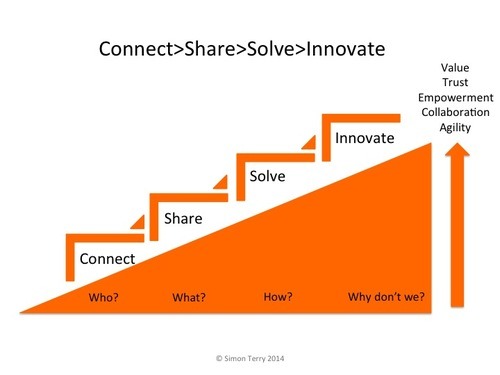
How can we stand in more effectively? The Value Maturity Model offers us a guide:
- Work for a purpose and gather those around you who share that purpose
- Make connections between people to improve the efficiency of the network
- Share relevant information, add new information to your networks and don’t pass on the dross. Working out loud is a great practice that helps others and John Stepper has described how working out loud works for introverts.
- Help solve problems of others in your network
- When you see an ability to make a unique difference, take that chance. Innovative opportunities don’t happen often. Take a risk and leverage your network to make something unique happen.
To fight the discrimination of attention in the future of work, focus on standing in (networks).
Status is Over
Don’t report status. Share ongoing work and let collaboration advance the work.
Most of the time in meetings is spent sharing and discussing status. A large portion of our emails are status updates. In organisations with social networks much of the information shared is in the form of a status update.
All of this information is better pulled as needed than pushed in a time consuming way to everyone. As we all know, listening to someone else’s status is rarely relevant or useful. What has happened is done. If you are impacted or involved, you already know. For everyone else, the value rarely justifies the time
Importantly, all that can happen from a status update is awareness. Many of those a status updates are made solely to make others aware of our performance. Often the consequence of that awareness may be identification of an error or problem after implementation.
When you work out loud on work that is ongoing, there are many more valuable conversations that can be had. People can:
- help solve problems
- suggest improvements
- highlight risks or issues
- add information or ideas
- offer assistance
- avoid duplication
- reuse your work practices or approach to improve their own
Reporting status is good for history books and the ego. Reporting on ongoing work is better for learning and collaboration.
Look back at the sand behind you
Yesterday I asked a room of managers of Yammer networks in a Masterclass to work out loud. I asked them to share their biggest challenge and their biggest success. The challenges came out quickly. Successes were slower.
This experience is very common. Everyone has some form of success to report. However many need help to focus on what they have achieved.
We work so hard on shifting the sand in front of us. We know exactly how hard moving that sand will be. We know we lack the resources and time. Knowing our challenges is easy.
When we look back at the sand we have already shifted, we realise it is always this way. Work is tough but we get the job done. The obstacles are the work worth doing. Small wins accumulate. However we spend less time appreciating our achievements. We always gave forwards to the new sand.
Working out loud makes the work we are doing visible. It enables other to help us to appreciate what we have done. Importantly it gives us a record to review to appreciate our own achievements.
Take time each day to note one thing going well. Share that work. You will compile a better picture of the sand piling up behind you as you work
Start small. Start now.
Each journey of a thousand miles, begins with a single step – Lao Tsu
If you have time to email, then you have time to work out loud. Find one email to reply out loud instead. Repeat.
If you have time to talk, then you have time to lead. Find one person to influence. Repeat.
If you have time to do, then you have time to experiment. Find one hypothesis to test in action. Repeat.
If you have time for a meeting, then you have time to start a movement. Find a group to engage in a purpose and action. Repeat
If you have time for a coffee, then you have time to learn. Find one moment to reflect on how to do better. Repeat.
If you have time to fix, then you have time to make change. Find one way to make the system better. Repeat.
Small scale changes accumulate given the time. Small interactions reinforce change and build community.
You have the time and the work. Start now. Start small. Repeat.