The Cold Dark Path

image

Two Competing Loops

This week at the first meeting of the League of Social Intrapreneurs in Melbourne I was introduced to the Berkana Institute two loops theory of change. The model of change in complex systems resonated immediately.

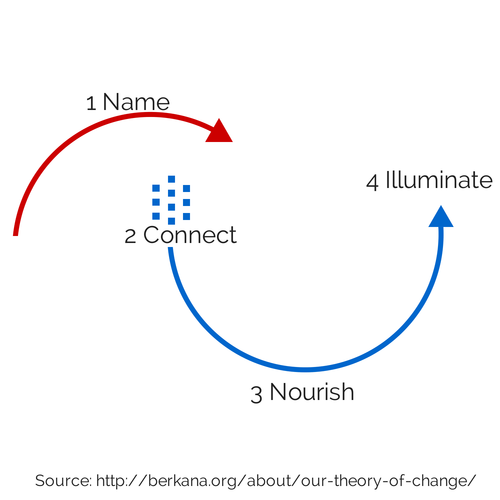
When a system nears its peak, change agents identify the need for alternatives and drop out.  They connect and begin to explore alternatives nourishing a new system through experimentation. Eventually the stories of their success illuminates the change to those who remain in the old declining system.

A four step model with four simple verbs seems clear and straightforward. Why is it that the path of change is such a cold dark path?

Nobody Warns You about the Dip

Stepping out of a warm and comfortable ongoing system with its present day rewards is a daunting uncertain choice however bleak the future of that system may look. Those with most to gain will oppose the agents of change who name the issues and start to work on alternatives. Opposition will not always be fair or balanced.

//platform.twitter.com/widgets.js

Most difficult of all is that dip in the diagram above. The uncertainty and the need to build a new complex future means the alternative system starts along way back and with a great deal more risk. Selling another path even to yourself can be a challenge in this scenario.

All the discussions about collaboration, requests for advice and stories shared among change agents at the League of Social Entrepreneurs, in Responsive Organisation, in Change Agents Worldwide or in other conversations that I have with unreasonable people belong at the bottom of the loop where people struggle nourishing new alternatives.

We must embrace the fact that the road to change is a road with dips and uncertainties. Proceeding any other way does not prepare people for the work ahead.

Nourishing Change Takes Hard Work

Most change fails after the connect stage.  Declaring a need for change is initially easy and exhilarating. Manifestos are thrilling. Connecting with other like minded people has a wonderful effect for the spirits and is a great way to reinforce the need for change.

Then nothing happens for a really long time. It grows cold and dark on the path of change.

Lots of drudgery dogs those walking the cold dark path of change. Meetings need to be organised and venues found. Compromises need to be negotiated between people who are 99% aligned. Factions and fragmentation occurs and saps the energy of everyone. More change agents need to be recruited, especially for the work. Experiments need to be agreed, funded and run. Failed experiments need to be cleaned up. New experiments agreed, funded and implemented. Success needs to be found. Someone needs to find money or work out the details of the new model. Communication materials don’t write themselves. Just when success seems inevitable the dying system finds a way to set you back.

Change falls apart when the connected agents of change won’t work the experiments long or hard enough to nourish the success of the new system. If they won’t invest the time to build new connections, share successes, to solve the daily issues and to innovate a path forward then the nourish stage will never offer an opportunity to others to join in the change.

If the organisers of the first meet up about a change end up with all the actions, then a change initiative has work to do to find others to nourish the change. Engaging others in the work matters more than engaging them in the idea of the change.

Join in the Work

Lots of people want to join change at the exhilarating beginning and again at the celebratory end. Traditional management focus only on the beginnings and the endings but leadership is found in realising the collective potential of the journey.

The question is who is willing to walk the cold dark road. Those change agents who do the leadership work of nourishing new experiments shape the future. That path is hard but the work is the most purposeful and rewarding

Why #responsivecoffee?

Yesterday was another great responsive coffee event in Sydney. The event began with my short talk about creating value with social business and working out loud. I shared some insights from the Enterprise Social Collaboration Value Maturity Model as a framework for developing a more responsive culture in an organisation. Then the group dived into a vibrant conversation sharing challenges and opportunities as people work to make their organisations more responsive.

One question I am often asked is ‘what is the value of a Responsivecoffee event?’ Here’s my response:

Connection matters:

People working in change can feel isolated. Simply meeting others doing similar work can make it feel more possible. Connection is the foundation of community. After the session yesterday there were all sorts of new connections established that will support people to do more work faster.

Connection is also important because of the diversity of Responsive Organisation challenges. People attending the event were considering the Responsive organisation approaches from the mindsets of consulting, communications, learning, knowledge management, technology, change, property management and many more functional areas. The connections cut across the boundaries of organisations, products, industries, roles, functions and ambitions of the organisations. All those diverse connects help expand the range of possibilities and enable clients to implement change faster.

Sharing Matters:

The conversation was a treasure trove of insights and shared experiences. That sharing encourages people and enables fast change. Many people are just starting out in the journey of being more responsive and more social. Hearing the stories others shared have them confidence to start and a sense of the possibilities and challenges ahead.

Problem Solving Matters:

Many people brought a practical problem to the table and over coffee leveraged the collective insights of the group to move forward and move faster.

Innovation Matters

Responsive coffee remains an agile experiment in value creation. The formats change to create value for those who are attending from session to session.

We are even seeing new intercompany collaborations and experiments being spun off these events. Participants are going away to work together to create new products and services to help accelerate change and address challenges shared. If you don’t bring people together to explore what might be possible you will never see the next horizon.

The Value of Responsive Coffee is Accelerated Maturity

The benefits of Responsive Coffee reflect that of the Value Maturity Model because a purposeful cup of coffee with other change agents is an act of social collaboration. We need more and richer connection to accelerate change in our organisations and the adoption of new ways of working for value. Value occurs in the rich conversations of social collaboration.

Long live #responsivecoffee.

Image credits: 

Coffee: http://pixabay.com/en/coffee-cup-time-meditation-talk-14662/

Photo of Responsive Coffee: Luke Grange

Integrate at Goals, not at Process

image

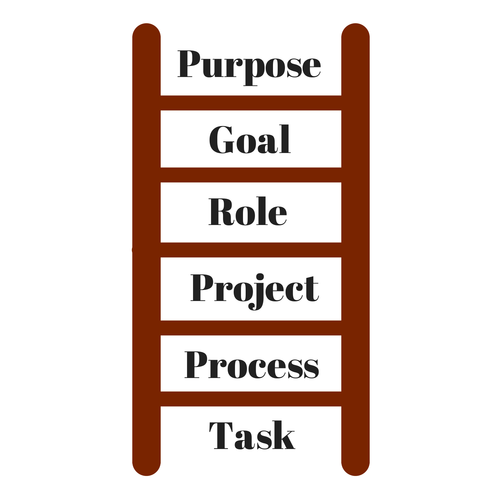
How do you integrate open network conversations into closed linear processes? Integrate social conversations by integrating at the purposes and strategic goals. No organisation wants its collaboration constrained by processes or systems.

Organisations, vendors and analysts are touting the advantages of integration of enterprise social networking into legacy processes in organisations. Enterprise social networking needs to be come a part of the everyday work in organisations as it is another set of tools to foster conversations and collaborations that create value. Without connection to the daily work of individual employees, enterprise social conversations won’t deliver the value we need. However, far too many of our existing work processes aren’t set up to accommodate creative, agile and productive social conversations. Patterns of allowed conversation in a process based integration rarely changes that.

Don’t Integrate through the Current Process

Existing legacy processing systems are designed for efficiency. They constrain choice. They automate steps and narrow discretions. The goal is to simplify tasks, remove errors and ensure repeatable activities can be achieved with the minimum in investment in human talent.

These systems achieve significant efficiency gains with a cost of human potential, agility and effectiveness. However, they are not designed for conversation about work. One only has to reflect on everyday poor customer experiences to see that these systems gain efficiency by handling poorly the exceptional, unusual case or situations requiring a response to change. Conversations, change and collaboration do not fit the industrial model of work that these process systems are designed to fulfil. They are not designed to leverage the potential of talented knowledge working employees connected in networks.

Collaboration is not a layer that can be integrated into existing fixed processes designed for efficiency. Collaboration offers the opportunity to enable people to change and improve the process and the work. Collaboration creates choices with a view to increasing agility, improving effectiveness and realising human potential.

A conversation that must integrate into a process system will become a conversation about the constraints of the system at some point.

Integrate by Creating a Purpose-oriented Conversation

Offer people autonomy, purpose and an opportunity to develop mastery and you will offer them an ability to fulfil their potential. If you want to integrate social conversations into your work, integrate the conversations at this level. The key to reinforcing human potential is to offer people a way to discuss how their work aligns and creates value for the purpose and goals of the organisation, not its processes.

image

An employee who is challenged to integrate his or her work at the level of the goals of the organisation has an opportunity to stop, change or transform the process. That employee can respond to the situation before them, use their discretion and use the talents of their colleagues. The employee can look to deliver greater value than the current process allows. That liberty reinforces their accountability and validates the organisations confidence in the potential of the employee. A key barrier to engagement in many organisations is that an employee can struggle to find the connection between their work and the goals of the organisation. Goal-oriented conversations can play a critical role to surface that connection.

Another advantage of reinforcing a connection at the level of enterprise-wide purpose and goals is that it acts as a reminder that collaboration is an enterprise-wide experience in work. Collaboration is not constrained to the customer management systems or work process systems. A collaborative ecosystem and the social conversations that support it should reach throughout the organisation to achieve its goals and purpose.

Leverage human potential to help realise goals

Telling people what to do and shaping how they might be allowed to have a discussion seems easy and seems efficient. However, it comes at a significant cost of human potential. Leadership in networks demands more of employees, leaders and their organisations. To maximise the opportunities for networked ways of working, allow people the opportunity to find integration of their social conversations at the level of the organisations purposes and strategic goals, not constrained by its processes.

If you would like to create greater value in your enterprise social network or discuss how the Value Maturity Model applies to assist your organisation to create strategic value through enterprise social networking and other forms of collaboration, please get in contact. I am available through @simongterry or Linkedin or www.simonterry.com
Value is a fractal

image

Enterprise social networks are made up of individuals who form their own groups and networks and the community is an aggregation of each of these components. We need to remember this structure when we start to think of value in enterprise social networks.

From Top-Down to Every Scale

One resulting characteristic of value in enterprise social networks is that they resemble a fractal, a mathematical shape that shows similar characteristics at any scale. Value in an enterprise social network does not only occur at the aggregate level.

Smaller scale activities are more important to sustain and grow the development of value across the whole network. There is less opportunity to order or impose value creation in a network than in traditional hierarchies where top down value is the priority and individual value is rarely considered.

Value For Users and Groups Makes a Network

Individual and group practices that create value are the underpinning of value for the whole network. Value comes from connection, sharing information, solving problems and innovating for an individual or the whole community. Without this value to the individual or group, no value creation at the network level will sustain itself.

Individuals and groups must understand and see the value being created to continue to work in new ways in the network. Developing the maturity of a network means building this sense of how value is created and how it aligns to strategic goals.

Create a Sense of Value at Every Scale

The power of the Value Maturity Model is that it is designed to take advantage of this characteristic. The method can be shared with users, with groups and with the whole community to help them make sense of how value is created for them and for the network.

Secret tools of community managers or organisational leaders won’t help individual users and groups find their own path forward to value. The power of value creation in an enterprise social network is the ability to leverage people’s potential to help

If you would like to create greater value in your enterprise social network or discuss how the Value Maturity Model applies to assist your organisation to create strategic value through enterprise social networking and collaboration, please get in contact. I am available through @simongterry or Linkedin or www.simonterry.com

The Last Thing We Need is an Enterprise Social Network

Dear CEO

Re: The Last Thing We Need is an Enterprise Social Network

The purpose of this email is to explain why the last thing we need is an enterprise social network.

This email is in response to the conversation about enterprise social networking in the executive leadership meeting yesterday. We thought it best to summarise the position of the leadership team, because yesterday’s conversation got derailed by anecdotes about social media, technology terminology, fear of change and discussion of abstractions like collaboration, future of work and new organisational structures. Before you left the meeting, you remarked “Based on this discussion, I think an enterprise social network is the last thing we need”. We agree.

We don’t want faddish technology. We need execution of strategy.

As CEO, you’ve been rightly suspicious of all this discussion of social inside the organisation. It is bad enough that your teenage children never look up from using social media on their phones. Whatever that involves, it can’t be needed activity in our organisation. We are a place of work.

What made this country great was well-run organisations, hard work and increasing effectiveness in creating value for customers. That takes focused strategy, disciplined execution and a willingness to do the hard yards. Great organisations aren’t built by chasing technology whims. They come from executing strategy to create better value. When we need to create better execution on strategy, the latest fashionable technology is the last thing you need.

We need better strategic value creation

Times are tough. Industry is more competitive than ever and change keeps increasing. We know customer and shareholder value needs to go up and costs need to come down. We have a strategy that is about meeting these new customer & stakeholder expectations, improving the organisational efficiency and delivering the returns that shareholders demand. We all wonder from time to time whether everyone in the organisation gets the imperative of the new strategy and whether they are all working hard enough to find new ways to create value. We know that we perform better when we have better conversations to make sure that our employees are aligned to the strategy. What we don’t need are distractions when there’s doubt that people even understand the strategy.

When we need strategically aligned value creation, the last thing you need is an enterprise social network.

We need new more effective ways of working

To fulfil the strategy of the organisation, we know as a management team that we will have to start to work in new more effective ways. There has been too much wasteful duplication of work in the organisation. Too many of our processes & policies don’t line up across the silos, aren’t agile enough for the environment and don’t meet customer needs. Both our customers and our employees complain about how badly we do this. We need to start working in new and different ways to identify, solve and improve this on a continuing basis. We have to focus everyone on find and using better work approaches that help us to fulfil the strategy.

When we need working in new and more effective ways, the last thing we need is an enterprise social network.

We need to change management and leadership in every role

Working in more effective ways will likely require us to change the way management works. We are going to need to push decisions down to people closer to the customer and give our people the ability to fix problems. We will need our managers to move from command and control to a coaching and enabling role. We need to ensure that all our people are realising their potential and able to work to create new sources of value. Of course in this new role, middle management will need to be trimmed and the new flatter organisation will need to change more often as we respond to further changes driven by our customers. Employees will need to step up into a leadership role in these changes and with customers, the community and the organisation.

When we need to change the culture of management and asking every employee to play a bigger role in leadership, the last thing we need is an enterprise social network.

We need different conversations

Changing the culture of management is going to demand very different conversations in our organisation. We are going to have to find ways to make sure that conversations are efficient and effective. We need to leverage the contributions of more people from across the organisation. We won’t be able to rely on long meetings, workshops, speeches, video and emails. Did you see the budgets for communications, off sites & roadshows in the forecast for next year? We have to do something different. We will need to involve our people more in making decisions. If that’s going to happen our people will need to be better informed and better able to channel their contributions. Our people will need ways to inform themselves, learn by pulling what they need, share ideas of how to work better and collaborate to solve work problems. We are going to need to encourage our people to join conversations that use their capabilities to innovate, to create value for customers and create new forms of working.

When you need to change the conversations, collaboration and culture of an organisation, the last thing you need is an enterprise social network.

We need more from our people

We wrapped up the last executive leadership meeting reflecting on how big these demands will be on our people. We will be asking for a lot of change in them, their work and the way the organisation exists around them. We will be asking our people to play an increasing role in the success of the organisation. We will want them to lead new conversations to create the future for this organisation. We need our people to be more engaged because we will need much more from our people.

Conclusion: What we need

After you left the executive leadership meeting to catch up with the board, we realised that we are clear what we need as an organisation:

  1. we need to succeed by fulfilling our strategy to create greater value in a rapidly changing market; and to do that
  2. we need to be able to work in new & better ways that create a more effective, agile and responsive organisation; and to do that
  3. we need a new culture in management and more leadership from our people; and to do that
  4. we need new conversations that enable our people to discuss and act on creating better strategic value; and to do that 
  5. we need more engagement and a better ability to leverage the potential of our people to contribute to and lead this change; and to do that
  6. we need an enterprise social network to support the first 5 steps.

If you are surprised by point 6, think back through the needs again. After all you were the first to say that an enterprise social network is the last thing we need. We don’t want an enterprise social network because it is new technology or because it is good for some abstract goal. We need one to help our people to execute on the changes necessary to achieve the goals of our strategy. Enterprise technology only makes sense when it enables us to work in new ways that deliver strategic value. As your management team we can see that the value creation opportunity is compelling. We couldn’t see it when you made your remark, but we have come around to your perspective.

The paperwork required by our old process is already on your desk, but a number of our people have started experimenting with solutions to see what value we can create. (Interestingly, their first suggestion is a better procurement process.) When you get back from the board, your assistant will show you how to log-in and join us discussing how we implement in the new enterprise social network.

Thanks for challenging us to come up with a better way of working.

Please think of the environment and don’t print this email. We’d encourage you to discuss it on our new enterprise social network instead.

If this post sounds familiar or if you would like to create greater value in your enterprise social network or discuss how the Value Maturity Model applies to assist your organisation to create strategic value through enterprise social networking and collaboration, please get in contact. I am available through @simongterry or Linkedin or www.simonterry.com

Working Out Loud Creates Value

image

Working Out Loud is one of the most crucial practices for value creation in an enterprise social network. For many, it is also the least comfortable. We need to work at this new practice to deliver value.

Working out loud is the core new practice as sharing grows in an enterprise social network. When the conversation moves from sharing personal information to sharing work, value for the individual and organisation rises dramatically. That sharing is critical to the maturity of value creation in an enterprise social network. Without sharing of work, you hold back the benefits from other forms of work collaboration.

Working out loud creates great value in a network because:

  • working out loud gives a work purpose to the connection that has been formed in the network
  • working out loud invites community to form around people and their work enabling others to help, share knowledge and make work easier.
  • working out loud is not natural to many in the traditional workplace, but when people overcome hesitation and practice it they start to see the benefits of new forms of collaboration, that it makes work much easier & the culture much richer – a core driver of personal adoption
  • working out loud is the transition point to much wider collaboration across the organisation and particularly collaborative sharing and problem solving – work that is open is work that can be made better 
  • working out loud exposes the work which allows for better strategic alignment, reduced duplication and importantly recognition of the great work underway.
  • working out loud enables role modelling of transparency, vulnerability, learning, agility and experimentation.
  • working out loud by leaders can change the leadership dynamic from one based in control and expertise to one that leverages networks and collaboration.

Some great resources are available to help you with working out loud:

If you would like to create greater value in your enterprise social network or discuss how the Value Maturity Model applies to assist your organisation to create strategic value, please get in contact. I am available through @simongterry or Linkedin or www.simonterry.com
Beyond Adoption to Value Creation

Slide1

A great deal of attention in enterprise social networking has gone into ‘driving adoption’. A focus on adoption can distract organisations from the real challenge of any business activity, creating value in fulfilment of the organisation’s strategy.

Adoption is an intermediate goal

Adoption is a means to an end. Adoption is a tool of value creation. It is not the result. The desired outcome is the value created by an engaged community that allows for the fulfilment of a strategic goal through outcomes like better alignment, innovation, adaptation, better customer & community focus, greater agility or improved efficiency.

The desire to move beyond adoption is growing. Luis Suarez recently argued that the language of driving adoption is missing the mark. Joachim Stroh has also highlighted ways in which we need to move beyond traditional adoption.

The logical next step from adoption is the end goal of work. Business and people work to create value in line with a strategy. We need our use of enterprise social networking to create value for each users and for the business as a whole.

Adoption as a goal alone can lead us astray

Our focus on adoption is often reflected with concerns from our traditional hierarchical ways of working. For example I have been asked the following questions about adoption that indicate something is going astray:

  • If we don’t have universal adoption, how will people get our messages?: If you are focused on one-way communication, there’s a good chance they don’t listen to your messages already.
  • Can’t we just mandate adoption? You can, but it rarely works to create an engaged & valuable community. Incentives may be a transitional tool to help people engage with the solution but take care that they don’t make participation an end in itself.
  • Won’t our people resist adopting this new solution? If the solution offers no value or is seen as a distraction from real work, they should resist. If it creates value for users and they see its value to the organisational strategy then this is an issue that we will overcome.
  • What’s the right number of users to adopt a social network? There is no magic number. The right answer is enough of the organisation to create enough valuable conversations for users and the organisation. That can be a surprisingly small percentage of the organisation, provided they are well connected into the larger organisation.
  • We have lots of users. Nobody knows what to use it for. What do we do now? You have users but it is likely you don’t have a community that understands how to do things together to create value for your strategy.

Most importantly of all, enterprise social networks are infrastructure, not tools. Employees need to make sense of a new enterprise social network and integrate it into their work. There is no pre-ordained usage that people can adopt like many other technology systems. Adopting a network as another conversation tool may be interesting but rapidly loses relevance in a busy workplace with many high volume channels for communication. The best guide to employees is to direct their sense-making into how it will create value for their work and strategic value for the organisation.

Often adoption drives demand a lot of overhead and effort. They are pushing something into a community. Where this effort goes to creating niche use cases with easy adoption, selling a uniqueness event in an enterprise social network or investing all the time in unusual campaign activities it can backfire. Employees who come to think of the enterprise social network as being used only for a special activities may not consider the opportunities for every day value creation. In these networks, there is a dramatic difference in utilisation between when adoption is being driven and every day use limiting the potential of the platform. Use caution that your efforts to drive use reinforce the connection to value in daily work and strategy.

Importantly adoption is rarely a goal that makes sense to the managers and leaders whose support is needed to foster a collaborative culture and role model usage. Conversations advocating adoption of social collaboration and other future of work practices can seem abstract and a side issue to the work of the organisation to many managers. Managers are looking for how enterprise social networks contribute to value creation.

Personal and Strategic Value

Value is different for every organisation as organisation’s purpose, strategies and goals differ. Value need not be a hard dollar return on investment. ROI can rarely be calculated in the abstract for infrastructure. From an organisation’s perspective defining a contribution to a strategic goal is often more effective.

Value is different for each individual depending on their goals, their role, their work preferences and their needs. Individuals will need to change their work practices in ways that make sense to them. Role modelling and storytelling will assist this journey but they will make their own sense of value.

There are 5 key elements of the work to moving the focus of enterprise social networking to value creation:

  • Create Strategic Alignment: Make explicit the connection between social collaboration and the strategic goals of the organisation. At a minimum, these conversations will educate your employees on the purpose, strategy and goals.
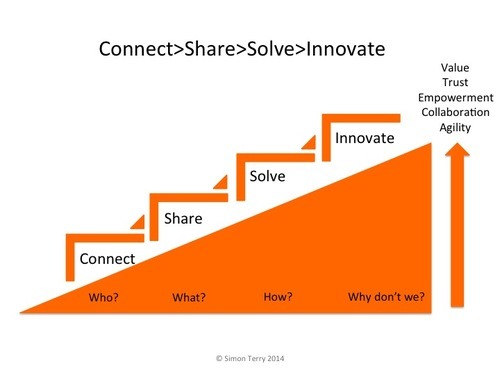
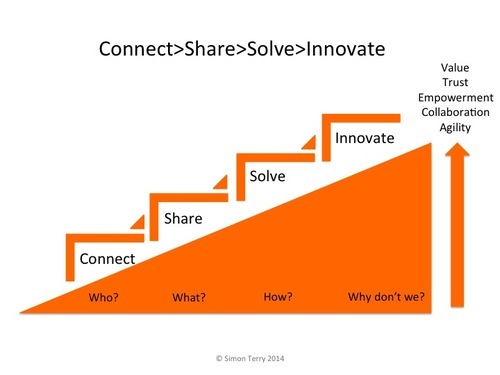
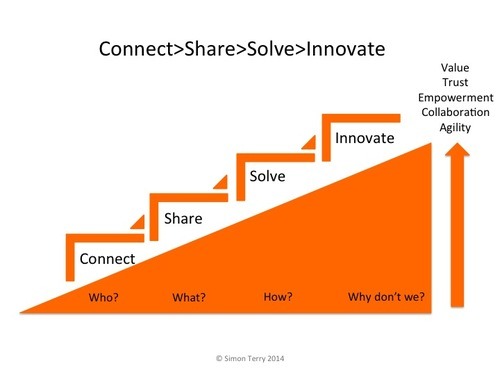
  • Guide Personal Value Creation: Guide employees to understand how the enterprise social network creates value in their work. In my work with organisations, I use a Value Maturity Methodology based on users maturity through 4 stages Connect>Share>Solve>Innovate.
  • Experiment & Learn: Create an environment for employees and the organisation where the enterprise social network fosters experimentation to create new forms of value in work. Encourage sharing and solving challenges.
  • Foster A Learning Community: An engaged and aligned community of employees working together for business goals is the greatest opportunity for value creation in organisations. Focus on how community accelerates value creation and the key roles required in any community. Understanding the roles of champions and leaders is critical.
  • Discuss Value Creation: Social networking accelerates double loop learning. Discuss value creation in the network as the work conversations occur. Celebrate lessons and successes. Back innovations with corporate muscle. Use these new learning conversation to foster alignment with strategic goals and encourage people to find new personal value.

If you would like to create greater value in your enterprise social network or discuss how the Value Maturity Model applies to assist your organisation to create strategic value, please get in contact. I am available through @simongterry or Linkedin or www.simonterry.com
Stop Magical Thinking

image

Magical thinking is any attempt to bend reality to the will or hopes of an individual. Whether by sleight of hand or genuine higher powers, magical thinking leads people into flights of fancy.

Many will remember the Magical Realist school of literature that delivered some extraordinarily captivating novels. Novels would move along telling an engaging story. Then suddenly they would swerve free of reality while magic transformed the world.

Sadly many business plans follow this swerving course at exactly the moment value needs to be created. Instead of exploring the human changes required they swerve into magical thinking. Magical thinking makes for engaging stories, but it makes for terrible plans for the future of work.

Stop Magical Thinking at Work

Let’s leave the magical thinking to creative arts and stop it in the future of work. Value in the future of work is hard work and we will need to create it together.

A really good indicator that magical thinking is creeping in to plans in business is the use of the passive voice. The human contribution to change slips away and magic takes over. Nobody need do anything because great stuff is about to happen suddenly entirely on its own.

The following things are all examples of magical thinking:

  • Adoption will be driven by the right launch, right features, etc.
  • Value will be created by adoption of the terminology, features, systems or processes.
  • Culture will be changed
  • Leaders will be changed 
  • Ideas, changes and new practices will be understood and adopted easily
  • Hierarchy, command and control, micromanagement, etc will be eliminated
  • The desired outcome will be delivered by new policies, processes, measures or systems.
  • More social/analytical/collaborative/cooperative/community-oriented/engaged/innovative work will occur and will be valued by management
  • New forms of value will be created
  • Great new jobs will be created
  • New efficiencies will happen
  • New performance metrics will be adopted

Change is not Magical. Change takes work

None of those things happen without the hard work of leading changes in the attitudes, behaviours and outcomes of the way people work. A real person needs to make that change happen. That special someone has to help others to:

  • Change attitudes about work so as to
  • Change behaviours at work so as to
  • Change the outcomes from work

Only those changes in outcomes create value. Value creation is critical because value creation determines what businesses do and keep doing. Sadly, value does not magically appear.

Before we see any value, at least one leader has to experience those changes in attitudes, behaviours and outcomes themselves. Then that special leader get to work hard to create the value for others through effort, influence and experimentation.

There is no passive voice in leadership. Let your actions speak louder than words.

So when do you start?