To Shape Change, Start Leading Change

image

“If we want things to stay as they are, things will have to change.” (spoken by Tancredi) from ‘The Leopard’ by Giuseppe Tomasi di Lampedusa

Times of disruptive change are difficult for those in power and those who benefit most from the current way of things. Many of these people prefer to ignore the rising changes in society. In effect, they abandon their leadership role in shaping change in the system.

Enduring disruptive change demands an engaged form of leadership. The future in disruption is not written. Leaders should seek to engage, lead and shape change to the benefit of their organisations. 

The Networked Economy is Here to Stay.

Many leaders of organisations have a lot of power, status and wealth tied up in the way things are now.  They are the masters of the current system, adept in its ways and confident in managing the current model of work and the organisation.  They have both personal and professional reasons for hoping that nothing changes.

Change doesn’t work that way. We are now part of a global ecosystem of actors connected in digital networks.  Access, visibility and transparency have increased driven by the new connectivity.  Change that enters this new system is magnified, spread and developed by the action of agents all around the world.

Lead or Let others Decide The Future

The connected digital networks of global actors means the future of work won’t be ignored, stopped or reversed. Others will go on to develop better ways of working whether you and your organisation participate or not. The less you participate, the more you appear a candidate for disruption by one of these actors.

Organisations face a leadership challenge in this environment.  Effective leadership, continuous learning and a vibrant culture is required to take effect of the advantages of the new approaches.  Senior managers need to play a critical role helping organisations adjust and maximise the benefits from these changes.

However, managers face changes in the future of work that change their power, status and potentially their financial position.  Networks can operate with less layers of management and roles that were once managements prerogative are being delegated to frontline employees or automated in systems. New two-way conversations with engaged and enabled employees, customers and other staked holders can require leaders to deal with new complexity. In this case, it can be tempting for a senior leader to sit on the sidelines hoping the changes are a fad or that they might pass over the organisation.

You Can’t Lead a Community if You are Not Engaged

A simple case study of this mindset comes when you consider the level of management attention to stakeholder activism in social and digital media. Because this activism is now more visible and empowered by digital and social networks, management can see resentment that once was hidden. Bear in mind the resentment is not new.  It just has a bigger audience and influence than before.

Many of these social activist activities have large impacts on organisations because the activist have a community and the organisation has only a network.  

The critical difference between a network and a community is how engaged the participants are. That engagement arises as a result of acts of leadership to create common purpose, to shape an agenda of action and to influence others to act. Leaders who ignore the burgeoning networks around the organisation allow others to shape the communities, their purposes and their influence.

Senior leaders of organisations need to engage with the networks around their organisation.  The opportunity to create productive communities far exceeds the risks. Listening and acting on feedback of networks of stakeholders is one of the better mitigants of risk. Failure to engage and to understand the needs of the networks creates an opportunity for others to lead. 

Who Helps Creates Value in Your Organisation?

image

The difference between a network and community is a culture of collaboration. Collaboration doesn’t just happen. It is grown through the action of leaders.

Markets are Value Networks

The markets we use when we exchange financial value today are networks. Networks of connected agents exchange value in our stock exchanges, banks and risk markets. These networks did not arise simply because people connected. Financial markets are facilitated by practices that help transform connection into valuable interactions.

When the networks of merchants in coffee houses became stock exchanges, they relied on the role of brokers and market makers to help build a valuable marketplace. These roles helped people:

  • to build trust in the new market,
  • to create liquidity that enabled activity when demand and supply from participants was not perfectly matched,
  • to share information,
  • to develop new ways of working
  • to help the new markets to enforce the rules and standards of the exchange.

The same leadership work to build value, trust and new ways of working is found in the history of banking, insurance or other exchanges.  

The value created in these networks did not occur because the network existed. It occurred because of the work of people to build a collaborative culture in the network. People need to build a sense of how to use these new exchanges and to build trust in that they would deliver more value than risk.

Your Network Needs Market Makers

Any collaborative network will need leaders to help facilitate the creation of value in the network.  This leadership will be a combination of technical support from community managers and change leadership support from change champions in the organisation and the organisation’s senior management.

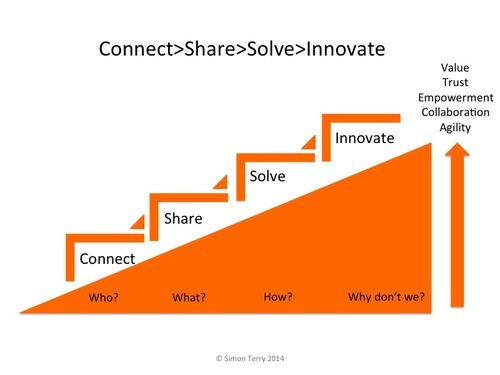
The Value Maturity Model highlights the way that collaboration’s market makers need to work to facilitate the value creation in your network:

  • Connecting relevant people to the network and into groups
  • Sharing information that may not have reached its necessary audience
  • Helping to solve issues by matching needs and capabilities, finding other resources or information and even holding a problem or information until there is a match of demand or supply.
  • Providing the systems and support to enable innovation experiments to be fostered until they are proven or fail.
  • Experiment and lead adoption of new ways of working
  • Helping lead the change in the culture of the organisation to allow the development of further cultural change.

To maximise the value of the networks in your organisation, you will need to develop the leadership capabilities that can take advantage of networks.

If you would like to create greater value in your enterprise social network or discuss how the Value Maturity Model applies to assist your organisation to create strategic value, please get in contact. I am available through @simongterry or Linkedin or www.simonterry.com

Lead Human Complexity.

image

The more any quantitative social indicator (or even some qualitative indicator) is used for social decision-making, the more subject it will be to corruption pressures and the more apt it will be to distort and corrupt the social processes it is intended to monitor – Campbell’s Law

Traditional management often seeks to reduce complex human behaviour to a single measure to manage. This approach works well for unthinking machines but it struggles with the complexity of human ability to shape behaviour on expectations.

People aren’t Widgets

Economists have been looking at the impact of human expectations on policy decisions for centuries. However, too little of this thinking has made it into industrial models of management thinking.

Traditional industrial models of management treat human beings on the same basis as other elements of machinery in the manufacturing process. This approach does not allow for the difference between a machine and a human’s ability to alter performance based on their own expectations and as result of interactions with others. The creative potential of collective human intelligence quickly outstrips this approach.

John Maynard Keynes highlighted in 1936 how expectations can make even the simplest choices quite complex when interactions of other human actors are involved. His simple example of a prize for nominating the best looking six faces in a beauty contest:

It is not a case of choosing those [faces] that, to the best of one’s judgment, are really the prettiest, nor even those that average opinion genuinely thinks the prettiest. We have reached the third degree where we devote our intelligences to anticipating what average opinion expects the average opinion to be. And there are some, I believe, who practice the fourth, fifth and higher degrees.

The impact of expectations is found in many work activities. The expectations of peers can increase or decrease performance. Expected rewards shape behaviour, whether they are financial, status or emotional. Many highly skewed incentive schemes fail to achieve expected performance change because humans form a view of the likelihood or value of the returns for effort on offer. In some cases, a combination of human creativity, expectations and collaboration between employees & others will even produce totally unintended results

Human expectations of the future change the behaviour of people now. The accuracy of expectations does not matter. A critical role for leaders is to be a part of the conversations that are shaping the ongoing expectations in a team. Designing an incentive scheme and tracking the measures is not enough.

Networks Accelerate the Making and Sharing of Expectations

In our increasingly networked world, it is much less likely that any individual in an organisation will behave like a machine that has no choice but to optimise performance.  The networks inside and outside the organisation will create new expectations and accountabilities on individuals in the organisation. Expectations are just one part of the collective sense-making that will go on as people work to create value.  No individual or organisation is an island any more.

Leaders need to prepare to engage with this increasing complexity and to join the conversations to shape the expectations that will drive human behaviour. Creating a collective vision, building trust, realising human potential and fostering collaboration can all contribute positively to the expectations of individuals in a network.

If you leave the conversation to the network, you are losing your influence as a leader. You are also surrendering the potential for better performance.

Access, Reach & Transparency

Networks of people working together are not new. Networks run through all our relationships at work. The access, reach and transparency of our networks is what helps change the future of work.

Humans are Connected. Humans are Social

Networks were social before social networks. Being social in networks of relationships is what defines humanity. We sit around campfires. The first call on a telephone network was between colleagues. We tell jokes in the pub and send jokes by email. We share cat pictures by mail, email and on the internet.

Ordering products for delivery by mail existed before Amazon. Linkedin did not invent business networking. Instagram did not create the sharing of photos. Airbnb did not create the lodger. Data was big before we could manage it. Yo existed as an exclamation before the Yo app.

Access, Reach & Transparency

Digital and social networks have changed the game by radically expanding the access, reach and transparency of human networks. We can reach more people with greater ease than ever and our interactions are recorded to be accessed by others.

The changes in access, reach and transparency enable us to better see the wirearchies that weave through our hierarchies. They offer us new ways to seek information, to make sense of the world and to share our learnings. These changes offer new ways of working, collaborating and cooperating.

We must remember that all that has changed is the access, reach and transparency. Our new networks must support human endeavour and human relationships. Together we connect, we share, we solve challenges and we innovate. There is no magic other than the magic of human creativity.

Let’s keep human potential at the heart of our work in networks.

A Vision that is Yours Alone is an Hallucination

Steve Case once said ‘Vision without execution is hallucination’. Before you get to execution, a vision goes awry if it isn’t shared by the others who must do the work.

Read most standard texts on leadership and they will begin with the leader setting the vision of a team. ‘Leader [insert verb] the vision’ defines much leadership training. As a result the focus become crafting a compelling vision and communicating it in the most persuasive way. Leaders are then expected to ensure the team delivers to that vision. Case’s comment highlights the need to ensure delivery.

There is one flaw in this approach to leadership:

An hallucination is something you think is real but others cannot see. The fact you can see it is not enough. The team cannot see what you see no matter how good your communication skills. People cannot deliver what they cannot see.

Team visions are far more effective when created by the team rather than the leader. Allowing others to contribute to shaping the vision leverages their potential to find personal purpose, to contribute more and to improve the picture. It deepens their understanding of the situation and the drivers of change. People who co-create make their own sense. The work of building a vision engages and enables others to own the vision and lead adaptation over time. The full passions, expertise and experience of the team can contribute to shaping the outcome. That work is the best guarantee the vision is seen and well understood by all.

Imposing a vision and sustaining that imposition is really hard work and largely counterproductive. No amount of telling conveys the richness of the leaders vision in a busy age of continuous partial attention. In complex scenarios the leader’s vision may be partial or too simplistic. Confusion and misinterpretation are likely. In networks there will be competing visions and competing alternatives for work. Critically an imposed vision is always the leader’s and often a compromise of purpose and passion for the team. Abundance has been replaced with compromise.

A leader’s vision is rarely seen as open for improvement even if the leader seeks input. Power differences discourage feedback. The worst outcome for organisations seeking to respond to changing markets is to be stuck thoughtlessly delivering a dated vision imposed by a now out of touch leader. Pushing the vision through will disengage others, destroy the leader’s influence and jeopardise the business.

Next time you need a vision to guide the work of a team think ‘Team [insert verb] vision’. The leader should be the facilitator not dictator of that process.

Execution is far easier when a vision is co-created. We all need fewer hallucinating leaders.

Networks have Feelings Too!

In enthusiasm for our ability to connect people in networks and to see the potential of new ways of working, we can lose sight of an important element. Networks are composed of human beings.  The rules of human relationships still apply and there is no magical technology that allows us to escape these fundamental rules.

Networks need to Form, Storm & Norm to Perform too

The process of forming a group dynamic in a networked community follows that of a team. Because a network is a mix of strong and weak ties the process of reaching community norms may well be a difficult and extended one.  

In a network, each individual forms a sense of the community, its purpose and the practices that prevail. At times for some individuals or groups in the community this sense of meaning can be quite out of alignment with the broader consensus.  However, in some cases the interactions in the community do not surface the differences or do not make that misalignment obvious to those in the community.

If each participant proceeds on and does not meet a conflict with their sense of meaning, then they will not discover the need to revisit their view. Often this failure to develop common meaning and norms will create major challenges for the network later when conflicts arise. People who feel that their sense of the norms ‘are obvious’ and have been acting on expectations of the same from others may experience a deep breach in trust at this moment. 

A key role of social leaders is to foster the meaning in a network and alignment of norms and value creation.  Leading these conversations early in a network’s life will help accelerate the community development and avoid later issues.

Remember weak ties means limits

One danger of the weak ties found in large networks is weak accountability. Without a strong connection to you, I can easily engage in the avoidance of conflict and the hard work of leadership. Rather than deal with a difficult situation it is human nature to see if we can’t ignore it or pretend that it is someone else’s responsibility to respond. See a conversation in a network that disturbs you and you can let it go or worse filter it out, if there is no accountability to engage.

Equally weak ties can mean that there is little cost to me for the snide remark, the cutting comment or even troll activity. Personal accountability for our actions through strong ties to others cuts down on this behaviour. I may not have accountability to the individual but I have a reputation to maintain with others and so I moderate my behaviour.

Leaders need to foster an environment of accountability in networks. Encouraging all participants to engage, to challenge and to clarify understanding helps accelerate the value in the network.

Build a network up from a single conversation

In this wonderful video on innovation by Sylvain Carle from Creative Mornings Montreal, there is a description of Unix and the need to build up complex systems from smaller systems that work beforehand. Networks are complex systems composed of smaller connected systems. 

The smallest systems of a network is two people in conversation. The conversations in your networks should work as great stand alone conversations.  If those conversations don’t work the way they work in the rest of your life, then something is wrong.

This week I was asked ‘why can’t we just let the network do its job to create a community virally?’ Networks don’t create a community. They only connect people. Conversations create communities. Conversations help people understand the purpose of the network and the personal and collective value that will be created. Those conversations are the work of leaders. Engaging movements of people in sharing and spreading ideas is the work of leaders through stories and conversations, not the networks themselves.

Start your leadership work by focusing on creating effective, valuable and engaging conversations.  Build your network back from there.

Shapes, Guides, Decides: on Structure

In leadership we are starting to see the need to pull apart our obsession with jobs. We are realising that what matters more than a job is the roles that leaders play and their authority to play them.

A similar need exists in the structures we form from those jobs. In organisational design, we have a tendency to focus overly on structure as if it is the determinant of how the organisation functions.
The structure of an organisation is important. However, we know that all structures perform in different ways because of the networks of relationships that weave through them and the resulting culture that is created.
A focus on structure can be of little value to a manager looking to respond practically to the challenges of a networked economy. That manager often well knows that while changing structure can require as little as a new powerpoint slide, but the way things get done changes far less frequently and with a great deal more difficulty
Why?
  • Structure: A collection of status relationships between individuals. Shapes
  • Decision Process: The commonly accepted series of stages by which decisions are made in the organisation, including what information is expected, who is aware, who participates and who is consulted. Guides
  • Decision Rights: Who & how the final call gets made on any decision. Decides 

Structure influences decision processes and decision rights. However structure does not determine them and at times can work at cross purposes to the intended goals of the organisation. You can have a hierarchy where decision rights are delegated and there is a high level of autonomy. You can have a network that is paralysed by an insistence on consensus before anyone acts on a decision. 

The process used for decisions and what exercise of decision rights are accepted in an organisation is a function of the network of relationships more than the structure. Control by structure is often an illusion.

We need to spend less time focused on our structures and spend more time on how our relationships work and how we make choices.

The Blocking Boss

image

Obstruction is everywhere

The commonest question I am asked when talking to potential change leaders is:

What do I do when my boss doesn’t support my work, my change agenda or my leadership approach?

That challenge is one I am personally very familiar with it. I am not alone. Recently in conversation with Geoff Aigner one of the authors of The Australian Leadership Paradox we were both reflecting on how commonly change agents experience this challenge. The topic came up repeatedly in conversations the authors had exploring Australian leadership in preparation for that book. Many of the reasons for the conflict are tied to the four paradoxes that the Australian Leadership Paradox book outlines. If your boss prefers the other side of paradox, you are unlikely to agree on a way forward. However, both Geoff and I agreed that overcoming a blocking boss likely deserves a book of its own. Instead, here’s a short post from my personal experience.

In this post, I refer to a boss because it is the concept most experience. However, the person in a hierarchical position of power may not be your direct boss or even in your line of management. In other cases the blocking may be more abstract to pin down with distant committees or an abstract ‘they’ opposing your work. In these latter cases, it is essential to first separate the myth from the reality and find real people with whom discuss the work. One can’t argue with a perception.

Here is some lessons from my experience working with a unsupportive or blocking boss:

  • Be wary: Aware
  • Embrace your power: Ignore 
  • Change the conversation: Influence
  • Work the system: Evade 
  • Flee the system: Escape 

Be Wary: Aware

Before you continue with any change that is opposed by the hierarchy you need to be aware. You will need to check your motivations. You will need to understand your own strengths, weaknesses and resilience (each will be tested). You will need to be clear on your change, its impacts, risks and consequences. You will need to understand the landscape incredibly well. You will need to see the networks in the organisation, the political agendas, the personal agendas, the influence, the strategy and much much more.

If you are simply in the flush of enthusiasm for an idea, stop. If your ego is bruised by rejection or you don’t like criticism, ostracism or exclusion, then don’t continue. If it has become a power game to continue, then stop. Important change is not about you. Leading important change is about delivering better outcomes for everyone. Leading this kind of change takes enduring commitment and purpose to deliver for others. A bruised ego is a warning sign that this is personal. 

Only continue if you can see the landscape, the benefits and risks to others and your own motivations clearly. Only continue if you know that the journey will be rough and unrewarding and you have the strengths and the resilience to persevere. The experiences you have in this difficult leadership journey will demand continuing self-awareness and system-awareness. You will need to manage this carefully and know when to protect your self (see Flee the System: Escape)

Embrace Your Power: Ignore

The simplest technique is to ignore your boss and continue on. Of course, this is rarely the safest. It also misses the opportunity to understand whether your boss might be right (see Change the Conversation: Influence)

When you understand the difference between your job, the role you are playing and your authority, you may discover you don’t need your boss to endorse your work to achieve the change that you want. We often have far more influence and resources at our disposal than we expect or understand. Remember we have a uniquely human capacity to constrain our power to act. These constraints are insidious. Thinking you need support of your boss or organisation for action is one artificial self-constraint.

Without formal support from the hierarchy there is much you can do by taking on new roles and leveraging your authority in your networks. If you do this in a community with others, then you will magnify your influence. (see Work the System: Evade)

Sadly, you may find this also means you will receive no recognition for your work from your boss. You may even see your performance discounted for having engaged in activities that were not required or were seen as a distraction. Ultimately you might lose your job for insubordination or the threat you pose to the authority of your boss.

Most people are not comfortable with this level of risk. Therefore it is advisable to use this approach in combination with the others below. Remember if you believe enough in the change, losing your job when you can’t bring about change might not be such a bad thing (see Flee the System: Escape)

Change the Conversation: Influence

Every leader needs to have hard conversations to influence change in action. You should seek to engage your boss in conversation about the change, if only to understand their perspective more deeply. Prepare for this conversation.

How well do you understand your boss’ goals and drivers? What reasons does your boss have for blocking you? Does the strategy of the organisation or the bigger system give you any levers to change their perspective? Are there facts that you know that your boss does not or vice versa? What is it that you see that you may not have discussed adequately with them?

Before you begin this conversation recognise that the conversation will go best from a position of strength. Prepare. Find others who can help you with your change and to influence your boss (see Work the System: Evade).

Choose your timing. Make sure you have done all that you need to do on the other areas that you boss has asked of you. You don’t want this conversation to become a feedback session on how you fall short of your role’s performance expectations.

Prepare for the conversation.  Seek to find alignment on goals & purpose first. Only then move on to the implications and finally to agreeing new actions.

Hard conversations are not easy and may not be appreciated. The difficult conversations might lead you to further insight into changes required or to see change is impossible (see Flee the System: Escape). However, change will not come about without continuing to have hard conversations.

Work the System: Evade

Not all change uses official channels. Not all change is public and approved. There will be times when you might need to run a rebellion or even a revolution to make change happen, particularly in large organisations or large systems. At worst, you are going to have to play the politics of power and influence to at least continue your work or at best find someone more influential to release your constraints.

To continue to work on change when it is opposed, you will need to become well aware of how to lead in the networks in your organisation. You will need to use networks to avoid the obstructionist managers and build a coalition that can continue your work. This may even enable you to stop completely, if a coalition of others takes up your work.

You may need to even go into the networks outside your organisation and push change back in with influence from external sources. External networks, like customers and community, can validate the reasons for change. That can help you find new ways to influence your boss (see Change the Conversation: Influence) or more confidence & strength to continue (see Embrace Your Power: Ignore).

A boss who is asking you to stop work on change will not appreciate activity to perpetuate that change in this way. If you are working at the boundaries of the organisation take care that you are not jeopardising both your goals and the organisation. However, it is almost always required that you work the system and its rules to advance your cause when your boss is opposing needed change. The risks you are taking might lead straight to Flee the System: Escape.  Running an evasive strategy is rarely fast or effective first time. You will need to prepare for a long campaign and many setbacks. Be ready to persist.

Flee the System: Escape

Not all change succeeds. Sometimes persistent & effective opposition is a warning signal to leave. Your organisation may not want to become the organisation you would like it to be. 

Sad as it may be, in this case the best option is to get out fast. Staying will only lead to the organisation rejecting your changes and you.

Leave and take your leadership elsewhere. You will find greater reward working elsewhere and you might even find a way to make the change later.

Conclusion: Be Aware. Lead. Continue.

Be aware first and foremost. Maintain that awareness as circumstances change.  If you have a purposeful & needed change to lead, the only option that you have is to continue. When you stop, you lose your authority to lead. You will become part of the blocking mechanism of the manager who opposed you – by your actions, by your words or by your example.

Networks route around obstructions. You should too. Keep going. Be aware. Persist. Learn. Change your approaches but above all continue until you succeed or must escape.  

Good luck for safe and successful change leadership.

image

Networks Demand Leadership. Make Your Choice. Act.

image

Leadership in networks is less about the position you are assigned. The opportunity is the role you choose and the challenge is building authority. The job might be assigned, but the role is chosen and your authority is earned. The networks in and around your organisation are waiting for you to act. If you don’t act, they will move on without you.

Networks solve obstructions

Networks route around obstructions. One potential source of obstruction is the formal roles in an organisation, the hierarchy and the resulting silos.  What results is a wirearchy which Jon Husband has described as

a dynamic two-way flow of power and authority, based on knowledge, trust, credibility and a focus on results, enabled by interconnected people and technology

Think about your organisation. There is a formal process to get a decision made, but everyone knows that the real decisions don’t follow the process. There is informal lobbying. Often someone who is not the decision maker is hugely influential. People chat casually testing positions. Additional information is shared. Deals are done. Trust and credibility play a key role in influencing the ultimate decision, often more than the facts on the table.

These actions are all examples of a network working around the potential obstruction of a hierarchical role or process. These conversations are all examples of how ‘two-way flow of power and authority’ is shaped by people’s actions to demonstrate ‘knowledge, trust, credibility and a focus on results’.

You are a potential obstruction

If you aren’t results focused, aren’t performing the roles required or the network doesn’t have confidence in your actions, a network of people working together will start to route around you.  Your failure to lead others becomes an obstruction. No matter how fancy your title or your place in the hierarchy the network will start solving for the obstruction that you represent. The network in and around every hierarchy is what makes the hierarchy functional.

To avoid being an obstruction, you need to focus on your authority and fulfilling the roles that advance the needs of the organisation and its networks. Your job won’t save you.

Authority takes Action

Leadership in networks is not an abstract and exalted status. Every person in a network is connected. Leadership is demonstrated when people take on needed roles and others move to action.

Leadership is the technology of realising human potential. Leadership is the technology that inspires and enables others to action. That takes a decision to embrace a role, action, influence and authority.  In networks, including the networks wrapped around your hierarchy, that authority comes from action, not position.

The differences in influence and ability to create value come through action.  Action is what builds authority.  The best way for someone to assess your ‘knowledge, trust, credibility and focus on results is to experience it’.  Authority grows influence with other people in the network and that accelerates further action. 

Networks and Network Leadership is not Bounded

If a network needs to go around or outside the hierarchy to solve a problem it does. All it takes is a connection for your network to extend further. Network leaders need to ensure that their leadership goes outside their hierarchies as well.

Customers, community, other stakeholders all influence your knowledge, credibility, trust and focus on results. Sharing the voice of the customer or the community can be a significant part of influencing change. Try to have influence internally without influence externally and you will find over time that your credibility erodes. Celine Schillinger has described how change agents can find that they need to build credibility externally to be more influential in their internal networks.

Leadership is a Choice. A Choice to Act.

Taking on a leadership role is a choice. It is a choice to help others make something happen and enable them to realise their potential. Whether you are in a hierarchy or a network matters little. The same rules apply. The choices that you make, the knowledge that you gather, the influence you build through credibility and trust determine your authority as a leader and whether others will follow.

Nobody has to follow you. Our hierarchies are a fiction that supports our need for status, order and clarity. The networks in and around your organisation know that and work around the hierarchy every day.  

That same network is waiting for your choices and the actions that follow.