The Creative Conflict of the Eclectic

“Chief among our gains must be reckoned this possibility of choice, the recognition of many possible ways of life, where other civilizations give a satisfactory outlet to only one temperamental type, be he mystic or soldier, businessman or artist, a civilization in which there are many standards offers a possibility of satisfactory adjustment to individuals of many different temperamental types, of diverse gifts, and varying interests.” – Margaret Mead

The Creative Conflict of the Eclectic

As a singer, writer, actor and more Nick Cave is a prolific and creative artist. Part of his creative potential flows from his long list of influences, if this partial list is anything to go by. The creative power of an eclectic list of influences from a variety of fields, genres and schools of thought is that it offers us the contrast & conflicts that enable us to push our work beyond its normal range. The ability to span a wider range of influences and to embrace ongoing conflict of schools of thought is an important part of why culture moves forward when management often sits still.

A wide range of inspirations & inputs offers us views that shatter our hallucinations and draw in the perspectives of the wider communities around us. Ideas profit by the testing of conflicting view points and the demands of additional stakeholders.

As Margaret Mead suggests in the quote above, we need diverse roles and viewpoints to be able to realise the creative potential of all people. We need diverse sources of conflict to see the world as it isAverages & standards constrain us. We need to leverage the creative potential of all human capabilities. In our organisations and our approaches to personal knowledge mastery, we need to resist the temptation to associate with similar people and to be drawn to the bubble of our own reflected opinions. We need to engineer difference of views and the conflict that flows from it.

The leadership task is not alignment without conflict. The work of leadership is alignment before, during and after conflict. In a world of continuous change, the conflict is inevitable. We must choose to embrace it.

But Conflict Must Change Work

Conflict and debate can be captivating. Generating new ideas and thoughts is often an extraordinarily exhilarating process. Creativity is itself an occupation for many.

Most organisations need more than creativity. They need change that can create new value.  The delivery of better value in its widest sense is what matters. That takes new and better ways of working.

Let the conflicts and the inspiration catch you in the process of making a little change. At that moment, there is a far better chance of inspiring some new form of value.

Inspiration exists but it has to find us working – Pablo Picasso
Are You Leading for the Quarter or the Future?

image

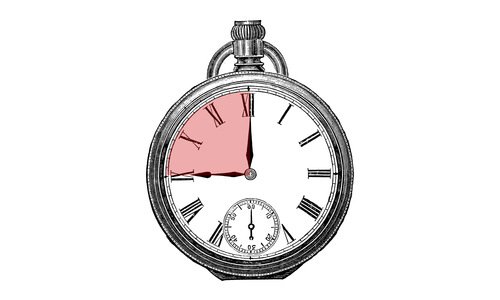
No rational person would jeopardise their future to meet an arbitrary 90 day milestone. Too many corporate incentives are structured exactly this way.

There are many eloquent complaints about the danger of the short term focus of corporations, especially publicly listed ones. My concern is that this short term focus stands in the way of more human and more responsive organisations. This short term focus divides accountability.

Time is short

One force driving the pathology of traditional management approaches is short time frames & arbitrary division of time. Results are fragmented down to hourly, daily, weekly, monthly and quarterly targets. We engage in the division of time as much as we divide work.

Incentives and management processes are tied to these short term results. Dividing time in this way values values the present quarter or time period to the exclusion of almost all else. As a consequence the arbitrariness of the short time frame becomes an invitation to treat the entire process as a game and to push the future far from consideration.  

Getting the number

When a decision is made with the sole objective of delivering a number, we enter a realm of dangerous ethics and considerable risk to the future. Purpose, customer relationships, employee engagement and community reputation are immediately in jeopardy, as everyone focuses to deliver the certainty of the financial outcome required.

The pressure of a short time frame immediately eliminates activities:

  • that may require upfront investment, time or effort
  • that may involve uncertain returns like experimentation, new product development, enabling customers, employees or other stakeholders, etc
  • that involve thought, analysis, research, input or consultation
  • that deliver large benefits beyond the time period
  • that have any form of initial dip in performance

This remaining options usually come down to one or more of the following:

  • bringing forward returns, usually at a significant discount
  • grabbing more value in the relationship with another stakeholder without regard to longer term consequences in the relationship (for example by raising prices without regard to impacts on loyalty or market position, demanding rebates from suppliers, etc)
  • arbitrary cost cutting, especially employees or ‘discretionary expenses’ like marketing, training, maintenance, support, etc where effects are not immediate 
  • accounting treatments, particularly relating to the recognition or allocation of revenue or costs and the valuation or recognition of assets and liabilities
  • outright fraud and deception

Waste

Some of these changes may cut waste or realise value, largely by accident. In many cases, the organisation responds to the changes with innovations that ameliorate the longer term impact or at a minimum defer them for another quarter. Pressure can inspire creativity and efficiency. The negative future effects and ongoing pressure can also generate a treadmill of even greater pressure.

We must be clear that this activity is waste. Playing the numbers game is wasteful effort. It risks the future and compromises the core value creating relationships in the business. The demands of the ‘numbers game’ work to unravel any efforts to become a more responsive organisation. The ask to meet numbers always pushes for planned outcomes, maximum control and a lack of transparency in decision making.

No Division of Accountability

Accountability for outcomes is core to the future of any organisation. Ending number games does not mean an end to accountability. It means greater accountability.

  • Let’s be accountable to make every decisions in line with purpose and values.
  • Let’s ensure all employees are accountable to deliver now, for a better future and to realise people’s potential.
  • Let’s ensure that the accountability is an accountability to all stakeholders.
  • Let’s also work to deliver each day in a realistic manner to our long term goals, not just scrabble to manage an arbitrary day that we choose to report.

We need to end the division of accountability.

A Tasting Plate

Self-help books are full of the best practices of other people’s lives. We are each unique. Treat the example of others as less of a recipe and more of a tasting plate.

No Recipe

The world is full of advice on how to get the most out of life. Usually that advice is distilled from the example of other’s successes. However best practices are often highly contextual.

Each person has a different circumstances: temperament, upbringing, capabilities, commitments, relationships, goals and purposes. What works for one person as effective practice rarely works for everyone. This is one reason why self-help advice is often so maddeningly contradictory. There is no universal recipe for success. We would even struggle to agree what that means.

Tasting Plate

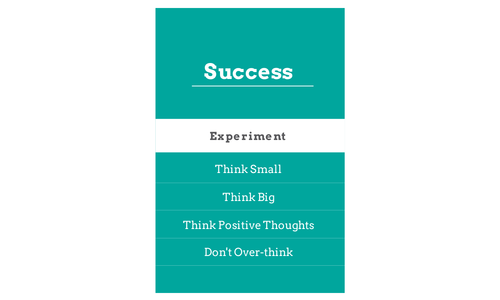
Treat best practices as a tasting plate. Try out those practices that appeal to you. Experiment to see what works. Do more of what works. Add your own twists. Recognise circumstances change. You may need new experiments from time to time.

Importantly, as a leader, recognise that your practices are not universal. Allow people the opportunity to experiment with working in the way that works best for them. That is the path to make the most of their potential.

A Vision that is Yours Alone is an Hallucination

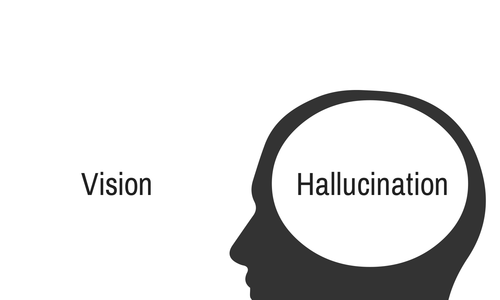
Steve Case once said ‘Vision without execution is hallucination’. Before you get to execution, a vision goes awry if it isn’t shared by the others who must do the work.

Read most standard texts on leadership and they will begin with the leader setting the vision of a team. ‘Leader [insert verb] the vision’ defines much leadership training. As a result the focus become crafting a compelling vision and communicating it in the most persuasive way. Leaders are then expected to ensure the team delivers to that vision. Case’s comment highlights the need to ensure delivery.

There is one flaw in this approach to leadership:

An hallucination is something you think is real but others cannot see. The fact you can see it is not enough. The team cannot see what you see no matter how good your communication skills. People cannot deliver what they cannot see.

Team visions are far more effective when created by the team rather than the leader. Allowing others to contribute to shaping the vision leverages their potential to find personal purpose, to contribute more and to improve the picture. It deepens their understanding of the situation and the drivers of change. People who co-create make their own sense. The work of building a vision engages and enables others to own the vision and lead adaptation over time. The full passions, expertise and experience of the team can contribute to shaping the outcome. That work is the best guarantee the vision is seen and well understood by all.

Imposing a vision and sustaining that imposition is really hard work and largely counterproductive. No amount of telling conveys the richness of the leaders vision in a busy age of continuous partial attention. In complex scenarios the leader’s vision may be partial or too simplistic. Confusion and misinterpretation are likely. In networks there will be competing visions and competing alternatives for work. Critically an imposed vision is always the leader’s and often a compromise of purpose and passion for the team. Abundance has been replaced with compromise.

A leader’s vision is rarely seen as open for improvement even if the leader seeks input. Power differences discourage feedback. The worst outcome for organisations seeking to respond to changing markets is to be stuck thoughtlessly delivering a dated vision imposed by a now out of touch leader. Pushing the vision through will disengage others, destroy the leader’s influence and jeopardise the business.

Next time you need a vision to guide the work of a team think ‘Team [insert verb] vision’. The leader should be the facilitator not dictator of that process.

Execution is far easier when a vision is co-created. We all need fewer hallucinating leaders.

Every action writes your autobiography

image

I came across this quote today in an exhibition of the work of the photographer Sue Ford.

We can learn from artists

For an artist it is clear that each work even a representation of another is an expression of their own potential as an artist. To make a work is to put the best of your talents on display.

We can learn a much about the future of our work from the edges explored by artists.

One of the reasons art demands this challenge is the arts is an arena of the long tail. Harold Jarche has discussed the implications of the long-tail for the future of work. We are increasingly engaged in knowledge work in a networked economy as content creators, sharers or remixers and facing the same economic effects as artists.

Every action writes your autobiography

The insight from Sue Ford’s quote above is to recognise that every action we take is an opportunity to put the best of our talents on display. We express ourselves through the big and small actions we take every day. Often the actions we don’t take are even more important when we give up the opportunity to realise our potential or to learn and grow.

We will be judged by our actions. Networks are demanding and will route around the inactive, those who fail to lead or those who fail their potential. Our reputation will be built and quickly shared through our networks. We write an autobiography in action and we are judged not for our words but the actions we take.

What do you want your autobiography to say? What potential is yours to realise? Your next action will provide an answer.

Why not make your next action a work of art?

The Cold Dark Path

image

Two Competing Loops

This week at the first meeting of the League of Social Intrapreneurs in Melbourne I was introduced to the Berkana Institute two loops theory of change. The model of change in complex systems resonated immediately.

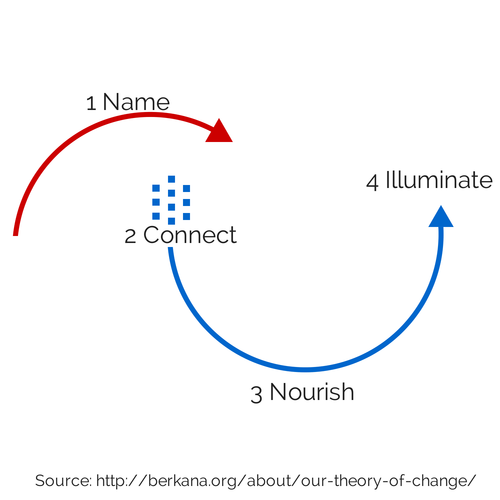
When a system nears its peak, change agents identify the need for alternatives and drop out.  They connect and begin to explore alternatives nourishing a new system through experimentation. Eventually the stories of their success illuminates the change to those who remain in the old declining system.

A four step model with four simple verbs seems clear and straightforward. Why is it that the path of change is such a cold dark path?

Nobody Warns You about the Dip

Stepping out of a warm and comfortable ongoing system with its present day rewards is a daunting uncertain choice however bleak the future of that system may look. Those with most to gain will oppose the agents of change who name the issues and start to work on alternatives. Opposition will not always be fair or balanced.

//platform.twitter.com/widgets.js

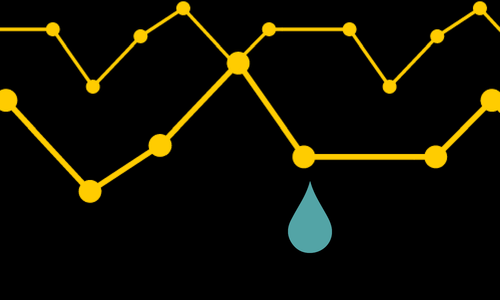
Most difficult of all is that dip in the diagram above. The uncertainty and the need to build a new complex future means the alternative system starts along way back and with a great deal more risk. Selling another path even to yourself can be a challenge in this scenario.

All the discussions about collaboration, requests for advice and stories shared among change agents at the League of Social Entrepreneurs, in Responsive Organisation, in Change Agents Worldwide or in other conversations that I have with unreasonable people belong at the bottom of the loop where people struggle nourishing new alternatives.

We must embrace the fact that the road to change is a road with dips and uncertainties. Proceeding any other way does not prepare people for the work ahead.

Nourishing Change Takes Hard Work

Most change fails after the connect stage.  Declaring a need for change is initially easy and exhilarating. Manifestos are thrilling. Connecting with other like minded people has a wonderful effect for the spirits and is a great way to reinforce the need for change.

Then nothing happens for a really long time. It grows cold and dark on the path of change.

Lots of drudgery dogs those walking the cold dark path of change. Meetings need to be organised and venues found. Compromises need to be negotiated between people who are 99% aligned. Factions and fragmentation occurs and saps the energy of everyone. More change agents need to be recruited, especially for the work. Experiments need to be agreed, funded and run. Failed experiments need to be cleaned up. New experiments agreed, funded and implemented. Success needs to be found. Someone needs to find money or work out the details of the new model. Communication materials don’t write themselves. Just when success seems inevitable the dying system finds a way to set you back.

Change falls apart when the connected agents of change won’t work the experiments long or hard enough to nourish the success of the new system. If they won’t invest the time to build new connections, share successes, to solve the daily issues and to innovate a path forward then the nourish stage will never offer an opportunity to others to join in the change.

If the organisers of the first meet up about a change end up with all the actions, then a change initiative has work to do to find others to nourish the change. Engaging others in the work matters more than engaging them in the idea of the change.

Join in the Work

Lots of people want to join change at the exhilarating beginning and again at the celebratory end. Traditional management focus only on the beginnings and the endings but leadership is found in realising the collective potential of the journey.

The question is who is willing to walk the cold dark road. Those change agents who do the leadership work of nourishing new experiments shape the future. That path is hard but the work is the most purposeful and rewarding

The Art of the Unreasonable

image

Every day I deal with unreasonable people. I wish there were more of them.

Unreasonable clients

The unreasonable people I meet are those executives, entrepreneurs and other change makers who are trying to change their organisations, to create new products or who are trying to make the world more human. These individuals don’t want to hear that it is hard, or that success is unlikely or that they are unlikely to see rewards.

These individuals are purposeful and all they want is help to bring their unreasonable visions into being. Willingness to persist is what ensures that they will succeed. They want to know they are not alone and that there are people to help them deliver their visions of the future.

Unreasonable partners

In addition to conversations with my clients and prospects, I am exposed to the unreasonableness of Change Agents Worldwide.  It is entirely unreasonable to believe that you could form an effective consulting and thought leadership network full of smart, highly capable and rightfully busy people without any traditional forms of central coordination.  However, Change Agents Worldwide delivers, constantly challenges itself to do better and the community is prepared to engage because the purpose of a better future of work is unreasonable, but necessary.

My respect for that group and others like it is huge because the network views spreading unreasonableness as part of the mission.  You only have to look at the extraordinary Executive Change Agents who are trying to make change in some of the largest corporations in the world, often solely on their personal authority.

If your organisation does not have people like these, why not? What are you doing to champion them, enable them or hire more?

Unreasonable inspiration

Unreasonableness inspires me. Do Lectures Australia was full of people willing to believe that they could deliver the extraordinary if they just started small and they started now. Social enterprises are another haven of the unreasonable as people seek to use the levers of business to address the challenges of the world. Social movements, like Change Day, inspire me, because they ask people to seek to make a difference and are led by unreasonable people, like Helen Bevan and Mary Freer. Artist are another inspiring source of an unreasonable view of the world.

What is inspiring you to be more unreasonable? What in your organisation shows others that more is possible, new thoughts are allowed and that more can be done?

Unreasonable change

We can’t change settled management practices without unreasonableness.  We can’t create more customer centred organisations within the bounds of what we define internally as acceptable or our accountabilities. We can’t make our organisations better for customers and society on the sensible practices of the past. If we want to be more responsive, we need to be a little unreasonableness.

If we want to lead, we need to be a little unreasonable in our expectations and actions.

There are more than enough forces in our world to encourage the normal, the static, the secure and the stable. Most people find it hard enough to win the support of their boss. Let’s foster the unreasonable.

Go find someone who wants to be unreasonable. Help them. Spread the contagion. That unreasonable purpose is the best engine of change.

//platform.twitter.com/widgets.js

Note: GBS = George Bernard Shaw. 

//platform.twitter.com/widgets.js

Networks have Feelings Too!

In enthusiasm for our ability to connect people in networks and to see the potential of new ways of working, we can lose sight of an important element. Networks are composed of human beings.  The rules of human relationships still apply and there is no magical technology that allows us to escape these fundamental rules.

Networks need to Form, Storm & Norm to Perform too

The process of forming a group dynamic in a networked community follows that of a team. Because a network is a mix of strong and weak ties the process of reaching community norms may well be a difficult and extended one.  

In a network, each individual forms a sense of the community, its purpose and the practices that prevail. At times for some individuals or groups in the community this sense of meaning can be quite out of alignment with the broader consensus.  However, in some cases the interactions in the community do not surface the differences or do not make that misalignment obvious to those in the community.

If each participant proceeds on and does not meet a conflict with their sense of meaning, then they will not discover the need to revisit their view. Often this failure to develop common meaning and norms will create major challenges for the network later when conflicts arise. People who feel that their sense of the norms ‘are obvious’ and have been acting on expectations of the same from others may experience a deep breach in trust at this moment. 

A key role of social leaders is to foster the meaning in a network and alignment of norms and value creation.  Leading these conversations early in a network’s life will help accelerate the community development and avoid later issues.

Remember weak ties means limits

One danger of the weak ties found in large networks is weak accountability. Without a strong connection to you, I can easily engage in the avoidance of conflict and the hard work of leadership. Rather than deal with a difficult situation it is human nature to see if we can’t ignore it or pretend that it is someone else’s responsibility to respond. See a conversation in a network that disturbs you and you can let it go or worse filter it out, if there is no accountability to engage.

Equally weak ties can mean that there is little cost to me for the snide remark, the cutting comment or even troll activity. Personal accountability for our actions through strong ties to others cuts down on this behaviour. I may not have accountability to the individual but I have a reputation to maintain with others and so I moderate my behaviour.

Leaders need to foster an environment of accountability in networks. Encouraging all participants to engage, to challenge and to clarify understanding helps accelerate the value in the network.

Build a network up from a single conversation

In this wonderful video on innovation by Sylvain Carle from Creative Mornings Montreal, there is a description of Unix and the need to build up complex systems from smaller systems that work beforehand. Networks are complex systems composed of smaller connected systems. 

The smallest systems of a network is two people in conversation. The conversations in your networks should work as great stand alone conversations.  If those conversations don’t work the way they work in the rest of your life, then something is wrong.

This week I was asked ‘why can’t we just let the network do its job to create a community virally?’ Networks don’t create a community. They only connect people. Conversations create communities. Conversations help people understand the purpose of the network and the personal and collective value that will be created. Those conversations are the work of leaders. Engaging movements of people in sharing and spreading ideas is the work of leaders through stories and conversations, not the networks themselves.

Start your leadership work by focusing on creating effective, valuable and engaging conversations.  Build your network back from there.

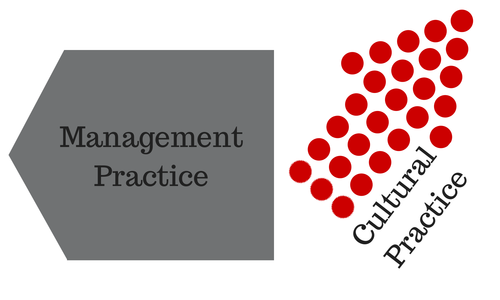
Management Practice Lags Culture

image

Management practice is influenced heavily by hierarchy, tradition and risk aversion. As a result our practice as managers lags the changes in culture in the society around us. Leaders need to work to close the gap between management practice and social expectations.

Management Practice is a Lagging Indicator

The way we manage our organisations is defined by practices that often trace back to the industrial era. The consequences of this are evident in many ways:

  • the diversity of our organisations does not reflect the diversity of our communities. Gender is just one diversity dimension in which management practices lag that the practices and views of society as a whole.
  • organising activity using networks and leveraging the potential of people to contribute is another way in which organisations are only beginning to address opportunities that communities, our personal relationships and the innovative organisations have already embraced
  • resistance to give up hierarchy, planning and demands for predictability and certainty when even the political structures based in these models have surrendered to approaches that operate far more adaptively and responsively.

Art is a Leading Indicator of Changing Society

Our cultural products adapt far more quickly to changes in society than our management practices.  Film, television, music and other forms of entertainment rapidly embrace changes in the way society operate and reflect that in the protagonists of the stories, songs and other art forms.

An example can be seen in the role of the detective in arts like novels, film and television.  In the birth of the industrial era, the detective was a logician, like Sherlock Holmes unravelling facts and relying on expertise in predictable processes, By the early 20th century the detective was a master of the human elements of relationships, like Simenon’s Maigret.  The uncertain times of the mid century introduced the detective in a much more ambiguous role. Richard Martin has documented how the changing nature of the detective film reflects our changing society.

Cultural products appeal to our need to be entertained, connect and engage with each other. Therefore they must be relevant to our society as it is today. Art is an experimental market where failure is common and success is usually defined only by audience acceptance. Someone is always seeking a better way to express the zeitgeist.

Why does management practice lag changes in the culture of society?

Management practice lacks these same pressures. Too much of our management practice is assumed to be canonical and confirmed only by inward looking assessment:

  • Focus on best practice: Best practice is historical and often particularly contextual. However, managers are often reluctant to move beyond accepted best practice.  As Harold Jarche has argued we should look instead to practice to be best and look to be more social leaders.
  • Risk Aversion: Avoidance of failure is a core tenet of management practice. Managers stick with practices that have worked safely for them, often in face of evidence that newer practice is better. Safety is valued.  There are real costs to this risk aversion.
  • Hierarchical & Internal: Managers who are more hierarchically senior set the bounds of acceptable management practice and control the HR processes that reinforce acceptable practice. Without an external & learning mindset, these leaders can inadvertently reflect management views and mindsets of a previous generation that were handed down to them during their early career.

Change

Responsive Organisations will have a culture and a set of management practices that reflect the needs of our society now. These organisations will experiment, test and measure the effectiveness of their practices in the marketplace and in their organisation. They will not rely on canon, hierarchy or accepted opinion.

The benefits of organisations using management practices that better reflect the changing culture of our communities are clear. These organisations will be more human and better able to realise the potential of all people.

Bringing this change about is the work of leaders and change agents. 

Shapes, Guides, Decides: on Structure

In leadership we are starting to see the need to pull apart our obsession with jobs. We are realising that what matters more than a job is the roles that leaders play and their authority to play them.

A similar need exists in the structures we form from those jobs. In organisational design, we have a tendency to focus overly on structure as if it is the determinant of how the organisation functions.
The structure of an organisation is important. However, we know that all structures perform in different ways because of the networks of relationships that weave through them and the resulting culture that is created.
A focus on structure can be of little value to a manager looking to respond practically to the challenges of a networked economy. That manager often well knows that while changing structure can require as little as a new powerpoint slide, but the way things get done changes far less frequently and with a great deal more difficulty
Why?
  • Structure: A collection of status relationships between individuals. Shapes
  • Decision Process: The commonly accepted series of stages by which decisions are made in the organisation, including what information is expected, who is aware, who participates and who is consulted. Guides
  • Decision Rights: Who & how the final call gets made on any decision. Decides 

Structure influences decision processes and decision rights. However structure does not determine them and at times can work at cross purposes to the intended goals of the organisation. You can have a hierarchy where decision rights are delegated and there is a high level of autonomy. You can have a network that is paralysed by an insistence on consensus before anyone acts on a decision. 

The process used for decisions and what exercise of decision rights are accepted in an organisation is a function of the network of relationships more than the structure. Control by structure is often an illusion.

We need to spend less time focused on our structures and spend more time on how our relationships work and how we make choices.