Celebrate Outcomes

The process is just a process. Often the process is one of many competing paths. Outcomes matter more.

In a recent conversation about customer experience, we were discussing the way people fixate on processes. Processes appeal to our industrial management mindsets. Processes are an engineering challenge of neat inputs and defined steps delivering an outcome in a mechanical fashion. Processes are so easy and alluring.

As a result we see troubling signs:

  • people compete for the beauty of their customer journey map. Have a look at Pinterest there are hundreds that are so gorgeous they reflect no real customer experience ever
  • organisations obsess about adoption over value creation because adoption is far more susceptible to a process
  • change management becomes an exercise of templates and measures rather than a series of changes in human relationships and mindsets
  • leadership is discussed an exercise in steps or processes to be managed rather than work to realise of the potential people in real complex circumstances 
  • measures, averages and other abstractions of the process mindset take precedence over human considerations.

Raising process to an exalted state devalues the complexity of humanity. The computer does not need to say no. Putting process over outcome leads to the outrage economy as people try to fight their way out of a narrow industrial mindset.

We need to focus on real human relationships. We need to allow for the mess and power of human emotions. We need to consider networks with learning, change and feedback, not just linear processes. Importantly, we can allow for human scales, learning and flexibility. Most importantly, we can allow for human conversations. That is the path to achieving the real messy and complex outcomes that we need.

Our organisations, our customer experiences and our relationships will be better for a broader more human approach.

Leaders Aren’t Painkillers

No team wants to hear they need pain. We wish for less anxiety, pain and challenge at work from time to time. We can wish our leaders would take the pain away. However, leaders aren’t there to be painkillers. Nobody says:

‘Sounds like a problem. Take two leaders and call me in the morning.’

Leadership is the technology of realising human potential. Effort, challenges, pain and anxiety are a key part of that process. Leaders who remove all pain underperform.

– in a complex fast changing world obstacles are the work. There is no steady painless state. Relief is illusory and temporary.
– pain is feedback: the pain we want leaders to remove is a signal we need to change.
– the right challenge is productive: human potential is realised against a growing challenge and developed through effort. We learn by doing not by being led.
– tension and conflict is a reason to examine our thinking, create new approaches, explore the broader system and collaborate better
– painkilling creates dependence where the leader is expected to solve greater and greater levels of challenge and the team just rests until things are painless .

We tell ourselves we need pain in many polite ways when we talk about the importance of flow, tension, mastery, practice, learning, empowerment and effort. Nobody likes to endorse pain. No team wants to hear that they need it. Sugar coating just leaves teams unready for the effort and change involved.

Great leaders don’t remove all pain. They engage teams in solving their own challenges. They work with others to remove the unbearable but maintain the productive pain.

So What Now?

Leadership is always a fallible hypothesis.

Leaders must be capable of being wrong to be engaged in leadership. If you are telling people what they want to hear, it isn’t leadership. If you are speaking in platitudes, then you aren’t leading anyone.

Leaders engage others in the hard work of change.

A testable hypothesis

The surest way to test the hypothesis of your leadership is to engage others and ask them to work with you. They will either follow or they won’t. Nobody can be forced to follow you. Your views aren’t always going to be right.

A leader must take a position that is specific enough to be potentially wrong and specific enough to be actionable in hard work. The change needs to be something detailed enough that others can fight for it or fight with it. Remember being proved wrong or working through opposition can be the critical learning experience in any change.

‘So What Now?’

Avoiding the risk of failure through management speak and motherhood statements only accelerates leadership failure. Any attempt to deceive or avoid simply delays the inevitable.

Too many leaders never discover the failure of their leadership. They leave the room confident but all that remains is question echoing in the minds of the audience:

“So what now?" 

Start small. Start now.

Each journey of a thousand miles, begins with a single step – Lao Tsu

If you have time to email, then you have time to work out loud. Find one email to reply out loud instead. Repeat.

If you have time to talk, then you have time to lead. Find one person to influence. Repeat.

If you have time to do, then you have time to experiment. Find one hypothesis to test in action. Repeat.

If you have time for a meeting, then you have time to start a movement. Find a group to engage in a purpose and action. Repeat

If you have time for a coffee, then you have time to learn. Find one moment to reflect on how to do better. Repeat.

If you have time to fix, then you have time to make change. Find one way to make the system better. Repeat.

Small scale changes accumulate given the time. Small interactions reinforce change and build community.

You have the time and the work. Start now. Start small. Repeat.

No Fine Print in Leadership

image

Stuck at the lights next to this car insurance billboard I had occasion to read the fine print. The fine print, which is illegible in the photo, explained:

  • That the actor in the photo is not the identified customer
  • That the saving may not be replicated in another customer situation
  • That standard underwriting terms and conditions apply i.e. the insurance may not be available to a customer
  • That the car insurance is not provided by Coles but by Wesfarmers Insurance, the underwriter
  • That a customer should read the product disclosure statement to determine whether the insurance is right for them.

Lawyers will have demanded these disclaimers to make the messages safe and to rule out risk. No marketer ever wanted a disclaimer on an ad. As a result of this legally required list of disclaimers the proposition of the billboard is solidly undermined, if anyone ever reads them. No wonder the print is hard to read from a distance.

Don’t Rely on Fine Print in Leadership

Noble intentions in leadership are often undermined by the safety of fine print. Some leaders communicate with hidden disclaimers:

  • I want this team to be open and honest* (*until there is uncomfortable conflict, particularly with me)
  • I am not hierarchical* (*until it involves my status)
  • My focus is success of the team* (*until I’m told otherwise)
  • We need to be more innovative* (*as long as it is guaranteed to succeed)
  • We need to engage all our stakeholders* (*until I have a view)
  • We need to move faster and be more agile* (*until it is my decision)

Like the ad above, these disclaimers undermine if not subvert the message of the leader. Many of these leaders genuinely mean these statements when they are made. Their intentions and desire to change are noble. For others, these are just the kinds of statements that leaders make. They are leadership platitudes.

However change takes more than the safety of good intentions or platitudes. Change needs people to stick out the hard times. Leaders who opt for disclaimers take the safe route.  Often, they just failed to think their comments through and were surprised by the hard decisions that they entail.  By failing to reconcile their statements with likely eventualities or their own personal reactions when particular situations arise, they end up escaping through the silent disclaimer when things get tough.

Leaders need to understand that their public statements are seen by their teams as commitments. There is no division of ‘core and non-core’ promises. These are not indications of present intent subject to disclaimers. They are commitments to other people who need to rely on them to manage their uncertainty, trust & support to go through change. With this focus, it pays to think through the commitments and to accept that delivering against those commitments made will be hard and involve challenges.

If you are going to say it, be prepared to back it up. Leadership is hard work and means taking risk. Leave the safety of disclaimers to the lawyers.

Talent is not an Asset. Talent needs a Community

Reading Austin Kleon’s Show Your Work for insight into working out loud, I came across the concept of a scenius coined by Brian Eno.  The idea of a scenius is that great talents arise from scenes that foster them. Great talent arises from interactions in an ecology of talent.

What really happened was that there was sometimes very fertile scenes involving lots and lots of people – some of them artists, some of them collectors, some of them curators, thinkers, theorists, people who were fashionable and knew what the hip things were – all sorts of people who created a kind of ecology of talent. And out of that ecology arose some wonderful work. – Brian Eno

There isn’t a War for Talent

Talent isn’t oil. We haven’t yet reached peak talent. There is plenty of untapped wells of talent left.

The concept of a War for Talent has motivated organisational HR departments and executives ever since a McKinsey Quarterly article coined the phrase in 1998. The article related to changing demographics of people entering the workforce that lasts to 2015.

McKinsey’s original war has almost run its race (& even been made more redundant by the forces of a changing economy). We might have arguments about new Wars for Talent now, but the competitive and hoarding nature of the concept has inspired managers ever since. Why wouldn’t you want to hoard the largest stock of talent? Why wouldn’t you want to win in the competition for a scarce resource?

The War for Talent also had another unintended consequence in organisations. Because acquisition was easy to measure, it focused organisations on the battle for talent external to the organisation. Internal talent was often inadvertently devalued in comparison to the battle to win new talent. Internal talent was rated on potential and regularly decimated. The focus on those rated high potential talent was retention. For the middle range there was little focus on deployment, development or growth in potential.

The scenius idea highlights why so many organisations that have pursued a stock oriented approach to talent have discovered that it fails to deliver.  Talent is not a stock to be possessed. It is a flow that grows through connection, purposeful work and community.

Talent needs a Community 

Organisations that have tried to hoard talented people generally find that their talent decays or departs quickly. The half-life of a stock hoarded talent is short. 

The surest way to lose talented people is to disconnect them from inspirations, deprive them of purpose and underemploy their skills and expertise. The hoarding mindset encouraged organisations to do exactly this. Organisations wanted to disconnect their talent from others who might poach them. They wanted to have more talent than they needed ‘just in case’ and sought to deploy talented people in roles that weren’t stretching them to have a pipeline of future talent ready.

In contrast, a community of talented people grows in number and skills. Talented people grow through the interactions in a scenius, their networks or other learning communities. They grow by reaching out to the example of others, by stretching the use of their skills and by learning against great challenges, not by sitting on a shelf waiting to be deployed.

Once you see the flow of network interactions within which talented people operate it becomes clearer that all the talent need not be inside your organisation. Organisations need to foster value in their talented people by purposefully networking your organisation.  

Organisations need to recognise that talent will be active participants in the flow of knowledge and learning experiences outside the organisation too. All employees should be encouraged to reach out into networks because it develops the talent of everyone in the organisation and gives your organisation greater access to the real strategic benefit of those networks.

Talents grow when they are deployed against challenges. Make sure your people have the opportunity to realise their potential in the flow of interactions around them. Give all your employees the chance to grow and leverage their talents in networks.

What are the Ethics of Work?

A great discussion on the ethics of working out loud broke out yesterday across my social streams prompted by a thoughtful blog post by Kandy Woodfield. The post and the many discussions it prompted have been insightful and a few key points have arisen for clarification in my strong advocacy of the benefits of working out loud:

  • While I have not been explicit on this, like other forms of social collaboration, working out loud is in my view a voluntary practice. It is not meaningful to describe an activity that involves forcing someone to work out loud as a learning experience or as social collaboration.  
  • Kandy’s call for support for learners through the vulnerability of the learning experience is critical. The objective is to better realise people’s potential and that takes a supportive culture, the right systems and the focus of leadership.

This last point for me was the clue to a broader issue that began to be discussed with many colleagues: 

What are the ethics of work?

If we are right to subject working out loud to an ethical investigation, then perhaps we should extend the same challenge to work. Many of the risks and vulnerabilities that occur in learning experiences are magnified in daily work, but occur with little consideration of the impact on the individual. Worse still work experiences are often designed by managers to exaggerate these vulnerabilities in the name of motivation or performance.

Culture creates an Environment of Support or of Risk

As young children we learn and we make mistakes freely and publicly. It is our approach to the world. As children, we mostly laugh as we learn. At times this process may be frustrating for child and parent.  Either might experience the odd temper tantrum but this learning process is expected of children. As a result, they are supported and encouraged in learning by a family and social environment. Their pace of learning is phenomenal becuse they are free to make sense, to experiment, to observe, to ask questions, to get into new environments and to try.

By the time we reach the workplace, things are not always as supportive. Mistakes are frowned on. Questions can be discouraged. Experimentation is dangerous. People have a status, a job and a place. Failure to learn adequately fast and accurately is treated a performance issue. Public sharing of shortcomings is common with leader boards, rankings, status and accreditation levels, gamification, etc. None of this has anything to do with working out loud or even learning. These practices are widely adopted as best practices from our traditional industrial management model. It is how we work.

Many of the dangers that Kandy raises for working out loud arise not because of the work is out loud, but because it is work. Traditional workplaces using industrial management thinking are often unsupportive of learning and the learner. 

To extend the argument of the blogpost, the way we work presents ethical issues. The danger comes not because of the visibility of working out loud. Mistakes will always happen. People will always be vulnerable if they are doing. The danger comes from the lack of a supportive work environment that encourages learning.

When the majority of learning is unstructured and on the job, this is a much more dangerous situation.  Everyday on the job individuals are trying to improve their performance by learning to work better.  The organisation must be hoping to see the growing benefits of an employee’s work. If we don’t support learning, all of this is at risk.  

Professional learning managers are ensuring that the 10% and the 20% of learning is managed ethically. Who is responsible for the 70% on-the-job learning? 

Leadership is the Technology of Human Potential

We need to ensure our approaches to learning and the development of the potential of people are effective and ethical wherever they occur.  Leaders at all levels in organisations need to work to create an environment that supports learning and supports learners.

We don’t need more of empty platitudes of declaring a learning organisation. The leadership hard work is considering how all the systems in the organisation support or encourage learners, learning, the sharing of knowledge and the development of personal & community potential. That is a great and highly rewarding ethical challenge for leaders in organisations everywhere.

We can start simply:

  • we can support people to learn and discuss the value of learning
  • we can coach people through the challenges of learning
  • we can encourage people to experiment with new and better ways of working
  • we create a voluntary community that shares the vulnerability of the learning experience and supports the learner with peers
  • we can support all of this with fun

A key to the rapidly changing environment of our networked economy is that organisations need to get better at learning and leveraging the potential of our people.  If we take Kandy’s query to heart in respect of on-the-job learning & the very nature of our work, organisations will be better at managing this challenge.

Our organisations will be more responsive.

To Shape Change, Start Leading Change

image

“If we want things to stay as they are, things will have to change.” (spoken by Tancredi) from ‘The Leopard’ by Giuseppe Tomasi di Lampedusa

Times of disruptive change are difficult for those in power and those who benefit most from the current way of things. Many of these people prefer to ignore the rising changes in society. In effect, they abandon their leadership role in shaping change in the system.

Enduring disruptive change demands an engaged form of leadership. The future in disruption is not written. Leaders should seek to engage, lead and shape change to the benefit of their organisations. 

The Networked Economy is Here to Stay.

Many leaders of organisations have a lot of power, status and wealth tied up in the way things are now.  They are the masters of the current system, adept in its ways and confident in managing the current model of work and the organisation.  They have both personal and professional reasons for hoping that nothing changes.

Change doesn’t work that way. We are now part of a global ecosystem of actors connected in digital networks.  Access, visibility and transparency have increased driven by the new connectivity.  Change that enters this new system is magnified, spread and developed by the action of agents all around the world.

Lead or Let others Decide The Future

The connected digital networks of global actors means the future of work won’t be ignored, stopped or reversed. Others will go on to develop better ways of working whether you and your organisation participate or not. The less you participate, the more you appear a candidate for disruption by one of these actors.

Organisations face a leadership challenge in this environment.  Effective leadership, continuous learning and a vibrant culture is required to take effect of the advantages of the new approaches.  Senior managers need to play a critical role helping organisations adjust and maximise the benefits from these changes.

However, managers face changes in the future of work that change their power, status and potentially their financial position.  Networks can operate with less layers of management and roles that were once managements prerogative are being delegated to frontline employees or automated in systems. New two-way conversations with engaged and enabled employees, customers and other staked holders can require leaders to deal with new complexity. In this case, it can be tempting for a senior leader to sit on the sidelines hoping the changes are a fad or that they might pass over the organisation.

You Can’t Lead a Community if You are Not Engaged

A simple case study of this mindset comes when you consider the level of management attention to stakeholder activism in social and digital media. Because this activism is now more visible and empowered by digital and social networks, management can see resentment that once was hidden. Bear in mind the resentment is not new.  It just has a bigger audience and influence than before.

Many of these social activist activities have large impacts on organisations because the activist have a community and the organisation has only a network.  

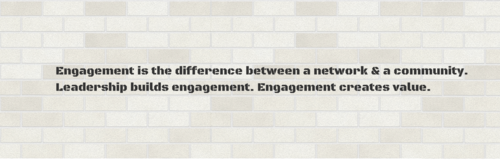
The critical difference between a network and a community is how engaged the participants are. That engagement arises as a result of acts of leadership to create common purpose, to shape an agenda of action and to influence others to act. Leaders who ignore the burgeoning networks around the organisation allow others to shape the communities, their purposes and their influence.

Senior leaders of organisations need to engage with the networks around their organisation.  The opportunity to create productive communities far exceeds the risks. Listening and acting on feedback of networks of stakeholders is one of the better mitigants of risk. Failure to engage and to understand the needs of the networks creates an opportunity for others to lead.