Infrastructure of culture

Culture eats strategy for breakfast – Peter Drucker

Enterprise social networks are a new form of communication in organisations. Culture is the outcome of how we interact. New interactions will change the culture of our organisations over time. Managing culture changes is critical for organisations coping with disruption.

Adam Pisoni recently quoted a comment I made at Disrupt.Sydney that enterprise social networks are ‘infrastructure of culture’. The comment was building on Kai Riemer’s talk at Disrupt.Sydney that technology that acts as infrastructure (of connection, of transportation or of communication) is open to novel uses and depends on users to make new sense of the infrastructure. Kai was drawing a distinction with our traditional tool based view of technology where it exists for a specific purpose. This point highlights one reason why we often have an inability to forecast where new communication technologies lead us in terms of changes in interactions and societal change.

Enterprise Social Networking is an Infrastructure for Culture

The culture of an organisations is a sum of the interactions across the organisation. It is the ‘way we do things around here’ or ‘what happens when the CEO is out of the room’.  Culture runs deep and is the outcome of thousands of interactions. Speeches, posters and announcements don’t determine culture. As social animals, people look for guides as to what is acceptable in the stories of the organisation, the daily behaviours of others as they interact and importantly in how moments of crisis or conflict in the community are resolved. What happens when things get uncertain is at the core of the culture of a company.

Disruptive change tests the culture of organisations. Shaped by purpose and values as demonstrated in action, culture has an enormous influence on how the organisation runs and what is possible. Many organisations need new strategies to respond to disruption. However, if your strategy runs counter to your culture you will face challenges and likely fail. In the face of disruption, many organisations have found they simply cannot pivot their strategy because it threatens some deep elements of their culture.

A common goal of launching an enterprise social network to execute a strategy to ‘change  culture’. Looking for more leadership, authenticity, accountability, openness or innovation, organisations assume that the network is a tool to deliver that outcome. These organisations are usually disappointed initially. Culture changes the strategy. All they see at first in the community on their network is their organisation’s current culture, just much more visible than ever before. The good, the bad and the ugly is on display. Even worse, the much vaunted new values from the strategy are often not on display because the community is not yet comfortable with those novel interactions, is waiting for a lead from others or does not accept that they can be arbitrarily imposed from above.

Communication networks are infrastructure, not tools. The change in culture is in the community adopting new behaviours, not the technology. The potential of enterprise social networks to change the culture of organisations occurs over time as the interactions change. Importantly, social networks offer opportunities to accelerate this change.

How do new interactions accelerate change the culture of the organisation?

  • Build common purpose:  Social networks are a place to discuss and connect around purpose. Purpose is not imposed.  It comes out from interactions and work in the organisation. Too often when organisations have a new strategy, it is the executive team who assumes the right to set the purpose and only they understand the context that drives the need for change. A social network allows others to discuss and question this.
  • Empower change agents:  enterprise social networking often appeals to a group of early adopters, your organisational change agents. This group of diverse individuals have been looking for a way to have a larger voice, to connect and to drive change. These early adopters will drive a lot of the initial interactions & innovations.  Their goals are each different but they are often more comfortable with many of the values that organisations seek such as collaboration, openness, innovation and experimentation. The challenge for organisations looking to leverage these individuals to drive change is to authorise their activities and encourage the new interactions in constructive directions. Senior leaders can use their authority to play a key role in ensuring that your network does not become a sub-culture of the broader organisation.
  • Lead and role model: People look for role models and leaders. They will follow their guide in the behaviours that they demonstrate. Build a group of leaders of the community and let them know that they are responsible for fostering constructive interactions. Make sure your hierarchical leaders are playing a positive role and not discouraging change.
  • Share stories:  We learn culture from stories of interactions. Social networks allow us to share those stories in new ways and with new audiences. Encourage story telling and make sure you are looking to draw out the cultural lessons of the stories being told.
  • Make interactions visible:  Social networks are a new medium to see interactions. Remember the majority of people will watch, read and learn. Your culture will be on display and shared more widely than ever before.
  • Create interactions across sub-cultures:  Large organisations are often frustrated by the number of sub-cultures as communities within the organisation develop their own interactions. These sub-cultures often create unresolved conflicts blocking progress. Connect these individuals in one community and let them learn about each others contexts. Building shared purpose, concerns and understanding will build a greater commonality of culture.
  • Create conflict:  If there are values conflicts or other regular interactions driving conflict in your organisation, they will surface in enterprise social networking. The faster you bring these out the sooner culture changes. How you work to resolve these through collaboration will be key to your future culture. Remember it is better to resolve these internally before they leak externally through employees or other partners experiencing the conflicts and sharing them.
  • Allow the creation new interactions:  As infrastructure, an enterprise social network is open to employees, leaders and other participants to create new interactions.  If you encourage experimentation and quickly weed out failures, you will be driving innovation in your culture as each new successful pattern of interaction develops.  Embrace the chaos and you will see rewards as your culture develops.

Communities change culture when they adopt new interactions through the role modelling of others and the support of leaders. Enterprise social networking is an infrastructure to accelerate this process through new interactions and innovation. Disruption often demands rapid changes to organisation’s cultures that have been built up over many, if not hundreds of years. Networking the community within the organisation is critical to enabling the organisation to manage that change.
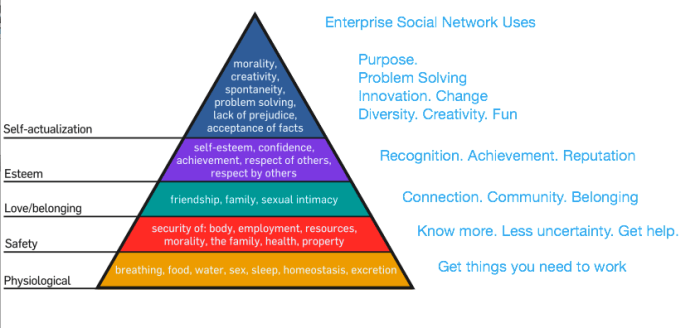
Recently I was discussing that the experience of working with the evolution of an enterprise social network. I remarked that it is a little like an iceberg. One idea or use is visible to you and draws you initially. However, as with the seven questions, over time the uses grow and develop as the sense of community builds. Over time we discover more under the water as we develop our conception of what an enterprise social network can be and the role we can play in it.
There is something in common between John Stepper’s great questions and my iceberg metaphor.  There are parallels as shown above between the uses of a social network and Maslow’s Hierarchy of Needs.
Social networks are about human connections and are sustained by human needs being met. People begin use with one need, often quite simple. The first challenge in building the community is to find a common use for people to work together to solve. Over time people explore more needs across the hierarchy creating new use cases in the community as they do. In this way, it is no surprise there is a parallel to Maslow’s attempt to document a structure of human needs.

We are all dead

“If the rate of change on the outside exceeds the rate of change on the inside, the end is near.” – Jack Welch

We are all dead.

The rate of change external to each of our organisations is now so great that no organisation can ensure it is changing faster than the external system. Global interconnectedness, the rapid speed of ideas in a digital economy & new means of working and collaborating means that change will only continue to accelerate.

So if we are all dead what do we do? Change the game.

Jack Welch’s quote assumed that the organisation needed to generate enough change internally to beat the system. If you are a massive diversified conglomerate like GE, then that is a real challenge

Don’t beat the system. Become the system instead. Organisations need to design their structure, boundaries and processes to integrate with opportunities going on around them in that external change. Instead of hunkering down to fight off the change, organisations need to rethink their defenses. The best defense may just be a welcome:

Have an outward facing culture: If your organisation is looking inwards for your ideas and opportunities, you are dead. If your organisation, only worries about its competitors, then don’t worry they are dead too. Open your organisation up to look globally (that really means globally including Asia, Middle East, Latin America and Africa)
– Focus on opportunities to create an ecosystem: Allowing the system to shape your products, services and customers will accelerate your change. This can be achieved in many ways such as partnership agreements, an API or a customer collaboration community. Once you start to see and think about the system in which you operate, new opportunities to change and innovate will present themselves.
– Create agile & open edges in their organisation with the freedom to interact with external changes: hackathons, experiments, partnership agreements and a handful of strategic investments can generate a lot of exposure to change externally that will help the organisation adapt. Make sure your permission and performance processes actually give your people the opportunity to interact. They need to be able to move at the speed of the system and that means trust.
– Speed the sharing of information and execution in your organisation: Copy the system where you can. Use enterprise social. Use agile. Use design. Use minimum viable products. Hack, experiment and test away.
– Kill yourself first: What business model do you most fear losing? What product are you too dependent on? What customer can’t you lose? Tackle these challenges now. Engineer a way to change them or innovate like crazy in these spaces before others realise your vulnerability.

Enterprise Social fosters Social Enterprise

Two new trends are on the rise in business at the moment and they both use the words social and enterprise. Importantly these trends are often more closely connected than many realise. The trends are:

Enterprise Social Media, the use of social media to foster connection and collaboration inside an organisation; and
Social Enterprises, an organisation which exists to fulfil a social purpose by leveraging the approaches of the business world

Enterprise social media drives a more social outlook in any organisation where the culture will allow it. At the heart of the connection is that these trends force us to reflect on human concerns like purpose, community and our legacy – enterprise social media simply makes us social.

Enterprise Social Media fosters Purpose

Enabling your employees and other partners to connect and share their stories and experiences will quickly surface the themes of your purpose. Discussing and sharing these examples helps build a stronger sense of community in an organisation and deepens engagement. Importantly, the social network will also offer a forum to discuss, clarify and resolve of the conflicts of purpose that organisations face. Purpose is not a statement issued by management. Purpose is an ongoing dialogue with everyone in the organisation and it’s stakeholders.

Enterprise Social Media fosters Openness

Enabling your people to share their passions, interest, experiences and concerns is going to bring the surrounding community into your organisation. People now have a tool to collaborate on community and social issues. This can range from awareness building to forming groups of like minded employees to organising volunteering and activism. The more open your organisation the better it will be at responding to social needs and feedback.

Enterprise Social Media fosters Accountability

A highly engaged community can become a conscience for Purpose. If employees have a concern about delivery to Purpose or the wider social impacts, they have a forum to discuss and seek action. Importantly this is a public and transparent forum where they may have like minded colleagues. These conversations build accountability in managers across the organisation to explain the connection of their decisions to Purpose, to the creation of social value and to broader community impacts

Enterprise Social Media fosters Leadership

Organisations are full of people who have leadership potential but lack the impetus and a first follower. Social media offers a low risk environment for these first time leaders to connect with their personal purposes and to attract followers. It also offers an environment where leadership for the commmunity can be recognized by the community. Building the leadership voice, action & reward for leadership in your organisation will enable social value.

Enterprise Social Media fosters Innovation

Social value can be created in many traditional commercial organisations through adding a little innovation to everyday activities. Enabling your employees to make suggestions and work together to realise these ideas using enterprise social media can accelerate that process by bouncing unconventional ideas off traditional processes. Employee ideas can add social value by suggesting new challenges to tackle, a change in sourcing, to better ways to leverage waste and even debating where an organisation creates value for customers and the broader community.

Purpose+Openness+Accountability+Leadership+Innovation=More Social Enterprise

People crave purpose and to make a meaningful contribution to society. My experience suggests that given the chance people will leverage enterprise social media to seek to create additional social value in and through their colleagues and organisation. These conversations can generate deep pride and engagement.

The main barrier to this effect is a culture unwilling to allow the challenging conversations required. Our work in fostering more social enterprise is to get out of the way of our people, embrace the growing potential for more social value and do what we can to build stronger purpose and social impact.

Speak up

So is ignorance an impediment to progress or a precondition for it? In a recent New Yorker article Malcolm Gladwell discusses Albert O. Hirschman’s work on how creativity can be driven from our efforts to recover from ignorance

Many entrepreneurs strike us as remarkably naive. They dared to act whether others saw only risk.

Hirschman wrote the book Exit, Voice & Loyalty, that I read in a long ago economics degree. I would recommend Hirschman’s book to anyone as it is short, an easy read and amazingly insightful as is discusses the choices of consumers, community and employees to agree, exit or speak up.

That book was a revelation to me because it helped me to clarify that there was a powerful path between acceptance and refusal. There is another path between buying or selling. You don’t have to choose only to stay or exit. You can also speak up for change. Usually it is only when people speak up that the system is able to understand the meaning of the otherwise silent & often missed exits.

Reading Exit Voice and Loyalty led me to the opinion that it is usually better to make your first choice to find some way to speak up or make change happen from within the system. There are only so many opportunities for exit or acquiescence. At some point, we all need to shape things in our world. We can all do this more.

Speaking up gives others the chance to respond to your needs or concerns. Speaking up defines the unnoticed issues. Speaking up is not without risk and conflict. In many cases, it demands the creativity or the naïveté of the entrepreneur to safely make your point and generate change.

In an age of technology to enable collaboration and social interaction, we all need to accept that more connected consumers, communities and employees have many more means to express their views. As voice moves from rare to common, these stakeholders will increasingly prefer voice to slipping quietly away.

We should hope that voice is the growing preference too. After all, losing the support of others is a form of feedback, but not particularly useful feedback.

Speak up and encourage others to speak up too.

Great advances are social

I was fascinated by this article on new research into the rise of the Mayan civilisation.  You might wonder why I post this article here and why you are reading about the birth of the Mayan civilisation.  The punchline is at the end:

“great civilizations don’t grow out of previous dominant groups like the Olmec, nor do they arise in isolation. They are the result of hybridization”

Hybridization requires the very human and social processes of conversation and exchange of knowledge to enable cultures to exchange information, ideas and technology.  

Our organisations need to be social and connected well with customers, community and the environment.  In our hyperconnected world, the pace of these interactions is increasing around us.  

If we are not engaged, we will be isolated while others advance.  That can only increase the danger of digital disruption.

S.O.C.I.A.L

Emergent Enterprise Social Networking Use Cases: A Multi Case Study Comparison by Kai Riemer and Alexander Richter of University of Sydney Business School.  

This study includes analysis of a NAB case study.  A great conclusion:

Most notable however is that this network shows an elaborate and more pronounced idea-generation practice than we have observed in other networks. A closer look at the content of these conversations reveals the benefit for the corporation when viewed from an organisational learning perspective. For example, in more than a quarter of all instances employees brainstorm matters of corporate strategy, work philosophy, working conditions and sustainability. Furthermore, people engage in dis- cussions about their immediate work processes, exchanging ideas that can be influenced and implemented by the employees themselves. Interestingly, there are also a number of conversations about improvements to or developments of new products and other customer-related issues. Finally, people discuss ideas for personal (skills) development and workplace learning.