The power of digital disruption is in its power to leverage learning at scale and speed. If we consider our stakeholders as individuals, who we work with and learn from, things change radically. We need to start to apply these new ways of working throughout our organisations.
Are we being replaced by robots?
Automation and mechanisation have been disruptive throughout human history. But in the past, people were only considered inputs to production. But now we have real alternatives. Enabled by digital tools, we can focus on creativity to realise human potential. That’s shifting the game, from one of simple mechanical efficiency to human effectiveness.
How do we change our approach?
Start small. Start now. Start at the edges, with change agents, positive deviants inside and outside the organisation. Look out for rapid and dynamic influences which force change. Adapt and be accountable. Work with and through your people.
We have choices in the future we want. To ensure a better future, we need to create it. We can begin now together.
Our annual experiment in disrupting the conference panel format occurred again at the Disrupt Sydney conference last Friday. The anti panel followed an extraordinary morning of inspiring speakers and provocative discussion of the impacts of disruption for good and for evil.
The anti-panel was reinvented again for its third appearance at Disrupt Sydney. This year the panellists set the teams in the room three activities on the theme of disrupting Sydney as a place, community and City:
– create a collage of your inspirations from the morning for the future of Sydney
– develop a newspaper headline on a vision of Sydney in 2050
– build a model in Lego of an intervention to move Sydney to a positive future.
The power of an anti-panel is to leverage the ideas, insights and interactions of the whole room. Using exercises individually and in groups enables people to work in parallel. Challenging people to communicate in other ways and to be hands on changes the nature of ideas. We had an incredibly broad ranging discussion driven by the creative potential in the room.
We experienced a different panel to previous years. The interaction between participants was far greater. The depth of discussion was less due to the physical challenges to be met but the breadth of ideas increased. The panellists learned from the energy in the room that we had one design flaw. The newspaper exercise was too narrow a constraint for the middle of a Friday afternoon. Luckily, we adapted timings to shorten that exercise and moved on to a coffee break and Lego to restore momentum.
The themes of the debrief were clear:
– people enjoyed the opportunity to interact through shared creative tasks
– we need time to reflect and to create new ideas and approaches
– ideas flowed from doing
– one person’s utopia is another’s dystopia
– the power of storytelling and metaphors
– whether we were pessimists or optimists, it was clear we could not sit passively with the range of change, opportunities and threats. The future needs to be created.
That final insight was a wonderfully generative outcome from an afternoon of purposeful play. Let’s create our future. A great place to start is leveraging the creative potential of many people.
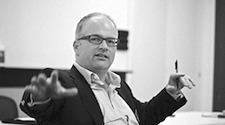
The anti-panellists were Kai Riemer, Matt Moore and Simon Terry. Thanks again to the DDRG for the opportunity to deliver the anti-panel.
Bridges go from one side to the other. They connect. Bridges don’t make value judgements about the shore.
In our passion for change it can be easy to dismiss the value of other ways of working. In so doing, we make it harder to bring change about. Before we can encourage people to new ways of working, we need to connect with where they are today.
Change Agents aren’t masters of elegant theory. They connect people to new practice. They help people take up the how. Change Agents are as much marketers, salespeople and evangelists as they are theorists. Effective change connects the new and old domains.
Build a bridge to a different opinion. Walk awhile on both shores. Your influence will be greater for it
Satirists rule debate now. John Stewart may have retired but satirists like John Oliver are hailed as a leading critiques of government inanity. The Onion and its peers struggle to describe things that aren’t actually happening. Political candidates & business leaders satirises themselves with their strict focus on ideology, message, image and popularity. Some of our greatest satirists are accidental ones.
The need for satire has also been fostered by the extent to which our institutions no longer engage with reality. Science is attacked. Data is scorned. Ideology rules. When a president needs to literally show his people melting glaciers, satire seems easier than persuasion. Satire is also a way to have the ‘in joke’ and bind a community against those who won’t change.
Satire has always been away to have the awkward conversation with power. The jester is often the voice of reason. Humour can lead us to see the hidden elements of culture and to discuss the elephants in the room. Those arguing for change need to use as much mockery as they use conflict. At least a good joke can keep a smile on people’s face and embarrass the corridors of power as we fight for change.
However, satire has its limits. Satire can expose but it rarely proposes. We need to combine our satirists with debate about new models and new approaches.
We can keep our satire. We need to help our institutions back to reality. We need to start conversations from facts. We need new hypotheses and we need to be able to test and learn our approaches. We need to engage conflicting views and move them. We should keep our snark and our smiles but let’s use them to foster change not move in comforting circles.
“By breaking the rules of the game, he has disrupted the game as such. He has exposed it as a mere game. He has shattered the world of appearances, the fundamental pillar of the system. He has upset the power structure by tearing apart what holds it together. He has demonstrated that living a lie is living a lie. He has broken through the exalted facade of the system and exposed the real, base foundations of power. He has said that the emperor is naked. And because the emperor is in fact naked, something extremely dangerous has happened: by his action, the greengrocer has addressed the world. He has enabled everyone to peer behind the curtain. He has shown everyone that it is possible to live within the truth. Living within the lie can constitute the system only if it is universal. The principle must embrace and permeate everything. There are no terms whatsoever on which it can co- exist with living within the truth, and therefore everyone who steps out of line denies it in principle and threatens it in its entirety.” – Vaclav Havel, The Power of the Powerless
What exactly is the power in your company’s hierarchy?
A Culture of Consent
Debates over structure, governance and power dominate management. We want to get the right balance between command and autonomy as if this is a formula that can be designed externally and imposed. The realities of power in organisations are simpler than we perceive.
An organisation is not a state. Despite their orders, minions, wealth and luxurious surrounds, senior managers are not rulers. There is no army, no police force and no jail. Shareholders are not voters to provide legitimacy to coercion. Security guards have limits on their ability to apply force and is rarely constructive. Coercive power is in organisations is rather like the Emperor’s New Clothes. Senior managers know this well because daily they experience the limits of their ability to order.
Organisations have one form of power – exclusion through exile or ostracism. Senior management have security guards to escort you from the building. Management can encourage others to turn on you. They can deprive you of this source of income and relationships in a community of peers, but have no other power. Look closely, they probably can’t even deprive you of resources, as these are usually under the day-to-day management of your peers. You already work around that issue daily as you make your organisation’s budgeting work.
All the power of the hierarchical leaders of organisations is given to them by the culture within the organisation. It is social influence, not power backed by force. Like the greengrocer in Vaclav Havel’s example above, you either live within that culture (and sustain its power) or you don’t (and become a dissident or rebel).
If the Emperor of Management has no clothes..
Change is closer than you think. Start to create new influence or question the sources and approaches of power and you are already leading change, potentially far more quickly than you realise.
Management are not a blocker outside the system preventing change. They are a part of the same system and equally aware of its issues. Encourage them to adapt management practice through conversations about influence, culture and the practices of power.
Network with like minded peers discuss and debate what needs to change. How should influence be structured in your organisation?
Culture is not a project just for the HR team. The consequences of the real cultural norms are far wider and far more important than a poster of values. Culture will shape what the organisation perceives and how it is able to respond.
Living in reality and being more human is harder than you think. First, you must separate reality from the views that you have chosen to believe. Second, you must continue to engage with the reality of the situation without the warm support of culture.
The future models of power in your organisation are a discussion for the community. Adopting elaborate models of autonomy and decision making without this discussion is swapping one naked emperor for another. If you adopting a new model, what is it about this model that makes it closer to the reality of influence in your organisation?
The ability to survive and restart reduces the threat of management power. That means a sense of personal purpose, savings of six to twelve months of living expenses, marketable capabilities and good external networks. Removing the danger from exile and strengthening purpose against ostracism frees the rebel to lead change.
“For the real question is whether the brighter future is really always so distant. What if it has been here for a long time already and only our own blindness and weakness and has prevented us from seeing it around and within us and prevented us from developing it?” – Vaclav Havel
We hold these truths to be self-evident: that all men are created equal; that they are endowed by their Creator with certain unalienable rights; that among these are life, liberty, and the pursuit of happiness – Thomas Jefferson
Caution is fine with large change. Taking care with change is important. However, not all change can be approached gradually. Major societal changes will be binary when they enable new human potential.
Softly Softly
The softly softly approach works until it doesn’t. Caution breaks down when change is at a scale that sits outside the normal gradual evolution because it dramatically enables human potential. These step changes have consequences beyond work for business, society and our lives. These social changes give rise to new actors, new behaviours, new approaches and new values.
Nobody will be perfect. Thomas Jefferson wrote those stirring words on an inalienable right to liberty while owning slaves. His plantation ran on the backs of slaves. The Founding fathers of the United States were aware of the conflict slavery represented. Confronted with conflicting values, they chose to move cautiously. To this day, it remains a mark on Jefferson’s otherwise extraordinary reputation
Take care standing against changes that enable increasing human potential in work and society. When these values change, we look back and think “what were they thinking?”. Arguments constructed in historical logic fail the new tests of humanity. The historical examples are many: slavery, racism, the emancipation and equality of women, child protection, factory working conditions, civil and political rights, indigenous affairs, etc.
Many of these changes are not yet fully resolved. Newer battles for human potential are playing out across the future of work and society as we decide what kind of future we want. Whenever we stand against enabling others’ potential or pursuit of happiness, we would be wise to consider the potential for rapid shifts in social values.
Take care with the big social changes in human potential. Once you stand on the wrong side of history, the future will not forgive.
The peculiar character of the problem of a rational economic order is determined precisely by the fact that the knowledge of the circumstances of which we must make use never exists in concentrated or integrated form but solely as the dispersed bits of incomplete and frequently contradictory knowledge which all the separate individuals possess. The economic problem of society is thus not merely a problem of how to allocate “given” resources—if “given” is taken to mean given to a single mind which deliberately solves the problem set by these “data.” It is rather a problem of how to secure the best use of resources known to any of the members of society, for ends whose relative importance only these individuals know. Or, to put it briefly, it is a problem of the utilization of knowledge which is not given to anyone in its totality. – Friedrich A Hayek “The Use of Knowledge in Society”
Yesterday I met with an organisation that wanted some of my help as they sought to solve a problem. The organisation was developing a new knowledge sharing system to enable is staff to be better informed about products and processes. There was one slight issue with this problem. The organisation already had multiple systems to enable its staff to be better informed about products and processes: intranets, social networks, training, help & support tools, automation, etc.
Problems Everywhere
As we asked why these other systems didn’t work it became clearer that the project team’s issue was that it was solving a problem for others, rather than with others. The explanations for needing a new system did’t stack up and suggested there was more that needed to be learned from the users:
‘Most of the learning is peer to peer. We need to give them better options’: Why do they prefer to learn from peers who might be inaccurate or unavailable? Why will they change this if you offer a new system?
‘They won’t use a collaboration system because they say they don’t have the time’ : if time is a question of priority, why isn’t it a priority? To what extent is the culture, leadership and performance management of the team driving this lack of priority? If they won’t collaborate why will they have the time to use something else? What is there time actually spent on? What do they do instead?
‘Those system don’t give them the answers they need so we are building a new one’: If the last system didn’t understand what was required, how do you? What does relevance look like to each user? What does relevance look like to their customers?
‘They want help with process X, but we are building something innovative for all processes’: Why do they want help with that process? What’s innovative about ignoring the demand?
The Answer is Everywhere
The answers to these questions are dispersed in a wide range of people beyond the project team. They draw in questions of culture, of practice, or rational and irrational behaviour by real human beings doing real work under the daily pressures of customers and a large organisation. There’s a lot of learning to do.
We have the tools to solve this dispersion and gather insights into what needs to be done in the practices of Big Learning:
we can actively collaborate with the users and other participants in the system to get under the pat answers and explore the deeper reasons and problems
we can use the practices of design thinking to better understand and shape employee behaviour & the systems involved in action
we can analyse data to understand in greater detail what is going on
we can experiment and iterate to ensure that proposed changes work the way that we expect
we can enable and empower the users to create changes to their work
we can accelerate the interactions and the cycles of learning to move faster to better solutions
These aren’t parallel techniques to be applied independently. The practices of Big Learning work best as an integrated system that draws together the insights from all of these approaches to help organisations learn and work. Big Learning enables organisation to work with and through its employees to deliver change. Change does not have to be done to them.
The reason organisations need to develop systems to facilitate Big Learning is elegantly described by Hayek in the conclusion to his essay “The Use of Knowledge in Society”. Hayek was critiquing the schools of economists who thought that centrally planned interventions designed by experts would be effective. The context may differ but organisations still use forms of central planning by experts to create change. These changes fall short for a fundamental reason – experts can’t know enough alone:
The practical problem, however, arises precisely because these facts are never so given to a single mind, and because, in consequence, it is necessary that in the solution of the problem knowledge should be used that is dispersed among many people
The practices of Big Learning help bring people together to share insights, learn and work as one.
The status quo isn’t predetermined. It is just where we go back when the conflict of change ends. The status quo doesn’t exist without the conflict of change and doesn’t end until the change succeeds.
The etymology of phrases can be an arid occupation but it can also deliver up the odd insight. The Latin phrase ‘In statu quo res errant ante bellum’ was the source of our phrase ‘status quo’. It means ‘in the state in which things were before the war’ and was used through history as a way of restoring the pre-existing order of things in treaties following conflict.
There’s two points of significance there:
you need conflict to have a status quo
you go back until you go forward
These days we often use the phrase status quo loosely as if it is somehow a pre-derermined state. It isn’t. The status quo is defined by the attempted change. The conflict of change creates “the way things were before”. That way is simply an aggregation of all the previous changes.
There’s no point worrying about why the status quo in the systems we are seeking to change resists change or why there may be conflict. The status quo is just a status. It doesn’t have any ideas, a say or any actions. Those belong to the people in the system. Once a change in the system is started by some of those people, that conflict continues until there is no return by everyone to the status quo.
Embrace the conflict as part of the change process, use it to learn how the change needs to be improved and recognise that conflct will be there until the changes become the “way things are”. The desire of change agents to bring about a better system will ensure that.
Change agents deprive the status quo of its power and status.
Diana Renner and I were discussing working out loud this week when Diana mentioned that she had an unpublished blog post in development that I recognised as the feeling of the ‘trembling finger’ when I am about to work out loud. This guest post is a result of that conversation. It is too good not to be widely shared.
–
The Dizziness of Freedom
“…creating, actualising one’s
possibilities, always involves negative as well as positive aspects. It always
involves destroying the status quo, destroying all patterns with oneself,
progressively destroying what one has clung to from childhood on, and creating
new and original forms and ways of living” Rollo May
It has been almost two years since I stepped
into the unknown and became an independent consultant. Looking back, it feels
less like a step and more like a leap. In a single gesture of defiance, I
traded security for freedom, leaving behind a relatively comfortable,
predictable role in a large organisation. I had never expected to end up
working on my own. But the promise of freedom was alluring. It still is. At the
same time freedom opens up possibilities that are terrifying.
In his book The Concept of Anxiety,
Danish philosopher Søren Kierkegaard explores
the immense feelings of dread that accompany that moment when we find ourselves
at a crossroads in life. The moment when the choice to do something hangs in
perfect balance with the choice to do nothing. Kierkegaard uses the example of
a man standing on the edge of a tall building or cliff, from where he can see
all the possibilities of life. As he looks over the edge, he experiences both a
fear of falling and at the same time a terrifying impulse to throw himself
intentionally off the edge.
Every edge I have stood on has provoked
feelings of dread and excitement. Whether going into a first meeting with a new
client, writing a few pages in my book, or facing a bored and unmotivated
group, I have struggled with what Kierkegaard calls our dizziness of freedom.
Just like Kierkegaard’s protagonist,
staring into the space below, I have contemplated many times whether to throw
myself off or to stay put.
However, what seemed risky and largely unknown
two years ago rapidly has become part of a familiar landscape. It would be
natural to relax and enjoy the view… Yet I have
learned that it is at this very point that I need to become more vigilant than
ever and exercise my freedom to choose in three key ways:
To rally against the safe but numbing comfort of the status
quo. I need to keep reminding myself that the
greatest learning is just outside of my comfort zone. I need to keep stretching
myself to keep growing.
To resist the strong
pull of the crowd. I have found perspective on the
margins, not looking to the outside for approval or acceptance, not following a
trend just because everyone else is following it.
To interrogate the
world’s criteria for what is good or successful. I am suspicious when I am being offered a formula to quick success
or many riches. It is powerful to be able to question mainstream expectations,
and carve my own path with courage and purpose.
The responsibility that comes with the freedom
to choose is terrifying. But the cost of not choosing is even more so.
We need to welcome this dizziness of
freedom as a sign that we are, in fact, just where we need to be. A sign
that we need to slow down and reflect on the risk, then step off the edge
anyway.
Diana Renner – Leadership consultant, facilitator, author of ‘Not Knowing – the art of turning uncertainty into opportunity’, Chartered Management Institute Book of the Year 2015, UK.
Changing structure is just rearranging deck chairs. You don’t need a new system. You don’t need a new process. More rules won’t fix what your current rules can’t fix. You don’t need more expertise because most of the potential you have goes wasted now. More data will mean more confusion not less. You won’t become more effective by being more efficient.
There are no transactional fixes. If you could flick a switch to create transformational change, everyone would.
There is no proxy for the hard work of change.
To create transformational change in the system that is your organisation you are going to need new conversations and new capabilities. At the start these conversations and capabilities will be uncommon and uncomfortable. You will need change agents to start the conversations, sustain debate and action and help others build the capabilities.
Your unique path to change will emerge guided at first by the few and eventually by the many. Find your change agents. Invest in their development and back their action.
When you need change, back the people who bring it about. Anything else is just a distraction.
PS: if you still think you need new structures, processes, systems, rules, expertise and data to change you will need change agents to be able to make use of them in your organisation