The Cold Dark Path

image

Two Competing Loops

This week at the first meeting of the League of Social Intrapreneurs in Melbourne I was introduced to the Berkana Institute two loops theory of change. The model of change in complex systems resonated immediately.

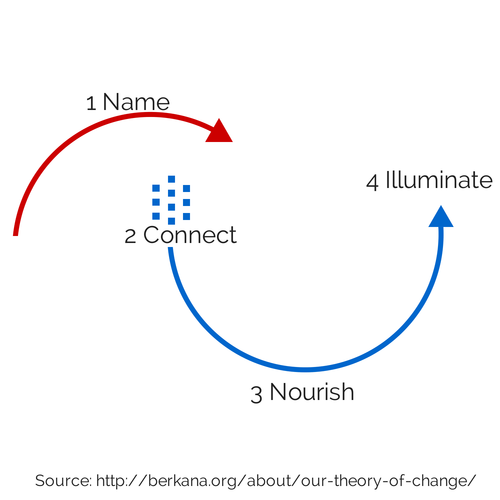
When a system nears its peak, change agents identify the need for alternatives and drop out.  They connect and begin to explore alternatives nourishing a new system through experimentation. Eventually the stories of their success illuminates the change to those who remain in the old declining system.

A four step model with four simple verbs seems clear and straightforward. Why is it that the path of change is such a cold dark path?

Nobody Warns You about the Dip

Stepping out of a warm and comfortable ongoing system with its present day rewards is a daunting uncertain choice however bleak the future of that system may look. Those with most to gain will oppose the agents of change who name the issues and start to work on alternatives. Opposition will not always be fair or balanced.

//platform.twitter.com/widgets.js

Most difficult of all is that dip in the diagram above. The uncertainty and the need to build a new complex future means the alternative system starts along way back and with a great deal more risk. Selling another path even to yourself can be a challenge in this scenario.

All the discussions about collaboration, requests for advice and stories shared among change agents at the League of Social Entrepreneurs, in Responsive Organisation, in Change Agents Worldwide or in other conversations that I have with unreasonable people belong at the bottom of the loop where people struggle nourishing new alternatives.

We must embrace the fact that the road to change is a road with dips and uncertainties. Proceeding any other way does not prepare people for the work ahead.

Nourishing Change Takes Hard Work

Most change fails after the connect stage.  Declaring a need for change is initially easy and exhilarating. Manifestos are thrilling. Connecting with other like minded people has a wonderful effect for the spirits and is a great way to reinforce the need for change.

Then nothing happens for a really long time. It grows cold and dark on the path of change.

Lots of drudgery dogs those walking the cold dark path of change. Meetings need to be organised and venues found. Compromises need to be negotiated between people who are 99% aligned. Factions and fragmentation occurs and saps the energy of everyone. More change agents need to be recruited, especially for the work. Experiments need to be agreed, funded and run. Failed experiments need to be cleaned up. New experiments agreed, funded and implemented. Success needs to be found. Someone needs to find money or work out the details of the new model. Communication materials don’t write themselves. Just when success seems inevitable the dying system finds a way to set you back.

Change falls apart when the connected agents of change won’t work the experiments long or hard enough to nourish the success of the new system. If they won’t invest the time to build new connections, share successes, to solve the daily issues and to innovate a path forward then the nourish stage will never offer an opportunity to others to join in the change.

If the organisers of the first meet up about a change end up with all the actions, then a change initiative has work to do to find others to nourish the change. Engaging others in the work matters more than engaging them in the idea of the change.

Join in the Work

Lots of people want to join change at the exhilarating beginning and again at the celebratory end. Traditional management focus only on the beginnings and the endings but leadership is found in realising the collective potential of the journey.

The question is who is willing to walk the cold dark road. Those change agents who do the leadership work of nourishing new experiments shape the future. That path is hard but the work is the most purposeful and rewarding

The Art of the Unreasonable

image

Every day I deal with unreasonable people. I wish there were more of them.

Unreasonable clients

The unreasonable people I meet are those executives, entrepreneurs and other change makers who are trying to change their organisations, to create new products or who are trying to make the world more human. These individuals don’t want to hear that it is hard, or that success is unlikely or that they are unlikely to see rewards.

These individuals are purposeful and all they want is help to bring their unreasonable visions into being. Willingness to persist is what ensures that they will succeed. They want to know they are not alone and that there are people to help them deliver their visions of the future.

Unreasonable partners

In addition to conversations with my clients and prospects, I am exposed to the unreasonableness of Change Agents Worldwide.  It is entirely unreasonable to believe that you could form an effective consulting and thought leadership network full of smart, highly capable and rightfully busy people without any traditional forms of central coordination.  However, Change Agents Worldwide delivers, constantly challenges itself to do better and the community is prepared to engage because the purpose of a better future of work is unreasonable, but necessary.

My respect for that group and others like it is huge because the network views spreading unreasonableness as part of the mission.  You only have to look at the extraordinary Executive Change Agents who are trying to make change in some of the largest corporations in the world, often solely on their personal authority.

If your organisation does not have people like these, why not? What are you doing to champion them, enable them or hire more?

Unreasonable inspiration

Unreasonableness inspires me. Do Lectures Australia was full of people willing to believe that they could deliver the extraordinary if they just started small and they started now. Social enterprises are another haven of the unreasonable as people seek to use the levers of business to address the challenges of the world. Social movements, like Change Day, inspire me, because they ask people to seek to make a difference and are led by unreasonable people, like Helen Bevan and Mary Freer. Artist are another inspiring source of an unreasonable view of the world.

What is inspiring you to be more unreasonable? What in your organisation shows others that more is possible, new thoughts are allowed and that more can be done?

Unreasonable change

We can’t change settled management practices without unreasonableness.  We can’t create more customer centred organisations within the bounds of what we define internally as acceptable or our accountabilities. We can’t make our organisations better for customers and society on the sensible practices of the past. If we want to be more responsive, we need to be a little unreasonableness.

If we want to lead, we need to be a little unreasonable in our expectations and actions.

There are more than enough forces in our world to encourage the normal, the static, the secure and the stable. Most people find it hard enough to win the support of their boss. Let’s foster the unreasonable.

Go find someone who wants to be unreasonable. Help them. Spread the contagion. That unreasonable purpose is the best engine of change.

//platform.twitter.com/widgets.js

Note: GBS = George Bernard Shaw. 

//platform.twitter.com/widgets.js

Management Practice Lags Culture

image

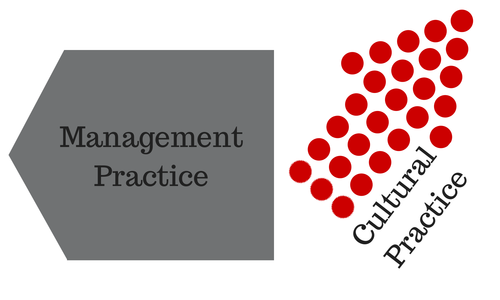
Management practice is influenced heavily by hierarchy, tradition and risk aversion. As a result our practice as managers lags the changes in culture in the society around us. Leaders need to work to close the gap between management practice and social expectations.

Management Practice is a Lagging Indicator

The way we manage our organisations is defined by practices that often trace back to the industrial era. The consequences of this are evident in many ways:

  • the diversity of our organisations does not reflect the diversity of our communities. Gender is just one diversity dimension in which management practices lag that the practices and views of society as a whole.
  • organising activity using networks and leveraging the potential of people to contribute is another way in which organisations are only beginning to address opportunities that communities, our personal relationships and the innovative organisations have already embraced
  • resistance to give up hierarchy, planning and demands for predictability and certainty when even the political structures based in these models have surrendered to approaches that operate far more adaptively and responsively.

Art is a Leading Indicator of Changing Society

Our cultural products adapt far more quickly to changes in society than our management practices.  Film, television, music and other forms of entertainment rapidly embrace changes in the way society operate and reflect that in the protagonists of the stories, songs and other art forms.

An example can be seen in the role of the detective in arts like novels, film and television.  In the birth of the industrial era, the detective was a logician, like Sherlock Holmes unravelling facts and relying on expertise in predictable processes, By the early 20th century the detective was a master of the human elements of relationships, like Simenon’s Maigret.  The uncertain times of the mid century introduced the detective in a much more ambiguous role. Richard Martin has documented how the changing nature of the detective film reflects our changing society.

Cultural products appeal to our need to be entertained, connect and engage with each other. Therefore they must be relevant to our society as it is today. Art is an experimental market where failure is common and success is usually defined only by audience acceptance. Someone is always seeking a better way to express the zeitgeist.

Why does management practice lag changes in the culture of society?

Management practice lacks these same pressures. Too much of our management practice is assumed to be canonical and confirmed only by inward looking assessment:

  • Focus on best practice: Best practice is historical and often particularly contextual. However, managers are often reluctant to move beyond accepted best practice.  As Harold Jarche has argued we should look instead to practice to be best and look to be more social leaders.
  • Risk Aversion: Avoidance of failure is a core tenet of management practice. Managers stick with practices that have worked safely for them, often in face of evidence that newer practice is better. Safety is valued.  There are real costs to this risk aversion.
  • Hierarchical & Internal: Managers who are more hierarchically senior set the bounds of acceptable management practice and control the HR processes that reinforce acceptable practice. Without an external & learning mindset, these leaders can inadvertently reflect management views and mindsets of a previous generation that were handed down to them during their early career.

Change

Responsive Organisations will have a culture and a set of management practices that reflect the needs of our society now. These organisations will experiment, test and measure the effectiveness of their practices in the marketplace and in their organisation. They will not rely on canon, hierarchy or accepted opinion.

The benefits of organisations using management practices that better reflect the changing culture of our communities are clear. These organisations will be more human and better able to realise the potential of all people.

Bringing this change about is the work of leaders and change agents. 

Shapes, Guides, Decides: on Structure

In leadership we are starting to see the need to pull apart our obsession with jobs. We are realising that what matters more than a job is the roles that leaders play and their authority to play them.

A similar need exists in the structures we form from those jobs. In organisational design, we have a tendency to focus overly on structure as if it is the determinant of how the organisation functions.
The structure of an organisation is important. However, we know that all structures perform in different ways because of the networks of relationships that weave through them and the resulting culture that is created.
A focus on structure can be of little value to a manager looking to respond practically to the challenges of a networked economy. That manager often well knows that while changing structure can require as little as a new powerpoint slide, but the way things get done changes far less frequently and with a great deal more difficulty
Why?
  • Structure: A collection of status relationships between individuals. Shapes
  • Decision Process: The commonly accepted series of stages by which decisions are made in the organisation, including what information is expected, who is aware, who participates and who is consulted. Guides
  • Decision Rights: Who & how the final call gets made on any decision. Decides 

Structure influences decision processes and decision rights. However structure does not determine them and at times can work at cross purposes to the intended goals of the organisation. You can have a hierarchy where decision rights are delegated and there is a high level of autonomy. You can have a network that is paralysed by an insistence on consensus before anyone acts on a decision. 

The process used for decisions and what exercise of decision rights are accepted in an organisation is a function of the network of relationships more than the structure. Control by structure is often an illusion.

We need to spend less time focused on our structures and spend more time on how our relationships work and how we make choices.

Why Work Must Be Human

The future of work must be more human. As we move deeper into a networked knowledge economy we can already see the fractures of the traditional industrial management model.  

Taylorist scientific management that underpins much of traditional management can be so abstract in its consideration of the human role in work that it can border on a psychopathic level of detachment. There are many examples where the parallels between sociopathy and management have been drawn. Some even go far enough as to recommend it.

How to become a corporate sociopath:

  • Lose empathy: refer only to customers and employees as acronyms, abstractions and averages (see FTE, Engagement score, Customer Satisfaction, Average handle-time, NPS, etc)
  • Lose ethics: Compromise your values to maintain your power & your position first in small decisions and then in decisions with larger influence over time (see Management, Hierarchy, Goal-orientation) 
  • Culture: Surround yourself with a culture that glorifies anti-social behaviour and down plays human elements (see Results-focus, Hard management skills, Efficiency, League ladder, Bell-curve, etc)
  • Lose Reality: Learn to withhold information then to spin information to further your agenda. Slowly begin to believe your own spin and create an internal world that shapes your perception and decision making (see Personal Branding, Managing Up, Stakeholder relations, PR, Marketing, Excel model, Corporate Politics, etc)
  • Isolation: Isolate yourself from friends & community and develop an echo chamber for your own views (see Silos, Work/Life Balance, Corporate retreat, Business Networking, Travel, Staff, Yes Men, etc)
  • Paranoia: Develop a healthy sense of paranoia to survive (see Competitive marketplace, Corporate ladder, etc)
  • Be Bold: Start to judge leadership, power and status on absence of fear, willingness to tackle large scale and boldness of action. (see Go Big or Go Home, Burning Platform, BHAG, Too Big to Fail, Bet the business, etc)
  • Narrow Goals: Sacrifice discussion of the diversity of potential goals to chose a single abstract financial measure of success (see EPS, ROI, Make Plan, etc)
  • Power: Begin to see all living things as commodities subject to your power. (see Human Resources, Processes, Policies, Inputs and Outputs, Capital and Labour, GDP, etc)

All in a normal day in many offices…

Making Work More Human

Not all organisations suffer from sociopathy. They balance the inhuman thread in management with other considerations to retain a focus on realising the broadest of social and human outcomes.

Breaking the bubble of sociopathy in dysfunctional organisations takes effort. The steps are not that hard to practice:

  • Listen: Start to listen to the real human voices. Help others to speak and tell their stories. Help others to share their potential and contribute to a better organisation.
  • Engage: Find out other people’s goals. Help them to realise their goals and their potential. Invest time in working for others and understanding their needs more deeply.
  • Immerse: Spend time in the actual environment where work occurs talking to the people doing the work and the customers and community benefiting from the work. See the context and consequences of actions.
  • Reframe: Change the scale of decision making. Look at individual impacts as part of the process. Use names of actual people. Ask ‘what could we do to create more value?’ Ask ‘Is there another way to move forward without these impacts?’
  • Design: Recognise that policies, processes and products are built by and used by real people. Design to their needs and with their involvement.
  • Collaborate: Share your plans with others and allow them input. Let others help shape and improve your work.  Be transparent as to the strengths and weaknesses in this process.
  • Experiment: Test potential decisions. Make room to learn.
  • Lead: Encourage. Enable. Inspire. Don’t impose or impact.

Making work more human does not require us to abandon capitalism, to remove our results focus or be less ambitious. It may make work more challenging but it will also increase our sense of purpose and reward. 

Every employee in an organisation can ask for one or more of these steps to be added to a decision making process. One such request may be novel but it is rarely seen as a challenge to the authority of traditional management approaches. Introducing these techniques acts as a catalyst of change. The impact is to help make work more human. We are all the beneficiary of that action.

SCNOW Webinar Series from Socialcast and Change Agents Worldwide

Change Agents Worldwide and Socialcast have now completed four great webinars on the future of work, enterprise social networking and collaboration:

Recordings of these webinars are available at the Socialcast webinar centre.

How to Make New Sense

The Tools of New Sense

Every man is made a fool through his own wisdom – Erasmus

Humour plays with our ability to make meaning from our circumstances. The best humour involves a deliberate misdirection of meaning before dropping us into a new insight with the punchline.

The tools of humour are the same tools as leaders, change agents and entrepreneurs need to use to find and share new meaning.  At the heart of how we make and share meaning are three key tools of our sense-making:

  • Context: how we frame our understanding and what we choose to include in our thinking
  • Categories: how we group and relate ideas
  • Narratives: the inner and external stories we tell to guide our lives

Change the Context, Categories and Narrative

When I hear any man talk of an unalterable law, the only effect it produces upon me is to convince me that he is an unalterable fool – Sydney Smith

An adept fool, as a master of humour, can play with each of these tools.  Humour makes us fools through what we know. Great fools leveraging our settled patterns to send us in the wrong direction before showing their ability to make us laugh as we are switched away to another insight.

Change leaders need to both understand and change their own contexts, categories and narratives. This activity is at the heart of finding new insights to drive their changes and actions.

Critically, change leaders need to be able to share these new insights which requires the ability to help others to hear new narratives, shift categories and change their frames.  This is the work leaders need to do to drive change in meaning. 

Next time you need to drive change consider:

  • How can you change the context in which the new behaviours are seen and occur?
  • How can you help others make different choices to categorise the new behaviours?
  • What new story can you tell?

Leaders Create New Meaning

Fools & Leaders Question Meaning

Life is far too important a thing ever to talk seriously about. Oscar Wilde

When it comes to serious challenges in life, Oscar Wilde & Neil Gaiman have a point. A key advantages of humour is that it allows for the lightheartedness and irreverence that lets us reconsider our understanding of our circumstances. The fool in a medieval court was the one who could speak new truths because he could play with meaning and context.  

Great insights and opportunities for change come when people rethink the meaning of their circumstances and their actions. 

Philosophical issues like meaning and sense are not popular topics in the halls of business. Ask a manager to unlearn some common practice and you will get a blank stare. Often those who start conversations that question the sense of commonly accepted practices and beliefs are quickly categorised as fools.

Managers find it hard enough to embrace the time for reflection in the midst of the pressures for constant action. However, we need leaders to go further and find new meaning to realise the value for their businesses and the potential of the future of work. Creating change and new value depends on the ability to make new sense out of circumstances and opportunities and translate that new sense to new behaviours.

New Thinking Needed

Research is to see what everybody else has seen, and to think what nobody else has thought. – Albert Szent-Gyorgyi

Spend time with the creative, the innovators, the entrepreneurs and the change agents and you discover that they specialise in looking beyond typical thinking. Making new sense of their circumstances and translating that to new action is a speciality of those who create change. The inspirations from a new sense of possibility is where they find the opportunities to act in new ways and to break through the perceived limits and institutions that have constrained others.

In some cases, this new meaning is a denial of constraints. Roberto Unger described what he called ‘negative capability’ as ‘denial of whatever in our contexts delivers us over to a fixed scheme of division and hierarchy and to an enforced choice between routine and rebellion’. Many entrepreneurs and change agents refuse to accept the currently accepted options presented for a problem or practice.

Finding another creative way beyond the frustratingly constrained choice between insider (who is constrained, muzzled & influential) and outsider (allowed to be unconstrained, confrontational & excluded) is critical if we are to see greater change. What matters in many organisations is not the loudness of the talk, what matters is meaning and action.

In his book Opposable Mind, Roger L Martin described one positive capability to break the accepted meaning as integrative thinking, a capacity to take a wider view of the systems and outcomes and find new paths forward. We need to ensure that the creation of new sense is a valid management activity if we are to leverage its creative potential in the future of our work and our organisations.

Lead Sense-Making

A pile of rocks ceases to be a rock pile when somebody contemplates it with the idea of a cathedral in mind.- Antoine Saint-Exupery

As managers adapt to a rapidly changing world, they are going to need to accept new uncertainties. We will need to help build the capability to still manage.

The best way for managers to deal with the rapidly changing circumstances we find in the new networked economy is for them to lead the process of making new sense of why organisations exist, the value that they can create and how. The future of work is the future of leadership and human potential.

This change in leadership will require managers to break with the comfort of current approaches to the understanding of their organisation and roles. Incrementalism which is by definition grounded in current meaning will not deliver transformative changes. Managers will need to explore new meaning, experiment with its application and convey that meaning to others through stories and action.

Sense-making is a critical foundation for a responsive culture. We already see sense-making as a characteristic of success in the use of new forms of collaboration. Sense-making is also a critical component of personal knowledge management in an era with an abundance of information and stimulation. Instead of a once-and-done exercise in understanding leaders will need to embrace a continuous learning and sense-making to find new and better opportunities for change.  This ongoing process will need to be a part of people’s work widely across the processes and interactions in the Responsive Organisation.

People make new sense of themselves, their roles and their position in the world as they choose to adopt new behaviours and create new value. We need to explicitly design our processes and roles to allow for sense-making. Only through leadership of this work will we find the new ways to change the culture & practices of our organisations

Revolution doesn’t happen when society adopts new technologies – it happens when society adopts new behaviors – Clay Shirty