Sometimes the honest approach is to agree to pretend for a little while.
Category: Uncategorized
Virality isn’t a function of content. It’s a function of the network in which the content is placed.
I just want to make sure that we’re all clear on this. (via kenyatta)
People share. Networks are networks of people.
No magic. Just a community of people sharing.
The Honest Dialogue of Leadership

For forty years you heard from my predecessors on this day different variations on the same theme: how our country was flourishing, how many million tons of steel we produced, how happy we all were, how we trusted our government, and what bright perspectives were unfolding in front of us.
I assume you did not propose me for this office so that I, too, would lie to you. – Vaclav Havel, New Year’s Address to the Nation, 1 January 1990,
The pressure to share good news and to conform within organisations can resemble that within a tyranny. Senior management in organisations is often under intense pressure to maintain a good news to customers, to shareholders and to the community. Without genuine dialogue, discussion of the present and the future in organisations can resemble a hallucination. It is not unusual that everyone knows the corporate line is spin and discusses their frustrations in private.
Vaclav Havel’s first address as President of Czechoslovakia after the Velvet Revolution is a reminder of the role each individual must play to engage with reality and to protect our humanity. Everyone can play a role to create the conversations that bring forward an honest dialogue. That will take a willingness to act to make change from everyone in an organisation.
Pretence Corrodes Reality & Humanity
The worst thing is that we live in a contaminated moral environment. We fell morally ill because we became used to saying something different from what we thought. We learned not to believe in anything, to ignore one another, to care only about ourselves.
Pretence is the expression of a view without regard to its reality. Pretence is what happens when you telling your boss, a customer or a shareholder what they want to hear. Pretence leads inevitably to a messy situation when you do that is you get stuck answering a question or defending a position. The next step is an out and out lie to maintain consistency or preserve what remains of your dignity. After life rarely rewards those who share the bad news late.
Go too far down this path and organisations begin to lose their perspective on the creative potential of humanity. Almost everything is sacrificed to maintain the illusion:
The previous regime – armed with its arrogant and intolerant ideology – reduced man to a force of production, and nature to a tool of production.
We Must All Lead Conversations Grounded in Reality
In other words, we are all – though naturally to differing extents – responsible for the operation of the totalitarian machinery. None of us is just its victim. We are all also its co-creators.
It takes two people to not engage in a conversation that should be had.
Senior leaders play a role in setting realistic direction and fostering a culture that faces reality. They use power and can leverage rewards to influence the behaviours of others to be constructive or destructive.
However, culture is an expectation as to patterns of interactions. Employees in any role can play a part to raise the facts that demand attention and to begin to change the patterns of interactions in the organisation. Authentic and public dialogue in public is highly viral and highly influential.
Cultures that cannot face the truth and seek to control individuals to prevent the shattering of the carefully constructed illusions are unhealthy and surrender the opportunity to leverage the exponential potential of human collaboration. We must all reserve ourselves the right to be a little unreasonable in defence of reality and our humanity.
On the contrary, we have to accept this legacy as a sin we committed against ourselves. If we accept it as such, we will understand that it is up to us all, and up to us alone to do something about it.
We all can benefit from regular reflection on the lessons from Havel’s speech for leadership in our organisations.
Photo Source: http://commons.wikimedia.org/wiki/File:Václav_Havel.jpg
Don’t Put Your Hand Up
You know the gesture. Put your hand up in the air and wait to be called.
Keep your hand down. Don’t do it again. Even the version where only you know that your hand is raised. Nobody knows you are waiting eagerly to be called to contribute.
We learned the gesture in childhood. At school, it was the way we asked permission to speak and permission to act. It became the way we interrupted the decision making adults.
We might no longer put our hand up. However the expectation remains that we must wait for permission to speak and permission to act. We wait for the decision making adults.
A parent-child relationship belongs in a family. It doesn’t belong in the workplace or in our social relationships.
Don’t wait for others to give you permission to say what needs to be said or to do what needs to be done. We are the adults now. The decisions are ours.
Keep your hand down and act.
Lead Human Complexity.
The more any quantitative social indicator (or even some qualitative indicator) is used for social decision-making, the more subject it will be to corruption pressures and the more apt it will be to distort and corrupt the social processes it is intended to monitor – Campbell’s Law
Traditional management often seeks to reduce complex human behaviour to a single measure to manage. This approach works well for unthinking machines but it struggles with the complexity of human ability to shape behaviour on expectations.
People aren’t Widgets
Economists have been looking at the impact of human expectations on policy decisions for centuries. However, too little of this thinking has made it into industrial models of management thinking.
Traditional industrial models of management treat human beings on the same basis as other elements of machinery in the manufacturing process. This approach does not allow for the difference between a machine and a human’s ability to alter performance based on their own expectations and as result of interactions with others. The creative potential of collective human intelligence quickly outstrips this approach.
John Maynard Keynes highlighted in 1936 how expectations can make even the simplest choices quite complex when interactions of other human actors are involved. His simple example of a prize for nominating the best looking six faces in a beauty contest:
It is not a case of choosing those [faces] that, to the best of one’s judgment, are really the prettiest, nor even those that average opinion genuinely thinks the prettiest. We have reached the third degree where we devote our intelligences to anticipating what average opinion expects the average opinion to be. And there are some, I believe, who practice the fourth, fifth and higher degrees.
The impact of expectations is found in many work activities. The expectations of peers can increase or decrease performance. Expected rewards shape behaviour, whether they are financial, status or emotional. Many highly skewed incentive schemes fail to achieve expected performance change because humans form a view of the likelihood or value of the returns for effort on offer. In some cases, a combination of human creativity, expectations and collaboration between employees & others will even produce totally unintended results.
Human expectations of the future change the behaviour of people now. The accuracy of expectations does not matter. A critical role for leaders is to be a part of the conversations that are shaping the ongoing expectations in a team. Designing an incentive scheme and tracking the measures is not enough.
Networks Accelerate the Making and Sharing of Expectations
In our increasingly networked world, it is much less likely that any individual in an organisation will behave like a machine that has no choice but to optimise performance. The networks inside and outside the organisation will create new expectations and accountabilities on individuals in the organisation. Expectations are just one part of the collective sense-making that will go on as people work to create value. No individual or organisation is an island any more.
Leaders need to prepare to engage with this increasing complexity and to join the conversations to shape the expectations that will drive human behaviour. Creating a collective vision, building trust, realising human potential and fostering collaboration can all contribute positively to the expectations of individuals in a network.
If you leave the conversation to the network, you are losing your influence as a leader. You are also surrendering the potential for better performance.
The Creative Conflict of the Eclectic

“Chief among our gains must be reckoned this possibility of choice, the recognition of many possible ways of life, where other civilizations give a satisfactory outlet to only one temperamental type, be he mystic or soldier, businessman or artist, a civilization in which there are many standards offers a possibility of satisfactory adjustment to individuals of many different temperamental types, of diverse gifts, and varying interests.” – Margaret Mead
The Creative Conflict of the Eclectic
As a singer, writer, actor and more Nick Cave is a prolific and creative artist. Part of his creative potential flows from his long list of influences, if this partial list is anything to go by. The creative power of an eclectic list of influences from a variety of fields, genres and schools of thought is that it offers us the contrast & conflicts that enable us to push our work beyond its normal range. The ability to span a wider range of influences and to embrace ongoing conflict of schools of thought is an important part of why culture moves forward when management often sits still.
A wide range of inspirations & inputs offers us views that shatter our hallucinations and draw in the perspectives of the wider communities around us. Ideas profit by the testing of conflicting view points and the demands of additional stakeholders.
As Margaret Mead suggests in the quote above, we need diverse roles and viewpoints to be able to realise the creative potential of all people. We need diverse sources of conflict to see the world as it is. Averages & standards constrain us. We need to leverage the creative potential of all human capabilities. In our organisations and our approaches to personal knowledge mastery, we need to resist the temptation to associate with similar people and to be drawn to the bubble of our own reflected opinions. We need to engineer difference of views and the conflict that flows from it.
The leadership task is not alignment without conflict. The work of leadership is alignment before, during and after conflict. In a world of continuous change, the conflict is inevitable. We must choose to embrace it.
But Conflict Must Change Work
Conflict and debate can be captivating. Generating new ideas and thoughts is often an extraordinarily exhilarating process. Creativity is itself an occupation for many.
Most organisations need more than creativity. They need change that can create new value. The delivery of better value in its widest sense is what matters. That takes new and better ways of working.
Let the conflicts and the inspiration catch you in the process of making a little change. At that moment, there is a far better chance of inspiring some new form of value.
Inspiration exists but it has to find us working – Pablo Picasso
Are You Leading for the Quarter or the Future?
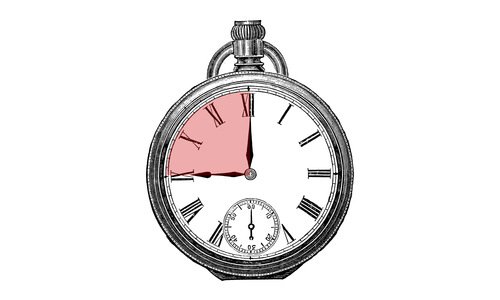
No rational person would jeopardise their future to meet an arbitrary 90 day milestone. Too many corporate incentives are structured exactly this way.
There are many eloquent complaints about the danger of the short term focus of corporations, especially publicly listed ones. My concern is that this short term focus stands in the way of more human and more responsive organisations. This short term focus divides accountability.
Time is short
One force driving the pathology of traditional management approaches is short time frames & arbitrary division of time. Results are fragmented down to hourly, daily, weekly, monthly and quarterly targets. We engage in the division of time as much as we divide work.
Incentives and management processes are tied to these short term results. Dividing time in this way values values the present quarter or time period to the exclusion of almost all else. As a consequence the arbitrariness of the short time frame becomes an invitation to treat the entire process as a game and to push the future far from consideration.
Getting the number
When a decision is made with the sole objective of delivering a number, we enter a realm of dangerous ethics and considerable risk to the future. Purpose, customer relationships, employee engagement and community reputation are immediately in jeopardy, as everyone focuses to deliver the certainty of the financial outcome required.
The pressure of a short time frame immediately eliminates activities:
- that may require upfront investment, time or effort
- that may involve uncertain returns like experimentation, new product development, enabling customers, employees or other stakeholders, etc
- that involve thought, analysis, research, input or consultation
- that deliver large benefits beyond the time period
- that have any form of initial dip in performance
This remaining options usually come down to one or more of the following:
- bringing forward returns, usually at a significant discount
- grabbing more value in the relationship with another stakeholder without regard to longer term consequences in the relationship (for example by raising prices without regard to impacts on loyalty or market position, demanding rebates from suppliers, etc)
- arbitrary cost cutting, especially employees or ‘discretionary expenses’ like marketing, training, maintenance, support, etc where effects are not immediate
- accounting treatments, particularly relating to the recognition or allocation of revenue or costs and the valuation or recognition of assets and liabilities
- outright fraud and deception
Waste
Some of these changes may cut waste or realise value, largely by accident. In many cases, the organisation responds to the changes with innovations that ameliorate the longer term impact or at a minimum defer them for another quarter. Pressure can inspire creativity and efficiency. The negative future effects and ongoing pressure can also generate a treadmill of even greater pressure.
We must be clear that this activity is waste. Playing the numbers game is wasteful effort. It risks the future and compromises the core value creating relationships in the business. The demands of the ‘numbers game’ work to unravel any efforts to become a more responsive organisation. The ask to meet numbers always pushes for planned outcomes, maximum control and a lack of transparency in decision making.
No Division of Accountability
Accountability for outcomes is core to the future of any organisation. Ending number games does not mean an end to accountability. It means greater accountability.
- Let’s be accountable to make every decisions in line with purpose and values.
- Let’s ensure all employees are accountable to deliver now, for a better future and to realise people’s potential.
- Let’s ensure that the accountability is an accountability to all stakeholders.
- Let’s also work to deliver each day in a realistic manner to our long term goals, not just scrabble to manage an arbitrary day that we choose to report.
We need to end the division of accountability.
A Little Bit of Rebel
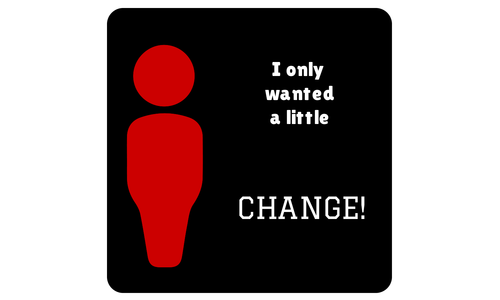
Most rebels start small.
At the end of Richard Martin’s wonderful discussion of the power of rebel within organisations there is a reference to starting small. It reminded me that ‘from little things, big things grow’
Many change agents start out in a small and quite compliant way. They only want to make a little change for the better. They see something that needs fixing and try to fix it. These rebels start out making change for the system. They want to make the system work just a little better.
Systems don’t like little changes. Systems push back. Small fixes are crushed.
At this point, many people seeking change stop discouraged. The rebels go on. Rebels move from a small change to making bigger changes to the system. They start to see that their small problem is a symptom and that changing the system is part of the solution. Now they want to make changes to the system.
Systems don’t like changing. Systems push back. Big changes are opposed.
Many first-time rebels stop at this point. They don’t like the ostracism, the opposition and the risk. Only the dedicated rebels go on. Now the rebels want to fundamentally change the way that the systems in the organisation handles change. They want their organisations to have a better culture, to be more responsive, to be more human and to pursue bigger and more important purposes than purely financial return. These rebels are working for a change of system.
Systems don’t like change. Systems push back. Transformative change is fought.
The few remaining rebels just keep aiming bigger. Now they step outside the system and connect with others from other systems trying to make similar change. They start to work across organisations, industries and society to learn how to be more effective and more influential in creating responsive and human organisations.
These rebels are changing the world.

How do you help your rare and precious rebels grow faster?
- Do you have a culture of continuous improvement based on external performance measures that helps your people start the journey of change?
- Do you have the room for experimentation to try new approaches?
- Do you have a culture that fosters challenge to the big systems and processes and that supports and rewards the rebels?
- Do you take time to discuss the culture and systems that lie behind the symptomatic problems that you face repeatedly?
- How do you connect and engage your rebels, internally and externally, to help them stay the distance in the face of opposition?
A Tasting Plate
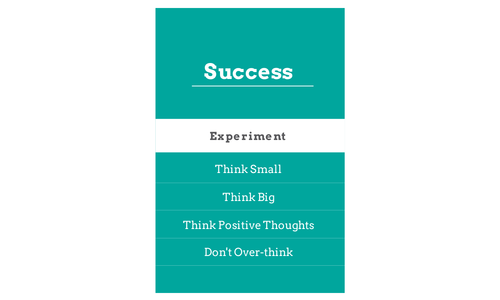
Self-help books are full of the best practices of other people’s lives. We are each unique. Treat the example of others as less of a recipe and more of a tasting plate.
No Recipe
The world is full of advice on how to get the most out of life. Usually that advice is distilled from the example of other’s successes. However best practices are often highly contextual.
Each person has a different circumstances: temperament, upbringing, capabilities, commitments, relationships, goals and purposes. What works for one person as effective practice rarely works for everyone. This is one reason why self-help advice is often so maddeningly contradictory. There is no universal recipe for success. We would even struggle to agree what that means.
Tasting Plate
Treat best practices as a tasting plate. Try out those practices that appeal to you. Experiment to see what works. Do more of what works. Add your own twists. Recognise circumstances change. You may need new experiments from time to time.
Importantly, as a leader, recognise that your practices are not universal. Allow people the opportunity to experiment with working in the way that works best for them. That is the path to make the most of their potential.

To be revisited regularly as hygiene for the soul: How to Find Fulfilling Work
Great advice to pursue the excellence in challenges before you and to grow into purpose.