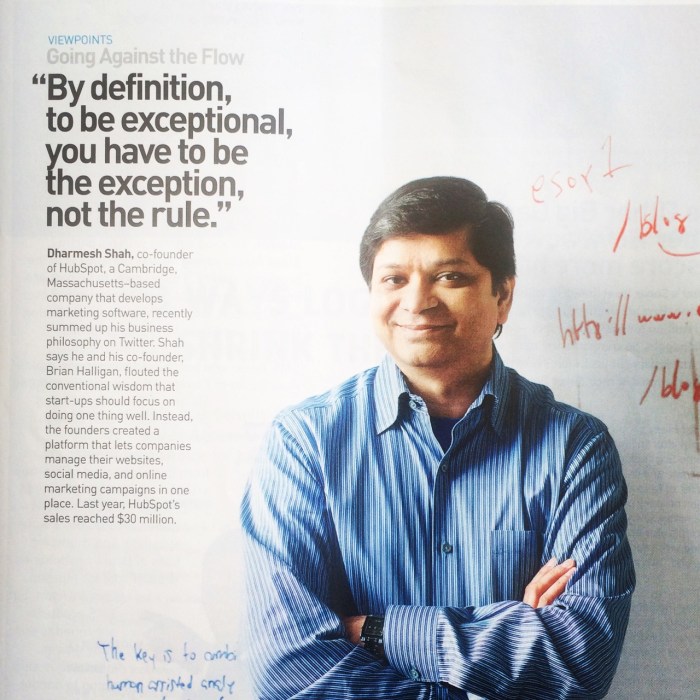
By definition to be exceptional, you have to be the exception, not the rule – Dharmesh Shah in Inc Magazine

Traditional organisations push people to fit in, to fit boxes and processes. The future of work organisations push people to realise their human potential.

Boxes and processes can be automated, copied and commoditised. Unique value is in the grey space of exceptions, obstacles and other human forms of mess. Insights, innovations and incremental value aren’t mechanistic process outcomes. They are human flashes of brightness in the grey.

Those flashes take work and new capabilities. Find the exceptions and exploit them. Push yourself to work into these grey spaces around your role, your customers and your organisation. Be led by purpose. Leverage your potential and the potential of others. Learn and build systems to learn together. Purpose, practice and mastery of working in the grey spaces are underpinnings of the new work.

Micromanagement & Autonomy

One consequence of better communication is little discussed. Better communication has enabled the school of management that micromanages employees. We would do better to use our communication technologies to enable our employees to realise their potential.

Management in the Dark

We are starting to forget what the world was like before pervasive communication. Read about the beginnings of our modern organisations in the 19th century and you are always surprised to consider the barriers communication presented. 

The flipside of the barriers to communication also meant that managers had autonomy. Before the railroad and the telegraph, you didn’t need to be very far away at all to be required to manage your branch, factory or location with complete autonomy. All the decisions required to run a business like hiring, sourcing, pricing, distribution, financing and distributing profits, were managed by local managers. There were no alternatives. There was simply no way to seek guidance in time for most of the decisions required to succeed in the market. The need to trust a manager in these circumstances meant that many corporations relied on family members, trusted associates or had real limits to their scale.

Global Micromanagement

Enhanced communication technology has enabled organisations to manage their business on a global scale. The two-way flow of information has enabled trust to develop in the use of cadres of independent managers. It has also allowed those with less trust in their managers to micromanage on a scale that has never before been possible.

Look at the marketing materials for big data and HR analytics offerings. Many of these solutions are promoted as ways to know more about your business and the actions of your employees than ever before. The ‘golden goose’ school of management then dictates that you tightly manage your employees leveraging the rivers of data, the ability to adjust process controls and to communicate in real time. These communications are increasingly mechanistic and some even claiming value in automating them. Increased efficiency of your employees is the goal. However, that efficiency represents a massive trade-off in effectiveness of employees and the organisation.

Better Understanding, Alignment and Trust

Once again organisations are facing the need to drive autonomy of employees. Because of the pace of our economies driven by modern communication technology, we have arrived again at a point where autonomy is required. In the past, communication was too slow to meet a competitive local market. Now communication in the competitive global market is too fast. Employees can’t anymore wait for advice from head-office or be constrained by a policy that no longer refects circumstances.

We need to recognise that the alternate opportunity of better communication is better understanding, better trust and better alignment. With better connection, we can enable people to achieve exponentially better performance because we have the foundations of trust. If we chose a human approach over a mechanistic one, we can leverage the many human talents of our people. That diversity has far greater value than relying on only the decisions of an all-powerful all-seeing management team.

Global communication technologies have made learning the competitive advantage in the modern organisations. Now that they also allow a massive scale increase in understanding and trust, why wouldn’t we want to involve all our people in leveraging their insights, talents and knowledge?

The future of work is not better micromanagement. The future of work is how we better realising human potential. That will take trust and human connection.
The algorithm for trust is human #futureofwork

We don’t need more algorithms to help us manage trust. The human brain is a finely tuned trust algorithm. Let’s focus on building trust, not proxies for trust.

The proxy for trust

Global connection and scale are routinely proposed as a rationale for new services to help us manage trust. Inspired by the success of rating systems in EBay, Uber and similar services, entrepreneurs continually propose new universal solutions to help manage trust.

Humans are actually very good in managing trust. Our built-in systems for assessing trustworthiness are pretty good. We can assess the trust worthiness of a person in their available social data pretty quickly. We can adapt that assessment in real time based on the actions of others. We use this trust assessment to determine our decisions.

The human trust algorithm isn’t perfect. Psychology, economics, manipulators, and criminals all can describe the flaws, but they are far more subtle and accurate than any five point scale. We don’t need a rating to discount an email from a Nigerian prince we’ve never met.

Rating systems are only a proxy.

The value of the ratings in EBay, Uber and other systems is that they act as a proxy for trust in otherwise low information frictionless systems. They don’t prevent issues, but they reduce recurrence because there are penalties within that system.

Rating systems that aren’t tied to a process or system are popularity contests and distorted by the best and worst of human social behaviour like social proof, bandwagon effects, abuse, etc. They don’t relate to human experiences of trustworthiness through interactions. The failure of Linkedin’s endorsements feature is an example of how ratings without consequences produce junk.

Even if an entrepreneur develops an elaborate effective trust system, few humans will cede their decision making to that rating. The trust rating will just be one proxy in a human decision using the human algorithm. Anyone who ceded their decisions to an algorithm would be exposed to exploitation by a simple hack of that algorithm.

Stop rating. Start Building Trust.

Trust is critical to the pace and effectiveness of modern commerce and organisations. However few organisations focus explicitly on how to build deeper trust within and outside their organisations. Let’s focus our investment there and not on 5 point systems. That investment will take human actions, interactions and decisions. This is one critical way we can help make the future of work more human.

Anti panel 3.0: the personal urgency to act #disruptsyd

We have choices in the future we want. To ensure a better future, we need to create it. We can begin now together.

Our annual experiment in disrupting the conference panel format occurred again at the Disrupt Sydney conference last Friday. The anti panel followed an extraordinary morning of inspiring speakers and provocative discussion of the impacts of disruption for good and for evil.

The anti-panel was reinvented again for its third appearance at Disrupt Sydney. This year the panellists set the teams in the room three activities on the theme of disrupting Sydney as a place, community and City:

– create a collage of your inspirations from the morning for the future of Sydney
– develop a newspaper headline on a vision of Sydney in 2050
– build a model in Lego of an intervention to move Sydney to a positive future.

The power of an anti-panel is to leverage the ideas, insights and interactions of the whole room. Using exercises individually and in groups enables people to work in parallel. Challenging people to communicate in other ways and to be hands on changes the nature of ideas. We had an incredibly broad ranging discussion driven by the creative potential in the room.

We experienced a different panel to previous years. The interaction between participants was far greater. The depth of discussion was less due to the physical challenges to be met but the breadth of ideas increased. The panellists learned from the energy in the room that we had one design flaw. The newspaper exercise was too narrow a constraint for the middle of a Friday afternoon. Luckily, we adapted timings to shorten that exercise and moved on to a coffee break and Lego to restore momentum.

The themes of the debrief were clear:
– people enjoyed the opportunity to interact through shared creative tasks
– we need time to reflect and to create new ideas and approaches
– ideas flowed from doing
– one person’s utopia is another’s dystopia
– the power of storytelling and metaphors
– whether we were pessimists or optimists, it was clear we could not sit passively with the range of change, opportunities and threats. The future needs to be created.

That final insight was a wonderfully generative outcome from an afternoon of purposeful play. Let’s create our future. A great place to start is leveraging the creative potential of many people.

The anti-panellists were Kai Riemer, Matt Moore and Simon Terry. Thanks again to the DDRG for the opportunity to deliver the anti-panel.

Disrupt the Metrics #disruptsyd

Can your people redefine success? Disruptive innovation changes the metrics of success.

Yesterday working on design thinking, I came across a great article on an Intuit’s lessons from measuring design thinking. A key insight that struck Intuit was that the value of design thinking is the ability to use research and empathy to redesign what success means and change the metrics of projects. The measures of success in Intuit were no longer fixed.

I am sitting today in conversations about digital disruption at the Disrupt Sydney conference by the University Sydney Business School Digital Disruption Research Group. What interests me is how often we accept assumptions as to the measures of success. We talk about disruption with traditional business measures: revenue, scale, market share, employment, productivity, efficiency, profitability, etc.

Disruptive innovations redefine effectiveness. They challenge traditional measures of success using deeper insights on what matters for real success. They don’t accept the prevailing and predetermined logic of success.

New measures already appear in conversations around us: bump factors, percentage of e-commerce participants, community participation, density of interactions, social good, global reach, food miles, transparency of business models. How do we use these in our work?

Do your employees have the opportunity to redefine success? If they can’t discuss what success means, there will be opportunities and threats that they can’t respond too. How do you create an ongoing conversation about new measures?

Building Bridges

The bridge, then, is a symbol both of choice and connection. We determine in which direction we wish to travel. We also work to connect people to people and people to knowledge…Our role is to make the right choices so that we build bridges towards holding spaces where positive connections can be made in the future that will benefit society. – Richard Martin

Bridges go from one side to the other. They connect. Bridges don’t make value judgements about the shore.

In our passion for change it can be easy to dismiss the value of other ways of working. In so doing, we make it harder to bring change about. Before we can encourage people to new ways of working, we need to connect with where they are today.

Change Agents aren’t masters of elegant theory. They connect people to new practice. They help people take up the how. Change Agents are as much marketers, salespeople and evangelists as they are theorists. Effective change connects the new and old domains.

Build a bridge to a different opinion. Walk awhile on both shores. Your influence will be greater for it

Be good enough

Talk to otherwise successful people about their unrealised ambitions and one phrase often comes up: ‘I am not sure I am good enough’.

When you dig into this uncertainty, they are the only ones imposing this doubt. All sorts of information suggests they are in fact ready to start. Whether because of a fixed mindset or some other fear, these talented people resist testing their capabilities or accepting the voice of their chorus of supporters. I recognise this fear because I’ve battled it myself. However, I’ve found only one antidote. Start.

Start. You are good enough. Good enough to try and to learn. Good enough to start does not require mastery. You can’t get mastery unless you start.

Be good enough. Start doing today.

The Future of Work is Flexible Talent

Your organisation has amazing talent. They want to grow, develop and make a big impact on the world. So why risk losing them over the constraints of a job.

Little boxes

You want digital talent but your employment agreement prevents their involvement in any other business activities or any forms of collaboration externally. You want thought leaders but your media policy prevents people from speaking externally. Your top talent wants development but it’s hard to find an internal program to meet their needs but you can’t pay for an external one. You ask your talent to report to people they don’t respect and wonder why they leave.

Your little boxes are killing your talent.

Flexibility

On the street today I ran into a former colleague who works full time and consults on days of unpaid leave. Another friend is a global thought leader who speaks on days he’s not being paid by his global organisation. The list of people who dabble in businesses on the side is huge.

When innovation is at the edge and learning happens mostly by experience, these are the opportunities that your talent craves. Release the shackles. Let them after it.

Set some ground rules. In each case above the successful examples involve simple ground rules against double dipping, conflicts and confidentiality. These rules are so obvious your talent will sort it out anyway.

None of these people worry about delivering their performance expectations because they are managed to outcomes. They have the autonomy, the coaching and trust to get the job done (& do more).

Remove the boxes and you will be thrilled with what your employees bring back to the organisation. Most importantly, create a flexible mix that is unique to the pair of you and they will stay.

Experimentation Is The Out-Perform Strategy Of The Future | This Much We Know

‘My interest in hacks come from my keener interest in the future of work, and its unremitting demand on the common worker to adapt, learn continually, and upskill. The future worker needs to test themselves, to build resilience, to become antifragile.

Fundamentally, we can do this through experimentation, a willingness to try things and (hopefully) safe-fail.’ -Jonathan Anthony

Experimentation Is The Out-Perform Strategy Of The Future | This Much We Know

The Cancer called Strong Leadership

Cancer begins when a cell abandons it purpose in the body and begins to replicate. Because cancer cells look like healthy cells, they defeat the body’s defences. Cancer kills because invasive cells strangle the healthy ones.

‘Strong Leadership’ is a cancer. With three word slogans, assertiveness and decisiveness, strong leadership tricks people into comfort, rather than defence. By refusing to admit error or debate, strong leadership rapidly becomes dangerously comfortable. Suddenly strong leadership replicates rapidly squeezing out real leadership.

‘Strong leadership’ is direction. As a style, direction works in a limited range of leadership scenarios where actions are predictable and little flexibility is required. Direction requires little or no trust. Direction doesn’t allow for the system to learn or even admit mistakes. The more complicated and complex the scenarios the more unhealthy direction is.

We are in a highly complex and interdependent world. Simple direction won’t cut it any more. We need to engage the learning and human potential of everyone. To do that we need to influence and we need to inspire. We will need to collaborate and consult the ideas of others. We will need to learn adaptive as we take the opportunities around us to make change. The work of making the future will belong to everyone, not just ‘leaders’.

The danger we face is that strong leadership strangles the debate and engagement required. Taking the high ground of comfort, strong leadership replicates at the expense of the leadership practices required.

The future of leadership won’t seem as clear cut and may even feel risky. We won’t be as certain as what we are doing. We will be more certain as to where we are going and why. We can have confidence in our own abilities. Let us put our faith in our own potential and the potential of others.