Work Ahead for 2017: Foundations, Personal & Organisational Work

directory-235079_1280

As the end of November approaches, that time has come again when we must consider whether we have the right initiatives in place for ourselves and our organisations as we get ready for 2017.  How are you transforming the capabilities and work practices in your organisation to make sure that your teams are more effective in their work?

Why is Work Changing?

The way we work is fundamentally changing under the influence of five main drivers:

  • Pervasive Global connection: As internet connectivity has gone mobile, we now have the ability to connect with, to converse with and to see the whole system of our stakeholders any time anywhere.
  • Automation: Digital technology has enabled us to automate simple tasks and string together increasingly complex processes and systems.
  • Data and Analytics: As digital connection and digital automation expands so does our ability to gather data and analyse that data to provide insight and run complex algorithmic processes.
  • Changing Consumer Expectations: As consumers are exposed to the potential of digital through consumer technology and consumer services, the businesses must meet disruptive and exacting standards for convenience, service, value and speed.
  • Accelerating Pace of Change: Disruption, greater responsiveness to change and ever-shortening cycles of feedback are the new norm for business and our work practices must adapt to enable our businesses to keep up.

We have already seen great change in digital transformation.

Further dramatic changes in the nature of work are here but ‘not yet widely distributed’ to borrow the phrase of William Gibson..

2017 Future of Work Recommendations

With these pressures on the way we work, every business should have a focus on how it is changing the way its people work and the practices that will support ongoing transformation of work. Here are my recommendations on what work you should have on your backlog for the new year:

Foundations:

These five are in place in your organisation today. However, they may not be well understood, managed or serving your purpose.  As you look to 2017 it is always worthwhile to ensure that the foundations are sound and well aligned.

2017-foundations

Purpose: Be clear on your personal purpose. Look for that purpose in the work you do. Clarify the shared purpose in your organisation. Don’t impose a purpose designed around the leadership table. Discover the purpose through the stories and the work that bring your organisation together.

Strategic Value: What value are you trying to create to fulfil your purpose? What kinds of value matter most to your stakeholders? When do they know you are creating value? What measures tell you that you are achieving your goals?

Networks: To compete in the network era, your organisation must be networked. How are you bringing people together to connect, to share, to solve problems and to respond to the networks around your organisation? The technology matters less than the connection, the behaviours and the shared purpose. Are you clear on the strategic value of your communities, are they well supported with sponsorship, investment and community management so as to accelerate their value creation?

Culture: Move beyond words on a poster. Move beyond generic platitudes. Move beyond an agglomeration of individual team cultures. What specific values are shared across your organisation? Why do these help fulfil your purpose? How do those values translate to expectations about behaviours in and across your teams? Is the culture in your organisation effective for your purpose and the value you are seeking to create? How do you personal role model the behaviours you expect from others?

Employee Experience: Are you working somewhere that values the employee experience and is adapting it to changing work and changing roles in the organisation? How have you aligned your employee experience to your desired customer experience? Does your workplace create rich value for employees and enable them to express their potential in fulfilment of purpose? Does your employee experience work as well for the one-hour temporary contract worker as the long term employee? Does it work equally well for all levels of the hierarchy and all corners of your network?

Personal Effectiveness:  Four Key Future of Work Practices

These four personal practices are enablers of the future of work. They enable an individual employee to deliver greater value in their work by responding to the opportunities and information in their environment. Agile and adaptive they empower employees to continuously improve and innovate.

1

Working Out Loud: Sharing work in progress in a purposeful way with relevant communities will accelerate learning, sharing and feedback cycles. Start working out loud now.

Personal Knowledge Management: Learn how to turn the personal information flood into effective sense making, learning and sharing. A critical skill to make sense of complexity and to leverage networks for learning.

Adaptive Leadership: Enabling the rebel and the change agent to lead more effectively in any system. Improving understanding, influence and the increasing the breadth of leadership techniques to create collective change in any system.

Experimentation: Move beyond the limits of your expertise. Learn by doing. Resolve uncertainty through action. Shorten cycles of decision making and feedback to increase personal effectiveness.

Organisational Effectiveness: Scaling & Accelerating Change

Organisations are made up individuals. These four practices of organisational effectiveness scale and accelerate the personal practices through a focus on design of systems for connection, learning and adaptation.

2

Open Collaborative Management: Middle managers are often those who find a change to digital ways of working most threatening and disrupting. Open up the work of management. Move management from planning, allocation and control to facilitation, alignment and coaching. Shorten cycles and improve the performance value of feedback. Foster the role of managers as network navigators and brokers. Management can be a critical point of leverage in achieving more open, more collaborative and more effective work.

Scalable Capability Development: Turn each employee’s learning into a contribution to scalable system for delivering strategic value. Create Big Learning systems that scale learning around strategic capabilities for the organisation’s success. Coordinate your learning agenda as an agile change program. Curate the capability building of your teams, leveraging learning from peer communities and leverage social learning to bring 70:20:10 and a performance-oriented approach to learning to life at scale and in the workplace.

Effective Networked Organisations: Take advantage of the networks in and around your organisation to rethink your business model and organisational design choices. Break the centralised/decentralised binary and move beyond hierarchy. Enable autonomy, foster alignment and improve effectiveness for purpose. Skill your teams to achieve effectiveness in the wirearchy. You don’t need to purchase a new management system. You need to adapt your approach to managing knowledge, trust, credibility and results to your purpose, culture and community.

Agile Innovation & Change: Adapt to the changing needs of the environment and stakeholders to deliver new value. Accelerate innovation and change through new approaches and by putting in place the systemic support for employee-led innovation, change and transformation to a more responsive organisation.

Simon Terry provides consulting, advice, speaking and thought leadership to global clients through his own consulting practice, and as a Charter Member of Change Agents Worldwide, a network of progressive and passionate professionals, specializing in Future of Work technologies and practices.  The focus of Simon’s practice is assisting organizations to transform innovation, collaboration, learning and leadership. 

Invest in Better Work

Collaboration and other future work practices require investment from organisations to foster community and support the changes in practices. The potential value from this investment is better work organisation-wide.

Speaking at Intranets2016, I had the opportunity to see a showcase of presentations from organisations large and small on how they have leveraged value from new ways of working, better communication and collaboration with employees. I also got a chance to speak to many of the people attending the event and discuss their challenges and concerns.

Reflecting after the event one thing was striking: Each of the case studies had invested time and resources into helping their organisation get the most out of collaboration and community.  They had spent time and money on strategy, on design work, on employee engagement, on training and community management. They had ongoing resources devoted to realising the value of community. When I spoke to many members of the audience winning the support of their organisation to invest in these elements was a major challenge. The success stories were successes because their organisations supported their team to realise the value of changing work.

Many organisations have not yet realised that the potential value creation from their new intranet, their new productivity tools or their new collaboration software far exceeds the investment they need to make to support change and adoption. These tool are part of the furniture in an organisation and while from time to time we invest in the latest version to stay effective, not much more is expected from their use. 

Organisations that invest in community and collaboration know the value creation opportunity is far greater than a more effective tool.  The value creation opportunity goes to the heart of their organisation by making work better, more productive and more effective. What little resource they choose to invest will deliver benefits that are multiplied by all the work that they do in the organisation. Scrimping or not investing at all in this capability leaves the tools to miss their potential and the community of users to miss the benefits.

Champions of social collaboration and new productivity solutions need to do more than fund the technology. They need to help the organisation see the strategic value of the new tool in new ways of working. When that value is clear then the business case for ongoing investment and in community and change is much more obvious.

The Future Belongs to the Curious #PSKEvents

Curiosity is a critical capability for the future of work. We have reached the end of stocks of expertise.

This morning I was lucky enough to be involved in a fishbowl conversation with Cheryle Walker, Andrew Gerkens, Renee Robson, Charles Jennings and an insightful audience. The final question of the engaging conversation about learning and performance was ‘What capabilities matter for learning and development professionals in the future?’ The question prompted a great discussion of the value of strategic, business, relationship and systems acumen as learning becomes more focused on performance improvement & more integral to work.

My contribution was that curiosity is an important capability. As the attention shifts to how organisations can manage big learning systems, those facilitating this change need to be curious well beyond traditional domains of expertise. When work is learning and learning is the work to quote Harold Jarche, there is a need for facilitators of this process to be looking at their system and looking beyond the organisation with an intense curiosity. The question is not ‘what do I or our team need to know?’ The question needs to be ‘what can we learn that helps us work better and be more effective?’

Traditional approaches to learning often have an implicit or explicit assumption that there is a fixed reservoir of knowledge to be known by employees. Global connectivity has shown us that the required knowledge is constantly expanding, being shared and being created as people experiment with the edge and step into new domains or engage with new systems.

Big learning processes are key to the future of responsive organisations. Performance will depend on how fast and how effectively we learn. To shape this we must remember, the future of work belongs to the curious.

Why Collaboration Value is Understated

image

Applying mechanical process productivity to collaboration provides us with an efficiency benefit case for collaboration. Understanding the true benefits of collaboration requires us to understand the knowledge work systems in place and the broader effectiveness of the organisation at creating value.

Value of Collaboration is Not Easy

We always facing the challenge of valuing the benefits of collaboration.  Collaborative technology is part of the infrastructure of the organisation. It’s use is open to many applications that will be co-created by the employees and shaped by the organisation. Many of the outcomes are not direct; collaboration facilitates a more effective organisation.

The temptation is to play it safe. We can use the same process efficiency mindset that applies to any other system to automate processes.  The question usually asked is “How much more efficient will our people be when they use a collaboration system?’  A number of studies have looked at the impact of collaboration systems on in process efficiency of knowledge workers. One of the most widely quoted statistics is the McKinsey survey that identified 20-25% of the time of knowledge workers could be saved with better ways to search for and interact on information. This mindset often drives an adoption focus to collaboration projects that misses a bigger opportunity to create value.

25% Better Off?

If you are processing iron ore into steel and you find a way to do it 25% better, then you will have 25% more steel or need 25% less inputs. That is a mechanical process saving. Inputs became outputs at a cost. This is how our traditional efficiency mindset has focused us on measuring value.

However, knowledge work isn’t like steel manufacture. At the end of a knowledge work process, we still have the inputs and the outputs. Both the inputs and the outputs can be shared widely at very low cost because they are easily reproducible. Most importantly, neither the inputs nor the outputs are fixed. 

Let’s consider a practical example. As a knowledge worker, you are asked to create a new process to improve the efficiency of steel production. Is the goal to do this 25% faster? No, the goal is to create the most efficient way of producing steel.  There are four elements that measure effectiveness of your work:

  • Reduce waste: If there is no better way currently possible or someone has already done the work, then don’t work on creating a new process. Do something else.
  • Reuse existing knowledge: If someone has developed a process that is more efficient, use that process as a basis. Don’t start with a blank page.
  • Create new knowledge: If you can bring together people who have never been connected, if you can share information that has not been shared you may be able to solve new problems or create an entirely more effective process for steel manufacture. This is likely to impact a much larger value opportunity than knowledge work in your organisation.
  • Create new value with existing or new knowledge: Your new process for steel manufacture will be able to be shared across your organisation and may even become a product in its own right.

The economic value of these four elements aren’t productivity measures of knowledge work.  The economic value is the impact on the production of steel and the greater value created in the organisation by collaboration to improve steel production. In my experience the benefits from simply stopping wasteful projects without any value add, is an order of magnitude larger than the productivity benefit from reduced search by knowledge workers.

Thinking more broadly about the economic impacts of collaboration can create a dramatic step change in the benefits for an organisation.  Rather than looking at efficiency in the cost base of knowledge work, collaboration impacts value creation organisation-wide. This new view has a critical role to play in shaping leaders support for collaboration and the level of investment an organisation should make in fostering collaboration in the organisation.

Simple Visuals of Where Digital Transformation May Go Next

Prediction is very difficult, especially about the future – traditional Danish saying often attributed to Nils Bohr

image

The interest in A Simple Visual History of Digital Transformation prompted some to ask about where do we go next. Make any predictions on digital transformation and you can be sure that someone is currently working to undermine your credibility. The following suggestions for the future of digital transformation are offered on the basis that these are ideas that exist “but are not yet widely distributed” to borrow an idea of William Gibson.

image

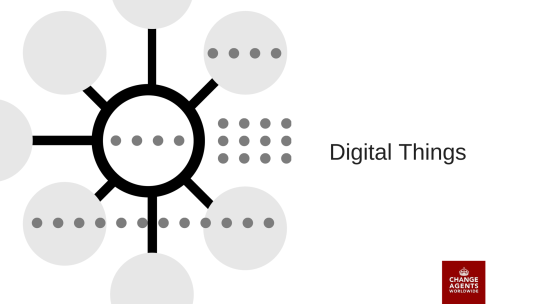
As the costs of digital connectivity and computing power fall, these capabilities are being added to more and more devices. The internet of things has reached our homes and our workplaces. The increased ability to gather and use information in real time will drive new innovations in our businesses and our lives.

image

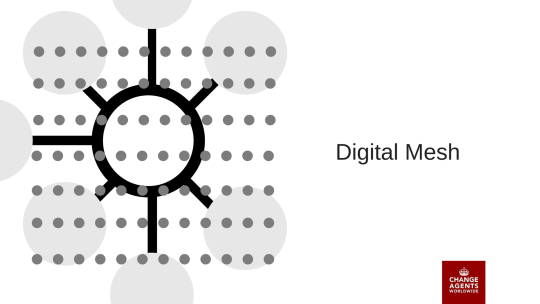
Add enough digital connectivity and computing power and you have created the potential for a mesh of sensors, connectivity and processing power to fill our environments. Now our digital things and our communication devices can be in constant contact and new applications will be developed to take advantage of the rich digital environment.

image

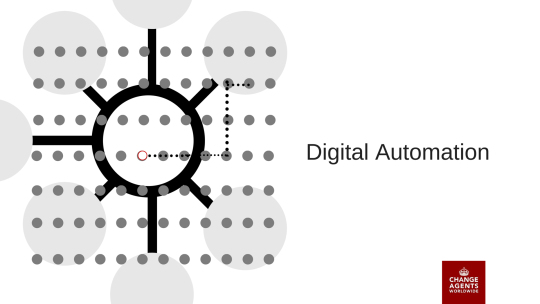
The digital mesh will help accelerate digital automation as many traditional roles of knowledge workers, such as the gathering, digesting and processing of information now flow from an ambient mesh and are managed through algorithms and their managers.

image

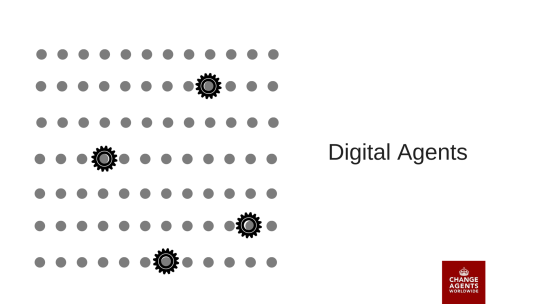
A digital mess also enables the greater leverage of bots, digital agents that can navigate the mesh and achieve outcomes for their owners, clients and masters. These algorithms take on the role of making local decisions or acting as advisers or facilitators across the breadth of the networks. Digital Agents help manage the scale of information and the real time demands of the mesh.

image

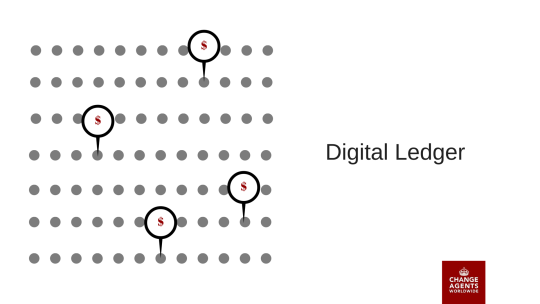
Distributed and connected computing power also enables us to revisit concepts of how we record, store and share information on concepts like ownership, identity and history of transactions.  Instead of a single ledger located in one location, the transaction history can be distributed and validated across the network, as in blockchain. Innovations will build on these capabilities into new domains.

image

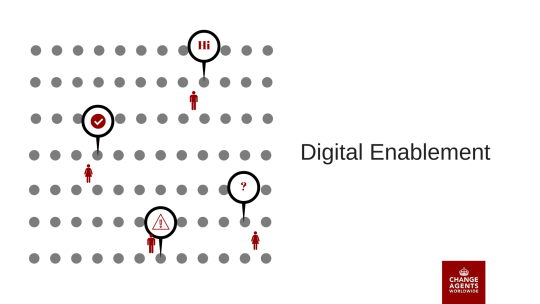
The digital mesh increasing can enable individuals by supplying capabilities need for individuals to have greater awareness, connection or to do work that was previously beyond the capability of a single individual. If an organisation is a solution to transaction costs as Coase suggest, there are new implications for the role and future of our organisations and the growing capabilities of the digital systems will shape the work individuals will do (or don’t do).

image

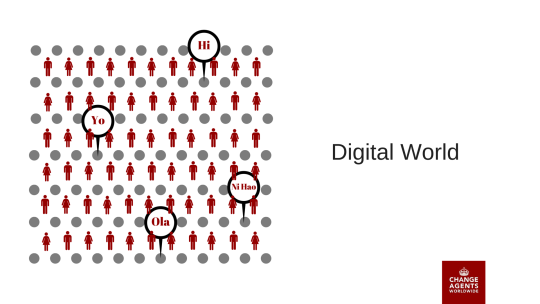
We have not yet begun to explore the potential of extending this digital mesh and its capabilities to the entire world. We can already see new approaches, such using e-commerce villages in China, video in education in India, market pricing data for farmers in the third world or mobile payments in Africa. As the costs of digital technologies fall and reach expands new entrepreneurs will solve new problems for those beyond the reach of this technology today. Perhaps then we will truly experience the power of the Internet of Humanity.

A Simple Visual History of Digital Transformation

image

Since the Mosaic Browser helped introduce the internet to the world, we have experienced a digital transformation of business. We had digital activities in our organisations before. We had already spend almost 50 years computerising processes. However, the digital connectivity of the internet began more radical change. Here’s an overly simple graphical reminder of elements of that journey.

image

We began by creating digital channels to connect our organisations to their customers.  The website began with simple digital brochures and basic contact information. Very quickly our websites became richer and more valuable.  Innovation began outside the organisation that showed the way for all subsequent phases of digital transformation.

image

We added processes to support the customer interactions. In many cases these processes were new, partial and designed solely to support the new digital channels.

image

We saw potential in these digital processes and started to apply them more widely. These processes worked in the midst of our legacy process and often in unconnected ways.

image

As the breadth of our digital channels expanded and we needed to manage new social and mobile channel needs, we needed a dedicated digital team to manage the expanding offering and to help integrate the core digital processes and infrastructure required to support growing digital ambitions.

image

With a digital team to advocate and lead the way on growing digital opportunities, we saw digital interaction takeover much of the electronic communication in the organisation and new integrated digital processes develop in supply chains, shareholder & community management and other forms of stakeholder engagement. APIs began to standardise digital communication formats in an increasing way for organisations. Organisations could leverage vast amounts of data on interactions and increasingly on activity across the organisation. 

image

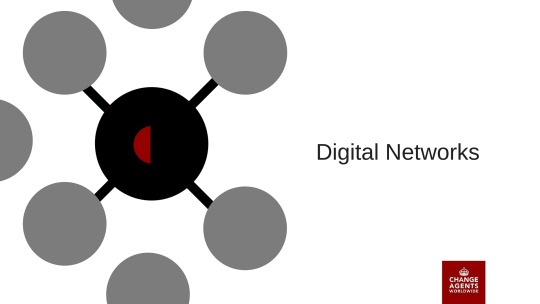
With digital interactions dominating & pressure to focus on core business activities, organisations began to become more aware that they operated in digital networks, connected to customers, suppliers and other stakeholders. Importantly, it became increasingly obvious that these networks connected all stakeholders reducing transaction costs and increasing transparency. Most dangerously these networks & data flows gave competitive advantage to those most able to leverage digital technologies in disruptive ways.

image

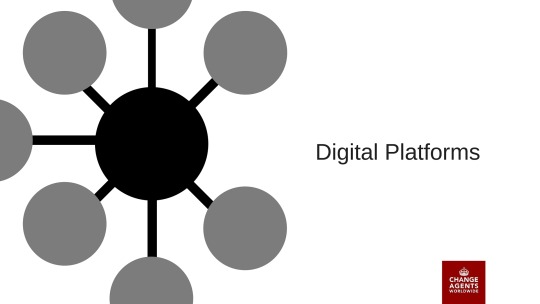
Seeing potential in connectivity, new and existing organisations saw the ability to focus on platforms that connected system players, creating new value and disrupting the traditional business of intermediaries. These platforms were increasingly agnostic of whether they ran on a computer, a phone or another device, giving them greater geographic and temporal reach.  We began to connect all processes & devices into networks to leverage the power of information. Concepts like employee, contractor, supplier and customer had less secure meaning in a networked world as chains of connectivity ran in all directions & right through the organisation.

image

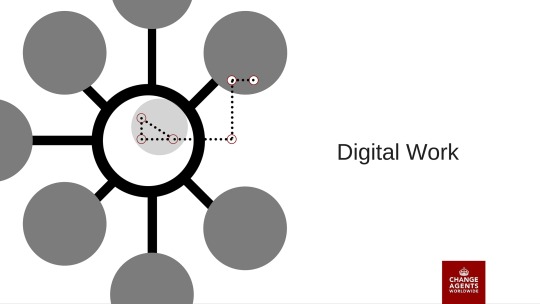
With platforms and networks running through and beyond the organisation, people began to explore the opportunities in new ways of working using digital. The boundaries of organisations no longer constrained the boundaries of work.  Seeking to retain talent, leverage information more effectively and create greater agility, organisations experimented with new digital ways of working and organising work.

This digital transformation has only just begun. There are many more phases ahead. The innovations and experiments of organisations will take us even further into exploring the potential of globally connected digital networks.

What Kind of Community Do You Have?

image

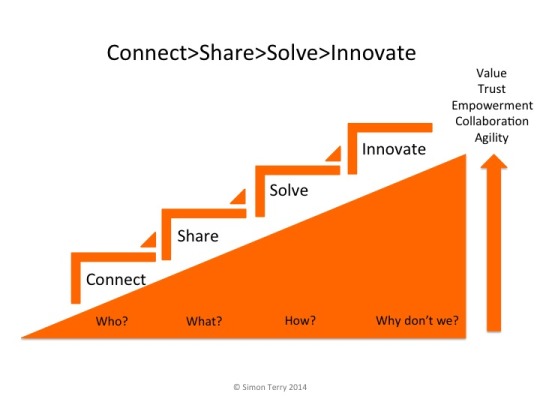
Enterprise Social Networks reflect the organisation’s culture and the maturity of collaboration in that organisation. As collaboration matures, different modes of engagement arise.  Higher levels of engagement aligned to the strategic objectives of the organisation are fundamental to the growing value of collaboration for any organisation.

Connect: The Directory

Many organisations don’t create much community in their networks. Networks or collaboration features imposed without thought or support will often languish. Without clear strategic rationale for collaboration in the organisation, their efforts create a new directory of employees (In many cases, a directory of only those who adopt). The collaboration features are used to create a social profile for individuals and to help people find others using the knowledge of those in the network.

Share: The Salon

When people are freely sharing ideas & their work, the level of engagement in the network rises. The community begins to resemble a salon. A salon can be an inspiring place filled with insightful knowledge and witty repartee. However, it can also be dominated by personalities, expertise and narrow schools of thought. Sharing knowledge is an important step on the journey of collaboration and a foundation for greater connection but posts with links is only an entry level for the human potential of social collaboration.

Solve: The Universal Genius Bar

When trust and engagement is high enough, people will see a community as a place to solve their work and personal challenges.  Like a Genius Bar, the community brings now just expertise and ideas, but solutions in the form of resources, processes and other ways to help drive change in the organisation. Well managed communities will be universal in their ability to reflecting the strategic intent of the organisation and the breadth of its people’s interests and purposes.

Innovate: The Platform

Successful cultures of innovation are those where people have a platform to which they can take ideas for development and trial. They also leverage the value of that platform as a way to track, understand and refine new ideas and those in development. When you have an innovation platform built on a rich level of engagement of all your employees, then the value and pace of change,  innovation and continuous improvement is accelerated.

Questions to consider:

  • Where does your organisation sit today in terms of the nature of the activity in your enterprise social network or other collaboration platforms?
  • What level of collaboration fits the culture of your organisation and its strategic goals?
  • What are the modes of collaboration that will help your organisation best achieve the value it seeks from bringing its employees together?
  • How have you authorised and enabled people to drive change and to collaborate in your community?
  • How can you move your organisations network from a Directory or a Salon into more valuable levels of engagement?
  • Do you have the leadership, community management and the change agents necessary to build trust, role model change and develop engagement?

The Value Maturity Model and its supporting tools are ways to help organisations plan and execute the development of strategic value in collaboration through enterprise social networks and other communities. For more information on the Value Maturity Model and how it can help you develop collaboration, please contact Simon Terry.

Execution is a Big Learning challenge

‘Vision without execution is just hallucination’ Thomas Edison

Vision & strategy is nothing without execution. Execution is often presented as a challenge of discipline. However the discipline at the heart of great execution is learning. Organisations need to use Big Learning systems to adaptive lay execute their strategy

Vision & Strategy are Hypotheses

The PowerPoint deck might land on the desk with a reassuring thud. The tables of data, the charts and the pictures explaining the vision and strategy are impressive. No matter how excited your strategy team is their plan is just still a guess.

Competitors don’t sit still. Customers are fickle. You underestimated the effort. You over estimated the upside. Reality is always different when you execute a strategy. Local leaders need to adapt the strategy to the reality they must tackle.

Organisations have tried to enforce stronger execution discipline to prevent this adaptation. They worry that the fragmentation of approach will cause issues. However a disciplined execution of a strategy that is not fit doesn’t add any value and can be disastrous. The learning opportunities for the organisation are lost.

Learning and adapting in coordinated ways throughout the organisation is the art of Big Learning. If your vision and strategy can’t adapt to reality, it is still a hallucination, no matter how widely it is shared. Organisations need to focus less on the discipline and more of the coordination of learning throughout the organisation. Finding effective adaptations and proofs of the strategy at work, changing to align and sharing them widely is what brings a vision to life.