The Growth Mindset of Collaboration

Over the last week I have been speaking to a number of organisations across SE Asia around how they can start to realise the value that collaboration can create.   I was outlining my Connect>Share>Solve>Innovate model and helping organisations to plan their collaborative communities using the approach. 

One question kept coming up. The commonest question I was asked was a variant of the following:

How do we encourage our employees to share and try to solve problems when they are afraid to make a mistake?

At the heart of this anxiety is what Carol Dweck of Stanford refers to in her book Mindsets as a fixed mindset. If an employee believes that their ability, status or position is fixed, then they do not want to risk anything that might show themselves as performing below expectations. In a fixed mindset, you avoid testing your inherent capabilities for fear that you will be disappointed. Highly hierarchical organisations encourage a fixed mindset.

Collaboration demands what Carol Dweck calls a growth mindset. To collaborate, we have to believe that through work and effort we can learn and get better together. Mistakes, embarrassment and other challenges are learning opportunities that are overcome with effort.

Shifting to a Growth Mindset

My answer to the question above came down to a simple recommendation:

Make sure in the culture of your organisation there is a personal accountability on employees to improve their work every day.

This recommendation sounds so obvious. Surely we can expect this from any manager.  However, many organisations treat their employees as if their capabilities are unchanging, that improvement is the work of specialists and managers and that daily productivity is all that matters. Mix in hierarchical relationships and you have strongly reinforced a fixed mindset in the culture of the organisation i.e. do your job with minimum effort to the best of your ability only and wait to be changed.

There are many ways a personal accountability for improvement can be created in organisations:

  • customer experience, customer service improvement, etc
  • continuous improvement, productivity, kaizen, six sigma, etc
  • rising financial or performance expectations
  • personal leadership expectations
  • innovation, experimentation, agile, lean startup principles, etc
  • organisational values of improvement, growing impact on purpose, etc
  • talent development and on the job learning

Use one or all of the above. Whatever way it works in your organisations culture and strategy, the requirement is that your organisation expects and rewards people for the daily effort to improve. Over time that helps to create an expectation that every individual will work to make their work better.

The growth mindset in your organisation will drive the value of more mature forms of collaboration. Importantly, it will also drive an uplift in performance overall.

The Double Loop Learning of Working Out Loud

Today I presented a case study at Learning Assembly Australia (#learnaus) on my personal practice of working out loud.  Like many such presentations, we were soon discussing the value of working out loud on the practice of working out loud. We needed the help of my #wolweek colleague, Jonathan Anthony, the master of meta when it comes to working out loud

However, there is an important reason working out loud commonly creates this experience. Working out loud fosters double loop learning.

The Double Loop

The concept of double loop learning is expounded in Chris Argyris’ classic article ’Teaching Smart People How to Learn’. Argyris contrast double loop learning with the single loop of every day problem solving.  He expresses double loop learning this way:

if learning is to persist, managers and employees must also look inward. They need to reflect critically on their own behavior, identify the ways they often inadvertently contribute to the organization’s problems, and then change how they act. In particular, they must learn how the very way they go about defining and solving problems can be a source of problems in its own right.

Working Out Loud Facilitates Double Loop Learning

When you narrate work in progress and do so visibly, you expose to others the single loop in process. Suddenly your behaviours, context, assumptions and approaches are open for review.  When you begin to answer questions or respond to suggestions of others on your work, you are prompted to reflect on the approach you have chosen. This process of reflection on how you are working opens up double loop learning.

Many people discover the presence of others is not even required for double loop learning to occur.  The process of getting your work visible and shareable can help you to realise new and better ways of achieving your goals. This process can also cause you to reflect on your role in the wider system with whom you are about to share your work. There is nothing quite like the challenge of expressing your thoughts to straighten out your thinking.

The power of double loop learning is that it can help realise breakthrough change in your personal effectiveness. By clearing the blockages, assumptions and other constraints that you have imposed on yourself, your work effectiveness increases. New avenues for learning open up.  Importantly, learning accelerates because the work & the reflection accelerate.  The faster you move around both single and double learning loops the greater the progress towards mastery.

Working Out Loud is a reflective practice. Use it to develop your double loop learning. Working Out Loud is a practice to help ‘learn how to learn’.

Learning from the shared practice of bread making

image

Tonight I started making a new loaf of bread. The one I made this morning is gone. As I began I reflected that what once terrified me as a mysterious challenge has become a practice I can tackle with confidence. Mastery is still a long way off, but the practice has its rewards.

Making bread is a simple practice but one with remarkable options for complexity. The simplicity begins with ingredients. There are only four required – flour, water, yeast and salt. However each of these is a natural product and yeast is a living organism. Variations in flour, temperature and vitality of the yeast interact with the practice of kneading, rising, shaping and baking to introduce complexity. Additional ingredients, processes and time spin bread off in other complex ways.

The complexity means there is a lot to learn and learning from the practice of masters is invaluable. My first loaves were flat and inedible. My own starter was weak, I lacked a grasp for developing the structure of the gluten and I was unaware of what to do when my following of recipes went awry, usually through some minor error of mine.

Here’s a few examples of how I learned from studying the practice of masters:

  • My master sourdough recipe came from the Fabulous Baker Brothers with accretions from all my reading. 
  • A sourdough course at the Brasserie Bakery gave me a better hands on appreciation of kneading and a better starter. 
  • I learned about letter folds to improve the dough from the recommendations of many recipe books. 
  • The Bourke Street Bakery’s Bread and Butter Project cookbook introduced me to a new effective kneading technique for the amateur
  • No knead recipes helped me to understand time and wet dough was my friend and trained me in the ability to plan a loaf ahead.
  • I worked out how best to slash and steam loaves in my home oven from the advice of others and my own experiments. 
  • Reading widely on styles of bread helped hone my confidence to build my own recipes and fix those that drift off track. Particularly useful were The Bread Bible, the Italian Baker, Nordic Bakery and Local Breads 
  • I have become a keen watcher of bakers at work from my lock pizza store to videos online.

If you reflect on the diversity of these influences, you will understand that my loaves aren’t copies of anyone of these sources. They draw from each in different ways, often at different times.

Complexity means each person needs to develop their own unique practice to leverage their opportunities and meet their own needs. There isn’t always a simple to follow recipe when techniques need to be learned. Experimentation is required to make sense of the practice and to make our own changes to make those practices suit.

However, we don’t do that learning and experimentation alone. We stand on ‘the shoulders of giants’ if we connect and learn from those masters around us. However, I can only learn from others if they are prepared to work out loud and share their approach. That working out loud is not all a free gift. I have paid for courses, a library of books and bought a lot of bread in my quest to learn.

The practices of the Responsive Organisation are far more complex than bread making. They involve the purposes, concerns and perspectives of many people in pursuit of common goals with agility and an external focus on customers and community. Sharing and building from our shared practice will help all of us to develop success. Working out loud fuels this learning and connection.

Practice is Habit – Make This Your Year

“We are spinning our own fates, good or evil, and never to be undone. Every smallest stroke of virtue or of vice leaves its never so little scar.” – William James

Complex changes like realising the Responsive Organisation and developing the future of work need people to connect in communities and along networks of practice. Forming new habits will be essentially to developing the richness of practice required.

Habits are required in Practice

How are those New Year Resolutions tracking? A week into the new year and many people are already struggling with new practices that look like failed intentions. New practices struggle to embed unless we turn them into habits.

I was planning to write today about the need for habits to reinforce practice when tumblr served up the William James quote above thanks to the Explore blog and the work of Maria Popova. The article on William James says many wise words on the value of habit in reinforcing habit. 

However I can point out the serendipity.  Maria’s relentless and excellent curation is a habit. My practice of writing this blog is a habit.  Without these habits and many more the coincidence would not be possible.  Similar serendipity is found in the practice of working out loud.  These moments of encouragement extend the practice further. 

To create change we need to start developing suites of new future of work practices and turning them first into experiments and then embedding the successes as habits.  Through the long practice of habit will come innovations, solutions to problems and a richer connection with others pushing the practice forward. We need to create the habits and connections that enable the serendipity to power change for Responsive Organisations.

Habits bring time to Practice

Habits bring the gift of time to practice.  They ensure that our feeble new practices are not killed by lack of attention or effort. Habits sustain us through the hard days and the days we would rather not. We all love quick wins but focusing on new practices reminds us that not everything transforms immediately. There are obstacles, new skills and lessons to be learned in practice.

Successful practice takes time and learning. Habits are the key to winning that time.

This is Your Year

This year is definitely my year. I would like it to be yours too. That will take some new habits.

This poster first featured on this blog a year ago when its claims were decidedly uncertain. The poster celebrated that the obstacles are the work. It sits in my office in my eye line as a reminder that it is relentless practice and good habits that will deliver me the year that I seek. There are many ways I can ensure it will be my year:

  • If I practice what I preach consistently
  • If I experiment, to learn and to build new good habits
  • If I keep focus and avoid the distractions of the bright and shiny things
  • If I keep looking for ways to move forward, overcome the obstacles and achieve my purpose; but most of all
  • If I keep translating the believe that ‘This is My Year’ into action

image

This year is your year too. Like it or not, it will pass with every action and omission you make. The choice is yours to make it a year to remember. Create the habits required to own your year. The resulting practice will deliver great rewards.

Habits don’t have to be big things. Small steps accumulate. Small steps that can be consistently repeated in a process of learning accelerate success.

What would make it really your year? What do you need to do consistently to make it happen? What is your new habit?

Clarity takes Mastery

There are no limits on how clear you can be on your purpose, your concerns, your circumstances and your action. Clarity takes mastery.

The last month has been chaotic with activity on all fronts. #wolweek became a frenzy on top of that maelstrom of activity. In moments like these I always find myself longing for greater clarity. Clarity is the starting point for focus and effective action. Clarity helps sift out the urgent but not important, the distractions and the pointless worries.

I have learned the hard way that there is no end point in this search for greater clarity. Understanding yourself, your environment and your goals well is an exercise in continual mastery. You grow, things change and you can always learn more. Communicating what you have learned to others with clarity is also a challenge of mastery.

Seeing clearly

Our minds are filters. They cut out much to enable us to focus and to act. We need to ensure that important information is not cut out in this process. We also need to be able to break unhelpful thoughts with new inputs. Without clarity we lose a lot of valuable insight.

Mindfulness helps to create the space to see clearly. Better understanding your purpose provides a focal point to guide greater clarity. Personal Knowledge Mastery helps structure your search and reflect on the value created in networks. Testing and learning guides your next action to be ever more clear and effective. Each of these journeys of mastery also helps you to express your purpose more clearly to others, saving time and effort and deepening relationships further.

Small increments in clarity reduce stress and dramatically improve effectiveness. There is no end point. Start the work of improvement today.

Reflection Transforms You

Today I was talking to a former colleague who reflected that after a year our personal approaches to work had changed dramatically and the way we see the world had changed too. My response was that if you reflect on your work that outcome is inevitable.

The process of daily reflection identifies ways to change and to improve. Lots of daily changes driven by reflective practice accumulate. In pursuit of mastery your approach to work becomes barely recognisable to where you began. Reflection transforms you step by step.

Working Out Loud Helps reflection

Harold Jarche recently made the point that working out loud isn’t much value without reflection on the value to you and to others of what you are sharing.Reflection is required for working out loud but it is also driven by the practice.

Reflection is a key driver of the benefits of working out loud. The practice of working out loud will accelerate personal learning and transformation through:

Purpose: Working out loud helps you discover the purpose behind your work and enables you to better focus your efforts. Things that bubble up to be shared are more likely to be purposeful for you. Purpose will also be near the things we choose to do most often. Understanding why you work is a key element of any transformation
Awareness: sharing your work sharpens awareness of what it is you do. Awareness is the beginning. As they say, knowing you have a problem is the first step.
Sharing: framing your work to be shared can give you a new perspective too. Asking yourself what others will see and what tacit knowledge you rely on is a valuable reflection process.
Engagement: the questions and observations of those with whine you share drive new insights and new lessons.

Work out loud and the connections and reflection will change you and your work for the better.

International Working Out Loud Week is 17-24 November. Get involved at wolweek.com.

The OODA Loop of Blogging

Work out loud and accelerate the benefits of blogging.

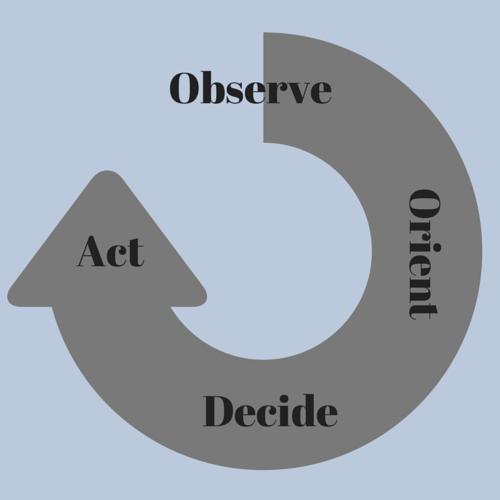
The OODA loop is one of my favourite strategic tools because it highlights the competitive advantage in speed and learning in a Responsive Organisation. I have also found OODA a useful mindset for my blogging and a way to ship posts consistently.

What is the OODA Loop?

Developed by a U.S. Airforce strategist Col. John Boyd the OODA Loop is the concept that strategic advantage goes to the party who can best navigate the decision loop through observing the situation, orienting themselves, deciding what to do next and translating that decision into action. Through transparency, autonomy and experimentation, a responsive organisation moves decisions to the edge of the organisation accelerating its OODA loop to deliver better business value.

How does OODA accelerate my blogging?

Observe: My blogging is built on a foundation of being constantly on the look out for insights. Every day as we work we are exposed to great ideas, wonderful learning and exciting conversations that challenge our thinking. The more I capture the more I learn and the more I have to share. Are you tuned to observe and capture these opportunities to share through a blog? Managing your attention to observe these moments and building a system to capture notes at the moment helps.

Orient: A blog is an expression of your cumulative knowledge and experience. Finding a way to orient a new observation against your current knowledge matters to building a consistent philosophy. You need to know how a new post fits into your blog. Once I have an insight I try to quickly connect it to other ideas on the blog and elsewhere that extend the thinking. Building this system of links helps reassure you of the value of a new post. Ultimately I would like these links to provide an ever evolving network structure to the ideas on my blog.

Decide: Struggled with a white screen? Found your 500 word post is 2000 words long? These are challenges of deciding what you are writing about. Decide to share one small simple idea. Keep it simple. Stop when it is done. If the idea gets complicated break it into a series. If you have oriented well then the decision on the role and scope of a post is a little easier.

Act: Write. Just start. The best way to solve a problem in a post is to write. You can always throw out and start again later. Only by writing and posting do you generate the interactions that create new insights. Embrace permanently beta. Ship the post and let others help you learn more. This focus on action in blogging is the power of working out loud.

Accelerating the OODA cycle on your blog reduces the risk of a writer’s block or a monster post that can be finished. Work out loud one idea at a time and invite others to share and accelerate your learning.

International Working Out Loud week is from 17-24 November 2014. For more on #wolweek check out wolweek.com. International Working Out Loud week is a great time to put OODA into action in your working out loud.

The Last Thing We Need is an Enterprise Social Network

Dear CEO

Re: The Last Thing We Need is an Enterprise Social Network

The purpose of this email is to explain why the last thing we need is an enterprise social network.

This email is in response to the conversation about enterprise social networking in the executive leadership meeting yesterday. We thought it best to summarise the position of the leadership team, because yesterday’s conversation got derailed by anecdotes about social media, technology terminology, fear of change and discussion of abstractions like collaboration, future of work and new organisational structures. Before you left the meeting, you remarked “Based on this discussion, I think an enterprise social network is the last thing we need”. We agree.

We don’t want faddish technology. We need execution of strategy.

As CEO, you’ve been rightly suspicious of all this discussion of social inside the organisation. It is bad enough that your teenage children never look up from using social media on their phones. Whatever that involves, it can’t be needed activity in our organisation. We are a place of work.

What made this country great was well-run organisations, hard work and increasing effectiveness in creating value for customers. That takes focused strategy, disciplined execution and a willingness to do the hard yards. Great organisations aren’t built by chasing technology whims. They come from executing strategy to create better value. When we need to create better execution on strategy, the latest fashionable technology is the last thing you need.

We need better strategic value creation

Times are tough. Industry is more competitive than ever and change keeps increasing. We know customer and shareholder value needs to go up and costs need to come down. We have a strategy that is about meeting these new customer & stakeholder expectations, improving the organisational efficiency and delivering the returns that shareholders demand. We all wonder from time to time whether everyone in the organisation gets the imperative of the new strategy and whether they are all working hard enough to find new ways to create value. We know that we perform better when we have better conversations to make sure that our employees are aligned to the strategy. What we don’t need are distractions when there’s doubt that people even understand the strategy.

When we need strategically aligned value creation, the last thing you need is an enterprise social network.

We need new more effective ways of working

To fulfil the strategy of the organisation, we know as a management team that we will have to start to work in new more effective ways. There has been too much wasteful duplication of work in the organisation. Too many of our processes & policies don’t line up across the silos, aren’t agile enough for the environment and don’t meet customer needs. Both our customers and our employees complain about how badly we do this. We need to start working in new and different ways to identify, solve and improve this on a continuing basis. We have to focus everyone on find and using better work approaches that help us to fulfil the strategy.

When we need working in new and more effective ways, the last thing we need is an enterprise social network.

We need to change management and leadership in every role

Working in more effective ways will likely require us to change the way management works. We are going to need to push decisions down to people closer to the customer and give our people the ability to fix problems. We will need our managers to move from command and control to a coaching and enabling role. We need to ensure that all our people are realising their potential and able to work to create new sources of value. Of course in this new role, middle management will need to be trimmed and the new flatter organisation will need to change more often as we respond to further changes driven by our customers. Employees will need to step up into a leadership role in these changes and with customers, the community and the organisation.

When we need to change the culture of management and asking every employee to play a bigger role in leadership, the last thing we need is an enterprise social network.

We need different conversations

Changing the culture of management is going to demand very different conversations in our organisation. We are going to have to find ways to make sure that conversations are efficient and effective. We need to leverage the contributions of more people from across the organisation. We won’t be able to rely on long meetings, workshops, speeches, video and emails. Did you see the budgets for communications, off sites & roadshows in the forecast for next year? We have to do something different. We will need to involve our people more in making decisions. If that’s going to happen our people will need to be better informed and better able to channel their contributions. Our people will need ways to inform themselves, learn by pulling what they need, share ideas of how to work better and collaborate to solve work problems. We are going to need to encourage our people to join conversations that use their capabilities to innovate, to create value for customers and create new forms of working.

When you need to change the conversations, collaboration and culture of an organisation, the last thing you need is an enterprise social network.

We need more from our people

We wrapped up the last executive leadership meeting reflecting on how big these demands will be on our people. We will be asking for a lot of change in them, their work and the way the organisation exists around them. We will be asking our people to play an increasing role in the success of the organisation. We will want them to lead new conversations to create the future for this organisation. We need our people to be more engaged because we will need much more from our people.

Conclusion: What we need

After you left the executive leadership meeting to catch up with the board, we realised that we are clear what we need as an organisation:

  1. we need to succeed by fulfilling our strategy to create greater value in a rapidly changing market; and to do that
  2. we need to be able to work in new & better ways that create a more effective, agile and responsive organisation; and to do that
  3. we need a new culture in management and more leadership from our people; and to do that
  4. we need new conversations that enable our people to discuss and act on creating better strategic value; and to do that 
  5. we need more engagement and a better ability to leverage the potential of our people to contribute to and lead this change; and to do that
  6. we need an enterprise social network to support the first 5 steps.

If you are surprised by point 6, think back through the needs again. After all you were the first to say that an enterprise social network is the last thing we need. We don’t want an enterprise social network because it is new technology or because it is good for some abstract goal. We need one to help our people to execute on the changes necessary to achieve the goals of our strategy. Enterprise technology only makes sense when it enables us to work in new ways that deliver strategic value. As your management team we can see that the value creation opportunity is compelling. We couldn’t see it when you made your remark, but we have come around to your perspective.

The paperwork required by our old process is already on your desk, but a number of our people have started experimenting with solutions to see what value we can create. (Interestingly, their first suggestion is a better procurement process.) When you get back from the board, your assistant will show you how to log-in and join us discussing how we implement in the new enterprise social network.

Thanks for challenging us to come up with a better way of working.

Please think of the environment and don’t print this email. We’d encourage you to discuss it on our new enterprise social network instead.

If this post sounds familiar or if you would like to create greater value in your enterprise social network or discuss how the Value Maturity Model applies to assist your organisation to create strategic value through enterprise social networking and collaboration, please get in contact. I am available through @simongterry or Linkedin or www.simonterry.com

The Learning Potential of Discomfort

image

When you become a leader, success is all about growing others – Jack Welch

Leadership is how we realise human potential. To realise potential great leaders help people to step out of their comfort zone. As a leader, you will need to get used to being out of your own comfort zone.

The friction of capabilities against a bigger challenge

A match doesn’t realise its potential until you strike it against a surface. The friction brings out the flame.

Developing the potential of people takes learning. We need to learn the limits of their capabilities. We need to learn how far their capabilities will stretch. This learning only occurs when people are out of their zone of comfort.

Great leaders excel at getting people acting outside of their comfort zone. Getting outside our comfort zones is where we can feel the friction of their capabilities against bigger challenges. That action to stretch ourselves is how we learn.

Leaders don’t make action safe. Leaders give people the confidence, purpose and support to do unsafe things to learn, to improve or to make change happen. This means guiding people into action, shaping the feedback and reflection to grow learning and helping people back up when they fall short to try again.

Leaders enable people to realise a potential that they might not fully accept or understand. These leaders never confuse competency with capability. They look for the upside. Great leaders help create the achievements that people describe later as “i never thought I could do that but I just did.”

Leadership can’t play safe

Before people take a risk for you, they want to know you are taking a risk too. If you build in too many failsafes, fallbacks and protections, then you will take the stretch, the risk and the learning away from the team. If you believe in others and take a risk on their capabilities the results & gratitude can be extraordinary.

Great leaders know they are realising the potential of their teams outside the comfort zone because they feel that friction in their leadership too. They push themselves to improve and realise their potential as well. Great leaders know they need to learn new approaches, build capability and improve to make things better.

Leaders can’t play safe to realise the potential of others.