I recommend everyone reads a quality biography of a social, political of business change agent that they admire. A good biography will highlight both the achievements and the extent to which much admired figure fell short.
Getting to know our heroes and heroines as real people matters to make change more accessible. The vast majority of admirable change agents are not exceptional people for their talents or virtues. In some cases, on closer inspection they lack the talents and virtues one would think necessary for success in leading change.
Change Agents are exceptional for their actions. They acted differently when others did not or would not act. They led when it was dangerous. They spoke up when it was unappreciated. They connected others to change when change was thought pointless.
We don’t need to be personally exceptional to act to lead change. Many change agents were surprised that their small first actions made them into opponents of a system that they were trying to help with a small fix. The response of the system made them change agents and gave them a focus for further change.
The path to change begins with action. We see a need to change the world and we start to do something about it. Don’t worry about whether you are the right person to lead the change. The fact that you have seen it and are prepared to act is start enough. Don’t worry about whether you will succeed or whether others agree. Often change agents lay the ground work for others or a larger coalition. If you see the need for change, your actions are needed.
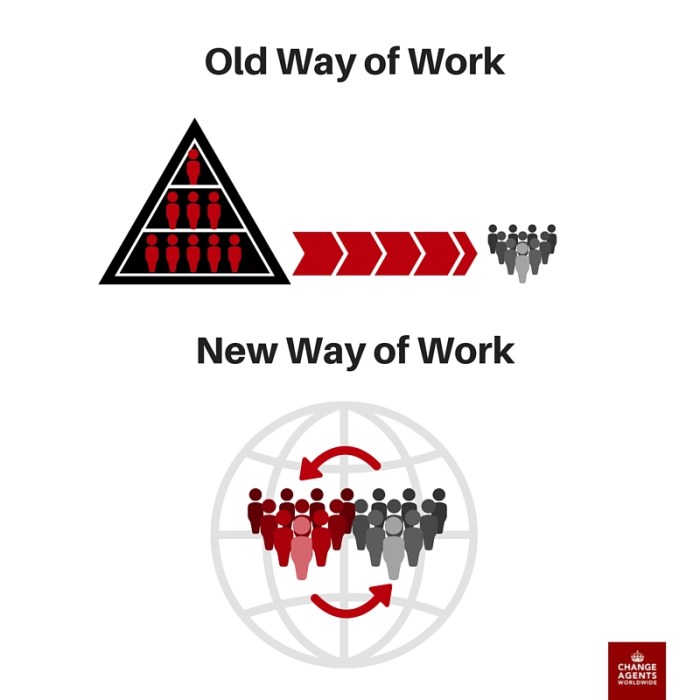
Work changes culture, not words. The future of work needs action to create new ways of working together. Creating new value requires people to do more than communicate. They must work in new ways.
With management of enterprise collaboration often falling in the Employee Communications function in organisations it can be tempting to see the challenges as primarily challenges of communication. How do we get people to use a new communication tool? What information do we want people to share in our new communication tool? Which communication tool should we use when?
The bigger and more valuable opportunity is to change the very nature of work. Changing work behaviours runs directly into the challenges of changing the culture of the organisation. After all, culture is the expectation of future behaviours in any organisation. What ways of working are expected, what work is valued and how others will support your work is all wrapped up in a rich tapestry of cultural expectations born of past behaviours, some going back as far as the origins of the organisation.
As we have seen from communication campaigns around values in organisations, message can temporarily influence expectations. However, what confirms a change in expectations is when people see new behaviours being practiced consistently, rewarded and ultimately expected by others.
Sharing information in enterprise social networks is a start but the real value of working out loud is created when people begin to change the very nature of their work process to respond to expectations that they be more agile, more transparent, more collaborative, more trusting and more open to the expertise of others. When this occurs they get the benefits of the input of others in greater speed, productivity and effectiveness. The changing nature of work and the changing culture of the organisation will develop hand in hand in this case and be supported by increasing personal and organisation value to justify the ongoing change.
Organisations that want to realise the true value of enterprise collaboration need to create an expectation that work will change to be more open. The best way to start that change is not with talk but by fostering the action that role models it to all in the organisation.
Three themes came through strongly on Day 1 of Intranets2016:
– focus on the work, not the technology
– consider your intranet in conjunction with your external internet presence because work stretches outside the organisation
– your organisation is human so engage them and help them with change to new ways of working
Work, not Technology
No intranet should exist as a cool piece of technology. No intranet should exist solely as a channel of communication.
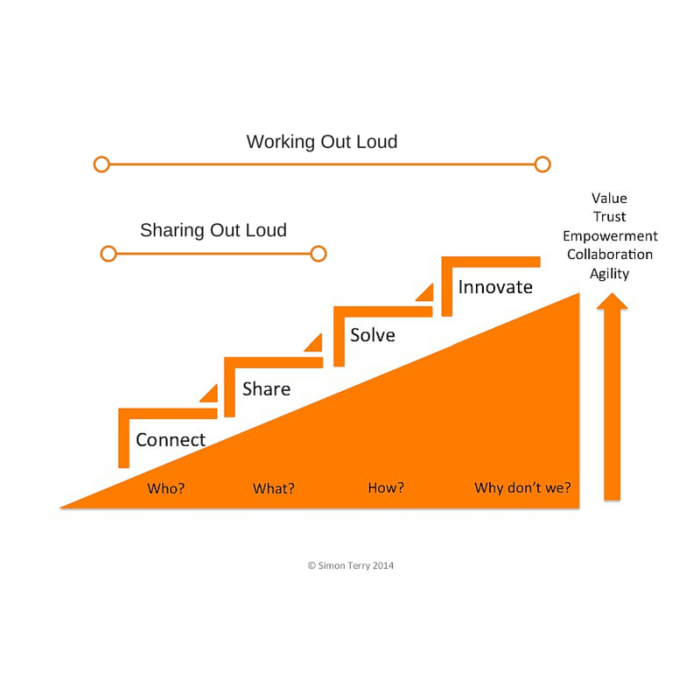
We come together to work. We want out tools at work to help us to do what we need. We need to connect, share, solve or innovate together. These use cases should be the focus and the source of value of any work tools.
Work goes Outside
Intranets need to connect with Internet assets because work goes outside and involves external communities. Examples were everywhere consistent navigation between internet sites and intranet to encourage architects to update the external status of projects, Australia Post using a public intranet to engage all its communities and the integration of external social content and other content into intranet experiences.
Our work involves stakeholders inside and outside the organisation. We need to have consistent conversations and share the same information to work effectively in a transparently connected world. Importantly, it makes no sense to be recreating materials and managing distinct solutions with the same information. Transparency in this way is a great way to address remote working and mobile worker needs.
Changing Work
Great tools need to be used. We need to help people to adopt the tools and use them in their work. Importantly change starts before the tools are designed. Using collaborative design and deep data analysis we should understand the work, the challenges and how use cases can align to business needs.
Organisations then need to invest in ongoing support for leaders, champions and users. New ways of work are not launched they are fostered, role modelled and rewarded.
Leaders of traditional organisations often look at the discussion of Responsive Organistions with horror. Confronted with transparency, autonomy, less process and experimentation they exclaim ‘where’s the risk management?’ Responsive Organisations can have highly effective risk management but they leverage adaptation not compliance in managing risk.
Traditional Risk Management.
Traditional risk management is an elegant science. Determine the risks, their frequency and their consequences. Choose your appetite to take risk informed by this assessment and the cost and outcomes of mitigation. We mitigate or accept risks driven by the risk appetite. This process is straight forward in organisations where the focus is scaling a proven process or business model. Risks and their mitigants are reasonably well understood.
We often focus on the compliance, policies and processes as risk management. They are simply the mitigation, an outcome of what should be a considered decision of what risks to take and which risks to avoid. Many businesses go wrong when they forget to set a risk appetite and seek to mitigate all risk. We have seen organisations where risk appetite declines and processes are tightened with every bad outcome.
Responsive Risk Management
Responsive Organisations approach risk with the same fundamentally commercial logic. However they tackle the risk assessment and mitigation in a more adaptive and systemic way.
If the risks of activity are unclear, hard to assess or changing quickly more dynamic risk management will be required. We step out of the domain of setting a fixed policy or process and move into learning in a distributed way. We apply the same process but we learn and mitigate risk using other methods.
Better understanding by leveraging the insights of entire network of the organisation and its stakeholders is a risk mitigation strategy. So is a continuous process of experimentation to ensure losses are small until greater confidence is achieved. Autonomy shifts the locus of accountability closer to every day risk decisions and accelerates the responsiveness to bad outcomes. Most importantly of all motivating people through purpose and a focus on outcomes mitigates the incentive mismatches which create many risks for traditional organisations.
The best risk management strategy is responsible, engaged and responsive people. People help drive the adaptation and response to a changing environment of risks. Responsive Organisations manage risk using this distributed capability to adapt.
Intranet projects are still popular these days. There is great new technology platforms & many new features available. Internet designs have moved on a lot so your old intranet is starting to look a little tired. Now your employees have new devices so your intranet needs to be mobile first and responsive. Think of the opportunities for new branding, a new name, better search and a refresh of all the content. Finally the intranet could be at the heart of the knowledge management and collaboration in the organisation. Delivering a new intranet is a signature career achievement.
Stop. Are you sure you need that new intranet?
New intranets don’t come cheap. Even after the technology solutions is acquired, the expenditure has only just begun. All that wonderful new design is going to cost money. You will need personas, card sorts and then branding advice. Getting the information architecture right can make all the difference so you will need a lot of time spent on the taxonomy of content, hierarchies of information, businesses and users. Glossaries and other reference materials will need to be reviewed and updated. Search will need to be tuned to make sure that it delivers the right options. All your existing content will need to be reviewed to fit into the new design. Throw in a policy and product information refresh and the costs and time skyrocket. Then there is the maintenance costs of all that content. Add in personalisation, collaboration and social features and the work never ends.
What is the Intranet really for?
To senior managers, an employee communications or HR team, an intranet is a showcase of the organisation, its business strategy and its knowledge. It is the one source of truth. It is the hub of collaboration and a critical place to share messages with all employees. This perception can create a whole lot of politics that disrupts the effectiveness of your new intranet. People become focused about the need to control the design and the content. User focus is swapped for the desire to meet the needs of the hierarchy. That control has real consequences when it disengages users. Worse still it can force one template on everyone and make everyone into ‘content providers’. The costs of this control are in content that gets out of date and grey market sites that spring up to break the shackles. Soon the efforts to get around the intranet are drawing investment, effort and attention away from the platform. Confusion escalates and the intranet site is on its way back to being a stale reservoir of knowledge.
To an employee an intranet is where all the links in corporate distribution emails go. Usually the intranet is the last place they go to look when they and their colleagues don’t have the answer to hand and local searches have turned up no relevant ideas. Often the intranet is the place where knowledge is tied up in clunky processes & policy that don’t reflect their day job. Everything is anonymous. The context and authority that comes from human connection is lost. An employee does not care about single sources of truth or showcases of corporate messages. They care about findability and usefulness. Nobody browses an intranet willingly.
I know many organisations who have built elegant product sites on their intranet to explain all the features, process and policy relating to their products. Too often they discover that their teams use the customer facing website for product information. The structure of customer facing product information is usually better suited to employee’s roles in explaining that information to customers. It is indexed for Google search. Legal requirements ensure that product teams keep the external information that matters up to date. Also the employee can send the customer a link if they need to explain lots of detail. The pretty intranet is a showcase but the internet is the workhorse. How much of your intranet site could you do away with by directing employees to external sites?
Are the behaviours going to change?
In our work, we create value through our actions. If the behaviours aren’t going to change, then don’t change the intranet. Changing only the technology alone, will foster only cost and confusion.
If you do want to get better at collaboration, communication and knowledge management, start with a clear understanding of the value to the organisation and the value to the user. Look for ways to achieve your goals that involved changed behaviours and community, not technology. When you are clear on the value of changed behaviours, you will be clearer on what your technology needs to look like to support that work. Now you won’t be forcing an intranet as a solution and you will be able to look at the breadth of options from social collaboration, to working out loud more, to using external internet sites and other tools of helping employees to find what matters most to help them do their job.
You will also have built a case for the whole organisation to align to working in new and better ways.
Read the literature on enterprise social networking, chat applications and collaboration and you could easily fall into believing that all that matters for a vibrant and valuable community is generating good answers to employee questions. The value of collaboration is not in answers. The value of collaboration is in changing the way work gets done.
Answers to questions are an early signal of the maturity of a network. Suddenly, it feels like the organisation has a Genius Bar of its own. Once people start to share their expertise, their knowledge and their ideas you have the platform for further development of the way your organisation works. However, many people focus on these answers as the point of collaboration. They become diverted by the need for more participation in answering questions and generating faster or more accurate answers. Some of the paths to achieve a better answer can have negative consequences to the further maturity of the network.
Placing the pressure of social support on a few champions alone can threaten the participation of a group critical to the success of the entire community. Badgering leaders to answer questions without any personal rationale leaves them seeing enterprise social as just another inbox. Gamification, badges and other recognition will increase participation but can also make participation, less purposeful, less flexible and more a numbers game.
The appeal of many of the new chat applications is that for a small engaged teams, such as a development team, project team or consulting team, they can provide a ready access to answers and a forum for sharing. However, a dynamic of answering can lead to the community descending into a ‘groundhog day’ experience of the same questions asked repeatedly. When people expect quick answers why search the community to see if your question has been asked before.
Solving work problems and innovating in an work community is about more than answers. Faster answers is an example of reducing the cost of knowledge work in your organisation. The greater value creation opportunity comes from step changes in products, processes and ways of working generated by employee interactions in your enterprise social network. This value creation impacts your entire organisation, not just its knowledge workers.
The bigger opportunity is to bring people together, to share their insights, to address problems and to create new ways of working. Answers play a dominant role in only the first two stages of that problem. The latter two stages require people to give and take, to debate, to test and to make business decisions to see new opportunities, change products, processes and reallocate resources. The best outcomes from the Solve and Innovate phase are outcomes of the group dynamic, not an individual contributor’s answer. This generative process is far harder to gamify because small infrequent contributions can play a critical role in moving a group forward, for example making available access to a critical resource. It is in this process that we move beyond Sharing Out Loud to genuinely purposeful Working Out Loud.
Moving the maturity of collaboration in your organisation beyond just answers is more than a technology or incentive challenge. Creating real collaboration in work depends on having a strong value case for the organisation and the individual. It also requires the engagement of wider organisations systems to support the changes in work. Lastly, community management can play a critical role in fostering the development of work communities and the wider organisation transformation.
If you would like to discuss how Simon Terry and the Value Maturity Model can help your organisation to get greater value from collaboration on any platform, please get in touch through Twitter, Linkedin or https://cotap.me/simonterry.
Curiosity is a critical capability for the future of work. We have reached the end of stocks of expertise.
This morning I was lucky enough to be involved in a fishbowl conversation with Cheryle Walker, Andrew Gerkens, Renee Robson, Charles Jennings and an insightful audience. The final question of the engaging conversation about learning and performance was ‘What capabilities matter for learning and development professionals in the future?’ The question prompted a great discussion of the value of strategic, business, relationship and systems acumen as learning becomes more focused on performance improvement & more integral to work.
My contribution was that curiosity is an important capability. As the attention shifts to how organisations can manage big learning systems, those facilitating this change need to be curious well beyond traditional domains of expertise. When work is learning and learning is the work to quote Harold Jarche, there is a need for facilitators of this process to be looking at their system and looking beyond the organisation with an intense curiosity. The question is not ‘what do I or our team need to know?’ The question needs to be ‘what can we learn that helps us work better and be more effective?’
Traditional approaches to learning often have an implicit or explicit assumption that there is a fixed reservoir of knowledge to be known by employees. Global connectivity has shown us that the required knowledge is constantly expanding, being shared and being created as people experiment with the edge and step into new domains or engage with new systems.
Big learning processes are key to the future of responsive organisations. Performance will depend on how fast and how effectively we learn. To shape this we must remember, the future of work belongs to the curious.
My parody post on the Life-crushing Magic of Hierarchy, rightly prompted the reaction: “Yes, but what do you recommend we do about it?”. This entire blog is an extended essay on what to do to help make work more human. I believe the critical challenge for organisations as we move into the future of work is how to use learning, leadership and collaboration to create more life-affirming workplaces and work. For those who are looking for quick clarity, I thought I would distill a few basic responses to the challenge.
Call The Life-crushing Management & Discuss it
Frighteningly several people have taken the post at face value as a recommendation of management practices. This highlights our need to discuss the excesses and abuses of management practices more widely. Transparency & debate is a first step, because many of the practices will be stopped or adapted when challenged or discussed openly. Importantly, transparency alone is not enough. We need people to act on change too.
Calling hierarchical leaders to explain their actions is not a step taken lightly. Like it or not, the call will challenge some leaders and not all challenges are welcome. Simple steps can be taken to make it easier to call bad practice and start a discussion:
Don’t do it alone: Build a coalition or at least check your perspectives with others before you call a bad practice. Ensure that there is a crowd of supporters for your view point.
Seek to understand: Begin by seeking to understand the management perspective. Don’t presume malevolence or incompetence. Most bad decisions come from a lack of shared context.
Based your questions in higher purpose, values or strategy: Appealing to and clarifying the higher order can give you more basis for a challenge.
Add external perspectives: Closed systems atrophy. Some times lack of diversity can be the problem. Add external ideas, data and perspectives to add weight to your call.
Offer help: If you call something, be prepared to work to create a better way. There’s a lot of critics. There are fewer collaborators.
Discuss People, Outcomes & Purpose
The practices “recommended” share a common goal of valuing management power over the effects of work. Creating a vibrant discussion of purpose, the importance of meeting people’s needs and the impacts of work beyond the organisation is critical to moving to more meaningful work. Starting with a strong sense of why work is to be done and the goals it is to achieve for the organisation, the individual and other stakeholders is a key part of a better more engaging work environment.
Importantly, this begins to foster and “outside-in” perspective that pushes hierarchical managers to look to new data and perspectives in their decision making. Being clearer on goals and purpose is also a fundamental underpinning to allowing new forms of autonomy for employees to react and make change.
Grow Accountability, Autonomy and Change
As we add human accountability to the networks in our organisations, we enable people to begin to grow trust and influence. Think of the definition of wirearchy and focus on increasing ‘the dynamic two-way flow of power and authority, based on knowledge, trust, credibility and a focus on results”. Many simple issues in our organisations can be addressed by allowing people to share more information and begin to exercise autonomy to make decisions that need to be made beyond roles, mere compliance and process constraints. The exercise of that autonomy rises as accountability & trust rises. At the same time, we start to accelerate the pace of change in our organisations enabled by the distributed talents of our people. Increased accountability is one of the goals of traditional management, but common practices tend to disempower. We need instead to increase accountability and empowerment at the same time.
Build Capability
The appeal of traditional management practice is that managers need not be very effective at coordinating people and the employee’s roles are kept rote and simple. Working in more human ways will require organisations to build new capability to lead and to influence and also to make more complex decisions in every role in the organisation. We can’t manage and work in different ways if we have not helped people to develop the required capabilities. Enabling people throughout the organisation to gather information, to learn, to make change and to influence others becomes very important.
Continue the Collaboration & Change
There are no quick fixes, no gurus and no systems to buy to make a more life-affirming workplace. The steps above need to be led by management and by the entire team in the organisation over an extended period of change. We don’t necessarily need to start by throwing out hierarchy or managers. In most cases, they come back in another form anyway. What we need to do is to learn to work in new and much more effective ways that value human potential inside and outside the organisation.
Capabilities aren’t learned overnight and new ways of working take time to embed and be secure from the next round of management changes and new hires. The best way to carry this journey forward is to embed it in a collaborative change program that the entire team embraces. Making life-affirming work part of the cultural fabric of the organisation must be the ultimate goal. After all, there is no destination, just an endless journey of improvement and change.