Session with Cai Kjaer, CEO of Swoop Analytics at Microsoft Ignite:
Category: Collaboration
Talk to Your C-Suite about Yammer
Session at Microsoft Ignite with Cai Kjaer, CEO of Swoop Analytics:
Hear Stories from the Frontline of Collaboration: Yammer MVP Panel at #MSIgnite
Michelle Ockers of Coca-Cola Amatil on Useful Models for Communities of Practice
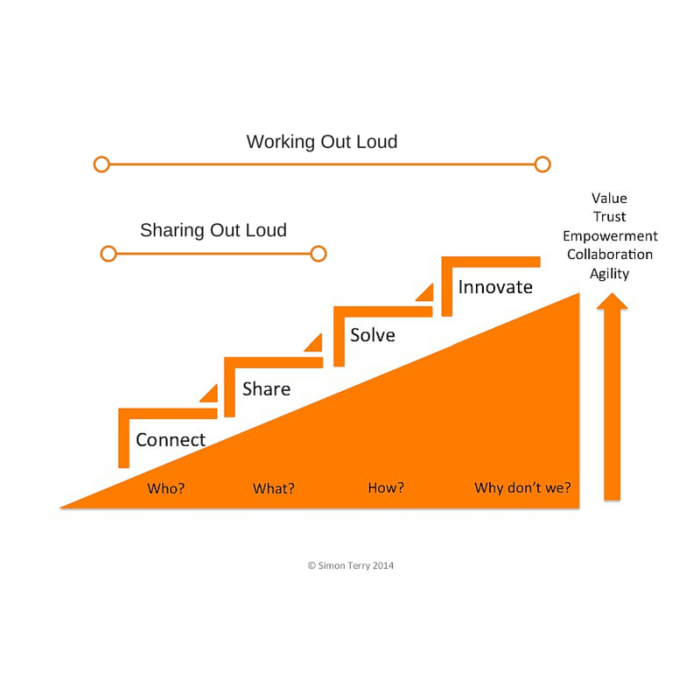
Michelle Ockers discusses useful models of Communities of Practice and discusses Harold Jarche’s model of Teams/Collaboration/Cooperation and my model of Connect>Share>Solve>Innovate.
Thanks for the mention, Michelle. It has been great to watch and discuss the development of your maturity journey at CCA Amatil on the use of Communities of Practice.
PS: Harold also has a great post that draws out relationships between our two approaches.
One Minute Video – Breaking Down the Value of a Yammer Message
Context
The dysfunction in organisations is often a lack of shared context.
Part of any community is a shared context. That context is a common set of facts and understanding of the world. At its best that context includes shared goals and purposes. This context enables people to see the world in enough of a shared way that trust and collaboration is possible.
Civil society breaks down when people stop sharing enough context to collaborate and reach consensus. Much of the dysfunction of politics globally is influenced by the breakdown of shared context. We can find our own media that reinforces our own worldview. Politicians actively reinforce this to strengthen their following and influence. The vitriol and political dysfunction is an outcome of a lack of shared context.
We’ve all experienced the moment where the same action takes on a different meaning in a different context. The car that wants to cut into your lane on a day you are late and stressed creates a different reaction to the same action on a peaceful day of vacation. Context can literally change how we see and react to the world.
In organisations there are many ways that shared context breaks down. At its most dangerous, an organisation can lack a shared context with the customers and other stakeholders that provide its reason for being. Look at any customer service breakdown and there will be a lack of shared context. Organisations lose track of their customer’s context when they stop listening to feedback and stop changing with their customers. Success builds ego and hubris that builds barriers to understanding.
Within organisations, shared context is absent when there are misalignments of purpose or information. The silos that brought us efficiency now promote division and lack of mutual understanding. No two teams can collaborate comfortably when they have their own sets of metrics and differing goals.
A key role for all in organisations but particularly for leaders is to create a shared context. Help people understand the whole system through transparency, understanding and engagement. When there is conflict and dysfunction, start building new understanding.
Work Changes Culture
Work changes culture, not words. The future of work needs action to create new ways of working together. Creating new value requires people to do more than communicate. They must work in new ways.
With management of enterprise collaboration often falling in the Employee Communications function in organisations it can be tempting to see the challenges as primarily challenges of communication. How do we get people to use a new communication tool? What information do we want people to share in our new communication tool? Which communication tool should we use when?
The bigger and more valuable opportunity is to change the very nature of work. Changing work behaviours runs directly into the challenges of changing the culture of the organisation. After all, culture is the expectation of future behaviours in any organisation. What ways of working are expected, what work is valued and how others will support your work is all wrapped up in a rich tapestry of cultural expectations born of past behaviours, some going back as far as the origins of the organisation.
As we have seen from communication campaigns around values in organisations, message can temporarily influence expectations. However, what confirms a change in expectations is when people see new behaviours being practiced consistently, rewarded and ultimately expected by others.
Sharing information in enterprise social networks is a start but the real value of working out loud is created when people begin to change the very nature of their work process to respond to expectations that they be more agile, more transparent, more collaborative, more trusting and more open to the expertise of others. When this occurs they get the benefits of the input of others in greater speed, productivity and effectiveness. The changing nature of work and the changing culture of the organisation will develop hand in hand in this case and be supported by increasing personal and organisation value to justify the ongoing change.
Organisations that want to realise the true value of enterprise collaboration need to create an expectation that work will change to be more open. The best way to start that change is not with talk but by fostering the action that role models it to all in the organisation.
Invest in Better Work
Collaboration and other future work practices require investment from organisations to foster community and support the changes in practices. The potential value from this investment is better work organisation-wide.
Speaking at Intranets2016, I had the opportunity to see a showcase of presentations from organisations large and small on how they have leveraged value from new ways of working, better communication and collaboration with employees. I also got a chance to speak to many of the people attending the event and discuss their challenges and concerns.
Reflecting after the event one thing was striking: Each of the case studies had invested time and resources into helping their organisation get the most out of collaboration and community. They had spent time and money on strategy, on design work, on employee engagement, on training and community management. They had ongoing resources devoted to realising the value of community. When I spoke to many members of the audience winning the support of their organisation to invest in these elements was a major challenge. The success stories were successes because their organisations supported their team to realise the value of changing work.
Many organisations have not yet realised that the potential value creation from their new intranet, their new productivity tools or their new collaboration software far exceeds the investment they need to make to support change and adoption. These tool are part of the furniture in an organisation and while from time to time we invest in the latest version to stay effective, not much more is expected from their use.
Organisations that invest in community and collaboration know the value creation opportunity is far greater than a more effective tool. The value creation opportunity goes to the heart of their organisation by making work better, more productive and more effective. What little resource they choose to invest will deliver benefits that are multiplied by all the work that they do in the organisation. Scrimping or not investing at all in this capability leaves the tools to miss their potential and the community of users to miss the benefits.
Champions of social collaboration and new productivity solutions need to do more than fund the technology. They need to help the organisation see the strategic value of the new tool in new ways of working. When that value is clear then the business case for ongoing investment and in community and change is much more obvious.
#intranets2016 Day 1: human work inside and outside
Three themes came through strongly on Day 1 of Intranets2016:
– focus on the work, not the technology
– consider your intranet in conjunction with your external internet presence because work stretches outside the organisation
– your organisation is human so engage them and help them with change to new ways of working
Work, not Technology
No intranet should exist as a cool piece of technology. No intranet should exist solely as a channel of communication.
We come together to work. We want out tools at work to help us to do what we need. We need to connect, share, solve or innovate together. These use cases should be the focus and the source of value of any work tools.
Work goes Outside
Intranets need to connect with Internet assets because work goes outside and involves external communities. Examples were everywhere consistent navigation between internet sites and intranet to encourage architects to update the external status of projects, Australia Post using a public intranet to engage all its communities and the integration of external social content and other content into intranet experiences.
Our work involves stakeholders inside and outside the organisation. We need to have consistent conversations and share the same information to work effectively in a transparently connected world. Importantly, it makes no sense to be recreating materials and managing distinct solutions with the same information. Transparency in this way is a great way to address remote working and mobile worker needs.
Changing Work
Great tools need to be used. We need to help people to adopt the tools and use them in their work. Importantly change starts before the tools are designed. Using collaborative design and deep data analysis we should understand the work, the challenges and how use cases can align to business needs.
Organisations then need to invest in ongoing support for leaders, champions and users. New ways of work are not launched they are fostered, role modelled and rewarded.
Vibrant Groups
In the Office 365 Community, I was asked by Cai Kjaer of Swoop Analytics how we can identify groups in social collaboration tools that are thriving, struggling or dead. We are becoming increasingly aware of the value of great group and team structures to the success of collaboration in organisations. With that in mind, group health takes on a key role in the success of networks.
Here’s my response to Cai’s great question:
Because groups exist for diverse purposes it is hard to assess universally but here are a few reflections at each level of a group’s purpose. I haven’t mapped to your three levels but there is a mapping that is possible from the themes below. e.g. Dead is when it is not a group anymore and at the other end if it is Solving work problems it is clearly thriving.
Is it still a group (Connect)? Most basically does the group serve a purpose that continues to attract people? Are people joining, do they come and visit the group and is it not losing its membership? Groups can exist as a kind of social distribution list. These groups can remain dormant/passive for long periods of time but play an important role when they are needed. More importantly does it connect people who are not connected elsewhere?
Is it still sharing information (Share)? Is new information being shared in the group? Are there interactions on the information in the group (Likes/Shares/Replies)? Is there a core champion team creating an experience for others in the group? How diverse are the contributions to the group? Is it playing a role brokering information sharing between different parts of the broader network?
Is it doing work (Solve)? Do posts in the group get a timely response? Does the topic at the heart of the group animate people to do things? Is the activity drawing in a wider group of champions and also activating more interaction from all the members of the group? How does the group drive value for members and for the organisation? Does the group create a strong cluster within the wider network?
In my view this is a cascade. If groups aren’t moving up the maturity curve, then they are falling down. Attention is limited in large organisations. People move on to other things when they don’t create value for them and the organisation. The exception would be groups as previous referred that exist solely for option value (i.e. might be needed later such as a CEO briefing group or a YamJam group). These groups should be few and documented in the community management strategy.
What’s your view? What defines a vibrant group? How do we get early warning of issues with groups?