The Cold Dark Path

image

Two Competing Loops

This week at the first meeting of the League of Social Intrapreneurs in Melbourne I was introduced to the Berkana Institute two loops theory of change. The model of change in complex systems resonated immediately.

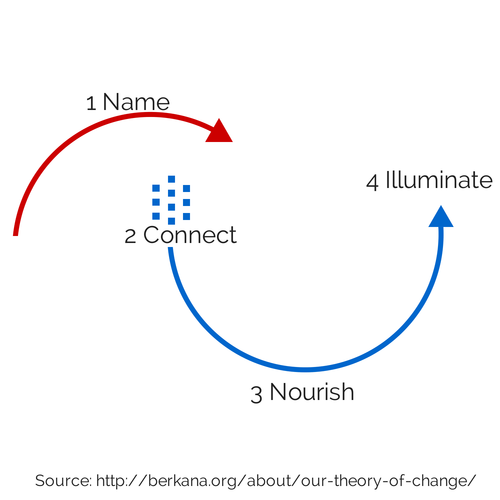
When a system nears its peak, change agents identify the need for alternatives and drop out.  They connect and begin to explore alternatives nourishing a new system through experimentation. Eventually the stories of their success illuminates the change to those who remain in the old declining system.

A four step model with four simple verbs seems clear and straightforward. Why is it that the path of change is such a cold dark path?

Nobody Warns You about the Dip

Stepping out of a warm and comfortable ongoing system with its present day rewards is a daunting uncertain choice however bleak the future of that system may look. Those with most to gain will oppose the agents of change who name the issues and start to work on alternatives. Opposition will not always be fair or balanced.

//platform.twitter.com/widgets.js

Most difficult of all is that dip in the diagram above. The uncertainty and the need to build a new complex future means the alternative system starts along way back and with a great deal more risk. Selling another path even to yourself can be a challenge in this scenario.

All the discussions about collaboration, requests for advice and stories shared among change agents at the League of Social Entrepreneurs, in Responsive Organisation, in Change Agents Worldwide or in other conversations that I have with unreasonable people belong at the bottom of the loop where people struggle nourishing new alternatives.

We must embrace the fact that the road to change is a road with dips and uncertainties. Proceeding any other way does not prepare people for the work ahead.

Nourishing Change Takes Hard Work

Most change fails after the connect stage.  Declaring a need for change is initially easy and exhilarating. Manifestos are thrilling. Connecting with other like minded people has a wonderful effect for the spirits and is a great way to reinforce the need for change.

Then nothing happens for a really long time. It grows cold and dark on the path of change.

Lots of drudgery dogs those walking the cold dark path of change. Meetings need to be organised and venues found. Compromises need to be negotiated between people who are 99% aligned. Factions and fragmentation occurs and saps the energy of everyone. More change agents need to be recruited, especially for the work. Experiments need to be agreed, funded and run. Failed experiments need to be cleaned up. New experiments agreed, funded and implemented. Success needs to be found. Someone needs to find money or work out the details of the new model. Communication materials don’t write themselves. Just when success seems inevitable the dying system finds a way to set you back.

Change falls apart when the connected agents of change won’t work the experiments long or hard enough to nourish the success of the new system. If they won’t invest the time to build new connections, share successes, to solve the daily issues and to innovate a path forward then the nourish stage will never offer an opportunity to others to join in the change.

If the organisers of the first meet up about a change end up with all the actions, then a change initiative has work to do to find others to nourish the change. Engaging others in the work matters more than engaging them in the idea of the change.

Join in the Work

Lots of people want to join change at the exhilarating beginning and again at the celebratory end. Traditional management focus only on the beginnings and the endings but leadership is found in realising the collective potential of the journey.

The question is who is willing to walk the cold dark road. Those change agents who do the leadership work of nourishing new experiments shape the future. That path is hard but the work is the most purposeful and rewarding

The Last Thing We Need is an Enterprise Social Network

Dear CEO

Re: The Last Thing We Need is an Enterprise Social Network

The purpose of this email is to explain why the last thing we need is an enterprise social network.

This email is in response to the conversation about enterprise social networking in the executive leadership meeting yesterday. We thought it best to summarise the position of the leadership team, because yesterday’s conversation got derailed by anecdotes about social media, technology terminology, fear of change and discussion of abstractions like collaboration, future of work and new organisational structures. Before you left the meeting, you remarked “Based on this discussion, I think an enterprise social network is the last thing we need”. We agree.

We don’t want faddish technology. We need execution of strategy.

As CEO, you’ve been rightly suspicious of all this discussion of social inside the organisation. It is bad enough that your teenage children never look up from using social media on their phones. Whatever that involves, it can’t be needed activity in our organisation. We are a place of work.

What made this country great was well-run organisations, hard work and increasing effectiveness in creating value for customers. That takes focused strategy, disciplined execution and a willingness to do the hard yards. Great organisations aren’t built by chasing technology whims. They come from executing strategy to create better value. When we need to create better execution on strategy, the latest fashionable technology is the last thing you need.

We need better strategic value creation

Times are tough. Industry is more competitive than ever and change keeps increasing. We know customer and shareholder value needs to go up and costs need to come down. We have a strategy that is about meeting these new customer & stakeholder expectations, improving the organisational efficiency and delivering the returns that shareholders demand. We all wonder from time to time whether everyone in the organisation gets the imperative of the new strategy and whether they are all working hard enough to find new ways to create value. We know that we perform better when we have better conversations to make sure that our employees are aligned to the strategy. What we don’t need are distractions when there’s doubt that people even understand the strategy.

When we need strategically aligned value creation, the last thing you need is an enterprise social network.

We need new more effective ways of working

To fulfil the strategy of the organisation, we know as a management team that we will have to start to work in new more effective ways. There has been too much wasteful duplication of work in the organisation. Too many of our processes & policies don’t line up across the silos, aren’t agile enough for the environment and don’t meet customer needs. Both our customers and our employees complain about how badly we do this. We need to start working in new and different ways to identify, solve and improve this on a continuing basis. We have to focus everyone on find and using better work approaches that help us to fulfil the strategy.

When we need working in new and more effective ways, the last thing we need is an enterprise social network.

We need to change management and leadership in every role

Working in more effective ways will likely require us to change the way management works. We are going to need to push decisions down to people closer to the customer and give our people the ability to fix problems. We will need our managers to move from command and control to a coaching and enabling role. We need to ensure that all our people are realising their potential and able to work to create new sources of value. Of course in this new role, middle management will need to be trimmed and the new flatter organisation will need to change more often as we respond to further changes driven by our customers. Employees will need to step up into a leadership role in these changes and with customers, the community and the organisation.

When we need to change the culture of management and asking every employee to play a bigger role in leadership, the last thing we need is an enterprise social network.

We need different conversations

Changing the culture of management is going to demand very different conversations in our organisation. We are going to have to find ways to make sure that conversations are efficient and effective. We need to leverage the contributions of more people from across the organisation. We won’t be able to rely on long meetings, workshops, speeches, video and emails. Did you see the budgets for communications, off sites & roadshows in the forecast for next year? We have to do something different. We will need to involve our people more in making decisions. If that’s going to happen our people will need to be better informed and better able to channel their contributions. Our people will need ways to inform themselves, learn by pulling what they need, share ideas of how to work better and collaborate to solve work problems. We are going to need to encourage our people to join conversations that use their capabilities to innovate, to create value for customers and create new forms of working.

When you need to change the conversations, collaboration and culture of an organisation, the last thing you need is an enterprise social network.

We need more from our people

We wrapped up the last executive leadership meeting reflecting on how big these demands will be on our people. We will be asking for a lot of change in them, their work and the way the organisation exists around them. We will be asking our people to play an increasing role in the success of the organisation. We will want them to lead new conversations to create the future for this organisation. We need our people to be more engaged because we will need much more from our people.

Conclusion: What we need

After you left the executive leadership meeting to catch up with the board, we realised that we are clear what we need as an organisation:

  1. we need to succeed by fulfilling our strategy to create greater value in a rapidly changing market; and to do that
  2. we need to be able to work in new & better ways that create a more effective, agile and responsive organisation; and to do that
  3. we need a new culture in management and more leadership from our people; and to do that
  4. we need new conversations that enable our people to discuss and act on creating better strategic value; and to do that 
  5. we need more engagement and a better ability to leverage the potential of our people to contribute to and lead this change; and to do that
  6. we need an enterprise social network to support the first 5 steps.

If you are surprised by point 6, think back through the needs again. After all you were the first to say that an enterprise social network is the last thing we need. We don’t want an enterprise social network because it is new technology or because it is good for some abstract goal. We need one to help our people to execute on the changes necessary to achieve the goals of our strategy. Enterprise technology only makes sense when it enables us to work in new ways that deliver strategic value. As your management team we can see that the value creation opportunity is compelling. We couldn’t see it when you made your remark, but we have come around to your perspective.

The paperwork required by our old process is already on your desk, but a number of our people have started experimenting with solutions to see what value we can create. (Interestingly, their first suggestion is a better procurement process.) When you get back from the board, your assistant will show you how to log-in and join us discussing how we implement in the new enterprise social network.

Thanks for challenging us to come up with a better way of working.

Please think of the environment and don’t print this email. We’d encourage you to discuss it on our new enterprise social network instead.

If this post sounds familiar or if you would like to create greater value in your enterprise social network or discuss how the Value Maturity Model applies to assist your organisation to create strategic value through enterprise social networking and collaboration, please get in contact. I am available through @simongterry or Linkedin or www.simonterry.com
When Circumstances Change, Change Your Approach

image

Changing circumstances demand changes in approach. Clinging to the old ways can be dangerous.

The Praying Mantis in the Schoolyard

When confronted with a threat, a praying mantis has a set program of responses to take advantage of the advantages of excellent camouflage: freeze & blend in, sway like a leaf, run to the nearest tree. All these strategies work well in the normal circumstances of a praying mantis, the leafy greenery of trees.

However when the wind is blowing strongly and a praying mantis finds itself blown to the unfamiliar circumstances of schoolyard asphalt, none of these strategies work. It can’t blend in. Freezing exposes it to risk of being stomped. What it runs towards is not a tree. It is the leg of a small curious boy. In the end, it need a generous young girl to carry it back to the bushes to escape the growing crowd.

Change Your Approach

A praying mantis can’t change its approach immediately. Evolution will take a while to catch up with asphalt. It will eventually adapt as a species, but that doesn’t help any individual insect.

Your organisation isn’t programmed by genetics. When circumstances change, your organisation and its people can adopt new approaches, experiment to find new ways and learn how to succeed in the new environment. If your organisation is still responding to the new network economy with the same approaches and practices that worked in the industrial era, it can be as dangerous as outdated practices were to the mantis. Nobody will be generous enough to return your organisation to its preferred environment.

There is No Formula – Just Learning

Many managers find this discussion deeply unsettling. Advocates of the future of work are calling for change, but they are often either highly conceptual or discussing concepts that seem very alien to the circumstances in an organisation.

The abstraction has a reason. The future of work is being driven by a network economy where the right strategies are often emergent and adaptive. Adopting a new fixed formula is as dangerous as the last one. While we would like a formula (and many offer to sell one), the future strategies need to be learned for each organisation in its own circumstances in the network.  Change can’t be imposed it needs to be led one conversation at a time.

Creating a responsive organisation that can leverage the human potential to learn and experiment a way forward will take new techniques and new ways of organising.  Many of these techniques that are rising to the fore in discussion of the future of work and responsive organisations are ways to foster the emergence of a new better approaches for organisation using networks, rather than fighting them.  That’s why much of the conversation comes back to enabling people to learn and act in new ways:

  • Leadership: fostering the leadership capabilities of each person to leverage their insights and their potential to lead change from their unique position
  • Experimentation: Moving from exercising the power and expertise of a few to experimenting to learn together
  • Learning: improving the ability to understand the environment by focusing on tools to better seek out, share and make sense of information.
  • Work out Loud: aligning the organisation and bringing out latent human capabilities using techniques like ‘working out loud
  • Collaboration & Community: Networks route around barriers. Therefore you need to bring down the barriers within and around your organisation. Isolation is not a winning strategy in a period of rapid change.

The Network Navigator

image

The power of a networked world is shifting the emphasis of work from expertise to navigation. Are you ready to move from expert to network navigator?

From Expert to Navigator – a financial services example

Research into perceptions of an advice relationships in financial services consistently often comes up with a common theme. Usually, the financial services organisation is keen to build a trusted relationship with the client as an advisor and to demonstrate its depth of expertise in the advice process. 

However, these goals are rarely what the client is looking to achieve. The client is often more interested in building a relationship with someone who is responsive to their needs and who can to help them navigate the complexity to find their own answers. The complexity the client needs to navigate is not just the financial decisions; it includes the organisations own advice and service processes. In times of complexity, uncertainty & change, clients are reluctant to be dependant on someone else’s expertise. They want control. They want to be guided across the map of choices and find an easier way through the process.

The Network Navigator

Networks and the increasing pace of change that they bring about are having a similar disruption for the traditional model of expertise-based advice.

Relying on a proprietary stock of knowledge is no longer enough to justify an advice proposition. Knowledge is increasingly a flow. Stocks of knowledge are out of date too quickly as the network learns more faster by sharing.  If clients want access to stocks of knowledge, they can find the information themselves (& access a greater diversity of insight and experience) if they are prepared to put in the time and effort.  Doing that work for them on an outsourcing basis is a low value task.

The challenge of a networked era is no longer gathering a stock of knowledge. The challenge is leverage rapid flights of knowledge and guiding others through networked knowledge creation. The skills that rise to the fore are no those of hoarding a stock of knowledge. The skills are those of being able to connect people, share capability and create new knowledge together.

The 8 Skills of a Network Navigator

A network navigator does not need to know the answer. They do not even need to know the whole way to the solution. They need to be able to lead others, to leverage the knowledge of the network and to find a way forward in collaboration to create new value: 

  • Setting a course: In a complex world often the purposes, goals and questions are as unclear as the answers. Helping people clarify their objectives and questions before and during their engagement with the network is a critical role that the network navigator can play.
  • Seeing the big picture map: Navigators are people who can hold the network system in view and manage the micro detail to guide people forward.  A navigator creates new value with an understanding the broader map and new & better paths that others may not have considered.
  • Make new connections: Increasing the density of networks can be critical to creating new knowledge and value from network interactions.  Bridging weakly connected groups is another role that navigators can play to realise new insights and value.
  • Recruiting a crew and local pilots:  Building community matters in new network ways of working.  Community takes connection to a deeper and more trusted level and begins to accelerate learning and change.  Network navigators know how to recruit crew to their travelling community and add local pilots as they need to learn faster in new parts of the network.
  • Translating strange cultures: Connecting diverse groups often means that there are differences of context, language and culture to be bridged before conversations can create new knowledge. Network navigators have the skills to understand and share diverse inputs.
  • Logging the journey: A network navigator works out loud to record their journey and let others contribute and benefit from the record.  A network navigator nows there are many others seeking the same answers or looking for better paths forward and makes that possible by sharing their work and inviting others to contribute.
  • Weathering storms & avoid shoals: Journeys through networks are not linear and often unpredictable.  The navigator has the experience and the confidence to see others through the storms and to sustain others in their journeys. Most importantly, when the storm is darkest, they have the passion to keep pushing and keep experimenting.
  • Navigating where there is no map: Network navigators need to be able to embrace uncertainty and ambiguity.  They need to be able to lead others forward to learning even if it is dark and there be monsters.

Acknowledgements:  This post is in large part inspired by conversations with a wide range of participants that occurred during John Hagel’s recent visit to Melbourne for the Doing Something Good dinner and Centre for the Edge workshops that I attended.  It is also informed by ongoing conversations about new networked ways of working among all members of Change Agents Worldwide.  

The Pineapple Effect: Learning to See the New World

image

Discovering the New World was a difficult enterprise, as we have all been taught. But even more difficult, once the New World was discovered, was seeing it, understanding that it was new, entirely new, different from anything one had expected to find as new

…the Old World catch the imagery of the New most forcefully when it still does not know precisely what it is dealing with, when information is scarce and incomplete, and it is difficult to separate reality from mistakes and fantasy.

from ‘How New the World Was’ by Italo Calvino found in Collection of Sand

We see the new through our old world. The new presents us challenges and mysteries of which we need to make sense. We make mistakes, learn and in the process we experience a Pineapple Effect.

The Pineapple Effect

The original meaning of the word pineapple was the cones of conifer trees. After the new fruit was found in the Americas, it was named pineapple for a perceived resemblance to what we now call pinecones. The discoverers of this new world fruit needed to made sense of it so they explained it with the tools they had at hand from their old world. Of course, the name was grossly misleading. There’s little beyond a surface resemblance between the two. Thankfully, pinecone came into usage and the terms went separate ways to avoid further confusion.

For those advocating for changes in the world of work this Pineapple Effect presents a quandary. How do we help people make sense of the new world of work?

Do you advocate for change using old models? or

Do you engage people in the creativity of the new with some mystery, mistakes and fantasy?

Build out from the Old

We see a lot of people choose the former path. The new world of social collaboration and new forms of work organisation are promoted often in very traditional terms that reflect management’s view of where benefits may lie:

  • reducing email
  • a new kind of intranet
  • increasing efficiency
  • making communications more effective
  • improving business processes or technology system adoption and use with a social layer

For many organisations, there is value in these approaches, if it begins the journey of adoption and further learning. New tools and new ways of working take new practice and new skills.  They must be learned the hard way, often by experimentation. Importantly, they often introduce new attitudes, thinking and elements of culture to the organisation. There is an important period of sense making that occurs as people engage.  As Buckminster Fuller said:

If you want to teach people a new way of thinking, don’t teach. Give them a tool, the use of which will lead to it

However, if this new thinking and new practice is not specifically enabled by the culture of the organisation, real limits will be met. Unless the potential of the new tools and practices can be realised in change, employees & their managers will see the new approaches as Old World v2.0. That alone will limit the sense people can make of the changes, the discovery and the ultimate extent of change.

Worst of all, it may mean that the organisation may come to see change as unnecessary or faddish. With heavily technical approaches to adoption of tools, there is a similarly technical expectation of quick returns. In many cases, that shortens the timeline for people to learn new ways and to demonstrate the value of the changing practices.

Explore a little mystery

The business world is usually reticent to live long with the dangers of uncertainty. Mystery, mistakes and fantasy are seen as sources of concern in most organisations.

Occasionally we see a burst of the froth and bubble of the new in the business media, such as the recent discussion of Zappos’ decision to pursue Holacracy as a decision making process internally. While few organisations are likely to adopt the same decision as Zappos, the conversations of managers around the world about other models of work are potentially creative, if they provoke new thoughts and experiments in new models.

Embrace a little chaos. Be prepared to make new sense. Accept that these new ways of working offer the potential for entirely new models of work,sharing knowledge and decision making. Accept that the new way of work can be an agent of significant cultural change. When organisations have stepped into that potential, they can discover:

  • people fundamentally redesign decision making processes to leverage social’s potential to engage more people regardless of their place in a function or their expertise
  • new forms of trust built as people have a richer sense of other’s agendas and purposes – trust is an extraordinary enabler of so much that organisations need like collaboration, performance and creativity.
  • innovation arise in many new and varied places as people are enabled to experiment with new and better ways of working.

Transformative change occurs when people have the liberty & support to experiment. That means allowing the opportunity to embrace discovery of new meaning and the accompanying chaos, mistakes, & fantasy. Importantly that also means the time for new meaning to grow in a community of people. Many initiatives are cut short before they mature into new meaning and innovations.

The new world of work presents us with the Pineapple Effect. We need both smart leverage of traditional approaches to encourage adoption and a willingness to experiment for new meaning.

The Pineapple Effect: Learning to See the New World

image

Discovering the New World was a difficult enterprise, as we have all been taught. But even more difficult, once the New World was discovered, was seeing it, understanding that it was new, entirely new, different from anything one had expected to find as new

…the Old World catch the imagery of the New most forcefully when it still does not know precisely what it is dealing with, when information is scarce and incomplete, and it is difficult to separate reality from mistakes and fantasy.

from ‘How New the World Was’ by Italo Calvino found in Collection of Sand

We see the new through our old world. The new presents us challenges and mysteries of which we need to make sense. We make mistakes, learn and in the process we experience a Pineapple Effect.

The Pineapple Effect

The original meaning of the word pineapple was the cones of conifer trees. After the new fruit was found in the Americas, it was named pineapple for a perceived resemblance to what we now call pinecones. The discoverers of this new world fruit needed to made sense of it so they explained it with the tools they had at hand from their old world. Of course, the name was grossly misleading. There’s little beyond a surface resemblance between the two. Thankfully, pinecone came into usage and the terms went separate ways to avoid further confusion.

For those advocating for changes in the world of work this Pineapple Effect presents a quandary. How do we help people make sense of the new world of work?

Do you advocate for change using old models? or

Do you engage people in the creativity of the new with some mystery, mistakes and fantasy?

Build out from the Old

We see a lot of people choose the former path. The new world of social collaboration and new forms of work organisation are promoted often in very traditional terms that reflect management’s view of where benefits may lie:

  • reducing email
  • a new kind of intranet
  • increasing efficiency
  • making communications more effective
  • improving business processes or technology system adoption and use with a social layer

For many organisations, there is value in these approaches, if it begins the journey of adoption and further learning. New tools and new ways of working take new practice and new skills.  They must be learned the hard way, often by experimentation. Importantly, they often introduce new attitudes, thinking and elements of culture to the organisation. There is an important period of sense making that occurs as people engage.  As Buckminster Fuller said:

If you want to teach people a new way of thinking, don’t teach. Give them a tool, the use of which will lead to it

However, if this new thinking and new practice is not specifically enabled by the culture of the organisation, real limits will be met. Unless the potential of the new tools and practices can be realised in change, employees & their managers will see the new approaches as Old World v2.0. That alone will limit the sense people can make of the changes, the discovery and the ultimate extent of change.

Worst of all, it may mean that the organisation may come to see change as unnecessary or faddish. With heavily technical approaches to adoption of tools, there is a similarly technical expectation of quick returns. In many cases, that shortens the timeline for people to learn new ways and to demonstrate the value of the changing practices.

Explore a little mystery

The business world is usually reticent to live long with the dangers of uncertainty. Mystery, mistakes and fantasy are seen as sources of concern in most organisations.

Occasionally we see a burst of the froth and bubble of the new in the business media, such as the recent discussion of Zappos’ decision to pursue Holacracy as a decision making process internally. While few organisations are likely to adopt the same decision as Zappos, the conversations of managers around the world about other models of work are potentially creative, if they provoke new thoughts and experiments in new models.

Embrace a little chaos. Be prepared to make new sense. Accept that these new ways of working offer the potential for entirely new models of work,sharing knowledge and decision making. Accept that the new way of work can be an agent of significant cultural change. When organisations have stepped into that potential, they can discover:

  • people fundamentally redesign decision making processes to leverage social’s potential to engage more people regardless of their place in a function or their expertise
  • new forms of trust built as people have a richer sense of other’s agendas and purposes – trust is an extraordinary enabler of so much that organisations need like collaboration, performance and creativity.
  • innovation arise in many new and varied places as people are enabled to experiment with new and better ways of working.

Transformative change occurs when people have the liberty & support to experiment. That means allowing the opportunity to embrace discovery of new meaning and the accompanying chaos, mistakes, & fantasy. Importantly that also means the time for new meaning to grow in a community of people. Many initiatives are cut short before they mature into new meaning and innovations.

The new world of work presents us with the Pineapple Effect. We need both smart leverage of traditional approaches to encourage adoption and a willingness to experiment for new meaning.

Obstacles are the work

Is it really December?  Businesses and schools are winding down for the summer break. The cricket has started. Christmas is rapidly approaching.  With that comes a quick close to 2013.

2013 has been a year of adventures, obstacles and challenges. More than anything else it has been a year of new momentum. I could not be more excited by the incredible opportunities that have arisen this year:

Embrace the Chaos and all its Obstacles

I was reflecting on all that has happened this year when Dany DeGrave tweeted yesterday about the need to maintain momentum in the face of obstacles:

Obstacles are the work. They show you have chosen to have an impact. They help us see our purpose. They provide the challenge and interest.

Obstacles are proof that your work matters to others. These challenges remind us that change is human and social. They encourage us to share knowledge with our networks, to work aloud and to pay attention to the knowledge moving around us.

Obstacles help us reflect on what matters. Pushback make us ask new or obvious questions.  An orderly progression of success can be quite tedious and generate its own doubts.  If success is that easy, are we missing something?

If there weren’t obstacles, our talents would not be required, we would not learn and not grow in the work. If there weren’t obstacles, we would not get the rewards of overcoming them.  If there weren’t obstacles, we would not have the joys of collaborating with others to move forward around over, under or through.

Your Obstacles. Your Momentum. Your Year.

So next time you are considering a year of obstacles, remember the hard work proves that you are on the right track. Obstacles are proof of your momentum.

I bought this poster at the midpoint of this year. It has been a reminder ever since that every year is my year.

image

Every year is your year too. Move past challenges. Reflect on the successes.

Maintain momentum in doing whatever you need to do to make it your year. Your impact is up to you.

If you would like your own or other great posters, the source is The Poster List. 

I have come to the frightening conclusion that I am the decisive element. It is my personal approach that creates the climate. It is my daily mood that makes the weather. I possess tremendous power to make life miserable or joyous. I can be a tool of torture or an instrument of inspiration; I can humiliate or humor, hurt or heal. In all situations, it is my response that decides whether a crisis is escalated or de-escalated, and a person humanized or de-humanized. If we treat people as they are, we make them worse. If we treat people as they ought to be, we help them become what they are capable of becoming. –

Johann Wolfgang von Goethe

(via scpb)

Getting credit

It is amazing what you can accomplish when you don’t care who gets the credit – Harry S Truman

Yesterday I discussed the vexed issue of ownership of collaboration. Credit for the successes of collaboration is one other reason people are so keen to own it and also why ownership belongs with the users.

Credit is also a vexed issue for innovation. As Harry Truman notes, giving credit away is often the only way to get something done. Far too many change agents are frustrated that their good ideas are quickly taken for implementation, often without credit or further involvement. Sadly, the great ideas don’t get implemented easily.

Three other challenges come for organisations that run on the concept of credit:

  • Credit debates are rarely factual. Credit is usually a part of a performance management process that is not connected to facts. Debates about credit suggests people are much more concerned with appearances of performance.
  • Credit gets in the way of collaboration. Credit tends to assume there is one creator of every outcome. Collaborative outcomes, like design thinking processes, don’t fit the system
  • Credit is distinct from accountability which is much more important. I would rather know who is taking accountability for delivering something than who would like to plans to claim it.

How can an innovator or change agents deal with issues of credit?

  1. Don’t Play the Game:  There is nothing to gain and a lot to lose playing along, keeping ideas secret and trying to hog or claim credit.
  2. Work Aloud: working aloud enables others to understand what you have been involved in and reduces the risk others misjudge your involvement later.  Working aloud engages stakeholders progressively. Working aloud reinforces accountabilities, because it enables others to know who to follow up.
  3. Move on & Work with Collaborators: The advantage of being oriented to innovation is you know you have more ideas and opportunities ahead of you. Many of those clamouring to gain credit know that they don’t have the luxury. Often they will learn their lesson when they need help on the next round.
  4. Give Credit Where it is Due: Innovation processes can be convoluted with lots of participants inputs, reuse of ideas and evolution to a successful implementation. Recognition at the end is hard.  Make sure you recognise others along the way. You will discover building a fact based culture of recognition will flow back in appropriate recognition of your role.
  5. Take Accountability for the Innovation System: Individual ideas matter less in an organisation. What matters more is to have a functioning system of innovation, a consistent process that delivers a cadence of innovations into the market. Innovators and change agents should be build a system that lets everyone in on innovation