Breaking Down the Value Creation Opportunities in A Yammer Post

image

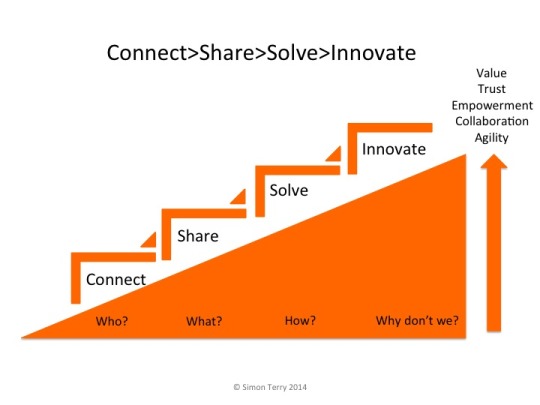
Value is created in enterprise social networks as people connect, share, solve and innovate together. That value creation is an outcome of the work people choose to do together. Measuring the activity in the technology isn’t a measure of the value created, it is simply a measure of adoption. The value of the adoption comes from the organisations strategy and the work of its teams.

However, the features in a typical Yammer post, or any enterprise social network, can give us a guide as to how people come together in networks to work in new ways.  Let’s break down a Yammer post using the Value Maturity Model so see how new organisational value gets created.
image

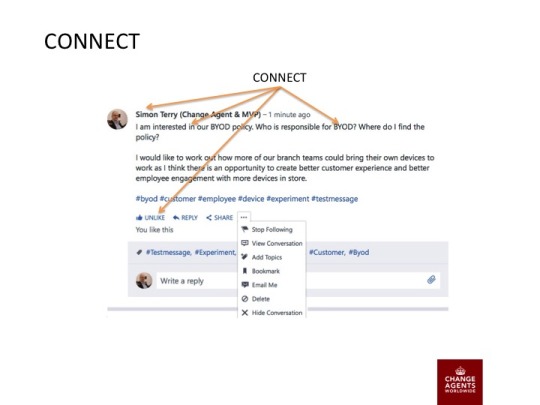
Connection brings people in the organisation together often for the first time.  That connection can be a simple as the feeling of belonging or recognition when a post gets a like. It might be bringing people together around a topic of current need or ongoing mutual interest like a community of interest or a community of practice.  Most directly, connection can be a way in large, distributed or siloed organisations to find the people responsible and get in touch to move work forward. 
image

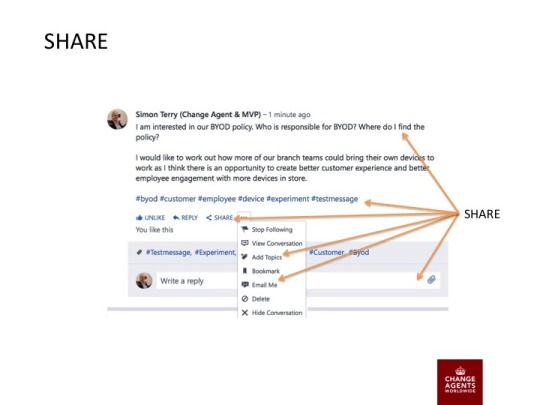
Sharing lifts information out of its hiding places, makes it findable and directs it to people who need to know. That can happen in the enterprise network through replies that answer common questions for everyone’s benefit, provide links to information or provide documents meeting a present need and saving future time and searches.  Shares make sure information reaches the right people whether a group, an individual through a private message or even by taking a message out to email to those who don’t regularly use the network. All sharing is silo-busting. Adding topics, either in a message or later, provides people new ways to navigate information and helps make information searchable. Sharing creates a rich domain for social learning and helps the new employee seeking to learn more. A culture of sharing fosters working out loud to help people achieve personal purposes, bring work to the surface and further increase these benefits. Most importantly of all, this activity helps build a shared and discoverable context for the work of the organisation reducing errors, duplication and improving problem solving and efficiency.

image

Value creation accelerates when an enterprise social network becomes a way for people to come together to work on solving problems. People can ideate, offer solutions and work together in the thread or in groups to discuss ways to solve work problems with existing or new solutions. Having a way to discuss and work through problems in products, policy or process, either through fixes or hacks, helps the organisation continue to flow for those doing the work. The problems raised in this way are able to be solved not just for one user but for everyone in the organisation. The value of these solutions will increase as the problems that teams tackle increase in value. Leaders, experts and creative individuals can help enable the organisation to move past its daily obstacles and create better experiences for customers, employees and other stakeholders. The benefits here are in work in the network and out in the organisation that continuously and responsively improves organisational effectiveness.
image

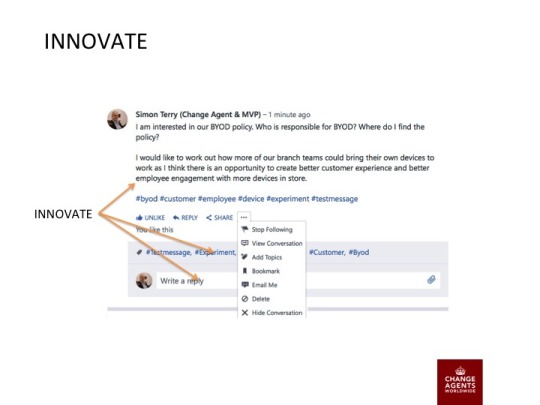
Innovation adds value to the organisation when employees feel enabled and encouraged to put forward possibilities, to seek ways to make them happen and to recruit capabilities and coalitions to experiment and execute on opportunities.  Vibrant communities will work well beyond a single post out into the broader organisation to make their ideas a reality and help the organisation to respond to its opportunities. Innovation allows employees to explore ways to better fulfil the purpose of the firm, to radically reshape the processes of their work and to deliver new forms of value.

image

Building the Goodwill of Networks

Networks give people access to more people than ever before. However, they can also create new inconveniences by allowing people to free ride. Networks are fostered when people are encouraged others to making contributions to others first and to consider in their approaches the value created for others in their requests. These actions, like purposeful and generous working out loud, rebuild the goodwill that free riders consume.

The Network Externality of Free Riders

In economics, an externality is a cost imposed on other people who did not choose to incur it. Free riding is where a person consumes more than their share of a common resource. Every network depends on common resource of goodwill in continuing connection. A common barrier to the development of collaboration in networks is the network externality of thoughtlessness and free riding.

Great networks build up goodwill among the members which facilitates collaboration through trust, shared connection and a sense of reciprocal benefits. Free riders are members of those networks who don’t contribute to the general goodwill. 

The Externality of Thoughtlessnesss

Thoughtless activities in networks consume goodwill because they impose costs on others in the network without any return:

  • Noise: It takes time and effort to filter out noise. Creating noise in networks is costly to everyone. Noise can include repetitive posts, broadcast messages, long rambling messages, diversions from purpose, spam and other forms of low value messages.
  • Laziness: Failing to check that the question you ask has not been answered already or that the answer is not readily available. Let me Google That For You is a great example of a solution to this common occurrence.
  • Confusion: Making a unclear request of the network. In many cases questions are far easier to ask than to answer well. Many people do not think through what others need to be able to answer their query. It takes time and effort to clarify what the issue is and what answers or assistance will be helpful.
  • Selfishness: Making request of others for effort without giving anything back. We have all been asked to help others in our networks. The better requests are respectful of the individual and the network. Most of the requests that come through Linkedin have a clear benefit to the other person but much less consideration on how I might be interested in helping. Responding to these requests takes time and effort which lowers the value of the network and the priority of responding at all.
  • Lack of Follow-through: Making requests that are ambit claims, have unnecessary urgency or where you are not prepared to invest in follow through on the responses others will make. A common issue is when people ask for urgent help and then disappear again without responding to even acknowledge the answers given to their query. 
  • Unclear Benefit: Making unclear offers of benefits. If you suggest something offers ‘exposure’, ‘mutual benefit’, ‘rewards’, ‘an opportunity’ or similar it helps to quantify this in your request. Leaving it for others to discover the meaning of your obscurity imposes costs on others and on you.

There are many more examples. While it may be easy to decline all poorly framed requests, some times opportunity lurks under the thoughtlessness.  The challenge is that the time and effort to respond, to clarify, to negotiate mutual benefit and to help can unduly burden network participants. Suddenly people withdraw from helping others in the network because the collective experience is burdensome. 

Sidenote: Recognise Your Own Value In Networks

Under an avalanche of requests for free time, free help, free speaking engagements, free advice, offers of ‘exposure’ and general lack of consideration, it can be tempting to decide that you have to acquiesce because the whole system works this way. This is even more the case when you are told ‘everyone else’ seems to be doing things on this basis. We are still learning how to manage relationships at scales, timeliness and distances that have never been possible before in human history. Remember always you have choices. The best way to make choices is to respect the value you bring, set your own strategy and set your own rules for the value exchange. That way you take and miss the opportunities you choose, not others. Ask people you trust to help you assess the value you create, if you can’t do it yourself. Grace, humble respect for the value you create and a focus on reciprocity can make magic happen.

Replenishing Goodwill with Purpose, Contributions and Serendipity

One of the reasons that I am a advocate of John Stepper’s work in promoting the value of working out loud is that John has made explicit the value of making contributions to others. Making purposeful contributions to people in your network builds goodwill. It is a great way to start a relationship. People are more likely to assist you if they have seen you making contributions to others. Most importantly of all to make a contribution to another person you need to take the time to think of that other person and their needs.

Goodwill erodes if it is not actively restored by reciprocal benefits in a network. Creating goodwill through consistent contributions to others and serendipitous benefits helps the networks deliver net benefits to participants overcoming the costs imposed by the thoughtless and the deliberate free riders. The more people make purposeful contributions to others the more likely the balance will be a net positive one. For this reason many early online forums excluded lurkers in an effort to foster purposeful participation and reciprocity. The champions, change agents and connectors at the heart of your network will be some of the most purposeful, considerate and generous individuals that you know.

Fostering a culture of working out loud that is purposeful and generous will help any network overcome the challenges of occasional free-riding.

Five Daily Reflections of the Change Agent

Reading Seeds for a Boundless Life, a book on Zen Buddhism by Zenkei Blanch Hartman, I came across a reference to the Upajjhatthana Sutra’s Five Daily Reflections. The Sutra recommends daily reflections to help Buddhists to focus less on their attachments to ego & desires and more upon their actions.

Reflecting on these, I saw a parallel to common challenges for each change agent’s practice of bringing about a better world. Change agents are taking on difficult work, not for the benefits of ego or any personal desire. Change agents act out of a purpose to make an impact that helps others.  At the same time what surprises many who take on change is that the road is harder and more difficult than they ever expected.

Every change agent lives with these five daily reflections:

  • I can’t go back. There is no way to go back.
  • I can’t avoid obstacles. Obstacles are the work.
  • I don’t have forever. Time is limited.
  • Everything changes. Loss is part of that change.
  • My actions and my interactions are how I make the change work.

Once a change agent sees the need to make a change in the world, it becomes impossible to ignore. They can’t wish it away or pretend things are as they were. They can’t undo their commitment to purpose. 

Embracing that commitment means accepting that there will be obstacles to be overcome. The obstacles aren’t inconveniences or distractions. They are the work to be done to bring about the change. 

Time is always a constraint. Time demands we make the most of every opportunities to create change. Time means we must start now. Time means we must involve others.

Just as we must embrace the obstacles we encounter in our work, we must accept that there will be loss in bringing about change. Some things we lose will be important to us and to others. Part of a change agent’s role is to help others understand and manage that loss. 

We have only our actions and our interactions. That is how we bring about change. That is how our change will be judged. Ends don’t justify means. The means are a key part of the change.

Change agents can and do wish it were different. Keeping reflections like these ever in mind helps us to avoid the disillusionment that comes along with unmet expectations and unfulfilled wishes. Change agents are pragmatic and realise that little changes without the hard work to make change happen.

Who is that exactly?

One of the most important questions to ask in any leadership conversation is “Who is that exactly?” Getting beneath the opaque references to people is important to bring real human impacts to the foreground in decision making. Human behaviour is richer and more complex than segmentation and averages can show. Importantly, a specific conversation about people can also surface other impacts, alternative approaches and bias hidden in decisions. 

The Opaque Other

Politicians love opaque phrases to refer to their opponents: ‘the 1%’, ‘big business’, ‘immigrants’, ‘refugees’, ‘special interests’, ‘leaners’, ‘those people’, and so on.  The value of an opaque phrase is that avoids the risk of conflict with the current audience and builds a sense of conflict with an Other that they use to unite that audience. Demagogues have been threatening audiences with an Other since politics began. In an age when sexism, racism and overt discrimination have become less acceptable, the Other needs to take on a more opaque form. Usually when confronted with specific examples or challenged to name who exactly they mean, politicians duck and weave to avoid being more specific. Who they actually mean can be quite surprising to the audience. 

The Opaque Other at Work

The same opaque conversations have drifted into business and social conversations too. It is not unusual to hear that a particular decision will have an adverse impact on ‘retention’, ‘a small segment of customers’, ‘stakeholders’, ‘some performance indicators’, ‘poor performers’ or even just ‘employees’. Behind each of those opaque phrases are real human impacts often on a scale that is far larger and far more important than the phrase indicates.

Asking “who is that exactly?” lifts the curtain on that obscurity and enables a better quality decision. Understanding specific individuals impacted can reveal unintended consequences beneath the averages. Percentages and other statistics are driven by real human decisions by specific customers. I have seen examples where organisations have approved decisions like changes to customer loyalty programs that have a forecast of a minor uptick in customer churn, only to discover later that it adverse impacted the most loyal and most profitable customers. The business impact was far worse than expected. 

Equally changes to organisational structures, processes, performance management, leave, flexible working and other HR policies rarely impact employees equally. While they may looks so in the data used for business decisions, real human employees are rarely fungible. To consider one example, a decision to ‘spill and fill’ a management role in a restructure had a devastating consequence on the business because of the experience that was lost as employees took their talents to market and the market lacked of talent to fill a sudden large demand for lost experience. Had people considered individuals in both the roles and the market first a better decision could have been made.

If you want greater collaboration and innovation at work then you need to get beneath consideration of the opaque bucket called ‘our employees’. Innovation and collaboration are different for specific employee.  They have different meanings, benefits and costs to different people. A successful strategy focuses on real individual employee needs to achieve the organisational outcome.

Turning your conversation to consider the specific people impacted and ensuring that you understand them well before making a decision is important in any conversation. Importantly this is also a key step to make sure the decision is inclusive and not divisive. The consideration may not change the decision but it will make everyone more aware of the risks and impacts. The consideration will also improve the quality of any engagement you have with impacted people as discussions move into implementation.

Asking the simple question “who is that exactly?” will help you to consider the complexity of real people.

Returning to Autonomy

Ubiquitous communication is taking us back to approaches to organisation of work that predated modern communications. The challenge now is not lack of communication. The challenge is the complexity of ubiquitous communication.

image

If you were setting up a business in 1816 and you were going to operate over any distance, you needed to rely on your people to operate autonomously. Through much of the 19th Century as the telegraph, railroads and eventually automobiles arrived, communication and transportation remained slow and costly.  If you relied on instructing a distant workforce through more than an occasional letter or shipment, you were in danger of losing your business. Bureaucracy had been created to enable management on merit and talents and to provide consistent decision making to the management of local autonomy. People hired for trust, autonomy and the creative talents to manage a business because there was no other way to manage local affairs in a volatile changing world.

image

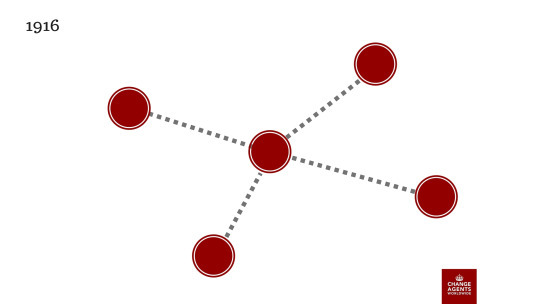
By 1916, the cost of communications and transport had fallen significantly. The technology of management responded by leveraging the communications technology to measure, simplify, standardise and organise. Risk, discretion and variation were eliminated to achieve economies of scale and consistency of quality. Communication technologies enabled the end of autonomy, replacing it with policy, process, hierarchy and management. Bureaucracy enabled by communication took over the art of management in a fast global world. People hired for experience, organisational fit and ability to execute.

image

In 2016, digital communications are ubiquitous, logistic networks cover the world and through technology like 3D printing and digital services we are even beginning to explore options to avoid transportation costs entirely. We have passed beyond exchanging, measuring and recording enough information to manage the business. Now there is too much information for everyone.  Employees, managers, customers and stakeholders are overwhelmed and unable to properly understand and respond to the system of interconnected processes that exist across organisations. 

In this complex adaptive system, we can no longer expect an all powerful centre to see and manage the processes, policies and business. We have returned to autonomy. People are hired for trust, autonomy and the creative talents to manage a business because there is no other way to manage complex affairs in a volatile connected and rapidly changing world.

The organisations that succeed in an interconnected world will be those who enable their people to respond autonomously to their environment, to lead experimentation and adaptation and to apply creative human intelligence to improving the system. New models of management are being developed now to create these responsive organisations

Design the Work

Don’t design workflow for the product features. Design work for the people. Let them improve the process from there.

Features Change

Microsoft MVP Melanie Hohertz, Online Communications Lead of Cargill recently remarked in conversation ‘People need to stop designing workflow in Yammer around product features’. This comment is needs to be more widely understood as it is a key source of frustration for many community managers and their organisations. I am not surprised Melanie would so simply distill the issues vexing community managers with Yammer. Melanie is always insightful about Yammer, based in both her excellent command of the product capabilities but also her expertise in community management.

Cloud software solutions have brought powerful new capability into our organisations. However they have also created havoc with traditional ways of working due to their agile product development methodology.

Processes Don’t Change

The process-centric history of management means we try to turn much of our work into a tightly defined process. Many organisation take agile cloud solutions like Yammer and build their features into tightly structured workflow. This process centric approach doesn’t work.

Yammer’s product development is highly agile. Product features change to a loose roadmap but also as a result of a continuous program of A/B testing. We might wish for greater certainty and transparency, but the agile approach isn’t going to change.

The testing enables Yammer’s product managers to learn from the use of the solution by all their users. Your unique use case of a tightly defined custom workflow won’t fit in this approach. That one workflow is a blip among the way millions of users engage with the tool. Melanie’s insight means that we need to step outside our traditional process-centric view and embrace a people-centric approach.

Collaboration takes Community

The opportunity with collaboration in the future of work is for people to be able to reshape their work. Collaboration is not just a layer over the process. Don’t design a process for the features of the tool. Design around the people, those who do the work. Give them the capability to shape their work. Help them to become more agile and adaptable. Let the people take their work forward from there. People will learn in time to navigate the changing features, adapting them to their needs. The product roadmap matters far less than the creativity and agility of community.

Supported in the right ways, people will improve their work through creating new network connections, sharing information, solving challenges and continuously creating new ways of working. The results will be more agile, more collaborative and more effective.

Algorithms Work Out Loud

Whether we like it or not, working out loud is coming as a work trend. The benefits for productivity, learning and effectiveness from working out loud make greater transparency and connection in our work inevitable. If we do not work out loud, it will be our tools that work out loud for us.

Algorithms Ascendant

If you have any interest in digital trends you will have noted the news that software beat the world’s best Go player 4-1. I’ve played a little Go and even at a much smaller scale than a competition board it is a mind-bendingly tricky game that relies on intuition as well as logic. Software being able to beat a Go master so comprehensively is a significant development because analysts had forecast it could be up to a decade before Go fell. Go is too complex for a simple brute force strategy of computation of possible paths. 

The breakthrough occurred because the Google team developing AlphaGo didn’t just rely on one source of technical expertise or one strategy to beat a Go Master. AlphaGo improved itself by testing multiple strategies in machine learning, specifically learning better models of play each time it watched or played a game of Go.  AlphaGo’s success reflected a key benefit of working out loud – learning through observation and experience of not just one’s own practice but also the practice of other Go algorithms and Go masters.

Algorithmic Insight

Whether we practice working out loud or not, the software around us is already beginning to leverage our work to learn and enhance its effectiveness. Social media sites are all moving to algorithmic display because they can leverage our behaviour and relationships to better meet our needs (& their own business models).  I remember my resistance when Yammer first implemented an algorithmic feed and moved away from following. I thought there was no way that I would value the algorithms choice of messages over my own curation of content through following strategies. These concerns passed quickly in use and it has been a long time since I reflected on the need for a better following model.  Incidentally, Yammer moved to this change as a result of analytics and A/B testing, leveraging the work of thousands of customers to find better ways to build its product.

These algorithms are coming deeper into our work. I recently had a demonstration of Microsoft Office’s Delve and Delve Analytics. My takeaway was here was that I was looking at the potential for algorithms and analytics to turbocharge the value by leveraging a form of passive automation of working out loud. Clearly tools like Delve can help by reducing search, however they can also deliver further benefits for learning, collaboration and business value by helping make working out loud a default practice in the future of work.

Delve offers a key way to address the concerns many critics of working out loud raise. Today working out loud requires an individual to push their work out visibly so that others can pull the work for the purpose of learning or collaboration. That first push upsets some critics as it is seen as contributing to noise, raising the possibility of unconstructive distraction or requiring incremental effort from the worker. My experience is that the benefits far outweigh this minor inconvenience.  However, algorithms and analytics like Delve, change this game by leveraging our working behaviours to pull information and insights from the work of others and make them available to enable us to better learn or to find better practice. 

Solutions like Delve enable all of our working out loud practice to rest on a pull model. If Delve can surface a document that I need to see or I can use from the work of my peers then it doesn’t rely on any more effort from my peer that to enable this sharing and configure privacy and security settings. If Delve Analytics can help me to learn how better to use Microsoft’s productivity tools by supplying insights on my use and that of my peers, then again it does not require my colleagues to measure, document and share their approaches. A similar example is that Swoop Analytics have now released Swoop personas to enable each user of an enterprise social network like Yammer to understand their personal style and effectiveness in the use of the platform. 

The trajectory of innovation is that these algorithms will be increasingly effective and increasingly deeply integrated into our products.

Is that it?

If algorithms are the answer, it that it? Do we no longer need the human practice of working out loud? Why don’t we just wait?

There is an adoption challenge of sorts with the coming algorithms. Algorithms can help with insight, but they cannot address the human side of openness to learn, willingness to experiment and ability to handle the social elements of working out loud.  We all need to learn to be able to manage new practices and to have mindsets to be able to benefit from the change.  These mindsets stretch from an attitude of generosity, desire for connection, a move from reliance on personal expertise and through to the ability to handle odd moment of embarrassment. If we do not get the mindsets right, then we will miss the benefits of new ways of working.

The value of the practice of working out loud now is that it enables each of us to learn important social skills in the network era: building connections, reciprocity, generosity and how to create and sustain the creation of value in networks.  The networks and the algorithms are not going away. The challenge for all those seeking to be ready for the future of work is to learn how best to leverage these new models.

Just like AlphaGo, those who are already working out loud are discovering new practices and approaches to work through their own work and through watching the practices of others. You can wait for an algorithm to arrive to make the change for you or you can get ahead of the curve and enhance your practice of working out loud.

Factlets

Factlets aren’t facts. Factlets are far more useful. Factlets are the fragments we keep to reassure ourselves we are right. They are the parts of facts that suit your argument.

Truth is irrelevant to a Factlets. All that matters is your argument.

Factlets are quotes from sources we have never checked. Factlets are theories we picked up in conversation. Factlets are opinions that ‘sound right.’ Factlets are that phrase everyone thinks they know without reading the book. Factlets are reassuring statistics devoid of source, method or context. Factlets are history that now has new meaning because new stories suit us better. Factlets are trends from a single data point. Factlets are the simple answer in a complex world. Factlets are easy, comfortable and quick.

Reality is hard, uncomfortable and slow.

Every time you see an argument that depends on one piece of information you will find a factlet. Factlets are bias, distortion and deceit. They dominate our thinking but thrive on a lack of attention. Factlets avoid the effort and inconvenience of real facts and actual knowledge.

Factlets couldn’t be more dangerous to our health, wealth and wellbeing.

Small Changes Accumulate

1 – Make a small change today.

2 – Do it again tomorrow. You have doubled your influence.

4 (2 to the power 2)- The next day invite 3 people to join with you in the next change. You have doubled your influence again.

8 (2 to the power of 3)- The following day ask everyone to bring 1 people to make the next day’s change. 

16 (to the power of 4) – From day five ask everyone to keep adding one person each time you make a change. Spread the message far and wide in your network.

1,073, 741, 824 (2 to the power of 30) – If you can double your influence for 31 days, only one month, you will have over a billion people carrying out that change. 

Most changes you want to make don’t need that many people or that cumulative power for change.  You might not get to double every day for a month, but the further you get down the path of small changes powered by a network, the greater your influence.

Of course, you have no influence until you start making change. Today.