Writing

Happiness is our creation

“Happiness is not a reward – it is a consequence,” Robert Green Ingersoll

Happiness is personal. Happiness is created. Decisions must be made to achieve happiness. Be aware of the decisions you make.

Happiness does not come. Happiness cannot be bought. Happiness is not found in others. Happiness is our creation.

Time is the ultimate allocation of priority. Make happiness a priority. Spend your time where you can be happy. This may require difficult changes to work, lifestyle and income, but you may be surprised at the ease with which happiness comes.

Attitude is for many people a choice. The same circumstances approached with different attitudes produce different levels of happiness. Choose the attitudes that foster happiness. Generosity, forgiveness, openness and a little equanimity go a long way. Seeing yourself as an empowered and responsible actor with choices helps too.

Action brings happiness. Action has an intrinsic value but also leads to better outcomes. If you are not happy, what can you change to be happier? Make small changes. Experiment. Find a way to make things better step by step.

The greatest barrier to happiness is the feeling that things can’t change. We experience enormous change every day. We can find new ways to change those things blocking our happiness. Abandon hopelessness and start making change.

Finding a way forward takes awareness of what gives and takes from your happiness. Without focus on the choices we make they slip by feeling like the force of circumstances. Put a small step of reflection and find new paths to happiness.

Happy New Year

“I have come to the frightening conclusion that I am the decisive element. It is my personal approach that creates the climate. It is my daily mood that makes the weather. I possess tremendous power to make life miserable or joyous. I can be a tool of torture or an instrument of inspiration; I can humiliate or humor, hurt or heal. In all situations, it is my response that decides whether a crisis is escalated or de-escalated, and a person humanized or de-humanized. If we treat people as they are, we make them worse. If we treat people as they ought to be, we help them become what they are capable of becoming.” Johann Wolfgang von Goethe

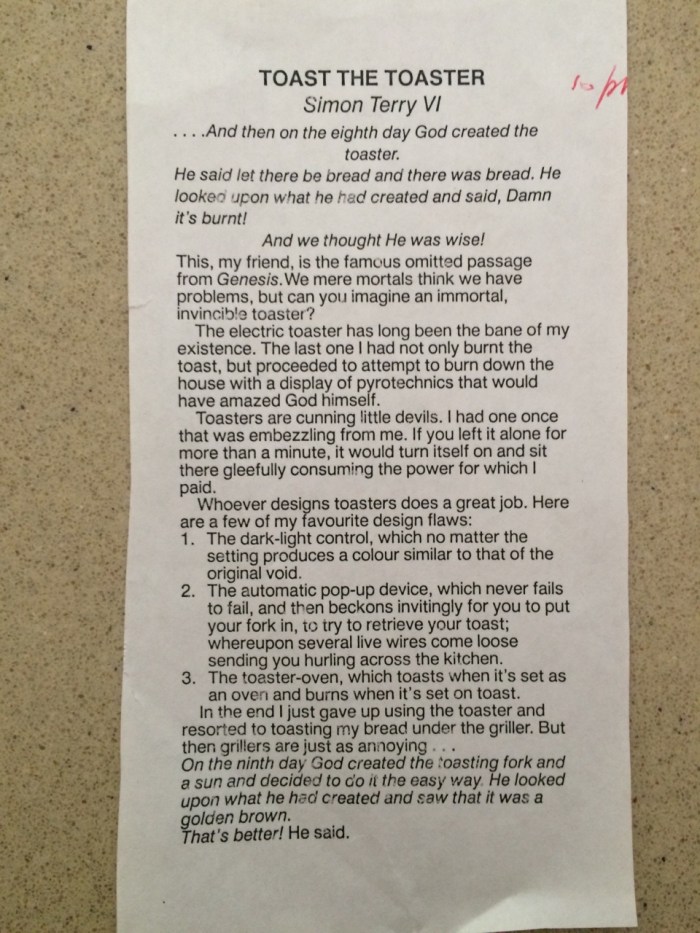
This light hearted essay from my school days resurfaced today. This essay reads many of like my current posts in format & style. An essay was conceived by Montaigne as a test or experiment of ideas. Today I write blogposts to experiment with ideas & to learn the art of writing. There weren’t blogs when I finished school, but essays like these were the experimental foundations for the writing in today’s posts.

A Gift from Blog Secret Santa – The Head and the Heart

This post was anonymously written as part of Blog Secret Santa. There’s a list of all Secret Santa posts, including one written by Simon Terry, on Santa’s list of 2014 gift posts.

I grew up in a 2-parent household, and for many years my dad was the sole breadwinner. He was a truck driver. He worked long, hard hours. And as I started to get into computers and technology, I distinctly recall my dad telling me, “Don’t do what I do. Use your brain.” My parents wanted what was best for me and I took my dad’s words very seriously.

In addition to that advice, I learned over time that using one’s heart is also instrumental in being successful. The path to this point was challenging. During my career I was the person who could do it all, the manager who made mistakes, the glue holding a team together. In each and every case I found that understanding the emotions, needs, and desires of others – and, critically, myself – was instrumental in being successful.

So let’s talk about that all for a moment.

Your co-workers

Having empathy for co-workers is a well-worn path for me. Before I dedicated time to working on myself, I found selflessness to be rather simple; I viewed my role, no matter what it was, as to be a vessel for others. This meant I would quickly and efficiently do what I was asked or told to do. But soon I started asking, “Why?” a lot – not to be a stick in the mud, but to gain greater understanding. I was in positions where I’d ask about business development or technology although I was solidly in a creative, UX, or programming role. This made some people uncomfortable but I found more and more that people really enjoyed talking about their work and having someone listen, understand, and work alongside them.

In one of my prior positions, I was tasked with the redesign of a video streaming product. It was going to involve people from teams across the company. Initially this was scary to me. I wanted to go it alone and figure it out, and be viewed as the super genius. But other parts of me knew this wasn’t the way to get the best product, and get the best support. So I scheduled 30-minute meetings, brief and to-the-point, with the stakeholders to get a sense of what they needed.

But instead of straight-up stakeholder interviews, I approached these meetings as listening sessions. We started with small talk about the project and work, but that quickly gave way to a platform for these individuals to have someone hear them. I listened critically, took notes, and genuinely participated in the conversation. That was what they needed. I learned a lot from them for this project, and was proud to have them count as true collaborators from the start.

Working on yourself

In addition to having empathy for co-workers, it is absolutely critical to have empathy and compassion for yourself. This has been a much harder path for me. For years, I had taken up habits and rituals that put myself last and others first; I saw anything else as selfish or indulgent.

Let me indulge for a moment. You’ve been flying, yes? And you know the safety instructions at the start of every flight? When they get to the point about oxygen masks, a big point is made: take care of yours first before helping others. It’s an excellent analogy. I’ve found that if you have not worked on designing yourself, on observing and understanding your words and actions, it becomes much more difficult to help and serve other people.

I’m not admitting that I’m fully realized, or fully developed. I’m learning new things about myself and the world every moment of every day. But I have a much stronger picture of who I am, what I value, and what I believe. My intentions and goals have led me to find those same beliefs in my family, friends, co-workers, and my employers.

Companies have changed, too

Something I’ve distinctly noticed over my career is a shift in company attitudes towards people. Some organizations, to this day, treat people solely as resources. They even use the word “resources” in non-business speak contexts, which is very telling. More and more, I’ve been attracted to organizations that encourage individuals to be, well, realized. They welcome people with big ideas, a personal brand, and a point of view. And they aren’t looking to quash it; they’re looking to grow on it.

I once joined an organization while I was teaching web design part-time. I loved teaching, and I was good at it. This organization, however, expected me to stop teaching and work 90-100 hours per week. All of this while I was in the planning stages of my wedding! But my work didn’t support or know this, and did not work to understand who I was. My values weren’t aligned with those of the company. I did not listen to what the company was saying, even though it was all implicit. As a result, it was a bad fit.

More recently I’ve worked with organizations that have spoken about all of this right up front: We know you love public speaking. We know you love teaching. And we know you love UX work. We want you to bring that same passion and that same drive to our work for clients and each other. We won’t stop you from doing it. Do it. It makes us stronger. That’s a very, very different perspective, and a very empathetic one.

So when I think about the future of work, I see empathy as the path forward. It’s a prelude to compassion. All of this is very powerful. It begins with ourselves, extends out to our co-workers, and can all be supported by an encouraging workplace.

I took part in Blog Secret Santa this year and this was my awesome gift.  It was great to wake up on Christmas morning and find a blog post under the tree. Thanks anonymous Blog Secret Santa. I love my post and it fits perfectly. Just what I always wanted.

Give Yourself a Gift

‘Tis the season for giving.

One of the best gifts I ever received I gave myself. What will be your gift to yourself this season?

Six years ago at a year end function after a day of making plans for the new year, the team gathered for dinner. Towards the end of that meal my then leader, Matt Lawler said:

‘I’ve been asking you all for commitments all day for next year. Tonight I want you to commit to one thing for yourself next year. What commitment are you going to make to yourself next year?’

That’s a powerful ask. The answers given by the team revealed the value of taking a moment for yourself and committing to something.

My commitment that night became a new habit and the basis of a much better way of working. I committed to make breakfast for my family at least 3 workdays a week. Now it seems a very small commitment, but at the time I was travelling 3 or more days a week. I haven’t been perfrct but I’ve exceeded that commitment in most weeks since.

Why did such a simple gift make a difference?

  • A gift of time: time is the ultimate way to allocate priority. It never comes back. Time with family is precious.
  • A gift of change: By making this commitment I had to change the way I worked. My new habit pushed out old lazy ways of working and gave me voice to argue for better ways for the team to work
  • A gift of perspective: the commitment helped me realise why I was working and where I got pleasure in life. That ultimately drove to the changes that led to the wonderful work & life I have today.

I’ve told Matt since how much that personal commitment gave to me. Here’s a chance to experience a version of same in this season of giving:

‘What are you going to commit to do in 2015 as a gift to yourself?’

Give

The legacy of our smallest gifts is long and strong. What to you may be a moment of effort can be a whole life to another. Give.

A year ago I went to a conference. As I stood around in the lunch break, I was approached by someone who began our conversation with the daunting greeting: ‘Hi Simon, you won’t remember me’. Sadly, at that moment that was mostly true. This conference attendee saved me from my embarrassment with an introduction and went on to thank me for changing their life.

How can you change someone’s life and not know?

The story began four years earlier.

I have an open door policy on career advice. Ask and you at least one conversation. Over the years I had the wonderful opportunity to chat with hundreds of people about their career ambitions.

The conference attendee and I had worked for the same organisation. We had shared time over a cup of coffee to discuss career advice. A frustrated HR analyst was interested in using a passion & expertise for mathematics more in their work. I simply suggested that an analyst with a passion for maths investigate opportunities in data science which was starting to develop into a hot and growing field with a shortage of talent. 

I had never reflected on that conversation again. The advice was simply me sharing something I knew with someone who needed to know it. We never discussed it again.

Now before me was that same analyst who said: ‘I now work as a data scientist. It is the best job I’ve had and I love my work. Thank you’

I was honored to be afforded such thanks. I felt embarrassed to receive any gratitude at all. All the hard work of that career change was done by the person giving thanks. I had done nothing more than point an individual in a new direction with a little piece of knowledge.

Small gifts can enable change

Our smallest gifts can help to change the lives of others. What we know may seem minor to us but to those who don’t know it is a revelation. We might just have the piece that fits in their life or work puzzle.

Serendipitous moments magnify the power of small gifts. Supply your gift at the right time and great change happens because someone or some circumstance is just right for change. Miss that moment and who knows?

This is the power of giving generously and working out loud. Share your knowledge, expertise and capabilities. You cannot know how far your talents go in helping others to make change.

You can’t know your ability to help others until you ask. If you aren’t going to ask, at least share so that they can find it themselves.

‘Tis the season of giving. Give generously. Have a happy festive season.

The Rules of The Organisation: part 1

All good is personal. All negatives are abstract. 
Information must go up. Opinions come down.
Internal facts override external facts.
Internal logic overrides external logic.
Internal outcomes override external outcomes. 
Arbitrary time trumps real time.
Arbitrarily chosen timelines have real consequences. 
Small errors have large consequences. 
Large errors have no consequences.  
Good news must be shared. Bad new must be good news to be shared. 
Decisions are made by the most senior person. 
Work is done by the most junior person. 
The most senior people work internally. The most junior people work externally. 
The most senior people know why. 
The most junior people know how. 
The more senior you are the more you talk about yourself. 
Junior people’s relationships are determined by senior people.
Junior people have too many people to engage.
Senior people determine their own relationships.
Senior people have too few relationships.
Only the most senior person can discuss the things that can’t be discussed. 
Small exceptions cannot be made. Large exceptions can be escalated. 
There is no value in emotion until there is. 
Junior people are fungible until they become senior. Senior people are unique. 
Measure something and it will be done. 
Nothing is done until it is measured. 
Measures matter more than people, but measures relating to people do not matter at all. 
Consistency is a virtue that is inconsistently applied.

Inspired by a post by Euan Semple on The System. ‘Tis the season to be merry. Happy festive season everyone.

The Poetry of Change

image

What is poetry? How can I explain it? And how do I explain it to you in prose? At moments like these prose is a brick through the poet’s window. The fate of the poet is to ignore the broken window and make good use of the brick, and of the draft. A broken window lets in a stranger world, not a familiar outside into a familiar inside, that’s gone to ruin, but rather a type of new encounter of the mind and its art—the air is welcome, the air is unwelcome. And still there’s the poet’s conductor, the cosmic madman in the mind, urging it all to poem. – Rowan Ricardo Phillips

Driving change in organisations can feel at times a little like describing the work of poetry in prose. The change agent speaks a different language and sees a different future. You are inclined to be treated as a madman. The art and poetry of change is embrace the discomfort and to leverage the opposition and disruption to creative ends.

Ignore the Broken Window

Change means breaking things. Many things will need and deserve to be broken. Some will be the things that you don’t want to lose. Many of the most difficult breakages will come from the pressure change puts on personal relationships.

Accept this breakage or jeopardise the change.

There is real personal discomfort for a change agent in this breakage. They can see different ways and want change urgently. Often it takes a long time for others to come on the journey and to ignore the damage of the path to a new future. Things might need to feel more broken before the new ways of working are embedded and effective.  If the people who aren’t coming on change are close friends or powerful players it can be quite uncomfortable.

Accept this discomfort or jeopardise the change.

A change agent understands that there is a greater purpose and benefits from better ways of working. They need to continue to act and share despite the discomfort because only conversation and example will create the path to new change. They need to communicate the change in language others can understand.

Make Good Use of the Brick and the Draft

The disruption of change will draw attention and conflict. The temptation is to seek to minimise this conflict in the approach to change. Attention is a scarce commodity. Conflict will help people focus on the changes and encourage them to understand. Don’t minimise the conflict and focus. Leverage it. Engage people in their own terms. Discuss the issues that people want to address.

Use the brick and accelerate the change.

The conflict of change is also an opportunity to leverage additional external perspective. Invite people to look outside the organisation. Let a draft of new ideas enter the organisation as people seek to understand and engage with the change. Encourage people to look to the networks outside the newly broken windows. Some of these ideas will create new conflict and new opportunities. There will be ideas there to foster and to develop new ways of working.  There will be evidence and case studies that help with the arguments for change

Use the draft and accelerate the change.

Urge it all to poem

Great change takes creativity. Great change finds a new and better ways of engaging others. Change Agents need to leverage creativity in their circumstances to make a poem of their change to a world speaking prose.

The Gap & The Value: Mastery, Professionalism and Self-confidence

image

Mastery is important to success as a knowledge worker.  However, a danger lies in the quest for improvement. Knowledge workers can confuse the road ahead with the achievement behind

Mastery focuses on the Gap

Mastery means always looking for ways to improve performance. There is always a gap.  Being self-aware means understanding where those gaps are and working hard to improve on them.  This challenge of improvement is an all consuming quest for many. It is the heart of professionalism.

The challenge of an awareness of shortcomings is that it can distort perceptions. Many highly talented people undervalue their contributions because they measure against perfection not above the bar for performance. It is not uncommon to find the greater the expertise the greater the awareness of the shortcomings and the less aware people are of their unique contributions. 

Performance management processes often reinforce this impact because of the economic incentives in managing down perceptions of performance and reinforcing the quest for improvement. The imposter syndrome is another consequence of awareness of shortcomings. A much more common consequence is a lack of confidence in sharing one’s work, promoting one’s expertise and the value that you bring. This can be devastating for career success when there are significant benefits to sharing your work and building a reputation for expertise.

Success requires focus on the Value

The unique value a professional knowledge worker creates is how they bring their expertise, skills and networks to bear on each problem and how this exceeds the standard of the average peer. An individual who is practising mastery will soon find themselves moving ahead of this level of performance. To understand their value, this professional must keep their eyes on the goal ahead and the bar behind. Both are moving all the time.  

The gap from average performance is unique value. A professional knowledge worker needs to understand this well and capable of being articulated. Self-awareness demands an understanding of both strengths and shortcomings. This self-awareness helps measure the value that is the basis of rewards to knowledge work.

The value and quality of knowledge work can be hard to assess. Price, reputation, networks and confidence all play a role in assessing the quality of knowledge work. Many talented knowledge workers are frustrated that less capable people have higher returns and bigger reputations. Unsurprisingly the difference is usually self-confidence and a willingness to promote. Nobody will believe in your value if you don’t.

Confidence in this value is an important foundation of success because it will influence your ability to argue for the value of your work and promote your achievements. Measure yourself not just against the road ahead but also by the achievement behind.

Reflections on Mastery & MCO

image

photo credit: Melbourne Chamber Orchestra Photo of Bill Hennessy, Artistic Director

Tonight was the Melbourne Chamber Orchestra’s celebration of a wonderful year. I was honoured to join the event as a board member. 2014 was a year in which the orchestra performed more than the prior two years combined, covered the distance from Melbourne to Mackay in its regional touring program inside the state of Victoria and entertained over 10,000 people with the artistry of their music. 

Mastery

Discussing the year with Bill Hennessy, the Artistic Director, and the other artists, I was not surprised that the conversations often turned to a discussion of mastery of one form or another. To choose a career in music is to choose a quest for mastery with the associated joys and frustrations. 

This is a group that knows well that mastery is not a designation or a destination, but endless determination. Artists understand that they must practice, rehearse, find more new ways to perform, share their expertise and constantly push themselves to better their art. The Melbourne Chamber Orchestra is only one vehicle in their quest but an important opportunity to perform, to explore the chamber music repertoire and to learn from others.

Mastery & Flow

The most remarkable rewards of this effort are the experience of flow. That moment when a greater challenge matches rising skills and pushes them further forward. The struggles drop away and there is an intensity of focus on performance itself. 

Sharing that experience with others, both artists and audience, is a remarkable event. The music generated makes the hair on your neck stand with its artistry, passion, energy and intimacy. An MCO concert or any chamber music concert is an opportunity to see, hear and feel this in action.

Mastery & Community

In pursuit of mastery and a life, Musicians are freelancers in a global economy of talent. Artist there tonight will be performing around Australia and the world before the next MCO performance begins the 2015 season. Their success depends on patrons, networks but above all the ever growing quality of their performances. We are lucky that they choose to base themselves in Melbourne to share their talents with us and to contribute to Melbourne’s rich musical community.

As the world of work changes, there is much we can learn from these artists on the importance of the quest for mastery. Our work is never done. We can get better. We must practice, learn and work. We need greater challenges to perform better. Our work can flow. Most of all we need communities who support us to perform at our best.

To learn more about MCO and its 2015 season, see mco.org.au