When we launched Change Agents Worldwide back in January 2013 we wanted to experiment with a new kind of organizational model. We wanted to create a commercial enterprise that was effectively, a network.
Very excited by the opportunities of helping realise the potential of the Change Agents Worldwide Network. If we are to learn how to manage the future of work, it begins with new forms of practice.
In the last century management’s overwhelming focus was efficiency. An industrial mindset influenced our definition of effectiveness to be driven largely by delivering more for less.
The influence was straight forward. The efficiency of a machine is how well it turns inputs into its fixed outputs. If a machine’s quality is stable (a risky but common assumption), then a focus on efficiency works as a proxy for effectiveness. Effectiveness slipped from sight in a period of unmet consumer demand, long growth and expanding global markets. We focused our organisations almost solely on efficiency. When changes in effectiveness were required, they came in the form of new disruptive innovators and innovations that rewrote the quality definition and a focus on efficiency resumed.
Human effectiveness cannot be defined as simply as that of a machine. Our traditional industrial machines turn simple inputs through process steps into fixed outputs. Humans can be reduced to that work too. For many organisations it became the goal of human work to make it fixed, repetitive and predictable. It is not a surprise that they discovered that the quality of this repetitive work was rarely stable.
Humans are capable of more than machine work. We are also capable of turning complex and diverse inputs into a simple open-ended output, like an action, a decision, a sentence, a service, a piece of knowledge or a song. Suddenly we can’t assume that inputs are consistent, quality is stable and that outputs are known. Our proxy has broken down and we need to return to a more direct focus on effectiveness.
The last decade has seen the slow rise of effectiveness as a management challenge and management grappling with new skills:
quality movements, continuous improvement and other disciplines have revisited the assumption around stable quality and even stretched to query whether the predetermined output matches what customers need
customer experience, design and similar disciplines have begun to look at the potential to shape new and better effectiveness of our products and experiences.
increasing focus on disruptive innovation has raised the challenge of why the traditional model must break and new strategy models query the narrow focus on efficiency vs other ways to achieve greater effectiveness (see Blue Ocean Strategy, Roger Martin, etc)
realisations about the shifting nature of work has caused many to reflect on whether efficiency is the best or at least only model for connected knowledge workers or any other role.
consumers questioning the need, quality, sustainability, morality, environmental and social impact of the products of industrial machine models
examining new models of leadership, organisation and development of people that encourage the development of true human effectiveness and realise untapped human potential.
rearguard actions to find ever more efficient machines (robots, big data, management algorithms, etc) that can replace humans in increasingly complex roles and work.
Responsive organisations recognise that the proxy of efficiency for effectiveness is fundamentally broken. The skills of efficiency remain relevant but they can no longer replace a focus on effectiveness.
The rise of effectiveness is on us. Our challenge is to adapt our approaches to work to make the most of our opportunities, not just to minimise our waste.
Every career choice is a hypothesis. Test yourself on your proposition and be prepared to pivot and adapt.
Starting Myself
When I left my corporate role, my initial plans were a little vague. I knew I wanted better balance in my life. I knew I wanted to have a bigger impact on my personal purpose and I was prepared to make changes. I was deliberately taking time off to reflect but I wasn’t yet sure of whether I wanted another job or to start a business.
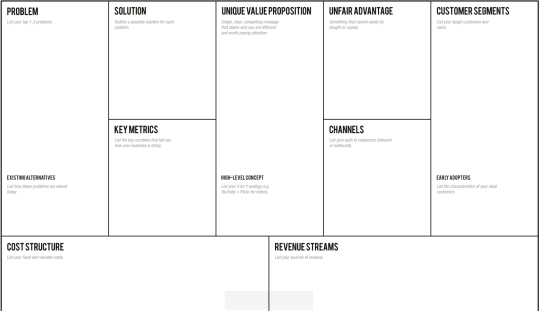
Because I had been involved in a startup, I had followed the development of Lean Startup thinking with keen interest. I also had ongoing conversations, with founders using the approach. As I pondered what to do with my career, I realised I had a chance to do the lean startup of me.
Expand Your Hypotheses
I had a few ideas of what I wanted to be involved in as I searched for new work and roles. These were my initial hypotheses. Some of these have proved to be valuable. Many were ruled out quickly because nobody else was interested in my offer or because the circumstances didn’t deliver the returns or impact on purpose that I wanted.
A simple example was that I initially thought I had an opportunity to work with startups or medium sized businesses. Firstly, these proved to be two completely different hypotheses with little overlap. In both cases, I found when there was money to pay mostly they didn’t want advice, they wanted outsourced management, access to my networks or some other proposition.
Also, I quickly discovered my initial hypotheses were too narrow and limited. People also started to offer me opportunities to do things that I had never considered before. Some of those opportunities, like the chance to join Change Agents Worldwide, to go to Do Lectures Australia, or the opportunity to work on development of a corporate university helped me expand my sense of what was possible.
Working through the hypotheses and pushing myself to consider the widest possible impact on purpose changed the work I do and the organisations that I chose to target dramatically. Along the journey I stopped looking for a job and became a consultant actively working in the future of work, customer experience and leadership (and starting up the business of me).
Relentlessly Test Hypotheses
You don’t know until you do. The only way to determine whether a proposition you have offers value is if someone is prepared to pay you enough and consistently enough to do it. There’s two points there:
You need to do stuff
People need to pay you consistently
When you are starting yourself up, there is a phase of networking and building profile. The danger is that networking and profile can be all consuming. Coffee and conferences can become your job. Growing networks can become your only return.
Get in and do things. Think like a startup and push yourself to do work every day. If you need to create a project to work on it, then do so. I found the best sales tool was when I was suddenly unavailable due to the volume of work. People started calling with work because I didn’t have time for coffee.
It surprised me how many people expected me to do work without being paid for it. I have done a few of those activities, not for the much offered ‘exposure’ but to prove to myself & others the value I can bring in an activity. However, once that is proved once it is time to make money or move on. Continued offers to work for free is a failed test of a hypothesis. Some times people will only pay when you’ve said no several times first.
Be Lean
Invest small and widely. There will be lots of temptations to put all your eggs in one basket, but remember each opportunity is a hypothesis to be tested. You don’t want to over invest in a proposition that won’t continue. I have turned down investment opportunities, jobs and partnership opportunities for this reason. I ended up deciding the best current scale for my business is me supported by amazing networks of the best talent from around the world, Change Agents Worldwide.
When someone asks me to go all in, I work with them to start with a small test instead. That way we both get to work out what is working and how much we want to invest together.
Remember time is the commodity that you have in greatest scarcity. Allocate your time to investments in your future with care. When people are wasting your time or don’t value it, allocate your time elsewhere.
Build Platforms
The power of a platform, channels or a consistent community is the ability to run many tests at once. Startups use platforms to learn faster. You can do the same.
Your network is a platform. Strengthen it (remembering your network is not your job). Your thought leadership activities are another platform (remembering it rarely pays the bills). Work with people who have platforms to run better and faster tests on your propositions.
International Working Out Loud week was born out of some casual conversations and unmet needs. It was a fun experiment. As we work to develop the idea further, it offers a platform for additional experiments in the potential of working out loud as a proposition to help others.
Pivot or Persevere
Every day as you test your hypotheses you are going to adapt what you do. You will make small and large pivots. When things work you will persevere and work to scale them like mad.
Recognise also that somethings that work don’t scale. For example, I have put on hold plans to work with a range of startups in favour of working on a few businesses like Sidekicker where we share a view of what it will take to realise a big potential.
I don’t see my pivots as failures. They are just opportunities to wait for better timing, a better understanding of a client segment or a better proposition. I know I will do work with more organisations in healthcare or more medium sized businesses. It is just a matter of finding the right proposition. While I wait I work still, building capabilities that will help in that eventual proposition.
Be Uniquely You
When I started my work, I wanted to be like all the other successful people. Over time, I realised my unfair advantage was being me.
My skills and experiences are relatively unique at least in the markets that I am working in. That is a very good thing. Trying to make myself more like others dilutes my unique value.
Some people won’t like your uniqueness. You also won’t enjoy working for them. If being you is not good enough for some, that is a failed test and it is time to move on and find someone who wants you for you.
The Lean Startup of You
You don’t need to quit your job, start a business or to become an independent consultant to apply lean startup thinking to your career. Start asking yourself how you create the most value, how you can do more of that and experiment to make it possible. You might find it requires a change of job over time but a lot can be accomplished right where you are now.
The power of a lean startup mindset is accelerated learning. Make sure you are putting what you learn into new actions.
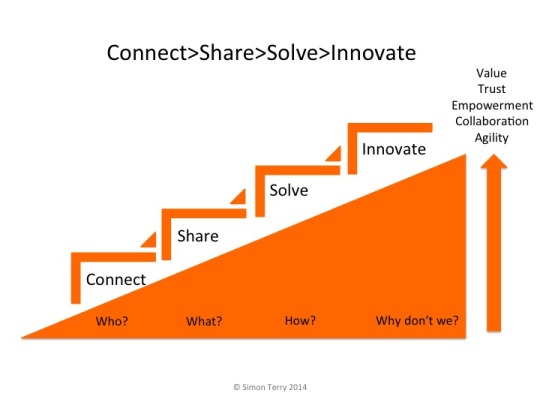
Connect is the first stage of the Value Maturity Model of collaboration because connection is what creates a network. Until people are connected together you don’t have any ability for someone to exceed their individual potential.
Connection only gets you a network. One of the reasons many people have been disappointed by their enterprise social network or their social media strategy is that they have not seen beyond creating the connections. A network has no vision. A network has no purpose. A network is neutral in creating value.
Community = Value
Community creates the value. Community is how people come together to share their talents and create greater value together. Communities can create visions, realise the shared purposes of individuals and work together to achieve more.
Network connection happens immediately. Community develops over time as people learn to trust others and as people learn the new interactions that create value for themselves and others. Sharing, solving problems and innovating together deepens the community and enables individuals to grow in their potential. These communities also always exist within larger communities, like companies and society, that are often more important in shaping the way people act.
People = Potential
Focus on the potential of human communities. Remember that bringing people together in a network is just the beginning of the potential that people can create. Communities will mature with common goals, leadership and action over time.
The levers of competitive advantage drive evolutionary change in business. As our economic society changes with new transportation, energy and information technologies relative advantage shifts and the thriving business change. With the proviso that any gross generalisation is untrue in a particular case, here’s a brief sweep over economic history.
Before the 19th century, an organisations best competitive advantage was its location. Transportation, energy and information costs made location a critical and often insurmountable advantage.
In the 19th century, an organisation’s best competitive advantage was ownership of an asset or technology. New energy sources, new information channels and new transportation options enabled new scale in monopolies and new returns from asset ownership.
In the 20th century an organisation’s competitive advantage was its efficiency in use of information and processes. Global consumer markets and long periods of economic growth rewarded those who optimised their execution for efficiency to reach these markets at a cost or margin advantage.
Now an organisation’s competitive advantage is its people. Organisations need the mindsets, culture, talents and other capabilities to adapt each day to a world of information transparency, global networked connection and rapid change. The effectiveness of people matters even more, if business must adapt to new approaches to use of energy. The effectiveness of a Responsiveorg comes from every employee better leveraging their information, networks and capabilities.
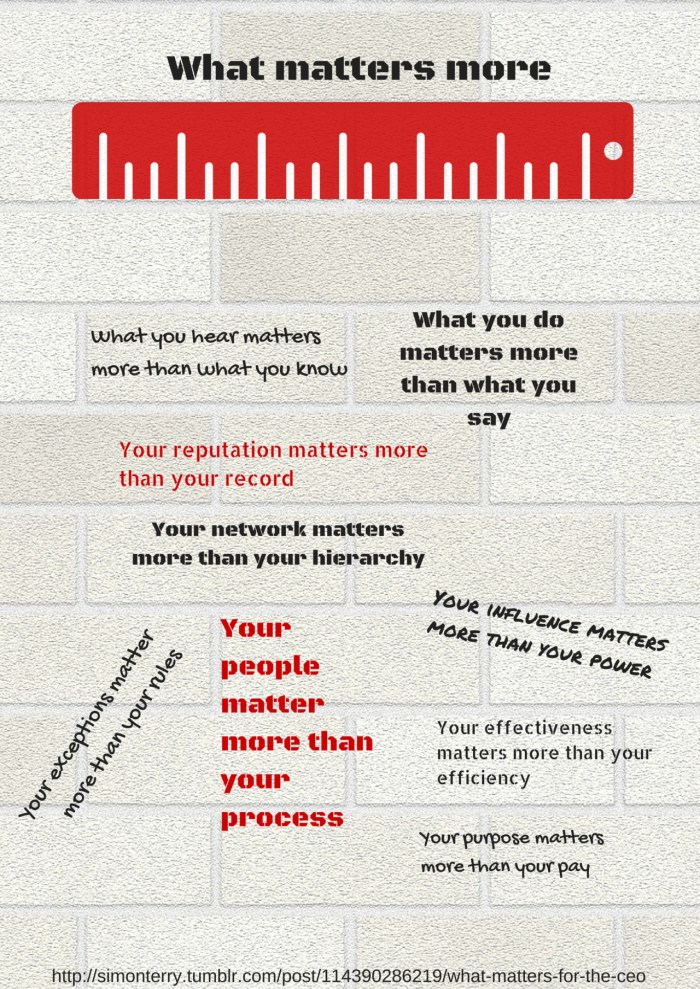
Looking up the hierarchy employees can believe that being CEO must be a game changing experience. However, the reality is that the imagined power comes with its own constraints. Here are a few words for the new CEO (or any new manager) on what matters. This is where the reality and the illusion diverge:
What You Hear Matters More Than What You Know: You have plans and agendas. You know the place & the ropes. You have great skills, knowledge and wisdom. Show it by going and listening to the people who matter most – those doing the work, your customers and your community. Ask their views and change your own. Let what you hear guide what you do.
What You Do Matters More Than What You Say: You are surrounded now by people who want to listen to you. You are supported by teams of professional communicators. You can order an expensive new brand campaign if you want. You have a soapbox but the smartest way to roll is to get down off the soapbox and go to work. Let others work out who you are by what you do.
Your Reputation Matters More Than Your Record: You must have a great record or you wouldn’t have the job. Nobody cares about what you did now. They only care about how you did it. The how determines your reputation internally and externally. Everything you do is added or subtracted from your reputation. Everybody wants to discuss your reputation because they want to predict what you will do next. Your reputation has more influence on what you will get done than you think.
Your Influence Matters More Than Your Power: Congratulations on being top of the hierarchy (excepting of course for your accountability to the board, the chair, shareholders, analysts, community activists, politicians, your family, and anyone who ever had a view about your company, etc). You have the power now, but mostly you can’t use it. You can’t sack everyone. You can’t survive a revolt. You can’t do the work yourself. You can’t answer every question. Accept that with all your power the best way to get anything done is still with influence, the same way you climbed the ladder.
Your Network Matters More Than Your Hierarchy: The hierarchy mutes your influence. A hierarchy is only one part of your network. Some of your direct reports are openly campaigning for your job. You’ve been there and you know they won’t wait long. The further down the hierarchy you go the less your voice is heard and understood. Importantly, you are now the face of the organisation to customers and the community. Looking down the hierarchy won’t help you deal with those critical stakeholders. Start leveraging the networks through and around the organisation. Those networks helped you on the way up and they will help you now. That’s where you should use your influence. The network magnifies your influence. That’s where you do your best work.
Your People Matter More Than Your Process: Nothing in the organisation gets done without people. The best processes, technology and organisations will fall apart without the right people. Start focusing on building their capabilities and changing the processes to adapt where required. Your customers and community will appreciate the immediate increase in your organisation’s responsiveness.
Your Exceptions Matter More Than Your Rules: If everything was predictable, great people wouldn’t be required. Focus on how you identify, manage and adapt for exceptions, anomalies and surprises. Don’t let your team explain them away. Many exceptions hide insights, risks, threats or breakdowns that your current processes can’t handle. Exceptions are where the disruptive innovations lurk and where reputations are won or lost. See exceptions as a chance for you to lead make changes, especially to help your people and your customers.
Your Effectiveness Matters More Than Your Efficiency: Your new staff are going to make your life extremely efficient. They will quickly create a schedule, cut access and manage a protective bubble of carefully selected information. That’s the best way for them to make their life easy and predictable again. However, obstacles are the work, exceptions hide insights and you will need to experiment on your personal effectiveness. Without slack, freedom to connect and thinking time you won’t be able to do this. Incidentally the need to focus on effectiveness of purpose goes for the whole organisation too (see ResponsiveOrg).
Your Purpose Matters More Than Your Pay: You’ve spent a lot of the crazy pay already and here I am saying it doesn’t matter. What matters is the impact you have on the world. The internal motivator called purpose pushed you so hard to get here. You wanted to make a mark, not cash. Delivering on purpose is what makes the role worth doing and will be how your tenure is judged. Years from now you will barely remember the money but you will see the faces of those in the network around the organisations whose lives you changed. Which way do you want to influence their lives? Let’s hope they are smiling later.
The Job Matters More Than You: Unless you are a founder or a complete failure, the role you play existed before you came along and will exist afterwards. That role means a lot to the hopes and dreams of all the employees, customers and community. Those dreams deserve your respect. The role is not yours. You are no better because you have it. You are just the current steward. Leave it better for the next person and make sure that you have the influence to choose them wisely. That may be the best legacy you can leave.
Following on from my recent posts on accountability in networks, I was asked recently whether a network could be accountable for an action or an outcome over an individual. This is an important question as we move into new ways of working. Anxiety over changes from the perceived effectiveness of alternatives to hierarchical models of accountability is a major barrier to management adoption.
Answering a question about accountability usually involves a number of layers because management tends to be vague when it uses the term accountability. The linearity of hierarchy makes accountability an easy concept to use loosely. Hierarchy often conflates accountability to make decisions, accountability for the outcome and responsibility to do the work
Let’s pull apart each of these meanings of accountability.
However you will need the holder of the accountability to understand the network leadership required to ensure the outcome from the network. This is why CEOs should not fear working like a network. It is how they actually work. Most CEOs know their orders go through so many layers that influence and authority in the organisational network matters more than the power inherent in their order.
Accountability in a Group
If you wish for network accountability, remember every network has sub-networks that will hold & manage that accountability on behalf of the group and manage the responsibility of other sub-networks to do all or part of the work. An every day example is a board of a volunteer, movement or not for profit organisation. Often the accountability can be diffused in a formal or informal executive committee of managers, the chair and other key influencers. The responsibilities for work are widely spread in free agent volunteers. This kind of accountability works but requires strong leadership in the group and the wider network.
Remember human networks have lots of accountability mechanisms like gossip, trust, reputation, authority, shunning and ultimately exclusion to manage situations where there may not be a hiearchical power to enforce accountabilities. Many of these techniques work without resort to force even against countervailing power. There’s a good reason volunteer organisations have lots of ructions.
Accountability to Decide
If you focus specifically on accountability as defining who holds the decision making rights, then network accountability needs a decision making system. Humans have lots of network decision making systems from consensus to democracy to more authority based models.
Networks work
Networks are how humans get stuff done. We have solved these issues in our history. Jon Husband’s definition of wirearchy captures this capability of networks neatly:
“a dynamic two-way flow of power and authority, based on knowledge, trust, credibility and a focus on results, enabled by interconnected people and technology”.
We need to work differently and we need to use different approaches to leadership, trust and authority to make network accountabilities work. That doesn’t make it less effective. Managers just need to learn new skills to leverage the exponential potential of human networks.
“the 21st century definition of a startup: A startup is a temporary organization designed to search for a repeatable and scalable business model… The corollary for a large company is: A company is a permanent organization designed to execute a repeatable and scalable business model.”
These definitions are useful and highly accurate. Most large organisations have chosen to focus on efficiency in execution of a business model as the rationale behind their efforts.
However, it is important to note that a corollary may follow but does not always preclude other logical alternatives. Breaking apart Blank’s structure there are a number of different elements in play:
the duration of the organisation: temporary vs permanent
the process of the organisation: search vs execution of a repeatable and scalable business model
an implicit difference between effectiveness of a search and efficiency of execution
Importantly there are other options that could be chosen for these spots in Blank’s definition:
Rather than looking at duration we could look at the ability of the organisation to change – adaptability with a scale from the highly adaptable startup to the fixed processes and systems of efficiency oriented large scale organisations.
Rather than focusing on process efficiency we could focus on effectiveness of process at achieving purpose – no scalable business models is permanently enduring; they must be subject to eternal change to be more effective and to better achieve the outcomes for which people came together.
From this we can see that there is at least one more logical model to chose. Let’s define a responsive organisation thus:
“a responsive organisation: is an adaptive organisation designed to search for more effective ways to execute a repeatable and scalable business model.”
Blank is right that you can’t behave like a start-up if you are trying to be efficient in execution and startups should not be judged by efficiency of execution. However there are more than two models for an organisation to choose. Large organisations can be responsive but they need to choose to adapt and be more effective.