Simple thinking is good. Clear thinking is great. Occam’s razor works.
Simplistic thinking takes simplicity too far. There is too much of a good thing.
Simplistic cuts down the complexity, averages out the uniqueness and narrows the debate. What gets left out are the insights, the opportunities to grow and the potential to do differently.
Change doesn’t just happen. Your leadership opportunity is that things bother you enough to make change. Make change happen.
There is an insight in the image above from Michelle Williams. Most people simply can’t be bothered. These are the people who say ‘surely someone is responsible for fixing that’ or ‘I am sure that change would be too hard’.
Of the few who do start to act, many abandon action at the first difficulties.
The responsibility to lead change often falls to those who chose to act differently. People want change but they can’t be bothered. When they see someone who acts, they can get on board or at least not get in the way. Authority to lead is given to those who chose to act.
Change is hard. It doesn’t just happen. Take what is bothering you. Find more people who are bothered too. Turn your collective concern into action. Persist.
That annoying bother won’t be fixed any other way.
One of the remarkable discoveries of the field of study called complex systems is how order, or what physicists call a lack of entropy, can be created out of seeming randomness by individuals or agents following a small number of very simple local rules. Such systems are said to be self-organising or self-assembling, and often have so-called emergent properties that were not part of any of the rules. The study of these emergent properties teaches us that it is the local rules themselves, not the finished product, that natural selection or some other selective products sculpted to make the finished product. – Mark Paget, Wired for Culture
Management loves order. That desire for order translates to efforts to plan and specify all the outcomes in the system. Instead, we need to leverage the potential of our organisations by allowing autonomy with simple rules.
The Deadly Entropy of Specifications
Specifying everything in a complex system calcifies the ability of the system to adapt to change. This is when management becomes bureaucracy. If there is only one predetermined process and one predetermined outcome, then individual employees are just cogs in a machine of work to achieve that outcome. However, we rarely find the expected efficiency in that machine. To start, the complexity of the machine prevents us from specifying our outcomes as clearly as we would like.
In addition, people are not machines and the world is not static or predictable. People can do more. They want to help and they want to respond to their environment. They learn more, change things, interpret, and reorganise things locally. However, our fixed system of outcomes won’t allow it. We find other people and a changing environment rarely enable us to execute the outcomes as simply as we believed.
All our effort to impose order accelerate chaos. Disconnected employees, disconnected processes, silos, poor design and mismatches to the environment accelerate entropy. Our system is not broken. It is working exactly as we intended it just doesn’t prove to be effective enough for a changing competitive environment.
The chaos of disruption is just the force of our environment selecting another organisation that is more effective. The chaos of decay sets in as our predetermined outcomes fall short of the require effectiveness of those who make the selection decisions:
our employees who can work elsewhere
our customers who can buy elsewhere
our communities who can support other businesses (with infrastructure, regulation, licenses to operate and valuable reputation); and
our investors who can seek better returns elsewhere.
An Alternative: Share Simple Rules & More Potential
Most managers use a few simple pragmatic rules (or heuristics) to do their job. The challenge in organisations is that these heuristic rules aren’t discussed. Manager’s rules are all slightly different in their effectiveness. Some of these rules will survive by promotion and be shared by role modelling, but many won’t surface, simply becoming the mystery of high performance. If nobody shares their rules, there is little ability to learn from more effective rules.
Managers should focus on fostering discussion around these simple rules and encouraging people to adopt the more effective ones. Working out loud is a great vehicle to foster these discussions as it surfaces the how of work in progress. More formally, organisations are experimenting with approaches like holocracy that force the organisation to surface these conversations about the effectiveness of rules, responsibilities and approaches. In time, as these experiments continue we will discover better ways to work and to manage.
Allowing people to operate within the bounds of simple rules enables them to exercise their potential, their local information and the judgment to make the organisation more effective. Simple rules tested for effectiveness are a great bureaucracy killer. For years, Nordstrom had an enviable reputation for customer service by having the simple guideline of “Use your good judgement in all situations.”
Importantly, focusing on simple local rules allows each part of a system to play its role as it sees fit without needing to align to a fixed objective or a higher set of instructions. Employees are challenged to bring their best potential and to be more human, not cogs in a machine.
The focus of this approach is to create enduring effectiveness and a competitive advantage in the organisation based in some simple expectations of the local rules of behaviour. Culture like that represents a critical competitive advantage.
Management is complex enough. Managers are time poor. Their lives are full enough of challenge, change and complexity. They will always be tempted by the one thing that they can buy, hire or do to make life easier. Too many people offer a single magic solution.
There’s no magic solution. Anyone selling the one thing (or the 5 or 55 things) is selling snake oil. Snake oil sells. It can sell like crazy. It just doesn’t work.
Management is hard work. The complex doesn’t simplify well. The choices remain. Change is hard. People are diverse. Obstacles have to be overcome. Things don’t just happen. Management is hard work because the challenge makes it worthy work.
Managers do the hard work of leading teams to realise potential and create value. There’s no snake oil required there.
Many organisations want the benefits of better collaboration and the potential of better leveraging the potential of their people in a community. Increasingly with the availability of enterprise social networking, social mobile apps and integration into other productivity tools, organisations have the network capabilities to create the communities at hand.
A Network with a Demanding Boss
Too many plans for enterprise social networks and communities are developed without any community participation. The organisation wants something from the network. They set about getting that goal. When realising the goal proves harder than they expect, the organisation resorts to communication, performance levers, gamification, or maybe even ‘change management’. Many of these remain efforts to impose an external rationale on a network.
If the goals of a network are imposed externally, it is not a community. It is a network with a demanding boss. Any network of this type will lose energy over time as people query the benefits of their participation.
Use the Network to Create a Community
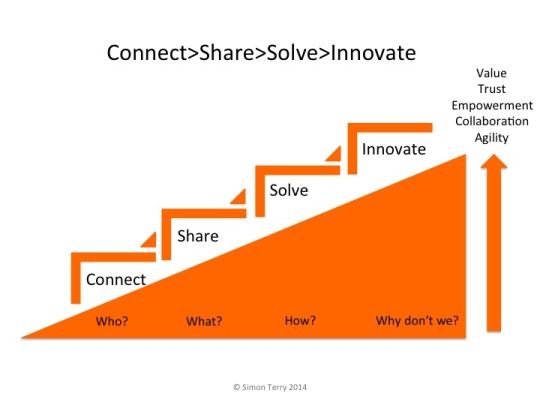
A community comes together around a common set of purposes. Use your network to discover, discuss and align those goals. Engage the people that you would like to form a valuable community to find out how they want to engage. My work shows that people have their own great reasons for adopting the practices that accelerate value at work and build communities. Those practices are those of the Value Maturity Model – Connect>Share>Solve>Innovate.
The organisation’s goals will become a part of that discussion naturally. Everyone works for the organisation and there will be some shared purpose. By engaging people you will discover the greater potential of the community and leverage its rich diversity of talent and perspective.
Ask leaders to lead
Much has been discussed about executive participation in enterprise social networking. Often it is seen as the panacea that will make people do the ‘right things’ in the network. Even the busy senior executives struggle to participate when it is imposed on them as an externally mandated task. Again, the effort is to impose an external logic for networking.
When you focus on the community, what is clear is that what is needed is leaders. We don’t need participation from senior executives, when need people who are willing to take on the role of leader in the community to help the community to achieve its purposes. Leadership should come from senior executives, but it can also come from other community leaders, influencers and champions.
Don’t focus solely on senior executives. Focus on finding leaders willing to help create a community and drive change. These people may well be your organisations mavericks and change agents. Embrace their ability to lead.
The Value Maturity Model is an approach to help organisations create strategic value in collaboration and social networking. The Value Maturity Model Canvas helps organisations to develop agile plans for communities using participation of community members. To learn more, get in touch with Simon Terry via about.me, twitter or Linkedin.
When we launched Change Agents Worldwide back in January 2013 we wanted to experiment with a new kind of organizational model. We wanted to create a commercial enterprise that was effectively, a network.
Very excited by the opportunities of helping realise the potential of the Change Agents Worldwide Network. If we are to learn how to manage the future of work, it begins with new forms of practice.
In the last century management’s overwhelming focus was efficiency. An industrial mindset influenced our definition of effectiveness to be driven largely by delivering more for less.
The influence was straight forward. The efficiency of a machine is how well it turns inputs into its fixed outputs. If a machine’s quality is stable (a risky but common assumption), then a focus on efficiency works as a proxy for effectiveness. Effectiveness slipped from sight in a period of unmet consumer demand, long growth and expanding global markets. We focused our organisations almost solely on efficiency. When changes in effectiveness were required, they came in the form of new disruptive innovators and innovations that rewrote the quality definition and a focus on efficiency resumed.
Human effectiveness cannot be defined as simply as that of a machine. Our traditional industrial machines turn simple inputs through process steps into fixed outputs. Humans can be reduced to that work too. For many organisations it became the goal of human work to make it fixed, repetitive and predictable. It is not a surprise that they discovered that the quality of this repetitive work was rarely stable.
Humans are capable of more than machine work. We are also capable of turning complex and diverse inputs into a simple open-ended output, like an action, a decision, a sentence, a service, a piece of knowledge or a song. Suddenly we can’t assume that inputs are consistent, quality is stable and that outputs are known. Our proxy has broken down and we need to return to a more direct focus on effectiveness.
The last decade has seen the slow rise of effectiveness as a management challenge and management grappling with new skills:
quality movements, continuous improvement and other disciplines have revisited the assumption around stable quality and even stretched to query whether the predetermined output matches what customers need
customer experience, design and similar disciplines have begun to look at the potential to shape new and better effectiveness of our products and experiences.
increasing focus on disruptive innovation has raised the challenge of why the traditional model must break and new strategy models query the narrow focus on efficiency vs other ways to achieve greater effectiveness (see Blue Ocean Strategy, Roger Martin, etc)
realisations about the shifting nature of work has caused many to reflect on whether efficiency is the best or at least only model for connected knowledge workers or any other role.
consumers questioning the need, quality, sustainability, morality, environmental and social impact of the products of industrial machine models
examining new models of leadership, organisation and development of people that encourage the development of true human effectiveness and realise untapped human potential.
rearguard actions to find ever more efficient machines (robots, big data, management algorithms, etc) that can replace humans in increasingly complex roles and work.
Responsive organisations recognise that the proxy of efficiency for effectiveness is fundamentally broken. The skills of efficiency remain relevant but they can no longer replace a focus on effectiveness.
The rise of effectiveness is on us. Our challenge is to adapt our approaches to work to make the most of our opportunities, not just to minimise our waste.
Every career choice is a hypothesis. Test yourself on your proposition and be prepared to pivot and adapt.
Starting Myself
When I left my corporate role, my initial plans were a little vague. I knew I wanted better balance in my life. I knew I wanted to have a bigger impact on my personal purpose and I was prepared to make changes. I was deliberately taking time off to reflect but I wasn’t yet sure of whether I wanted another job or to start a business.
Because I had been involved in a startup, I had followed the development of Lean Startup thinking with keen interest. I also had ongoing conversations, with founders using the approach. As I pondered what to do with my career, I realised I had a chance to do the lean startup of me.
Expand Your Hypotheses
I had a few ideas of what I wanted to be involved in as I searched for new work and roles. These were my initial hypotheses. Some of these have proved to be valuable. Many were ruled out quickly because nobody else was interested in my offer or because the circumstances didn’t deliver the returns or impact on purpose that I wanted.
A simple example was that I initially thought I had an opportunity to work with startups or medium sized businesses. Firstly, these proved to be two completely different hypotheses with little overlap. In both cases, I found when there was money to pay mostly they didn’t want advice, they wanted outsourced management, access to my networks or some other proposition.
Also, I quickly discovered my initial hypotheses were too narrow and limited. People also started to offer me opportunities to do things that I had never considered before. Some of those opportunities, like the chance to join Change Agents Worldwide, to go to Do Lectures Australia, or the opportunity to work on development of a corporate university helped me expand my sense of what was possible.
Working through the hypotheses and pushing myself to consider the widest possible impact on purpose changed the work I do and the organisations that I chose to target dramatically. Along the journey I stopped looking for a job and became a consultant actively working in the future of work, customer experience and leadership (and starting up the business of me).
Relentlessly Test Hypotheses
You don’t know until you do. The only way to determine whether a proposition you have offers value is if someone is prepared to pay you enough and consistently enough to do it. There’s two points there:
You need to do stuff
People need to pay you consistently
When you are starting yourself up, there is a phase of networking and building profile. The danger is that networking and profile can be all consuming. Coffee and conferences can become your job. Growing networks can become your only return.
Get in and do things. Think like a startup and push yourself to do work every day. If you need to create a project to work on it, then do so. I found the best sales tool was when I was suddenly unavailable due to the volume of work. People started calling with work because I didn’t have time for coffee.
It surprised me how many people expected me to do work without being paid for it. I have done a few of those activities, not for the much offered ‘exposure’ but to prove to myself & others the value I can bring in an activity. However, once that is proved once it is time to make money or move on. Continued offers to work for free is a failed test of a hypothesis. Some times people will only pay when you’ve said no several times first.
Be Lean
Invest small and widely. There will be lots of temptations to put all your eggs in one basket, but remember each opportunity is a hypothesis to be tested. You don’t want to over invest in a proposition that won’t continue. I have turned down investment opportunities, jobs and partnership opportunities for this reason. I ended up deciding the best current scale for my business is me supported by amazing networks of the best talent from around the world, Change Agents Worldwide.
When someone asks me to go all in, I work with them to start with a small test instead. That way we both get to work out what is working and how much we want to invest together.
Remember time is the commodity that you have in greatest scarcity. Allocate your time to investments in your future with care. When people are wasting your time or don’t value it, allocate your time elsewhere.
Build Platforms
The power of a platform, channels or a consistent community is the ability to run many tests at once. Startups use platforms to learn faster. You can do the same.
Your network is a platform. Strengthen it (remembering your network is not your job). Your thought leadership activities are another platform (remembering it rarely pays the bills). Work with people who have platforms to run better and faster tests on your propositions.
International Working Out Loud week was born out of some casual conversations and unmet needs. It was a fun experiment. As we work to develop the idea further, it offers a platform for additional experiments in the potential of working out loud as a proposition to help others.
Pivot or Persevere
Every day as you test your hypotheses you are going to adapt what you do. You will make small and large pivots. When things work you will persevere and work to scale them like mad.
Recognise also that somethings that work don’t scale. For example, I have put on hold plans to work with a range of startups in favour of working on a few businesses like Sidekicker where we share a view of what it will take to realise a big potential.
I don’t see my pivots as failures. They are just opportunities to wait for better timing, a better understanding of a client segment or a better proposition. I know I will do work with more organisations in healthcare or more medium sized businesses. It is just a matter of finding the right proposition. While I wait I work still, building capabilities that will help in that eventual proposition.
Be Uniquely You
When I started my work, I wanted to be like all the other successful people. Over time, I realised my unfair advantage was being me.
My skills and experiences are relatively unique at least in the markets that I am working in. That is a very good thing. Trying to make myself more like others dilutes my unique value.
Some people won’t like your uniqueness. You also won’t enjoy working for them. If being you is not good enough for some, that is a failed test and it is time to move on and find someone who wants you for you.
The Lean Startup of You
You don’t need to quit your job, start a business or to become an independent consultant to apply lean startup thinking to your career. Start asking yourself how you create the most value, how you can do more of that and experiment to make it possible. You might find it requires a change of job over time but a lot can be accomplished right where you are now.
The power of a lean startup mindset is accelerated learning. Make sure you are putting what you learn into new actions.