Writing

3 Steps Beyond the Plan

Today I had a powerful conversation with a client looking to take their business beyond being stuck to a plan. You know it is a good conversation when a question stops you in your tracks and makes you think hard. The question that stopped me was:

What process works to help teams move beyond simply following a plan?

I had to admit I didn’t think there was one process. There are no silver bullets. Changing to more responsive and agile ways of working challenges people to adapt. Because the purpose, context, business model and culture is different in every organisation, there is no one answer. 

As we discussed the question, three steps to a more responsive organisation came to the fore in our conversation:

  1. Focus on how value gets created: Plans take over from results when we confuse the tool and the result. Helping everyone in the organisation to understand the purpose and how value gets created gives them a better chance to align to outcomes and to adapt to new ways to create value. The role of a business model canvas is to help make explicit the hidden sources of value and the choices available in other paths to the goal. 
  2. Explore catalytic mechanisms & new questions that keep the focus on new ways to realise value: We settle for a plan when we stop challenging ourselves to find new or better ways. Hard questions keep the focus on the external environment and the need to change and adapt. 
  3. Help people to develop double loop learning: When we have challenging work to do, it is easy to let the work of the process dominate. We focus on getting better in the process. Double loop learning helps us to get better about how we are doing our work. To borrow the language of adaptive leadership it enables people to manage and be on both ‘the balcony and the dance floor’ 

These steps won’t deliver a more responsive & more agile organisation on their own but they will start your change. These can be combined with other tools and practices to create the model that suits your circumstances. 

How do you lead the change to move beyond the plan?

The Digital Workplace & The Platinum Rule

We know the golden rule – ‘treat others as you want to be treated.’  However, as we have better come to understand the diversity of people we have also come to realise there is a better standard.  The platinum rule is ‘treat others as they want to be treated’. The platinum rule should be at the heart of any digital workplace plans. After all, the digital workplace should not meet your needs, it should meet all needs. 

Diverse Needs


I’m not a huge fan of the GIF.  I generally prefer to express something myself because ironic or cultural references can easily go astray. Also easy to use distracting shorthand can often get in the way of effective communication, especially in work contexts. However, I understand that the use of GIFs presents an opportunity for pop culture references, humour, irony, emotional and shorthand exchange. All these help build connection and deepen a sense of shared community. 

I don’t need GIFs to be embedded in every social media platform, but I can understand why they are there. When I hear examples of organizations using GIFs for employee communication and learning, I know that intrapreneurs and Change Agents are leveraging differences to creative ends. 

Building a digital workplace platform for my needs alone would be a mistake. Too many digital workplace strategies are targeted at one user, often a proxy for the manager’s preferences hidden behind a series of employee personas. They fail to account for the diversity of experience, capability, preferences and working style of a real and ever changing base of employees and partners. 

A Platform for All

The platinum rule is important in the design of your digital workplace because it can take you to valuable places far beyond the comfort zone of you, your managers and even your employees. 

One of the key challenges of any digital workplace is ‘you don’t know what you don’t know’. Donald Rumsfeld’s ‘unknown unknowns’ are surprisingly common when introducing new technologies into work patterns & processes. Lock too much down to the needs of one user or a few users and you will miss the ability to adapt and experiment as proficiency and understanding goes. In many cases, employees cannot tell you what they want or will do when they start. Like me when first confronted by a GIF, they go ‘why would I use that?’  


Experimentation and discovery is critical to any digital workplace because it is a way to surface what employees need and support those needs as they evolve. That’s how you remain able to fulfil the platinum rule. Except your job is not to decide for employees what they can and can’t do. You do your job by enabling employees to discover and meet their own changing needs. 

Every Day Work Creates Every Day Trust.

slide1


Effective collaboration in your organisation depends on trust. The best way to build trust in your organisation is through collaborative work.

Trust is a consistent theme of this blog because it is fundamental to effective performance in organisations and social relationships. However, we mostly take it for granted and organisations often go out of their way to remind employees that they are not trusted and should not place their trust in the organisation.

Trust in the Work

One commenter on my recent post on collaboration and every day work suggested I was missing the need for trust to support collaboration. My response was that trust comes through actions and interactions.  Organisations often talk about trust as an abstract and something that can be worked on itself.

The reality of most trust building activities is that they create no trust unless they are connected to the fundamental interactions of the organisation. Trust is a manifestation of the expectations of interactions in the organisation, i.e. culture. Trust is human. All the fancy trust building exercises will fail if people believe the real interactions that support the work will occur differently.

Founding trust in and around the work to be done is important. Collaboration can deliver this new foundation for trust.  Transparency helps employees better understand what is going on in the organisation.  Networks leverage that transparency to deliver new accountability to help people have confidence in the work of others. Collaboration networks better enable employees to judge the intentions and capability of others based on the past performance in public interactions with others. Each of these interactions fosters a better level of understanding of the potential for trust.

Most importantly of all, collaboration networks can increase the interactions and the experience of generosity between employees. We all find it hard to trust strangers. Sharing a social network enables people to develop a deeper understanding of all of their peers not just those in their own teams.

Organisations that want to increase the level of trust between employees can benefit from focus on encouraging employees to work out loud and seeking opportunities for collaboration in their everyday work.

Get Out of the Way

Organisations also need to take care that they send signals that reinforce the value of collaboration and trust in every day work. Treat collaboration as inherently risky and you will discourage your employees from participating, trusting their colleagues and trusting the organisation.

When collaboration technology enables new interactions in an organisation, it can be easy to identify all the new risks that can be created. The traditional corporate approach to risk is risk elimination. Why not turn off the solution or the feature that creates the risk so that there’s no exposure to one poor decision by an employee. However, to avoid a rare event, this approach either excludes collaboration opportunities from the organisation or signals to employees that they cannot be trusted.

A better management of those risks is to place accountability on employees to manage the risks, both for themselves and others. That is a signal of trust in your employees and your willingness to make them responsible for a better workplace. That’s usually how you manage those risks outside collaboration technology where you have less control over what employees say and do anyway. Treating collaboration technology as specially unsafe is a bad signal for trust and ignores the opportunity to teach employees to the benefit of all the work.

This last point is significant. Trust, collaboration, agency and agility that you grow in your collaboration platform doesn’t stay there. Each of these capabilities are based in our human characteristics and follow wherever your employees go. They spread through the whole organisation. Manage trust well in the collaboration of every day work and the whole organisation will benefit.

Do You Want Power or Entertainment?

I woke up this Sunday and I had a terrible nostalgia for the days where my morning question was not:

“What have the politicians done to entertain us today?”

All around the world politics has become far too similar to a reality television show.  The politicians, the media and our focus is on the daily conflicts, dramas and stupidities. The media environment and the demand of the media audience is far less concerned about leadership (other than the theatre of a leadership contest) than the entertainment of the political show. We have forgotten that the exercise of power for the betterment of society is more important that a following.

Politics is not alone in this confusion. Thought Leadership and other forms of punditry also shows a similar confusion. The accuracy or effectiveness of advice to better society now matters less than the ability to entertain and accumulate an audience. Platitudes and gross simplifications play better than difficult messages or a call to hard work.

Here We Are Now, Entertain Us

Conflict has always entertained humans. Conflict is the key to all our storytelling. Threat based narratives help us understand our tribes and bind together in times of adversity. We can see why politicians and pundits rely on them heavily. Inspirational narratives tend to appeal to our ego, our desire for ease and the uniqueness of our community and suggest the inevitability of our future success as long as we continue to follow the advice of the storyteller. We are suckers for entertainment as the makers of content for our mobile phones are well aware. Politicians, thought leaders, media commentators and even corporate executives are just meeting the market demand.

Increasingly, in the age of mobile devices, entertainment is a solo activity. We have lost much of the collective experience of entertainment that was the standard experience of previous generations. That lack of collective context weakens the foundations of community and hinders collaboration. We need shared context and trust to come together to make change happen. Trust is an outcome of the work and the experiences we share together. If we are each following our own personal entertainment guru, there is a fragmentation of that larger shared community.

As social technology and far better media tools creep into corporate life, we have also seen the rise of the executive as entertainer. Senior management can now engage and cultivate a following internally through collaboration tools and externally through social media and even traditional media roles. For some the dynamic changes from leading to entertaining. Rather than advocating for change and conflict within the organisation, it is easier to demonise an Other, such as a competitor, an external stakeholder or abstraction like errors or waste and demand the attention of a following without pushing people to change themselves. These executives are far less likely to demand challenging change of people themselves for fear that they lose part of their following or that they lose status to someone who promises a more compelling external enemy or an easier life.

We Need Power

We need to do more than meet a market demand for entertainment. We need power to push us beyond the limitations of our own efforts and our own imagination. We need the power to step outside of our individual potential and collaborate with others. The exercise of power in this way is called leadership.

A comment in a recent article on the often hidden role of power in design practice put the issue in a way that helped me see the connection:

The definition of power: the ability to influence an outcome

This quote starkly highlights the connection of power and leadership. We can often confuse power with its past abuses or the privilege that vests it undeservedly or unevenly in others. We can prefer our power to be responsive to the needs of the community. However, as Adam Kahane has pointed out in Power and Love, it is wishful thinking to wish power away or to demand that leaders are only responsive.

Leadership is about influence. Leadership is about achieving outcomes together with and through the work of a community. Without any resulting outcome, all you are doing is entertaining the community with a show. Bringing people together to help address complex social issues is going to take the exercise of power.

We need leadership because we need the action of small self-governing communities of change. That work is the power that matters now. We cannot rely on the politicians, the thought leaders, the senior executives or the experts to deliver us. We will have to do the work of change ourselves.

There are No ‘Successful People’

Thought leaders everywhere on the internet want to tell you what ‘successful people’ do. There is no such thing as ‘successful people’. 

Success is not a group you join. 

Success is not binary. Success is not universal. All success is relative. The best success is personal. 

‘80% of success is turning up’ Woody Allen. 

The other 20% is knowing what to do when you get there & doing it. 

Success is not history. Success is not fame. 

Success is the perceived adequacy of the balance between a few prominent successes and many private failures. 

Success takes hard work and everyone’s work is different. 

Success is not what others think. It is what you achieve. 

Success is context, timing, time, strategy, capability, tactics, networks, reputation, persistence, practice, resilience, adaptation, learning, luck and mystery. There’s no universal formula. There’s no group that has these things when you don’t. What works for one person will fail for others. What works one day won’t work the next. 

Copying is rarely a path to success. 

There’s nothing that ‘successful people’ do. They don’t exist. The world is full of people working hard for their own personal success. Sometimes they succeed. Mostly they don’t. 

Ain’t Nothing Special


slide1

Yesterday I saw a list of all the reasons why people don’t use social technology to collaborate in their work. You know the kind of list: fears, habits, lack of understanding, lack of leadership, etc.  I have to admit I sometimes tire of the focus on the negatives, especially as a sales pitch for consulting work. My response was to point out to the author that at the heart of almost all the points that were raised was a lack of an understanding that collaboration is how work gets done. When we are clear that collaboration is an important part of work then we get over our objections and make it happen.  It also opens us up to consider the most effective ways to connect, share, solve and innovate together.

Ain’t Nothing Special

We can easily fall into the trap of selling collaboration technology as special. We’re adding new technology. Magical things will happen. You can have new conversations. You can do new work here. We will achieve all the abstract goals that you have always wanted like engagement, innovation, customer loyalty, productivity, and much much more. As much as we talk about them, these abstract capitalised nouns remain abstract because they aren’t the work most people are doing.

Positioning collaboration technology as different and special runs straight into a priority problem. Where do I get the time to do this new and different thing? How do I even find the time to learn how to do it?  With new and different also comes risk. What if I aren’t any good at this new magical and different thing?

Positioning collaboration technology as wondrously different also runs into the problem it is not new. This technology has been in use for nearly a decade and stretches back to models of technology that have been around far longer. Why are we talking as if it is special?

What is the Work?

Ask a different question instead. What work in your organisation requires people to collaborate? Focus on the work and not on the technology. Go find all the instances in each of your work processes today where people have to find coworkers to help, share information, share documents, solve problems together and meet and interact around business challenges.  That work is going on right now all around you. Start with the collaboration and bring the technology.

When you start with the collaborative work, you are having a different conversation.  The work is going on. You don’t need anyone to prioritise their time different. You only need them to consider which way will make their work more effective. How could that collaboration be different if they worked out loud? How might it be easier, faster, better quality or otherwise more effective?

Put the collaborative work of your organisation at the heart of your collaboration technology. Your users probably don’t want anything else there.

Talk is Talk. Work is Value

Because collaboration technology is often owned by support areas, we can see it as a communication technology. We can focus far too much on the new conversations that will come along as the community builds. You do not want to position collaboration technology as a place for chat or social interactions.

The purpose of your organisation is the work that you do. That work involves connecting, sharing, solving problems and making change. Do that work in your collaboration technology. Focus obsessively on creating strategic value by connecting to the collaborative work across the organisation. When you do so, you will surprise the organisation with the value that can be created by working differently. You will also find that most of the barriers disappear as people race to be involved.

The Standard You Walk Past

‘The standard you walk past, is the standard you accept’ – Chief of the Army, Lieutenant-General David Morrison

Nobody else is going to fix a hard or complex issue for you. There’s no natural or historical progression to solve the hard problems. Inaction of itself can be a barrier to others acting because as leader it signals acceptance. If you don’t like something, take action today. Otherwise you might just end up owning it.

The quote above is simple. At first flush, it seems intuitive enough. The actions of leaders are watched to set the standard of what is expected in the organisation. Culture is an expectation of how interactions will occur in a community. If the leaders see things and don’t act, then they must be OK.

What creeps up on you when you live with that quote for a while is that it sets an exacting standard. Everything you walk past, you accept and you endorse to others. Each moment of inaction is not just allowing something to continue, it could be helping foster it further by encouraging others that it is acceptable. This standard leaves no exceptions for:

  • the leader’s busy day
  • the importance of other priorities
  • the smallness of the issue
  • the obviousness of the leaders disapproval
  • the timing not being quite right to act
  • the discomfort or embarrassment of the leader or the other; or
  • the relationship of the two people involved.

Excuses to defer action are plentiful. This standard brooks no excuses. It demands action now.

Leaders take their communities on a journey to a better place. They do so by influencing new behaviours and actions on matters large and small. The best leaders tackle challenges in the moment and continuously influence their community for the better.

Next time you are walking by, stop and reflect on what you are owning.

Innovating Health Workshop at #HIC17

Unknown

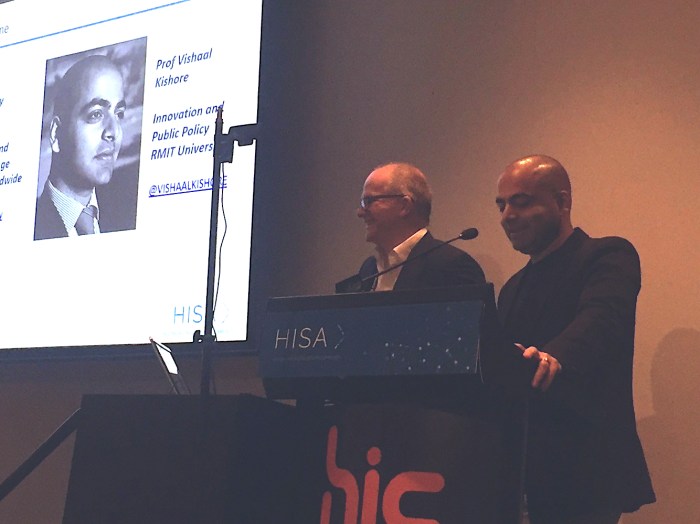
Last week, I helped facilitate the Bringing It Together workshop at the HIC Conference by HISA alongside Vishaal Kishore.  HISA’s Innovating Health series has been an important effort to help catalyse innovation thinking in the healthcare system. I have been proud to play a role in that important challenge in a number of events of the series. Over the year, HISA has brought together leading participants in the healthcare system in conversation on a range of innovation topics. The Innovating Health website summarises those discussions.  The goal of the workshop last week in Brisbane was to help translate the series into tangible actions for participants in the room.

The workshop used a world cafe format to enable the wide range and large number of participants to engage in a variety of topics around healthcare innovation in Australia. Key questions discussed in the rotating groups included:

  • What work is going on now
  • Priorities for Healthcare Innovation
  • Translating Ideas to Action
  • Barriers to Innovation
  • Leading the Change

As with each of the Innovating Health workshops, HISA will be digesting the content of the session, but I wanted to share some reflections on the process we experienced.

Urgency, Purpose and Passion

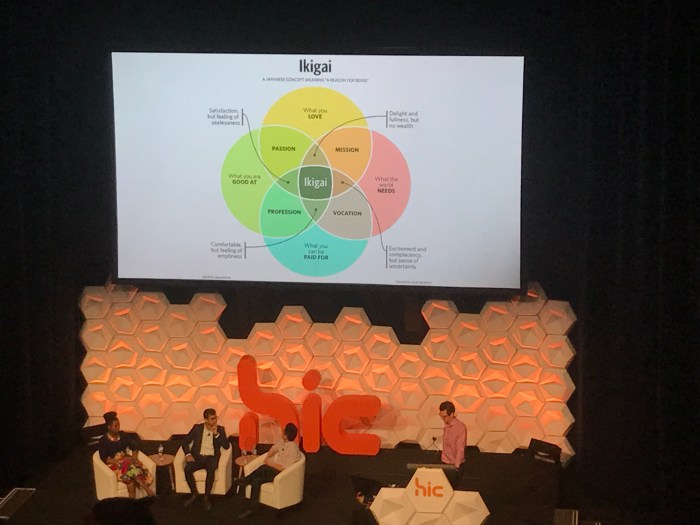
img_9330-1

A panel of young clinicians at HIC discussing Ikigai

Discuss Innovation and Healthcare in any room with participants in the healthcare system and the energy level rises. Healthcare is an industry where purpose lies very close to the surface. Many of the other sessions at HIC had highlighted the imperatives driving a demand for innovation and digital transformation in Australian healthcare. Everyone in the system knows that innovation is critical to addressing:

  • demographic changes with an ageing population & increasingly urban population
  • rising costs in an environment of budgetary constraints
  • the real opportunities to deliver simpler, easier and better consumer experiences in healthcare;
  • improve the working experience for Australia’s increasingly large healthcare workforce; and
  • opportunities to deliver consistently better care, improve quality of life and save lives.

img_9333-1

Dr Kaveh Safavi of Accenture Health puts the blunt need for change to the HIC audience

Our workshop buzzed with that passion and purpose. In around 30 minutes of the workshop, the five groups captured many ideas and debated topics with passion.

Harnessing this energy into the collaborations required for successful systemic healthcare change and innovation is a key opportunity and challenge ahead.

We are the System

Facing a complex system like healthcare, it is easy to blame the Other.  If only politicians, bureaucrats, clinicians, technologists, entrepreneurs, patients or someone, would do something all will be better. We need to keep front and centre that we are the healthcare system as consumers, as voters, as practitioners, as shareholders and as other stakeholders. We have greater capacity to shape action when we embrace our agency in the system.

In our workshop, this played out with an interesting dynamic. When we broke into the five topics, there was naturally a race to join the topics with clear action for others. The groups addressing Priorities, What’s Going on Now and Barriers were by far the busiest. The quietest group was Leadership.  Importantly by the third rotation, people had increasingly turned their attention to the need to lead change.

Effective change and collaboration takes leadership at all levels across the system. Healthcare can be a hierarchical system for many practitioners and participants. We need leadership that helps engage change from all involved and enables participants to lead the way forward in collaboration.

Talk is Talk. Action is Value

We structured the conversation as five groups but the reality is that all five groups ended up discussing similar issues across the healthcare system. Few issues arose that were surprises or the subject of fiercely contradictory views.  The time for talk is over. There is a strong consensus for action across the healthcare industry. The challenge is bringing that action to conclusion.

DGwyNFCUwAAC3_g

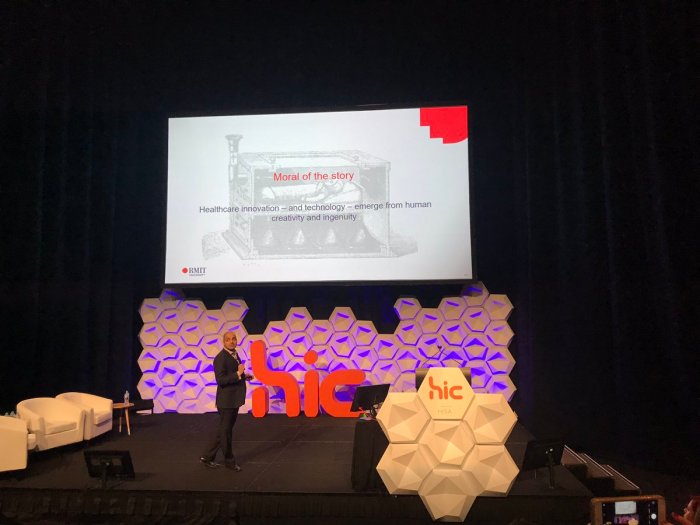
Vishaal Kishore’s closing keynote explored the human role in innovation and importantly the value of storytelling to engage human action.

The focus of HISA’s Innovating Health series ongoing and the work that Vishaal Kishore and I do in the system will remain on fostering this important action. In a large complex system with wide impacts we can easily lose our focus. As I noted in closing in my closing comments at the workshop, there can be enormous power in what John Hagel and John Seeley Brown call “small moves, smartly made“.  We don’t need to change everything at once. Such projects are daunting and unlikely to succeed. We need to keep working on the evolution of innovation across the breadth of the system through collaboration, leadership and a systemic view. Inspiring, fostering, leading and executing those changes will be the ongoing focus of my work.

Thanks to Greg Moran of HISA for the opportunity to participate in the Innovating Health Series, to Vishaal Kishore as a wonderful partner in this event and to Accenture and HISA for sponsoring the series.

We Shape the Arc of History

“The arc of the moral universe is long, but it bends toward justice.” – quote  attributed to Martin Luther King Jnr but with a long history

There is no natural arc to the history of morality in communities. The ‘arc of the moral universe’ changes when people change values and those new values scale up to influence community expectations. Those changes can be influenced by ongoing processes of economic and demographic changes within communities, but is often the work of leaders work to help communities to make sense of the need for change, to understand the new values in action and work to achieve better ways forward together. The way to ensure we don’t end up on the wrong side of history is to lead change for the better. That change is unlikely to be a smooth populist transition. It is a journey of conflict and rebellion.

No Inevitability

Things are getting better. Long term trends of the safety, economic and social security of people on this planet are positive. When we step out of the distorting mire of daily political conflict and shock news, we can see that there is a long term trend in human relationships that has been unquestionably positive. By simply casting our minds back 200 years we can find a range of social values that have radically changed and shaped a transformation of human political, social and economic relations.  Much of the digital transformation we have come to expect is founded on values that are fundamentally alien to society just two centuries ago.

Economic and technological change has enabled these shifts in values, but it does not ensure them. Social researchers from Marx to Fukuyama have found disappointment in a reliance on an inevitable course to history. There are too many signals across history that a determined group of people can take a society hostage and lead it by force, dogma, charisma or other means in a different direction. Many of the economic and technological changes are capable of being used to support and reinforce these other directions in social culture.  We already can see the risk of rotating groups of true believers in many social contexts.  The twentieth century to today shows that in many societies that use of technology and economic growth can exist along side inequalities that last for generations.

Leadership is Unsafe

The changes in society that we have seen to create the favourable conditions did not come about because of smooth inexorable shifts in public opinion. Leaders fought for that change. People had to rebel, march, campaign and fight for a better society. There’s no safety in a conflict of values. The action for change in society demands leaders who will step into this unsafe domain.

Let’s be clear when Martin Luther King Jnr spoke the words above he was inspiring his movement to keep up the protest and the fight.  He did not say these words to encourage people to wait for a shift in public opinion that would make it safe to change the nature of society. He said these words to make the change he was advocating seem inevitable and to rally people to his cause. He led that change. Fifty years later we still need leadership to sustain and grow those same civil rights.

We have a world where leaders can hear all of public opinion and where those who lose with change can often speak the loudest. In this climate, it can be tempting as a politician or CEO to play safe, to follow the community and rely on inevitable change in public opinion. The voices of those who feel they lose by change will make clear that this is the safest path. It may be easy and safe now but it is the path to the wrong side of history. Shifts in values when they occur don’t look kindly on those who acquiesced or enabled the continuation of injustice.

Leaders don’t follow communities. Leaders help communities to act on change. Leaders seek to influence changes in values and action and their success depends on the outcomes achieved. Leadership is not a story of power. It is a story of influence to make change for the better. A leader who plays safe and ignores an opportunity to push history for the better is not worthy of the title.

“Eternal vigilance is the price of liberty” – attributed to Thomas Jefferson and many others

Exit and the Lost Voice of the API Economy

In exploring the API Economy on this blog, I have explored the challenge of resolving tensions of purpose and also the critical role of trust. A recent story on gaming by Uber drivers of the Uber driver management algorithms highlighted another challenge of API Economy businesses.  In an economy of standardised API-driven interactions, exit is the only remaining option to signal dissatisfaction.

APIs Everywhere

Business models like Uber can encourage a line of thinking that soon in the future all transactions & interactions will be seamlessly managed by standardised interactions across APIs. We will lose the cost and complexity of human service interactions as we fit all of our interaction needs into code that can exchange information between systems. Everything in this API Economy runs incredibly smoothly, until it doesn’t.  The problems that I explored in previous posts above are the thin end of the wedge of examples of what happens when people and interactions fall outside the standard patterns of an increasingly locked-down platform economy.

As an aside, it is worth noting that classical economics has explored many of the implications of this algorithmic, API-driven utopia. The assumptions inherent in the futures being forecast increasingly start to align with the traditional models of economics. The API Economy is seeking to bring about (or also assuming) perfect transparency of information, frictionless transactions, rational maximisation of self-interest and a reduction of all interactions to transactions in universal markets.  At its extreme in the exploration of perfect competition and general equilibrium under the Arrow-Debreu model, economists effectively conceived of a global economy that exists for only a single moment in which all present and future transactions are completed. All work thereafter is fulfilling previously agreed futures and insurance contracts. The limitations that have been research at length of such traditional models would be worthy considerations for the advocates of an API Economy future. As examples, Behavioural Economics has explored the extent to which we are not rational maximisers and we much better understanding the issues of uncertainty of information in a complex world.

Exit and Voice in the API Economy

I ready Albert O Hirschman’s book Exit, Voice and Loyalty many years ago and it helped me see that the traditional economic model ignores our ability to create and exchange new information.  Hirschman points out that traditional economics only has one option for a dissatisfied consumer. They have to not purchase, exiting the market. The dissatisfied consumer has to hope that their signal will be picked up and correctly interpreted. For example, Uber Drivers frustrated with returns have to withdraw their services.  Unfortunately, instead of helping drivers to improve returns, Uber may respond by tightening the system rules to prevent driver exit or seeking to automate drivers away. Uber hopes that it can force any remaining drivers into voiceless Loyalty, where they take no action. For drivers, exit is a blunt tool of improvement. It is also a path to social and economic exclusion. 

Hirschman points out that through history consumers have an alternative, complain, collaborate and work with others to improve matters. Voice is an important input in our current economic system. Hirschman highlights in some examples there are even potential policy benefits to restricting market exit to encourage voice. Engagement matters and community is where we express our voice whether inside organisations or across boundaries. The losses of disappearing community are more than economic. With increases in inequality forecast, building exclusion deeper into the system of economics could have profound social ramifications. 

Voice is in danger of being lost if everything is an API. APIs don’t allow for a counterpart’s voice. Organisations that increasingly leverage APIs will need to be aware of the loss and carefully manage their engagement with counterparts to foster open discussion and the opportunities for learning. Community leadership will be an ongoing responsibility to ensure the luddites do not feel tempted to smash the machines in frustration at their economic exclusion. An API is the foundation of a more seamless and frictionless economy, but need not be a replacement for all human interaction. We may work for money but we also work to fulfil messy complex and changing human needs too.