I sat down on Sunday to write about our entangled lives, how we are caught up in networks of connection, obligation and expectation. I was reading David Whye’s Three Marriages which looks at these networks of commitment to love, work and the self. The tangle of these often contradictory commitments is what makes up a life. We may focus on the ease or the happiness of our lives but often the obstacles are the work. David Whyte references William Wordsworth’s Prelude and the bonds that come to us unexpectedly and even, at times, unwanted.
Whoever you are, no matter how lonely, the world offers itself to your imagination, calls to you like the wild geese, harsh and exciting – over and over announcing your place in the family of things
As I tried to start writing about our everyday tangles, commitments and frustrations, the word skein came to mind as a wind of yarn. That idea brought with it a distant echo of memory that I found I needed to untangle before I could write. Like our many invisible connections, the word skein had a hidden pull on me. A dictionary confirmed my understanding of the meaning of skein, but offered another clue.
To my surprise, skein has a secondary meaning, the formation of geese in flight. The ever-shifting form is its own entanglement, as geese share the load of leading the formation and manage their three dimensional relationships through simple rules that maximise the performance, efficiency and safety of the skein. A reference to wild geese brought to mind Mary Oliver’ famous poem, but I knew I had not yet got to the heart of my own tangle.
Je jalouse le sort des plus vils animaux Qui peuvent se plonger dans un sommeil stupide, Tant l’écheveau du temps lentement se dévide!
By this point, I knew it would have been better to let the mess go. I was now deeply distracted and unsettled. A connection broken or unfulfilled was taunting me and standing in the path of my progress. I couldn’t write anything until this lost idea stopped tugging at me. I wasn’t even sure at this point that there was anything inspiring my search. I no longer was clear why I had even wanted to write about entanglement. With a sense that there were likely better things to do, I searched on obligated to find the end. The tangle I was unravelling fell apart a few poems deeper in my search when Charles Baudelaire’s De profundis clamavi was pulled from the mess. The last line of that poem has been often translated:
‘So slowly does the skein of time unwind!’
That idea of ‘the skein of time’ was what the word skein had brought to mind. I found what I had been seeking through a lifetime of half-remembered threads. Life unravels slowly and these yarns entangle us more each day. Whether we want it to be so or not, we are on a thread of life stretching back and pulling us forward. We are our own narrative, other’s stories of us and a few unfulfilled dreams. I love Baudelaire’s poems and that phrase had been buried deep in a tangle of other memories of love, life and work. By the time that my curiosity was satisfied, I had lost the day. I had also lost the thread of the entanglement that I set out to explore.
Perhaps, I even got there through all the unravelling of half-remembered connections. After all, yarn has a second meaning too.
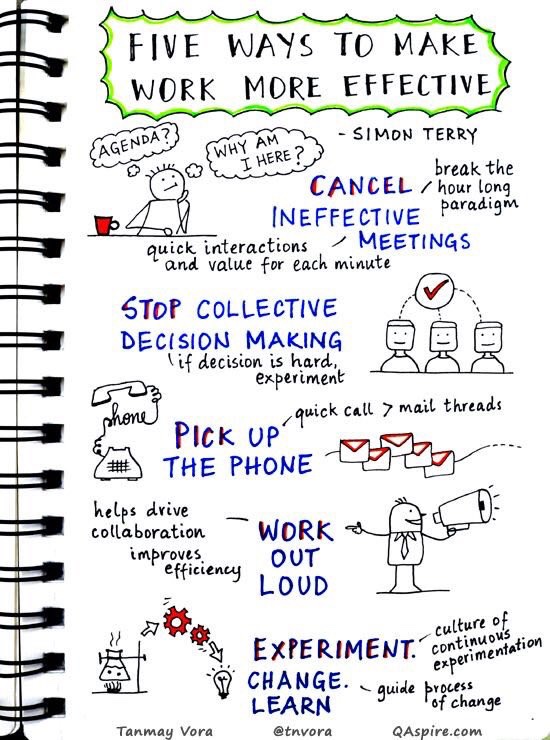
Tanmay Vora’s sketchnote of my last post on productivity
One of the more popular post on this blog is my effort at five productivity tips. The post is popular mainly because Tanmay Vora rendered it into the wonderful sketchnote above. I have mocked the top five format, so this is a next seven. In my work and experience since writing that post, I have learned more. Now I need to add to my list (one of the many dangers of a top five). So here is my list of seven more ways to work more effectively.
Remember as you take these forward they are suggestions, not rules. Your work, your organisation and your mileage may vary. Productivity tips are just tips. Everyone needs to evolve their own system to suit their unique preferences, skills and work.
Manage energy, not time
We are taught to not waste time. Supposedly, it is all we have. However, it doesn’t take much life experience to realise that not every moment is equal. Some times we have the energy to move fast. Some times we don’t. Persistence matters but grind is pointless. Take breaks. Manage your energy. You will get more done working when you are productive than staring at the screen for the point of it.
Manage goals & priority, not tasks
Anyone can fill a to do list. It’s much harder to do the most important and most valuable things first. We often confuse the urgent, the mundane and the easy for the most valuable things we can do. You don’t need to micromanage yourself. Put your energy against the highest priority. Make sure you can see the goals of the work. Do the administrivia when you are barely there.
Hire future peers
You don’t want people to work for you. The best people work with you and may some day replace or surpass you. Hire people who are or can be peers to work for you. Develop your people to do all you can do and more. The only way to multiply our effectiveness is through growing the talents of a team.
Delegate goals
Micromanagement sucks. Don’t delegate tasks. They are demeaning and put both of you at risk of irrelevant goalless work. If you manage your work by priority and value, allow your team to do the same. Allow them to create new ways to work and surprise you. Giving over the whole goal, lets people play to their strengths, not yours. Delegate the whole goal and then coach your team to achieve it.
Work outside-in
A lot of organisational politics is devoid of an external reality. A lot of time wasting tasks have no value to customers, the community, shareholders and other stakeholders. Work problems from outside your organisation back in. It’s amazing how many issues and problems disappear when you have external stakeholders on your side.
Asynchronous Work
We have more tools to work asynchronously than ever. As much as we love our real-time chat and video conferencing asynchronous work is the great productivity gain. Calendars don’t always align. Energy doesn’t always align. Let people make their contributions to work when they can and how they want. Asynchronous sharing, commenting, editing and more can be a powerful way to get more done with more people. The first simple step is to gather the feedback before the meeting. That way any meeting can be deciding what to do with the feedback.
Weave. Don’t multi-task
Nobody is as effective at multitasking as they think. There are real costs of task switching. At a minimum we need to understand each task in its context. However tasks have different cycle times and all tasks have big and little gaps. Not everything is real time and synchronous. If you plan your work to do other things in the inevitable gaps, you can get more done. Allow blocks of time for high value creation, problem solving and synchronous interactions. Weave other activities around these blocks. Phone calls, follow-ups, status checks and re-prioritisation are all great in-between tasks.
So that’s my next seven for now. I’ll keep learning, experimenting and adding to my practice. Maybe you can see a not-so-hidden theme emerging of working in a more human way with a focus on human relationships, talents, value and the up and down of energy. All these tips are pointless if the systems we work in don’t let us do that work.
I’m sure there will be more tips and themes. I’m keen to learn from others. What works for you to make your work more effective?
How clever are you, my dear! You never mean a single word you say!
Oscar Wilde
Five point plans, three word slogans, infographics, buzzwords and thought leadership. We are drowning in cleverness.
There are so many different kinds of stupidity, and cleverness is one of the worst.
Thomas Mann, Magic Mountain
The cleverness gets in the way of our ability to consider complex solutions, to persist with difficult problems and to connect with others. Why do the long hard work in community to create real change when there is a simple clever solution? We would be all better to embrace the foolishness of effort, understanding and slow shared creation.
I am sick to death of cleverness. Everybody is clever nowadays. You can’t go anywhere without meeting clever people. The thing has become an absolute public nuisance. I wish to goodness we had a few fools left.
Oscar Wilde
The on-rush of cleverness also creates chatter, distraction and entertainment. We don’t have time to be present. We don’t have time to consider. We don’t have time to understand, share, & solve together. We need to ‘get the right people on the bus’, ‘start with why’, ‘embrace the problem’ ‘recognise what gets measured gets done’, ‘eat strategy for breakfast’, ‘eat our own dog food’ and by the time we add another dozen or so smart snaps the time to do work has passed.
One of the lessons of history is that nothing is often a good thing to do and always a clever thing to say.
Clever gimmicks of mass distraction yield a cheap soulcraft of addicted and self-medicated narcissists.
Cornel West
We need to start questioning the clever. Much of this cleverness is so shallow that nothing lies below the surface. The more a thought leader vehemently defends their cleverness, the weaker I consider their proposition. Absolutism works for ideologies but not valuable programs of work. Ideas that matter are rarely clever on their face, but they are tested and capable of robust and deep exposition when required. If your cleverness feels like it is supported by ‘turtles all the way down’, it is mere trumpery.
I am so clever that sometimes I don’t understand a single word of what I am saying.
Oscar Wilde
Humans aren’t always clever. They aren’t neatly packaged. They aren’t always rational. Let’s lean into that messy dumb and engaging life of community. For all it’s tosses, turns and silences we will be better for the work.
Here we stand in the middle of this new world with our primitive brain, attuned to the simple cave life, with terrific forces at our disposal, which we are clever enough to release, but whose consequences we cannot comprehend.
Life in itself Is nothing, An empty cup, a flight of uncarpeted stairs. It is not enough that yearly, down this hill, April Comes like an idiot, babbling and strewing flowers.
In Melbourne, it is spring. Green shoots are breaking out all over the garden. Nature is reminding us that we can move beyond survival. This is a time to thrive.
For many, it may feel odd to talk about thriving. Unequivocally, we live in a time of overlapping crises – climate, income inequality, authoritarianism, pandemics and more. However dark the circumstances, we can still focus on our individual and collective potential. Making steps to realise potential however tentative and however small is still progress. We can’t rely on nature, history or others to bring us a better world. We must go make it.
Making a Thriving World
Almost always new growth, development and potential starts small, just like those shoots on the branches of the trees. By summer, those shoots might be a new branch. Now they are just a tentative green bud. We can only continue to do the little things individually and collectively that move us towards a richer and more vibrant thriving. If we work on our individual and collective potential together in the darkest times we will recover eventually. We can only to take one step after another.
Small actions accumulate over time. Some times transformational change needs to be fostered in small actions in small groups away from the wreckage of the main systems, as the Berkana two loops change model highlights. As it begins to thrive at a smaller scale, it can refine, strengthen and ultimately attract a wider community. Individual development is the same, we need to persist through the difficulties of new skills and new starts learning as we practice on a path to a new and wider mastery.
The time to prepare is now. The time to work on growth is now. Now is the time that we thrive. Together.
The best time to plant a tree is 20 years ago. The next best time is now
You don’t need 5 tips on how to manage remote/#wfh employees: Talk to your employees and ask them what they need to succeed. We call this radical new real-time performance support technique, conversation.
We don’t talk enough. Not text or chat. Talk. The kind of conversation that fosters relationships and deepens understanding. The conversations that explore assumptions and remove misunderstanding.
These conversations don’t have to be long. Usually it is preferable that they aren’t. Short but engaged conversations with active listening can make a lot more progress than a long broadcast conversation or a formal meeting.
A consistent schedule of conversations enables people to pick up and build on previous discussions. Context changes so more conversations enables better currency of understanding. Making these conversations predictable enables people to prioritise urgent issues for immediate discussion and leave the other issues for a regular update.
The biggest gain in your working strategy is more conversation. You don’t need a new tool. You have plenty of phones, videoconference options or if you are lucky enough to be outside lockdown then you can chat face-to-face. A short conversation will achieve far more than an email, a survey or an expensive employee engagement project will ever address.
If you are worried that employees may not be prepared to talk, then you have a much bigger problem, We know that a lack of psychological safety directly impacts quality, effectiveness and performance of teams. It might well be that new conversations are the only way to solve that problem.
Sadly, your little bird has many insights. However, a conversation supported by action is one simple way to start to change that. The more fear the more conversations and action. I’d suggest conversations are more effective and relevant than 5 tips you found on the internet.
The conversations are rarely as hard as you expect. Especially, if you engage one human to another. There’s all sorts of human experiences like shared purpose, connection, compassion, empathy and forgiveness that make even the toughest conversations productive and far more valuable. If the conversation is tougher than you expect, it is often better to know now and be able to address issues, rather than leave those discussions until later.
Talk. It’s surprisingly easy. Talk. There’s no better productivity tool.
As days drag into months there is a relentless nature to 2020. For me, escaping that experience involves a rediscovery and recreation of my boundaries.
We had barely escaped the summer bushfires and their hunt of climate crisis when the pandemic surfaced. The pandemic led to ever tighter lockdowns, economic upheaval and working from home. It also provoked a series of mini crises, projects and responses. On top of these challenges we have had cause to reflect on devastating illness and death, racism, poverty and discrimination of many kinds. Meanwhile here and around the world our discourse and community began to feel fractured. 2020 has become a year of relentless shocks and relentless doing in a state of relentless liminality. This environment tires the soul.
We do a lot. However not all of our doing is our choice of goal, approach, team or timing.
Agency is how we demonstrate and realise our potential. Not everyone has the privilege of making choices. In a year full of consequences, having choices without consequences has been a rare luxury. However it a luxury that feeds the soul.
I have leaned into writing in new ways, reading poetry and other small acts of creation to clarify the realms of agency. At the same time I have embraced the idea of needful work. Doing that is neither needful, a purposeful contribution to others, nor an exercise of my agency must be questioned. Work for distraction’s sake is a temptation in bleak times but contributes rather than relieves pressure.
Focusing on purpose and agency has been helpful. Seeing more clearly the boundary between mere doing and what I choose is a key way to shape a new boundary in the uncertainty and relentless efforts.
You glare in silence at the wall. Your stocking gapes: no gifts at all. It’s clear that you are now too old to trust in good Saint Nick; that it’s too late for miracles. —But suddenly, lifting your eyes to heaven’s light, you realize: your life is a sheer gift.
Reflecting on agency has also led me to reflect on the boundary between doing and being. The smaller and more pressured my world in 2020, the more urgent has been the need to have presence in it for me and for others.
Our busy busy lives can mean being gets lost in the day-to-day. We can distract from work doing and other doing like exercise, reading or more. We need to recreate the space to just be. One benefit of the restrictions of Melbourne’s lockdown has been time to walk each day. I have used that time to get out of my house and my head, appreciate my world within 5 kms and move to more presence.
Always on, always working and always connected presents challenges for us to find the boundary between doing and being. We need to treasure this boundary and find time to uncloud the mind. Just as agency helps realise our potential so does the clarity of who we are that comes with presence.
So subtly is the fume of life designed, To clarify the pulse and cloud the mind, And leave me once again undone, possessed.
Isolated in a pandemic, we are both hiding and exposed.
We join videoconferences, but don’t turn on our cameras. We hide behind digital identities, but we are tracked extensively by the platforms that support those identities. We silently and secretly navigate our shopping purchases in digital marketing pathways that influence our choices and behaviour. We go out in public briefly for exercise or shopping or protest, but we are wearing masks. We have never been so hidden. We are totally exposed.
One teacher, One doctor, one ecstasy, one illness, one woman, one man May hide another. Pause to let the first one pass. You think, Now it is safe to cross and you are hit by the next one. It can be important To have waited at least a moment to see what was already there.
No matter how much we hide or we isolate, we are not the hermits of old scratching out an existence in a remote wilderness. We are part of community. Even if we went out into a wilderness today to live alone, our digital communities, our relationship connections and the community infrastructure of support would follow us. We may not want to be found but drones will find us, devices will track us and should we need it an air ambulance could come airlift us out. We may want to hide but our world leaves us still exposed.
Never before has it been so clear to us that our risks and opportunities depend on working as a community together, rather than as individuals alone.
Like many, I had always assumed toddlers hid their eyes to hide because they were egocentric. The theory went that they assumed that their lack of sight applied to all. However, recent psychological research suggests that toddlers base that behaviour in reciprocity and mutuality. Perhaps we are more deeply engrained in the elements of community than we realise. There may yet be hope for humanity.
Be kind—love what you see—or go To sleep and stop dreaming you’re one of us.
There is comfort and protection in the hidden, especially in times of trauma and of loss. I have days where pulling the covers over my head and waiting things out seem like wise strategies. However, ignoring the world and hiding from connection is only a deferral. The answer is in the work of community, not in perfecting invisibility. The joy we seek is out there with others, not hidden away. Even if we run for it, that life will come find us and make us work to earn it.
today if ever to say the joy of trying to say the joy.
Suitable personal protective equipment to shake hands
Remember handshakes? They were an archaic work and social practice which disappeared in early 2020. Signalling respect, offering a peaceful intent and acknowledging agreement, they formed a peaceful symbol of connection in a busy world.
Connection matters
The handshake may be gone (forever) along with physical offices, indoor meetings and conferences, but connection between people remains important. We wave on our video conferences in an effort to signal similar recognition of others and to create the same sense of closure that handshakes offered.
My approach to collaboration and future of work practices begins with connection because it is a step that is surprisingly often overlooked. People assume that gathering people creates connection. Nothing could be further from the truth. Connection is what breaks down the barriers to people working together. Until we help teams address misalignment, fear, distrust and lack of shared norms, there will be no effective progress. Technology or wondrous adoption approaches will never overcome interpersonal group dysfunction.
The Connection in a Handshake
Reflect for a minute on what a handshake offers:
Respect: Recognition of the other as an individual
Sign of peace: No reason to fear an open hand offered in peace
Alignment: confirming agreements. We are in this together with shared intent.
Norms: the handshake itself sits in a context of social norms and practising a handshake reinforces shared group norms. These norms were why we all ended up in accidental handshakes back in February when we weren’t locked down
When we want to establish a new group, new project, new collaboration or any other form of shared work, we need to start with the elements of a handshake.
Respect: Is the environment one that will recognise individuals, respect their differences and allow them to share their potential? Are the people chosen with this respect?
Psychological Safety: Have we removed unnecessary and unhelpful fear and uncertainty that we can so that people can contribute freely?
Alignment: Does everyone understand why the group and they are there? Have they agreed to participate for those goals? Is there shared visions of success?
Norms and Governance: Are the ground rules of the work as a group clear and agreed by all involved.
There is a strong theme of participation, agency and agreement in these elements. Each individual must choose and acknowledge the shared efforts. We need to align the collective and the individual. If you have ever tried to shake an unwilling hand, you will know it is a clunky and uncomfortable experience that does nobody any good.
Many people seek to skip over the stages of forming connection. Some don’t respect the participants and see them merely as widgets in a larger plan. Some fear the storming and norming phases of team building and establishment of norms. Others prefer to retain an absolute say over goals, or to retain fear and control. Far too many organisations take norms for granted or assume that they can be imposed as ‘standard ground rules’ without explanation or practice. Any time saved skipping these ‘soft & messy’ steps leads to significantly larger delay, confusion and failure later.
We may not shake hands again soon. However, ensure that every collaboration, project or new future of work practice considers the value of connection up front. Your work will be better and more valuable for the time invested.
All the world’s a stage, And all the men and women merely players; They have their exits and their entrances, And one man in his time, plays many parts, His acts being seven ages.
If you are too busy to lead, then you are not a leader. Leadership is work, not a status. If you don’t do the work those who have given you authority and influence will offer that work to others.
The Work Of Leadership
Our leadership has become focused on performative not functional tasks. Leadership is work, not theatre. If our leaders do not focus on their work, they will loose their influence and their power.
Before I continue let’s define leadership. Leadership is the ability to influence individual or collective action. Leadership is not a status or a title. It is not for show. Leadership is granted by communities, not appointed by organisations or bosses.
Leadership is the work in groups of people come together to align and choose their actions. The foundation of leadership is the work of influence and the authority that others grant to leaders to have influence because of the work that they do.
We all recognise the theatre of leadership: the stage, the lofty pronouncements, the adulation, the email banner & more. Some leaders become so focused on this theatre as the role that they seek to outsource it to communications professions. The demand for ‘post on behalf of’ features in communication and community platforms is one inisidious example. Sure someone can write your emails or make your post, fixing the grammar and the sweeping rhetoric, but remember they are the one’s influencing others, not you. This feature may have a role when the risks are high, but it is limited role, not an outsourcing opportunity.
This focus on the theatre of leadership leaves many employees and community members heads scratching. There are real community problems to solve. They aren’t solved by stages, banners, slogans, messages or fancy rhetoric. The more time invested in those things the more disengaged the community that is looking for personal work to solve problems together. No wonder leaders of all forms are grappling with lack of engagement and authority. The answer is not more communications packaging to cut through. The answer is human connection, sharing, problem solving and learning together.
The theatre of leadership exists only to make the leader feel better. Performance satisfies the ego. Performance keeps up appearances. Performance lulls people into a dangerous complacency. Meanwhile the real work is forgotten or being directed elsewhere.
Communities make Leaders
Communities make leaders. They grant them the authority and the influence to help the community come together in action. If a person is too busy to exercise that authority and influence, it goes to another. Nobody chooses to delegate authority and influence. The community decides who to follow, based on who best does the work.
If you don’t do the work, you won’t be a leader. When the focus is on leadership theatre, people leave communities or they go looking for authority elsewhere in the community. It can be a tough conversation to explain to senior management that the reason they aren’t the most followed, most liked or most influential in their community is that others have done more work, won more trust and built stronger relationships. A ‘post on behalf of’ feature will increase activity from that leader. It does nothing for influence and authority. Communities reward humanity, openness, alignment, transparency, trust given and work done.
The work in question is to improve the functioning of the community. Community managers, champions and change agents are doing this work every day. The influence and authority is to help others to connect, share, solve problems and learn together to achieve individual and shared goals. If you aren’t working for the community, they aren’t working for you. If you are too busy to do that work, then why call yourself a leader? Cancel a few meetings and sessions of self-praise and go find your community again. You might want to start by enabling the community managers, champions and change agents to be more effective with a few degrees of freedom.
The praise that rings out to those in power standing on a stage is empty and hollow. Step off the stage and go to work. Do the hard work of connecting, sharing, solving and learning in the community. Enable others to succeed and let the trappings of theatre and ego fall away. There’s much more to be gained as communities and individuals achieve their potential. That is the work, not the theatre.