Writing

Public

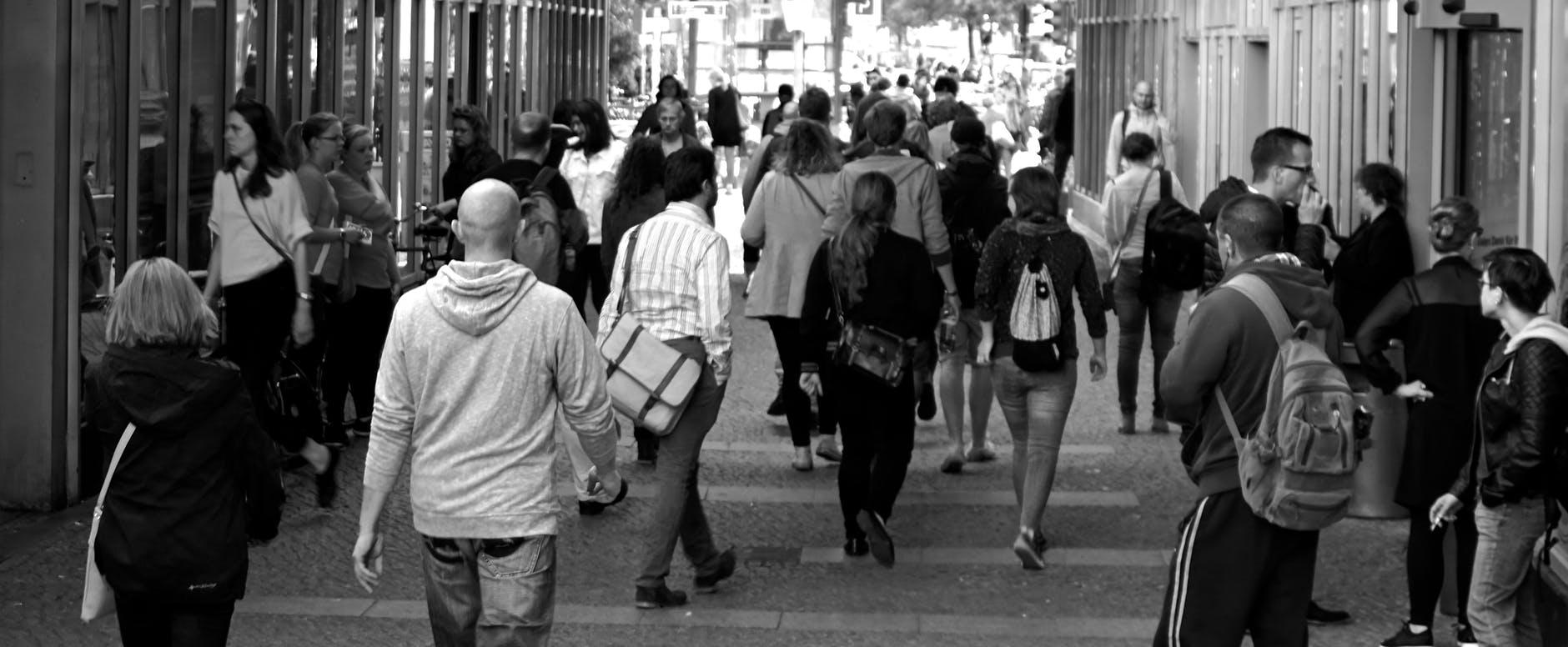
In our exaltation of the private, are we in danger of forgetting the interplay of the public?

Photo by Ingo Joseph on Pexels.com

Take out your troubled
photocopies and burn

the Pilgrim’s kiss. There’s only
one story. It always ends.

Ada Limon, Publicity

The public is community

When we describe something as public, it is a reminder that we live in community. Things that are public are of or for the community as a whole. This list includes public interest, public rights and most relevant at present, public health.

Working as a community comes with enormous benefits, humans didn’t dominate this planet because of their physical aptitudes. If anything, our success is much more about our social successes in producing food at scale, sharing learning and knowledge, adapting and innovating and creating social systems in which we don’t kill each other at least most of the time. The fact that our life is not ‘solitary, poor, nasty, brutish and short’, to borrow Hobbes’ phrase, is much to do with our shared connection in community. Our ability to conceive and manage the public domain is our advantage.

We haven’t got this right everywhere in the planet in every age. Mostly, we have got it murderously wrong to the benefit of a few and, for embarrassingly long periods, to the detriment of millions. However, at its broadest sweep we can argue that public administration follows Martin Luther King Jr’s dictum that

the arc of the moral universe is long, but it bends toward justice

Martin Luther King Jr.

That arc doesn’t bend itself. There’s no natural order or divine hand at work in bending towards justice. People took the public interest to heart and campaigned for change for thousands of years in big ways and small. Each contributing a little change, some even temporary, and yet each contributing a lot to our public knowledge of what we need to do and how we can improve.

Private Within Public

All the private rights and freedoms we enjoy exist within the public realm of our chosen communities. Those rights and freedoms aren’t independent of the public realm. They depend on it for recognition, protection and support. The rights and freedoms have been won by battles over public institutions and structures that enable the exercise of private freedoms. That public realm is also where the consequences of many freedoms play out.

Recognising this interderpendence isn’t curtailing freedom, but rather better understanding how the complexity of interdependence is to be expressed and what institutions and structures we need as a community moving forward. As others have expressed more eloquently, your ‘freedom to’ can impact another’s ‘freedom from’. Debates over the appropriate balance of these elements has occupied political philosophers for centuries and formed the foundation and ongoing evolution of most global political systems. This is not a new problem. What is clear is that absolutism, extremism and denial are not answers. The path forward is not a toddler’s insistence on personal autonomy. Nobody is an island. It is an open debate about the appropriate levels of interdependence in a society to the benefit of all.

What is unique about our current circumstances is that the tradeoffs between private and public have been brought closer in to the every day. Mostly, the public is off doing its thing over there and we get on with our private lives unaware. The challenges we are facing in a global pandemic, global warming, racism, sexism, and so on mean that there is ever more pressure for consideration of the public in private actions on a daily and hourly basis. That brings the inconvenience of being part of a wider public into stark relief for some. For the vast majority of people, this is a non-issue. People have willingly changed behaviour in the interests of the wider community. They know that they live and benefit from that community and its protections. A call to serve the public interest has been widely embraced in lots of small, simple, low risk ways – keep distance, wear a mask, vaccinate, reuse, recycle, reduce, changing to inclusive and respectful language, and so on.

The darkness
of daily wanderings resumed, the day’s sweet darkness,
the darkness of the voice that counts and measures,
remembers and forgets.

Adam Zagjewski, Balance

This behaviour in the public interest is critical because it is important to recognise whatever your political affiliation, your stance on vaccines or global warming that as a community we share some currently limited public resources – healthcare, education, an environment, etc. Most directly, in our current circumstances, our ambulance and intensive care hospital services are constrained. Even if we could as a society, or a market, choose to build more beds, we are at the limits of our trained healthcare professionals, in number and also the physical and emotional limits of 18 months of work in crisis conditions. Allocating all this precious capability to saving the lives of an influx of covid patients means that others will miss out on the care that is their private right. Defining a new hierarchy of freedoms doesn’t end the conflicts or the consequences, it just shifts them around. The outcome is usually that the consequences fall on those least involved in the debate, the most vulnerable.

Most people understand that their private enjoyment depends on recognition of a wider community. Rather than focus solely on the private risks and rights, we need to continue the conversations about the interdependencies and the public benefits. Without the shared realm of the public, the private benefits we seek would become largely meaningless.

Say something. I’m here, waiting, scrolling the radio.

On every frequency, someone hushes me. Is it you?
Twentieth Century, are you there? I thought you were

a simpler time. I thought we’d live on a mountain
together, drinking melted snow, carving hawk totems

from downed pines. We’d never come back. Twentieth
Century, I was in so deep, I couldn’t see an end to you.

Maggie Smith, Twentieth Century

Five Questions for Work Today

Photo by Tirachard Kumtanom on Pexels.com

The pressures of work are different. We need different conversations to engage people more deeply, manage stresses and leverage their potential. New questions start new conversations.

Here are the five questions that are creating great value for me in my work at present.

I am endeavouring to use variants of these questions consistently in all kinds of meetings and interactions in my work. These questions flowed from the recognition that Working From Home in a Deadly Global Pandemic is a different work experience that has new and different demands. In particularly, we need to work against the isolation and the narrow bandwidth of our current work arrangements. We also need to give people greater autonomy so that they can get more done in their day, without having to stop for meetings, approvals or input of others. Questions lead to learning. Using questions helps us to foster a culture of learning within our teams.

Five Questions

How are you?

This is a question we routinely ask and flippantly answer. At this time there is value in going deeper and sharing more of our personal experiences. From checking that people are really OK to allowing time for deeper discussion of personal circumstances, it is important to spend the time and show interest in our colleagues and connections. The insights of spending the time understanding how others is travelling will underpin how we care better.

What do you think?

When it can be exciting to talk to others, we sometimes forget to gather all the opinions around us. Showing genuine interest in others’ views and perspectives will improve the quality of the feedback, suggestions and help you get. The question leads to better collaboration and understanding. Those around us can be great at filling our blindspots and powering our understanding of how to do better or different.

What help do you need from me?

The help people need is the subtext of a lot of conversation. Bringing the subtext to the surface makes it easier and more safe for people to ask for help or share their challenges. When we are busy and stressed, some of these challenges may be no issue at all to another person with another perspective. Whether it is perspective, insights, assistance or connection, asking what someone needs helps tailor the value in the relationship to their needs.

What do you need to do that yourself?

Autonomy is rarely an accident. People need to feel authorised and supported to take additional responsibilities and get on with the work. Ask them what they need. The question puts forward the idea that the responsibility to tackle challenges is in their court. Together you will learn what people need to be more comfortable to exercise their power and autonomy.

What do we need to learn?

We might like to pretend our expertise makes us all knowing and perfect. Reality is that there is a lot to learn. Consistently bringing up learning as a goal of the work embeds an openness to new inputs and a willingness to experiment. We are all better when we are learning together.

If we all ask these questions consistently the people in and around our work will learn the questions. The more we ask questions that go to care, support, collaboration, learning and empowerment the more human our work will be.

Resignation

A strength overdone becomes a weakness. Too much resilience can make us fragile. Maybe instead of breaking, it is time to talk.

Winning does not tempt him.
His growth is: to be the deeply defeated
by ever greater things.

Rainer Maria Rilke (tr. Edward Snow).

The Great Resignation

Tempers are wearing thin. Frustrations are running high. Purpose and passion feel distant as the days roll on relentlessly similar.

I’m frustrated by discussion of the Great Resignation, an anticipated wave of coming resignations. Employers are presented as the victims of this Covid inspired act of their employees. What if there was something we could do to change the inevitable? Would you be prepared to discuss it?

Covid lockdowns and changing work might be a catalyst but it is unlikely to be the reason. People are resigning or planning to resign because many businesses have handled a crisis environment poorly. In particular, they have ignored it and stiffled discussion of how to better address the challenges. Action to make needed change has not been prompt enough.

Too many people I know felt that pressures increased and work expanded into their life through the Covid period. Because business was hard and stressful, interpersonal and business pressures increased. Too few organisations even considered these implications, let alone open up conversations on how work can be more rewarding and sustainable. Where change is needed, it is not coming fast enough. Relying on resilience alone made these work relationships brittle.

My door
opened on the new unknown
I threw stones

At the houses of starlets,
then ran off, colorless
into the shadows.

Jon Anderson, The Monument to Resignation

After delivering the capability to work from home, many organisations went back to focusing on when furloughs should be triggered, whether bonuses be cancelled and how else the bottom line could be improved. Those managers who had partners to provide care or older children gave little consideration to those employees struggling with younger children, those coping with grief, caring obligations or illness and those alone. Employees are not considering resignation because of their disloyalty.

We have stretched the resilience of our people by not discussing the real manifold pressures. My personal realisation came this week at the end of yet another busy day interrupted by a 5.9 earthquake. As the stress responses welled up and overcame me at the end of that day I realised that perhaps I had been unwise to roll on resiliently. I hadn’t listened to my own body until late in the day.

Dear Colleagues, now these years are filed
in the infinite oceans of bureaucracy.
Everything bleaches or fades. In other words,
goodbye. Sometimes it’s possible to walk,
although you’ve been told inside the oyster
shell of your heart there is no soul.

Jehane Dubrow, Fairytale with Laryngitis and a Resignation Letter

Exit, Voice and Loyalty

“How did you go bankrupt?” Bill asked. 
“Two ways,” Mike said. “Gradually, then suddenly.”

Ernest Hemingway, The Sun Also Rises

These pressures in our organisations are not new. Engagement has been an issue for years. We have ignored the pressures and responded with resilience training, mindfulness and more employee communication. We pushed the breaking point a little further out. A pandemic has pushed us beyond that new marker. We pushed ourselves into Hemingway’s realm of “gradually, then suddenly”.

Albert O Hirschmann’s classic treatise, Exit, Voice and Loyalty, examines a range of consumer, employee and political relationships from an economic and political perspective. Hirschmann’s point is that exit (not purchasing, quitting or resigning) and voice (as exemplified by speaking up to provide feedback or make change) are alternatives. If we want to reduce the number of consumers, employees and others leaving, we need new conversations to hear their issues and we need new action as a result of those conversations. Community can be a key part of coping.

For many years, I have been a passionate advocate of enterprise social media because it both enables employee voice and employees ability to solve their own challenges collaboratively. Platforms like Yammer or Facebook at Work can create open enterprise wide conversations from the bottom-up, from the quiet corners and from the agitator to start change for the better. These platforms themselves are not enough, politics, power, decision making, inclusion and the allocation of resources (ie all the forms of power) within organisations will be incredibly influential countervailing forces. Hence the need to consider psychological safety, engagement, participation, respect, ability to make change and other elements in the implementation of any social network in an organisational context.

In recent years, these platforms have been captured to some degree by organisational communicators looking to refresh the declining influence of traditional broadcast channels like email, video an the intranet in new ways. The products seeing new markets have focused on this top-down opportunity and the endorsement it brings. Often, this official endorsement comes with a desire to discourage the messiness and dissent of the bottom-up voice and to ensure that employee action remains within the tightly constrained world of the organisation chart. Power does what power does. At the same time the rise of chat channels like Slack and Microsoft Teams has returned the focus to the immediate, the urgent and the private group discussions within teams, rather than across the breadth of our organisations. We have started to lose the domain of the voices for change.

Our new world of work in a pandemic pushes employees beyond the organisation chart. They are working harder than ever in more roles than ever. Give them the voice and the tools to make change. Provide employees with the support to make work better. The alternative is to wish them well in their next roles.

Sliding Doors

Moments matter. Our smallest decisions have long tails. Still we live only one day and move step by step

Photo by Elena Saharova on Pexels.com

he sees me, we are strangers again,   
and a rending music of desire and loss—
I don’t know him—courses through me,

Susan Browne, Chance Meeting

Looking Back

The film Sliding Doors wasn’t particularly good but it had a compelling idea at its heart, that certain moments shape our lives in ways we can’t predict. With twenty-twenty hindsight, last week I stumbled across perspectives on two sliding doors moments in my own life.

One of these moments was a business and the other a personal matter. The details of both are largely irrelevant. Like the train doors, that change a life in Sliding Doors, it was not the events but their consequences that shaped the potentially different paths. The decisions we make do not matter themselves so much in the moment. It is what we do with them day-by-day thereafter that matter more. Some decisions we let define us and others we do not give the requisite support.

Soren Kierkegaard made the point:

Life can only be understood backwards, but must be lived forwards

Soren Kierkegaard

Only with the distance of years do we appreciate the consequences of moments in our life. Yet those insights give us little more than guidance as to how to act into the future. We cannot change what was. We need not fear or worry about it. The past is done. We can only move on.

Living Forwards

If you asked me for the lessons from my two sliding doors moments last week, the conclusions are simple:

  • Don’t defer decisions: make them quickly and move on. Nothing is gained in the middle ground of indecision.
  • Invest behind the decisions you make: a decision alone is not enough.
  • Don’t push for perfect: A workable decision today is better than a perfect decision at some point in the future that may never come.
  • Start and then adapt

Our lives are busy, messy and disorganised. Life comes at us fast and we can’t always perceive the consequences of our decisions and our choices. We need to live forwards to our goals and from time to time take the moment to understand what has gone before, not to change it but to learn a little for the future.

Life moves pretty fast. If you don’t stop and look around once in a while, you could miss it.

Ferris Bueller, Ferris Bueller’s Day Off

A global pandemic that has reshaped so much of our lives can feel like a moment of loss. We are grappling with fatigue, isolation, and all kinds of crises. There is no freedom from consequences. We have to embrace the now and live with it as unattractive as that may be. Importantly, as my lessons this week taught me, it may not be the big moments that act as sliding doors in our lives. Some times it is the smallest actions which play out with the biggest consequences. We can’t tell in advance what matters. We can only do what is best in each moment.

Let go of some of the stress that these moments are changing our lives. Of course, they are. Don’t focus too much on circumstances. Focus instead on backing your decisions. All we can do is make the best decisions each day and move step-by-step towards our goals as we understand them.

Or how a face, long lost, appears on a street swimming up out of a crowd, as if from a foreign element. What if not chance holds all these fast in its grip? The moment – great abyss of now: bearing the fruits of all moments before, ripe with disorganized creation

Ellen Hinsley, On a Short History of Chance

Embrace The Need For Difference

Our media environment creates a relentless pressure to be the same. Embrace the need for difference.

Photo by Ylanite Koppens on Pexels.com

Same Same

In my neighbourhood, the four major banks have now all moved their branches together. While geographic distribution to meet different customer traffic and communities might seem attractive. They have settled in four shops in a row, with a few regional banks nearby. Harold Hotelling, a statistician and economist, was one of the first to explain this clustering behaviour as a response to risk. By choosing the same location and using the competitors proof of demand they split the market. Further away there is a risk of a geographic preference favouring one or another. Businesses give up strategic differences for safety given uncertainty.

Hotelling’s logic on clustering of location has also been extended to product similarities. We see a profusion of near identical products differentiated by price and often an invisible quality difference. So many organisations benchmark their product strategy by what others or the market are doing. Industry conferences are full of the same advice, the same consultants and the same case studies just with different brands attached. There is safety in the herd.

Spend a day in social media and you will see the same advice on business, strategy, careers and life recycled again and again. Much of what is called thought leadership is repeating well-worn platitudes. There is safety in this advice. It will not offend. Others have proved the market. You don’t take a risk and can capture your share of a proven demand for ‘5 no-fail tips on something.”

Don’t get me started on the universal sameness of ‘good’ images on social media and their implications for mental health, body image and more. We are surrounded by a sameness so extreme that I recently saw a post putting together halves of faces of different Hollywood actors. The mega hits are remakes and known franchises. Not surprisingly when the risk of a film is measured in tens of millions, there is safety in similarity.

But Different

All this sameness can be alienating and depressing for those who might not fit the perfect stereotype. At times the lack of context on all this success advice reminds me of an old joke about asking directions where the punchline is “If you want to go there, you’d be best not to start from here”. We are telling people to go the same place and some don’t feel like they are ever going to make it. In all our focus on proven safety we forget that we crave difference and that difference is what makes true success.

For all the people writing case studies of Google, Apple, Amazon, Microsoft and Facebook now, we need to recognise when they started they were different, deliberately so. Many of them were so different as to be unsafe, predicted to fail or doomed to a minor market share. Each has changed its category and then changed category so much that the initial risks and departures are lost in time.

As uncomfortable as it may be and as hard and long as the path may be, difference is what wins out. The point of segmentation is not to divide the market the way your competitors do so as to better deliver your competitors strategy. The point of segmentation is to find your own group of customers and to do something different valued only by them. Kevin Kelly talks about the power of winning the support of a thousand fans. It’s more than enough support for most businesses and people and the path to greater things. Do something different and valued by your chosen group.

In my strategy work, I use Lafley and Martin’s Playing to Win regularly as a simple and effective guide to the questions that should be addressed in market positioning. One reason is that it is explicitly focused on the choices and dynamics of differentiation. Most importantly it explicitly asks “How will we win?”. That is a question that is oddly left unaddressed in many strategies that just point out that what is to be done is already being done by others.

Choosing to stand alone feels scary. People will point out that the herd is safer and that others are doing better in the pack. Choose to stand different and go looking for the community that will support you to succeed as you choose to succeed. As they come over time, your own community will be the safety net for your difference.

Choose to be different. Embrace your own way to win. Find your own community to support that journey. Over time your difference will be the foundation of your position and success.

The Work Effectiveness Conversation

Recently I joined a conversation about the role of cameras in our work meetings with Rebecca Jackson, Benjamin Elias and Kerrie Hawkins for Regarding 365. This is a short conversation with some great insights on why cameras are not necessarily an ‘always on’ proposition in our work meetings.

A key theme of this conversation is make meeting effectiveness a discussion for each meeting and work ongoing. For those who have followed this blog for a while, this is a major theme of my work. How people work effectively varies for a variety of reasons from the people, to the work, and to the circumstances.

The temptation to require particular patterns of work comes from our history of manufacturing as a model of work. Many organisations have not moved far from procedures and process dictating how everything should be done, even if the work of these organisations are increasingly knowledge work.. You can’t mandate people must use internal social media. It needs to be a decision of employees to choose how they connect, share, solve and innovate. You can’t mandate the best way for people to work. People need to make choices that work best for each team and each circumstance.

The cost of mandating ‘best practices’ is that you lose engagement of those for whom the mandated approach doesn’t work well, whether that is cameras on, meetings all day, agile practices, social tools or other processes. The mandate also reduces the opportunity for employees to make their work more productive for them and their colleagues. Arguing with a mandate is not worth the effort for many and you will lose their views and input.

The most effective workplaces are ones where employees are engaged. That also means they are the work places where employees are engaged in a continuous discussion about the better ways to deliver their work. Whether it is the use of cameras or another work practice you can start these discussions in your workplace by asking employees to share their views, experiment with different approaches and debate the best ways to manage work.

We have much more change and disruption to come in our work. We should look forward to the conversations about work that will help us all manage that change and improve effectiveness as we do so.

Jumping OVER

Jumping the fence out into something new. Photo by Mary Taylor on Pexels.com

We are enthusiastic about the potential to jump boundaries. The process of crossing boundaries is a difficult one. It can be hard to know if we are jumping in or out.

I want to go to the other bank

In the trees on the other bank
a solitary startled wood pigeon
flies towards me

Bei Dao, The Boundary tr. Bonnie S MacDougall

New Boundaries

Before the pandemic arrived in 2020, I had started working on better understanding and shaping some boundaries around my work and life. The last 18 months have reshaped that quest radically.

The boundaries have never been narrower. We have adapted to working remotely, but I think we are only just starting to proactively manage the implications for our organisations ongoing. These changes to work have social implications that are yet to play our. I wonder if the “Great Resignation” themes we are seeing promoted in the business media are not the outcome of constraining people and making them focus on the narrowness of their work undistracted by travel, busyness and other social distractions.

Near And Far

Effective individuals and organisations will not be constrained by the boundaries set by spaces. They will shape the boundaries of the networks that are necessary to succeed in their work. Focusing on network, rather than physical space, changes our view of near and far. A surprising percentage of our work interactions in a typical office and even common electronic communications are shaped by the ’50 meter’ rule. Such an arbitrary measure can’t be an outcome of effectiveness.

somewhere i have never travelled,gladly beyond
any experience,your eyes have their silence:
in your most frail gesture are things which enclose me,
or which i cannot touch because they are too near

ee cummings, somewhere i have never travelled

We need to teach our employees to navigate new networks and to cross boundaries, near and far. This process is not always an easy one. We need different skills to navigate networks. We will discover terrritories marked only on the map as ‘Here be Monsters’. Much of what we will encounter will be diverse, strange and uncomfortable. Success in these new environments will take different skills and learning.

Boundaries work in two ways. As much as they define ‘out’, they also define a new ‘in’. It is worthwhile for us to remember this. For every thing we grieve as we cross a boundary, we discover new and often more productive outcomes. Jumping out can be just jumping into a new context. The challenge is to ensure that the new context is better, more rewarding and more productive. Jumping boundaries to find a new hamster wheel is for hamsters.

As our physical interactions are constrained, we need to learn to jump new boundaries into better more productive ways of work. That process won’t always be comfortable at first. However, it may be the case that without leaving your space, you are jumping out into something new and better.

Allow me to stay in my room
and weave my rainbows.

Chungmi Kim, Allow Me

Rope-a-dope

Sometimes you need to hang on long enough for things to turn in your favour. Wait until you can play to your strengths.

Photo by Mikhail Nilov on Pexels.com

Rope-a-dope

The phrase Rope-a-dope comes from the Muhammed Ali-George Foreman heavyweight title fight in Kinshasa, Zaire, in 1974, known as ‘The Rumble in the Jungle‘. A 32 year-old Muhammed Ali was the underdog against the young and powerful title holder George Foreman. While Ali was know for his speed and reflexes, but after the first round rather than engage the fearsome Foreman, Ali set to wear him down. Ali ducked and weaved but mostly just covered up on the ropes allowing Foreman to hit him repeatedly but also to tire himself out. As Foreman tired, Ali was able to regain the offensive and the fight was stopped in the 8th round with Ali the surprise winner.

If a boxing analogy is not to your taste, recognise that the same strategy has been applied in many other contexts. Sailors sheet their sails or even take shelter in port during a fierce storm to preserve their vessels. Animals hibernate to escape the harshest of the winter. Surviving is a strategy because those who are destroyed by a fierce foe don’t win.

Some times success demands that we change our tactics. More importantly, success can depend on our ability to wait for the timing to swing to our advantage. We may even have to take a lot of punishment while we wait for the right time.

The Right Time

Our always-on fast charging world has led us to believe that the right time is always now. That we must relentless seek to chase success and lead from the front. First-mover advantages are constantly touted, even if they are rarely real. Many people become dejected when success takes time, feeling that it has taken too long or they have missed their chance.

It is a common experience that most ‘overnight successes’ have taken seven to ten years of waiting for the capabilities, the opportunity and timing to be in place. Much luck is carefully constructed and more about time than anything else. Malcolm Gladwell wrote a whole book, Outliers, on the importance of timing in success.

Overlay the frustrations of a global pandemic and all its public safety measures and many people are dejected that ‘their time’ is being lost. If you can succeed in this environment, then congratulations and no doubt it is because of the work and capability you have put together to meet the needs of this time.

It is important to note though that faced with as virulent and strong a foe as a global pandemic, a rope-a-dope strategy is perfectly viable. Hunker down. Sheet the sails. Adapt. Stay present. Go step-by-step. Plan to come back stronger at a better time.

Recognise that this is a perfectly valid plan. Forgive yourself the feeling that you should be doing more. Plan to support yourself as you get buffeted on the rope. If you choose to wait out the storm of blows, you need to be able to survive to the end. Focus on that survival and you will be ready for the opportunities that come to win later. Remember that a time that you can show your strengths is the right time to succeed. If the timing is wrong, that’s not about you or your strengths.

Rope-a-dope is OK. It might even be the perfect strategy for now.

Nostalgia

The 1980s never looked this good – Photo by Ron Lach on Pexels.com

Nostalgia sells. We are therefore caught in its grip. What we don’t always perceive is how it is holding us back.

Hoping to live days of greater happiness, I forget that days of less happiness are passing by.

Elizabeth Bishop

Nostalgia is a ‘sentimental longing or wistful affection for a time in the past’. It is a yearning for things and times lost to the ages. Nostalgia provokes us to remember the great experiences of our past and to see them as long gone and distant. Nostalgia in this way is a barrier to us seeing that those moments have made us and are still with us. There are no ‘halcyon days’. The past had its awful moments, more than today, but we have edited out the negatives from our memories.

Like any emotional connection, it will be exploited by marketers, trend setters and culture creators. The waves of ’80s themed music, movies and other experiences is just an effort to leverage our nostalgia for commercial success. We can have fun and enjoy nostalgia but there is a real danger if we become stuck there.

In exploring the many arguments of the lockdown vs let it rip debates gripping Australia and other markets through this pandemic, I have been struck how both sides are in the grip of nostalgia. The ‘let it rip’ advocates often explicitly say they want to ‘get back to their lives’. More subtly the strongest advocates of remaining locked down argue that we need to remain so ‘until this passes (& we can get back to our lives).’ We see the same dynamics in many similar debates in this time – working from home vs returning to the office, how schooling should be conducted, what leadership is, how we communicate, and more. Instead of building our future from what was, we need to build a future around what we need and what works.

I love the nostalgia of the typewriter. I own a few. I don’t write on them. Photo by Dominika Roseclay on Pexels.com

Nostalgia is a barrier to constructive change when it provokes the emotions that make us look back to solutions that no longer suit our lives, our times or our place. Our politics is full of people on both sides evoking the past as a productive way forward when our challenges are new and our society has changed. If we make the past, the standard by which all solutions are judged, we will miss the solutions that promise real and effective change.

I love an 1980s dance tune as much as the next person who lived through that era. I don’t for a minute want to go back to my awkward teenage years. I learned what I learned from that time and I have lived a life since. The potential to use those life lessons is much more important to me that any longing for any particular time, place or era.

When things are gone, we can’t bring them back with wishing. We need to grieve and move on in the here and now. Nostalgia can be an enjoyable escape. It is a major barrier to the effective change we need in our lives, work and society.

As usual, I was thinking about the moments of the past,
letting my memory rush over them like water
rushing over the stones on the bottom of a stream.
I was even thinking a little about the future, that place
where people are doing a dance we cannot imagine,
a dance whose name we can only guess.

Billy Collins, Nostalgia

PS For the ultimate nostalgia blast, Abba have a new song, ‘I still have faith in you’