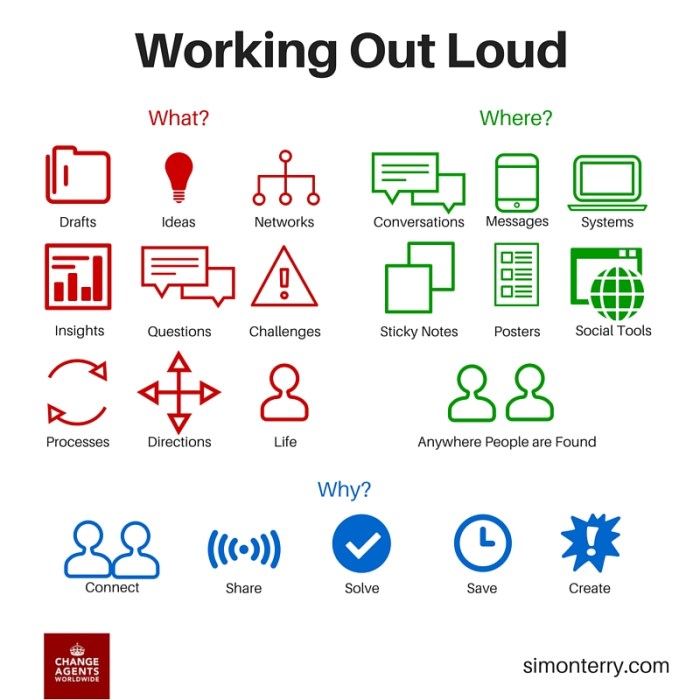
The What, Where and Why of Working Out Loud
Innovation, Collaboration, Learning & Leadership
The What, Where and Why of Working Out Loud
Make the work of others public so that we can celebrate it.
If you take only one thing from #wolweek it should be that public praise has value. You can’t celebrate the work of others enough when that work is hidden and you are silent.
None of us make enough effort to celebrate the great work going on around us. We become used to the support, the services and the products that let us do our work.
Who makes the great coffee you drink in the morning? Do they know how much you appreciate their work? What about the security guard who knows your name and greets you with a smile?
Who are your biggest supporters at work? Are they experiencing the same silence? Are they left wondering if they are making a difference?
Who in your life enables you to work? Do you publicly recognise their contributions.
Take a minute today and everyday to thank and celebrate those who help you do the work you do.
Yesterday, while working out loud in a community I shared how hard I found it to blog when I started. I didn’t have confidence in my ideas or my writing style. I assumed nobody was interested in what I had to say. My expertise sat mostly silent.
I also shared that my three habits of working out loud was the discipline to make me write each day. As I sat down to my first coffee, as I do now, I write my post. I publish at the end. That discipline helped me to prepare, to learn and to grow in confidence.
Describing my process was interesting to people. Far more valuable was me describing my doubts and concerns, the issues I faced and how I tackled them. That helped people close the gap between their own experience of doubt and mine. That’s far more likely to foster learning and new action. Melanie Hohertz wrote an amazing insightful & vulnerable new post inspired by that exchange.
On Linkedin, Rohan Light described my sharing of the rather difficult process to my #cmidisrupt talk as a hero’s journey. I hadn’t seen the parallels to Joseph Campbell’s work until he said it. I wasn’t trying to be heroic just sharing that good outcomes come from difficult processes. What this reminds me is that there’s a hero’s journey in all our work as we do battle with the underworld, need the help of others, pass points of no return and eventually reach our destination. Sharing that whole journey with others is what makes a work story engaging, encouraging and useful.
There is always a moment of vulnerability when we share our work. It won’t go away no matter how expert we are. Rather than pretend it is not there, wrap that vulnerability into the sharing. Make your vulnerability transparent and it moves from a hidden weakness to authenticity and a strength of your work.
Working out loud works best when your work is open to the contribution of others.
A short daily report, like “Long day. Too many meetings”, is a common starting point for many people’s practice of working out loud. Sharing this invites some sympathy and may draw some questions about what went wrong. However your network is left to do the work to interpret, connect and help. The fact that the day is done means opportunities to improve have been missed.
We encourage people to work out loud on unfinished work. Work that is still ongoing encourages others to help you finish. Advice & other assistance can have an immediate impact.
Bryce Williams mentioned the value of a narration in his definition of working out loud. Narration also makes it easier for others to help by supplying context. I’ve seen people respond to a report like the one above offering meeting productivity tips only to be told ‘I do that. Just a peak day on the project’. A better narration gives better context and lets others know what challenges you face without asking. Guide people to offer the help you need. If all you need is sympathy and connection, then help others understand.
Challenges you face are likely challenges for others. (We all struggle with bad meetings). Even if others can’t help they might learn from the answers you get. While sharing a short report on the day feels safer, it is much less valuable than offering a chance to contribute.
Make the way other can help and learn from you explicit in your working out loud. It is a small contribution you can make to your network and will bring about a step change in your experience. Work out loud to be open to the contributions of others.
The value of working out loud is closing the gap between our expertise and others. Working out loud makes sharing easier by making it grounded in reality and by making it more common.
Yesterday I had a phone call from a former colleague looking for an expert to help with a specific work challenge. After a discussion about the challenge and who might help, we agreed my colleague actually had the skills to do the work and would learn more by trying. That’s the benefit of one small moment of surfacing and sharing a work problem. Some times we discover we have the answer. We just can’t see it.
When we work silently we lose touch with the relevance of our work to others. We lose touch with the external benchmarks of how our skills are growing. Working in silence, we have only our thoughts for company. They are rarely useful companions. We don’t know what we don’t know. We aren’t always kind to ourselves.
Accumulation of silence also becomes a big barrier to starting to talk. We think some point needs to be spectacular to justify breaking the quiet. I know many fabulous experts who can talk passionately about their work one-to-one. Too many of them would never stand on a stage or otherwise step up to discuss their work because they think it is not special enough.
When you work out loud you increase the feedback on what you know and get clues as to what you don’t know. When you work out loud you prevent the rising expectations that come from silence. Small continuous acts of sharing connect, build trust and create shared experience of work. That makes all future sharing easier.
Reduce the silence a little. Share some work out loud.
Day 1 is here
The best way to have an ongoing benefit from #wolweek is to start a working out loud circle.
A wol circle is intimate, personal & private.
A wol circle provides support for your practice of working out loud.
A wol circle will help you discover your purpose.
A wol circle focused you on the contributions you can make.
A wol circle gives you a scaffold on which to build habits and learn.
A wol circle deepens your connection to others.
Gather a few friends and start working out loud.
Procrastiwork is a term coined by Jessica Hische to describe the work you do when you are avoiding the work you should be doing. This blog often forms a part of my procrastiwork. I love the opportunity to work out loud, to clarify my ideas and the conversations that are spun up from these blog posts. I learn so much from my procrastination that it can be quite addictive.
Jessica Hische’s point in coining the phrase is to point out that procrastiwork is a great hint to the work you should be doing. If you choose that work, it speaks to you. I’ve experienced the power of finding purpose in the work. This blog is a big part of my personal purpose of making work more human and it was through posts here that those ideas were surfaced from my work.
Procrastination can be purposeful if you ask yourself the right questions. Work out loud on the work you do to avoid work. The repeated process of transparency and reflection will help you find insights as to purpose.
The minimum viable blog is the least amount of content to communicate an insight and start a discussion.
Many people don’t share their work and ideas because their standards for publishing content are high. Their few posts could run in a newspaper or even a peer reviewed journal. Many people hesitate to work out loud for fear their work is not good enough.
A minimum viable blog is not the end point of an idea. It is a test. By elaborating an idea just enough, the minimum viable blog starts a conversation and draws out more inputs through working out loud.
Lower the bar. Break up your big ideas. Share them regularly in minimum viable form. Start new conversations and learn. Best of all, a regular minimum viable blog is a habit and a constraint. The best creativity is the outcome of consistent practice under constraints.
Start getting reading for #wolweek 16-23 November 2015. It’s time to start working out loud now. How are you going to leverage #wolweek? There are lots of options to connect, share and solve.
We don’t see things as they are. We see them through our intentions. The power of #wolweek is naming our intent and sharing it with others.
Many people work out loud naturally or have done so since social tools became available. They rightly query why we need #wolweek.
The simple answer is it is not for them, except as a celebration of their exemplary efforts. Wolweek is about change in the way people work. If you already work out loud then you also know the majority don’t share your approach.
In Meg Wheatley’s Two Loops model of change and most similar theories of change a key part of the process is naming the change. Why is a name required? We don’t see the world. We see the world through our own intentions. A new name helps engage our curiosity and to open our filters to look at behaviour again in new ways.
If it has never occurred to you or your organisation that almost all work is a collaboration and that all people learn from sharing, then working out loud is a shock to your system and a reason to look again with new intent. The vehemence of the response that all working out loud does is create noise tells me that this shock is working.
If you want people to act differently, you need to help people to look at things differently. Working out loud week is a collective shout to help that to happen.