Michelle Ockers of Coca-Cola Amatil on Useful Models for Communities of Practice

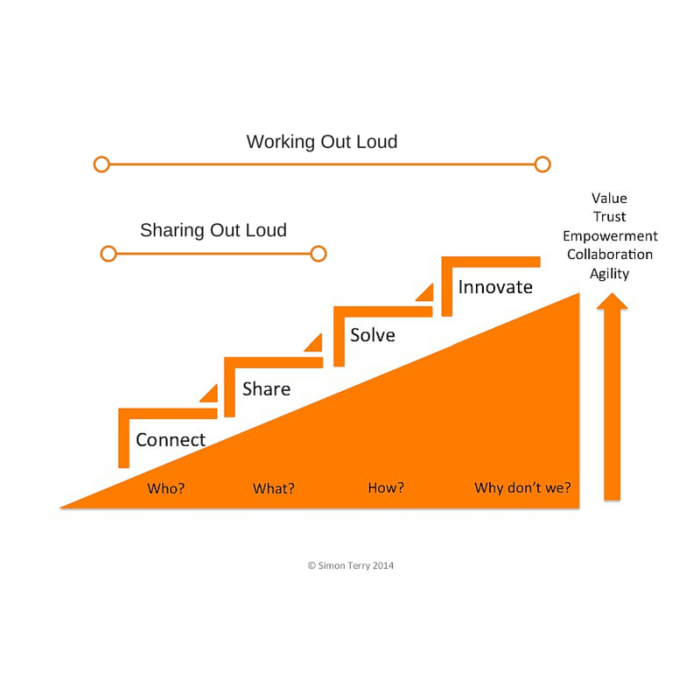
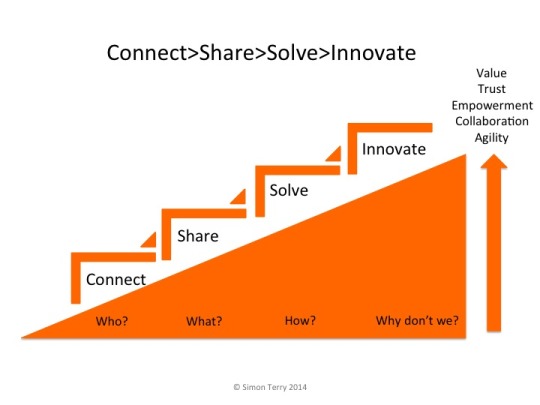
Michelle Ockers discusses useful models of Communities of Practice and discusses Harold Jarche’s  model of Teams/Collaboration/Cooperation and my model of Connect>Share>Solve>Innovate.

Thanks for the mention, Michelle. It has been great to watch and discuss the development of your maturity journey at CCA Amatil on the use of Communities of Practice.

PS: Harold also has a great post that draws out relationships between our two approaches.

Work Changes Culture

Sharing Out Loud

Work changes culture, not words. The future of work needs action to create new ways of working together. Creating new value requires people to do more than communicate. They must work in new ways.

With management of enterprise collaboration often falling in the Employee Communications function in organisations it can be tempting to see the challenges as primarily challenges of communication. How do we get people to use a new communication tool? What information do we want people to share in our new communication tool? Which communication tool should we use when?

The bigger and more valuable opportunity is to change the very nature of work. Changing work behaviours runs directly into the challenges of changing the culture of the organisation.  After all, culture is the expectation of future behaviours in any organisation. What ways of working are expected, what work is valued and how others will support your work is all wrapped up in a rich tapestry of cultural expectations born of past behaviours, some going back as far as the origins of the organisation.

As we have seen from communication campaigns around values in organisations, message can temporarily influence expectations. However, what confirms a change in expectations is when people see new behaviours being practiced consistently, rewarded and ultimately expected by others.

Sharing information in enterprise social networks is a start but the real value of working out loud is created when people begin to change the very nature of their work process to respond to expectations that they be more agile, more transparent, more collaborative, more trusting and more open to the expertise of others.  When this occurs they get the benefits of the input of others in greater speed, productivity and effectiveness. The changing nature of work and the changing culture of the organisation will develop hand in hand in this case and be supported by increasing personal and organisation value to justify the ongoing change.

Organisations that want to realise the true value of enterprise collaboration need to create an expectation that work will change to be more open. The best way to start that change is not with talk but by fostering the action that role models it to all in the organisation.

Invest in Better Work

Collaboration and other future work practices require investment from organisations to foster community and support the changes in practices. The potential value from this investment is better work organisation-wide.

Speaking at Intranets2016, I had the opportunity to see a showcase of presentations from organisations large and small on how they have leveraged value from new ways of working, better communication and collaboration with employees. I also got a chance to speak to many of the people attending the event and discuss their challenges and concerns.

Reflecting after the event one thing was striking: Each of the case studies had invested time and resources into helping their organisation get the most out of collaboration and community.  They had spent time and money on strategy, on design work, on employee engagement, on training and community management. They had ongoing resources devoted to realising the value of community. When I spoke to many members of the audience winning the support of their organisation to invest in these elements was a major challenge. The success stories were successes because their organisations supported their team to realise the value of changing work.

Many organisations have not yet realised that the potential value creation from their new intranet, their new productivity tools or their new collaboration software far exceeds the investment they need to make to support change and adoption. These tool are part of the furniture in an organisation and while from time to time we invest in the latest version to stay effective, not much more is expected from their use. 

Organisations that invest in community and collaboration know the value creation opportunity is far greater than a more effective tool.  The value creation opportunity goes to the heart of their organisation by making work better, more productive and more effective. What little resource they choose to invest will deliver benefits that are multiplied by all the work that they do in the organisation. Scrimping or not investing at all in this capability leaves the tools to miss their potential and the community of users to miss the benefits.

Champions of social collaboration and new productivity solutions need to do more than fund the technology. They need to help the organisation see the strategic value of the new tool in new ways of working. When that value is clear then the business case for ongoing investment and in community and change is much more obvious.

Vibrant Groups

In the Office 365 Community, I was asked by Cai Kjaer of Swoop Analytics how we can identify groups in social collaboration tools that are thriving, struggling or dead. We are becoming increasingly aware of the value of great group and team structures to the success of collaboration in organisations. With that in mind, group health takes on a key role in the success of networks.

Here’s my response to Cai’s great question:

Because groups exist for diverse purposes it is hard to assess universally but here are a few reflections at each level of a group’s purpose. I haven’t mapped to your three levels but there is a mapping that is possible from the themes below. e.g. Dead is when it is not a group anymore and at the other end if it is Solving work problems it is clearly thriving.

Is it still a group (Connect)? Most basically does the group serve a purpose that continues to attract people? Are people joining, do they come and visit the group and is it not losing its membership? Groups can exist as a kind of social distribution list. These groups can remain dormant/passive for long periods of time but play an important role when they are needed. More importantly does it connect people who are not connected elsewhere?

Is it still sharing information (Share)? Is new information being shared in the group? Are there interactions on the information in the group (Likes/Shares/Replies)? Is there a core champion team creating an experience for others in the group? How diverse are the contributions to the group? Is it playing a role brokering information sharing between different parts of the broader network?

Is it doing work (Solve)? Do posts in the group get a timely response? Does the topic at the heart of the group animate people to do things? Is the activity drawing in a wider group of champions and also activating more interaction from all the members of the group? How does the group drive value for members and for the organisation? Does the group create a strong cluster within the wider network?

In my view this is a cascade. If groups aren’t moving up the maturity curve, then they are falling down. Attention is limited in large organisations. People move on to other things when they don’t create value for them and the organisation. The exception would be groups as previous referred that exist solely for option value (i.e. might be needed later such as a CEO briefing group or a YamJam group). These groups should be few and documented in the community management strategy.

What’s your view? What defines a vibrant group? How do we get early warning of issues with groups?

Value the Individual

Value in collaboration is created by individual actions.

In building value for organisations through social collaboration we often resort to discussing the group, the team, the community and the network. There is lots of literature that references these terms and makes recommendations at these levels. Applying traditional business thinking we can lose sight of the individual and focus only on aggregates.

Networks don’t connect. Individuals take advantage of a network to connect with other individuals. Networks don’t share. Individuals share information in networks. The further we move into working, solving and innovating in networks the clearer it is that the value is created by individual actions multiplied by the power of a network.

Focusing on these individual actions is important because it reminds us to study individual motivations, mindsets and behaviours in the creation of effective collaboration. A culture of collaboration exists only in the expectations and behaviours of individuals. More importantly it enables us to talk to individuals about the value & practices of collaboration in language they understand. Nobody says to themselves ‘I need to engage transparently and collaboratively with an enterprise community’. People are looking to advance their work and their personal goals in tangible ways. People articulate often abstract concepts like generosity, authority, reciprocity, enagagement and trust in terms of very tangible actions in everyday work.

Aggregates give us opportunities to talk in lofty terms. Abstract capitalised bound abound. Many of these nouns seduce us with appeals to ideals not everyday actions. Real value is created with change driven using the language of individual users. If you value the individual, they will return the favour.

Do You Really Need That New Intranet?

Intranet projects are still popular these days. There is great new technology platforms & many new features available. Internet designs have moved on a lot so your old intranet is starting to look a little tired. Now your employees have new devices so your intranet needs to be mobile first and responsive. Think of the opportunities for new branding, a new name, better search and a refresh of all the content. Finally the intranet could be at the heart of the knowledge management and collaboration in the organisation. Delivering a new intranet is a signature career achievement.

Stop. Are you sure you need that new intranet?

New intranets don’t come cheap. Even after the technology solutions is acquired, the expenditure has only just begun. All that wonderful new design is going to cost money. You will need personas, card sorts and then branding advice. Getting the information architecture right can make all the difference so you will need a lot of time spent on the taxonomy of content, hierarchies of information, businesses and users. Glossaries and other reference materials will need to be reviewed and updated. Search will need to be tuned to make sure that it delivers the right options. All your existing content will need to be reviewed to fit into the new design. Throw in a policy and product information refresh and the costs and time skyrocket. Then there is the maintenance costs of all that content. Add in personalisation, collaboration and social features and the work never ends.

What is the Intranet really for?

To senior managers, an employee communications or HR team, an intranet is a showcase of the organisation, its business strategy and its knowledge. It is the one source of truth. It is the hub of collaboration and a critical place to share messages with all employees. This perception can create a whole lot of politics that disrupts the effectiveness of your new intranet. People become focused about the need to control the design and the content. User focus is swapped for the desire to meet the needs of the hierarchy. That control has real consequences when it disengages users. Worse still it can force one template on everyone and make everyone into ‘content providers’. The costs of this control are in content that gets out of date and grey market sites that spring up to break the shackles.  Soon the efforts to get around the intranet are drawing investment, effort and attention away from the platform. Confusion escalates and the intranet site is on its way back to being a stale reservoir of knowledge.

To an employee an intranet is where all the links in corporate distribution emails go. Usually the intranet is the last place they go to look when they and their colleagues don’t have the answer to hand and local searches have turned up no relevant ideas. Often the intranet is the place where knowledge is tied up in clunky processes & policy that don’t reflect their day job. Everything is anonymous. The context and authority that comes from human connection is lost. An employee does not care about single sources of truth or showcases of corporate messages. They care about findability and usefulness. Nobody browses an intranet willingly.

I know many organisations who have built elegant product sites on their intranet to explain all the features, process and policy relating to their products. Too often they discover that their teams use the customer facing website for product information. The structure of customer facing product information is usually better suited to employee’s roles in explaining that information to customers. It is indexed for Google search. Legal requirements ensure that product teams keep the external information that matters up to date. Also the employee can send the customer a link if they need to explain lots of detail. The pretty intranet is a showcase but the internet is the workhorse. How much of your intranet site could you do away with by directing employees to external sites?

Are the behaviours going to change?

In our work, we create value through our actions. If the behaviours aren’t going to change, then don’t change the intranet.  Changing only the technology alone, will foster only cost and confusion.

If you do want to get better at collaboration, communication and knowledge management, start with a clear understanding of the value to the organisation and the value to the user. Look for ways to achieve your goals that involved changed behaviours and community, not technology. When you are clear on the value of changed behaviours, you will be clearer on what your technology needs to look like to support that work. Now you won’t be forcing an intranet as a solution and you will be able to look at the breadth of options from social collaboration, to working out loud more, to using external internet sites and other tools of helping employees to find what matters most to help them do their job.

You will also have built a case for the whole organisation to align to working in new and better ways.
Breaking Down the Value Creation Opportunities in A Yammer Post

image

Value is created in enterprise social networks as people connect, share, solve and innovate together. That value creation is an outcome of the work people choose to do together. Measuring the activity in the technology isn’t a measure of the value created, it is simply a measure of adoption. The value of the adoption comes from the organisations strategy and the work of its teams.

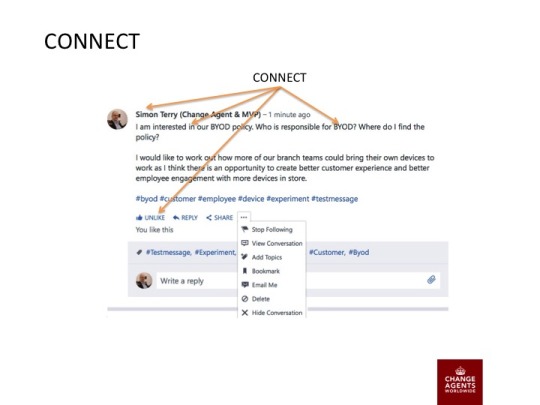
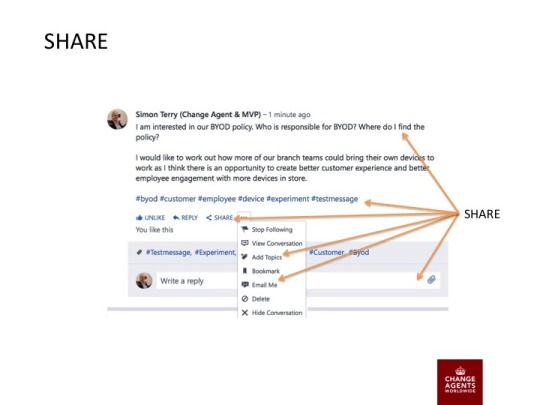
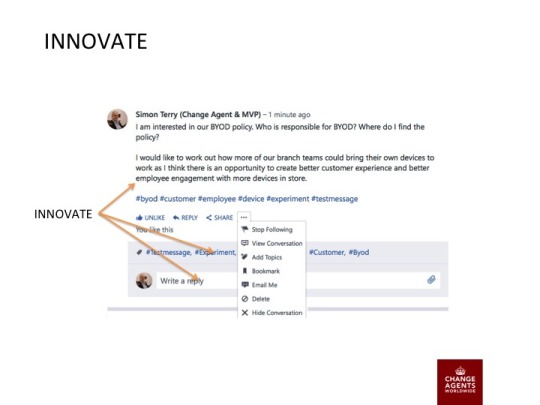
However, the features in a typical Yammer post, or any enterprise social network, can give us a guide as to how people come together in networks to work in new ways.  Let’s break down a Yammer post using the Value Maturity Model so see how new organisational value gets created.

image

Connection brings people in the organisation together often for the first time.  That connection can be a simple as the feeling of belonging or recognition when a post gets a like. It might be bringing people together around a topic of current need or ongoing mutual interest like a community of interest or a community of practice.  Most directly, connection can be a way in large, distributed or siloed organisations to find the people responsible and get in touch to move work forward. 

image

Sharing lifts information out of its hiding places, makes it findable and directs it to people who need to know. That can happen in the enterprise network through replies that answer common questions for everyone’s benefit, provide links to information or provide documents meeting a present need and saving future time and searches.  Shares make sure information reaches the right people whether a group, an individual through a private message or even by taking a message out to email to those who don’t regularly use the network. All sharing is silo-busting. Adding topics, either in a message or later, provides people new ways to navigate information and helps make information searchable. Sharing creates a rich domain for social learning and helps the new employee seeking to learn more. A culture of sharing fosters working out loud to help people achieve personal purposes, bring work to the surface and further increase these benefits. Most importantly of all, this activity helps build a shared and discoverable context for the work of the organisation reducing errors, duplication and improving problem solving and efficiency.

image

Value creation accelerates when an enterprise social network becomes a way for people to come together to work on solving problems. People can ideate, offer solutions and work together in the thread or in groups to discuss ways to solve work problems with existing or new solutions. Having a way to discuss and work through problems in products, policy or process, either through fixes or hacks, helps the organisation continue to flow for those doing the work. The problems raised in this way are able to be solved not just for one user but for everyone in the organisation. The value of these solutions will increase as the problems that teams tackle increase in value. Leaders, experts and creative individuals can help enable the organisation to move past its daily obstacles and create better experiences for customers, employees and other stakeholders. The benefits here are in work in the network and out in the organisation that continuously and responsively improves organisational effectiveness.

image

Innovation adds value to the organisation when employees feel enabled and encouraged to put forward possibilities, to seek ways to make them happen and to recruit capabilities and coalitions to experiment and execute on opportunities.  Vibrant communities will work well beyond a single post out into the broader organisation to make their ideas a reality and help the organisation to respond to its opportunities. Innovation allows employees to explore ways to better fulfil the purpose of the firm, to radically reshape the processes of their work and to deliver new forms of value.

image

Building the Goodwill of Networks

Networks give people access to more people than ever before. However, they can also create new inconveniences by allowing people to free ride. Networks are fostered when people are encouraged others to making contributions to others first and to consider in their approaches the value created for others in their requests. These actions, like purposeful and generous working out loud, rebuild the goodwill that free riders consume.

The Network Externality of Free Riders

In economics, an externality is a cost imposed on other people who did not choose to incur it. Free riding is where a person consumes more than their share of a common resource. Every network depends on common resource of goodwill in continuing connection. A common barrier to the development of collaboration in networks is the network externality of thoughtlessness and free riding.

Great networks build up goodwill among the members which facilitates collaboration through trust, shared connection and a sense of reciprocal benefits. Free riders are members of those networks who don’t contribute to the general goodwill. 

The Externality of Thoughtlessnesss

Thoughtless activities in networks consume goodwill because they impose costs on others in the network without any return:

  • Noise: It takes time and effort to filter out noise. Creating noise in networks is costly to everyone. Noise can include repetitive posts, broadcast messages, long rambling messages, diversions from purpose, spam and other forms of low value messages.
  • Laziness: Failing to check that the question you ask has not been answered already or that the answer is not readily available. Let me Google That For You is a great example of a solution to this common occurrence.
  • Confusion: Making a unclear request of the network. In many cases questions are far easier to ask than to answer well. Many people do not think through what others need to be able to answer their query. It takes time and effort to clarify what the issue is and what answers or assistance will be helpful.
  • Selfishness: Making request of others for effort without giving anything back. We have all been asked to help others in our networks. The better requests are respectful of the individual and the network. Most of the requests that come through Linkedin have a clear benefit to the other person but much less consideration on how I might be interested in helping. Responding to these requests takes time and effort which lowers the value of the network and the priority of responding at all.
  • Lack of Follow-through: Making requests that are ambit claims, have unnecessary urgency or where you are not prepared to invest in follow through on the responses others will make. A common issue is when people ask for urgent help and then disappear again without responding to even acknowledge the answers given to their query. 
  • Unclear Benefit: Making unclear offers of benefits. If you suggest something offers ‘exposure’, ‘mutual benefit’, ‘rewards’, ‘an opportunity’ or similar it helps to quantify this in your request. Leaving it for others to discover the meaning of your obscurity imposes costs on others and on you.

There are many more examples. While it may be easy to decline all poorly framed requests, some times opportunity lurks under the thoughtlessness.  The challenge is that the time and effort to respond, to clarify, to negotiate mutual benefit and to help can unduly burden network participants. Suddenly people withdraw from helping others in the network because the collective experience is burdensome. 

Sidenote: Recognise Your Own Value In Networks

Under an avalanche of requests for free time, free help, free speaking engagements, free advice, offers of ‘exposure’ and general lack of consideration, it can be tempting to decide that you have to acquiesce because the whole system works this way. This is even more the case when you are told ‘everyone else’ seems to be doing things on this basis. We are still learning how to manage relationships at scales, timeliness and distances that have never been possible before in human history. Remember always you have choices. The best way to make choices is to respect the value you bring, set your own strategy and set your own rules for the value exchange. That way you take and miss the opportunities you choose, not others. Ask people you trust to help you assess the value you create, if you can’t do it yourself. Grace, humble respect for the value you create and a focus on reciprocity can make magic happen.

Replenishing Goodwill with Purpose, Contributions and Serendipity

One of the reasons that I am a advocate of John Stepper’s work in promoting the value of working out loud is that John has made explicit the value of making contributions to others. Making purposeful contributions to people in your network builds goodwill. It is a great way to start a relationship. People are more likely to assist you if they have seen you making contributions to others. Most importantly of all to make a contribution to another person you need to take the time to think of that other person and their needs.

Goodwill erodes if it is not actively restored by reciprocal benefits in a network. Creating goodwill through consistent contributions to others and serendipitous benefits helps the networks deliver net benefits to participants overcoming the costs imposed by the thoughtless and the deliberate free riders. The more people make purposeful contributions to others the more likely the balance will be a net positive one. For this reason many early online forums excluded lurkers in an effort to foster purposeful participation and reciprocity. The champions, change agents and connectors at the heart of your network will be some of the most purposeful, considerate and generous individuals that you know.

Fostering a culture of working out loud that is purposeful and generous will help any network overcome the challenges of occasional free-riding.

The Value of Collaboration is Changed Work, Not Answers

Read the literature on enterprise social networking, chat applications and collaboration and you could easily fall into believing that all that matters for a vibrant and valuable community is generating good answers to employee questions. The value of collaboration is not in answers. The value of collaboration is in changing the way work gets done.

Answers to questions are an early signal of the maturity of a network. Suddenly, it feels like the organisation has a Genius Bar of its own. Once people start to share their expertise, their knowledge and their ideas you have the platform for further development of the way your organisation works. However, many people focus on these answers as the point of collaboration.  They become diverted by the need for more participation in answering questions and generating faster or more accurate answers. Some of the paths to achieve a better answer can have negative consequences to the further maturity of the network.  

Placing the pressure of social support on a few champions alone can threaten the participation of a group critical to the success of the entire community. Badgering leaders to answer questions without any personal rationale leaves them seeing enterprise social as just another inbox. Gamification, badges and other recognition will increase participation but can also make participation, less purposeful, less flexible and more a numbers game. 

The appeal of many of the new chat applications is that for a small engaged teams, such as a development team, project team or consulting team, they can provide a ready access to answers and a forum for sharing. However, a dynamic of answering can lead to the community descending into a ‘groundhog day’ experience of the same questions asked repeatedly. When people expect quick answers why search the community to see if your question has been asked before.

Solving work problems and innovating in an work community is about more than answers. Faster answers is an example of reducing the cost of knowledge work in your organisation.  The greater value creation opportunity comes from step changes in products, processes and ways of working generated by employee interactions in your enterprise social network.  This value creation impacts your entire organisation, not just its knowledge workers.

The bigger opportunity is to bring people together, to share their insights, to address problems and to create new ways of working. Answers play a dominant role in only the first two stages of that problem. The latter two stages require people to give and take, to debate, to test and to make business decisions to see new opportunities, change products, processes and reallocate resources. The best outcomes from the Solve and Innovate phase are outcomes of the group dynamic, not an individual contributor’s answer. This generative process is far harder to gamify because small infrequent contributions can play a critical role in moving a group forward, for example making available access to a critical resource.  It is in this process that we move beyond Sharing Out Loud to genuinely purposeful Working Out Loud.

Moving the maturity of collaboration in your organisation beyond just answers is more than a technology or incentive challenge.  Creating real collaboration in work depends on having a strong value case for the organisation and the individual. It also requires the engagement of wider organisations systems to support the changes in work. Lastly, community management can play a critical role in fostering the development of work communities and the wider organisation transformation.

If you would like to discuss how Simon Terry and the Value Maturity Model can help your organisation to get greater value from collaboration on any platform, please get in touch through TwitterLinkedin or https://cotap.me/simonterry.