Many organisations performance management values only more. When your organisation values extra outcomes, you lay the foundation for collaboration and innovation.
I meet organisations whose performance management schemes are so tightly managed that the only outcomes that are valued are those planned at the start of the year. Not surprisingly the narrow focus on more of one or two outcomes limits the potential of people and the organisation to change. Their efforts on new ideas or new collaborations will not be counted.
This focus solely on more value is another example of the Golden Goose School of Management. Specifying performance of people like widgets is only a localised maximum. The most obvious consequence of managing performance in this way is getting more of things you no longer need when circumstances change.
I have generally chosen to work where people value both more and extra value. The simple addition of extra value enables people to step beyond the box of their role. They can pursue new ideas, projects and collaborations without the need to seek approvals or changes to performance scorecards. This enables people to respond to changes and do what needs to be done. If that means a CEO of a small healthcare payments business sponsors the parent group’s enterprise social network, it happens and it is valued.
Make sure you value the extra contributions of your people whatever they are. The future of work will demand the flexibility in value and performance.
Senior executives need new mindsets and new capabilities to be effective in the networked work of the future. Four capabilities will help e executives make the most of their networks:
Personal Knowledge Management: Personal Knowledge Management gives executives the personal learning skills to manage the flow of information and to deepen their personal networks. As executives personally learn to Seek>Sense>Share they develop critical digital skills for network leadership.
Working Out Loud: Working out loud is a practice that helps surface the value of work and learning in networks. Leaders are already the focus of attention. Making their work in progress visible to others is a highly valuable step because it accelerates trust and learning.
Leading in Networks: Network leadership requires leaders to surface shared purpose, build trust and influence and enable collaboration. Expertise, rank and orders are replaced with adaptive leadership techniques that manage learning, tension & alignment.
We may have begun to move from an adoption conversation to a value conversation. However our hierarchical mindsets can still hold us back. A responsive organisation needs to shape how value arise from collaboration, not try to specify it top down.
Embrace Value
More and more organisations are focusing on how to create strategic business value in their organisation through the use of collaboration. They are seeing the value that can be created as a community journeys from Connection to Innovation. They recognise that adoption & use should reinforce the strategic goals of the organisation and is not an end in itself.
The Temptation to Specify
When an organisation identifies the way that it can create value in a community, our hierarchical tendencies begin to kick in. We start to specify how a community shall work to create value. This is how most organisation’s strategy planning processes usually work. We end up with a plan of what other people have to do.
Some guidance can be useful at the beginning of a community’s life when people are sense making. However, too much instruction will become a constraint on the value creation if the goals of value creation remain externally imposed on the community.
The best value comes when a community can use its knowledge, capabilities and ideas to create value in new ways. That won’t happen if the community has specified usage cases and a limited focus on the value that it can create.
Coach the Community to Create the Own Value
A large part of the difference between management and leadership is the difference between direction and coaching. Responsive organisations demand leaders who can coach teams managing highly adaptive situations, rather than direct.
Organisations need to coach the members of their communities to create valuable new ways of working using collaboration:
Coaching begins by clarifying goals: How do you help your communities understand the alignment between organisations strategic goals and the goals of their own work?
Coaching should enable action & experimentation: How do you help people to translate the opportunities that they can see into work that they can do alone or with the support of others?
Coaching should build capability: What skills do people need to manage this process for themselves? What barriers need to be cleared? How can they learn to create, deliver and coach themselves going forward?
The Value Maturity Model Collaboration Canvas is a coaching framework to help community leaders, champions and managers to shape the creation of value through collaboration. The tool asks members of the community to think through the questions that will enable them to create their own value. Spreading this coaching mindset through your organisation is the most powerful way to transform the value created by collaboration & communities. Spreading a coaching mindset through your organisation builds capability as it builds alignment and creates value. Enabling people to coach themselves helps your organisation become more responsive. It is the only way that you will get the value you didn’t plan and to adapt to the challenges you did not forecast.
Many organisations want the benefits of better collaboration and the potential of better leveraging the potential of their people in a community. Increasingly with the availability of enterprise social networking, social mobile apps and integration into other productivity tools, organisations have the network capabilities to create the communities at hand.
A Network with a Demanding Boss
Too many plans for enterprise social networks and communities are developed without any community participation. The organisation wants something from the network. They set about getting that goal. When realising the goal proves harder than they expect, the organisation resorts to communication, performance levers, gamification, or maybe even ‘change management’. Many of these remain efforts to impose an external rationale on a network.
If the goals of a network are imposed externally, it is not a community. It is a network with a demanding boss. Any network of this type will lose energy over time as people query the benefits of their participation.
Use the Network to Create a Community
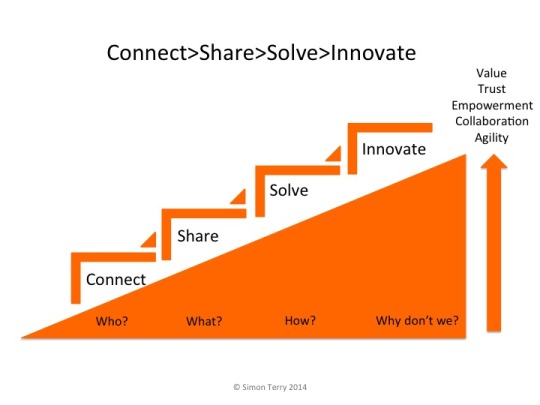
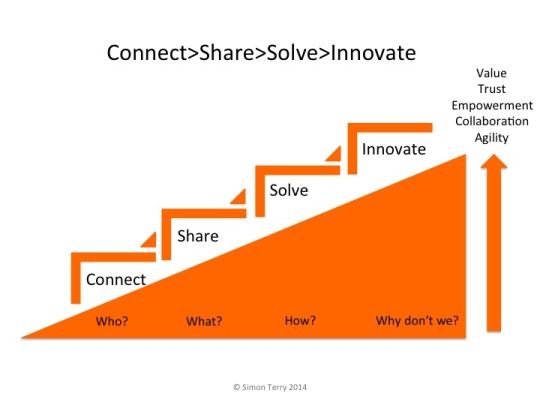
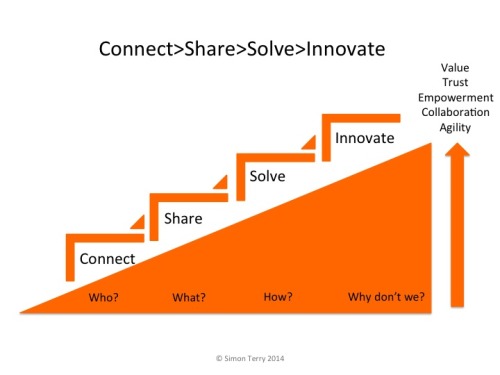
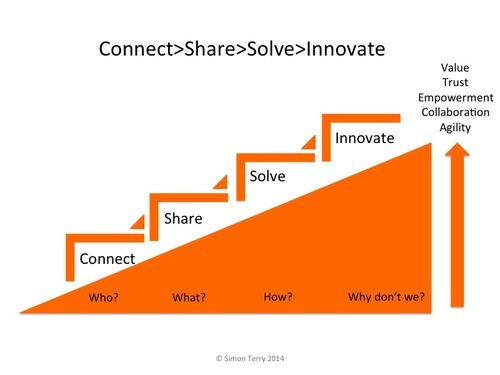
A community comes together around a common set of purposes. Use your network to discover, discuss and align those goals. Engage the people that you would like to form a valuable community to find out how they want to engage. My work shows that people have their own great reasons for adopting the practices that accelerate value at work and build communities. Those practices are those of the Value Maturity Model – Connect>Share>Solve>Innovate.
The organisation’s goals will become a part of that discussion naturally. Everyone works for the organisation and there will be some shared purpose. By engaging people you will discover the greater potential of the community and leverage its rich diversity of talent and perspective.
Ask leaders to lead
Much has been discussed about executive participation in enterprise social networking. Often it is seen as the panacea that will make people do the ‘right things’ in the network. Even the busy senior executives struggle to participate when it is imposed on them as an externally mandated task. Again, the effort is to impose an external logic for networking.
When you focus on the community, what is clear is that what is needed is leaders. We don’t need participation from senior executives, when need people who are willing to take on the role of leader in the community to help the community to achieve its purposes. Leadership should come from senior executives, but it can also come from other community leaders, influencers and champions.
Don’t focus solely on senior executives. Focus on finding leaders willing to help create a community and drive change. These people may well be your organisations mavericks and change agents. Embrace their ability to lead.
The Value Maturity Model is an approach to help organisations create strategic value in collaboration and social networking. The Value Maturity Model Canvas helps organisations to develop agile plans for communities using participation of community members. To learn more, get in touch with Simon Terry via about.me, twitter or Linkedin.
Connecting and Sharing create a reputation economy in your organisation to underpin the trust and collaboration required to Solve and Innovate.
Four topics are commonly discussed in communities around enterprise social networks:
Why would anyone go out of their way to help others?
How do we increase the value of collaboration in our organisation?
What is the role of leaders?
How do we cut down the gossip and non-work conversation in our network?
The answer to these four questions are connected to one element of successful networks: they create a reputation economy in the community that fosters collaboration.
The Value of Reputation
Humans aren’t the rational economic machines that most organisations try to manage with role descriptions, performance plans and other incentives. Humans do things outside the job description and the process every day. We work around the hierarchy. Importantly, we collaborate because we value relationships and we know that the returns from collaboration exceed the costs in our effort.
One of the challenges of collaboration is the danger that others will free ride on your efforts, improving their performance but bearing none of the costs. Mark Pagel’s Wired for Culture uses evolutionary approaches to behaviour to examine an important part of our defences against free riding, reputation. Because our relationships with our work colleagues are not transactional, over time we build a level of trust and a reputation for each colleague based on their behaviour. This reputation system influences who and how we collaborate with others.
Ever wondered why a users first ever request for help or crowd sourcing of ideas will usually struggle? They have no reputation in the community and others will hang back until someone shows they can be trusted.
Increasing the transparency and connection of reputation in your organisation will accelerate collaboration not just in a social network or other tool. Collaboration across the organisation will leverage the new transparent reputations developed.
Building Reputation
We don’t build reputation with our status in the organisation or by declaring we can be trusted. We build reputation through with who we are associated and how we act, particularly when we act against our interest.
The Connect and Share phases of the maturity of a collaboration community enable people to develop these critical stages of reputation. Working out loud for the benefit of others can accelerate that trust. As can demonstrating and encouraging a growth mindset. Sharing information, insights and solutions, particularly when there is no reason or benefit to the sharer is a powerful way to build a reputation. Others sharing without penalty and preferably receiving benefits establishes the view in the community that it is safe.
The reputations and the trust built in Connect and Share are what powers the value in the later stages of the model. People contribute later because they know that their contributions go to those who they respect and have the interests of the community at heart.
The Importance of Leaders
Leaders bring status into communities. However, as noted above, the presence of status is not enough to create or sustain trust. Actions by leaders count.
Leaders can play a critical role in showing the way to build reputation and in establishing that collaboration is safe and beneficial. Importantly, leaders can use their authority to calling out free-riding behaviour and encourage participation by others. Leaders can acknowledge the reputations built in the community giving them greater influence in the organisation.
Leaders also need to be aware that their status also brings a fragility to their own personal reputations. If they fail to act in the community to reinforce their authority, it will erode rapidly.
The Critical Role of Gossip & Non-Work Conversation
Organisations hate gossip and non-work conversation. They are seen as a threat to the singularity of corporate messaging and a waste of time.
However, gossip and non-work conversation are critical parts of reputation systems. Gossip is how we share our views of others reputations. Non-work conversation is another way for us to share and build our reputations with others.
Create a reputation economy in your collaborative community by fostering connection and sharing.
The Value Maturity Model is an approach to enhancing the value of collaboration in your organisation. The Model is supported by a range of tools and practices to enable leaders and community managers to maximise the potential in collaboration. If you would like to learn more about the Value Maturity Model, get in touch with Simon Terry.
The old way industrial of creating value is well understood and commonly implemented. Develop a unique proposition with a discrete market. Create a simple linear process to deliver the proposition by turning inputs into outputs with value creation at each carefully delineated step. Maximise control at the choke points in the process to maximise returns. Manage efficiency and throughput of the process to minimise waste. Reduce risk. As easy as that sounds we have spent over 200 years perfecting the process and still have much to learn.
We know far less about creating value in the massively scaled digital networks that we face today. Mostly we know what doesn’t work. Failure is accelerating. A focus on efficiency will kill a company competing with disruptive competitors. Networks specialise in routing around control points. Parallel disaggregated processes disrupt the linear, particularly if relentlessly focused on key opportunities to create value. Transparency across the process and rapid exchange of information changes the organisation-customer-employers-supplier- community dynamic in radical ways.
Value creation in networks to date has defaulted to the nearest analogies of the industrial model. Build a platform with a unique global scale that you can control. Strip the value creating process back to customer acquisition and platform development. Control advertising revenues ( or less commonly enterprise sales) as the principal form of monetisation. Experiment and acquire relentlessly. Be transparent internally and leverage networked models of organisation internally, but behave like industrial peers to the external market, except for carefully structured communities of co-creation and innovation.
The latest clues in the Cluetrain Manifesto are a reminder that this model is not guaranteed. At the same time, the lessons of the last Dotcom bust documented in Seely-Brown and Duguid’s ‘The Social Life of Information’ are a reminder that we have not yet reached our disaggregated and disinter mediated ‘markets are conversations’ utopia.
What is clear is that we need new ways of working. We will build new practices using our new global networks and relationships to exchange what works and to discard what does not. The key to success will be effectiveness. Effective organisations will mobilise their potential, connections and capabilities to pursue the ever-changing network opportunities, to learn together with their customers and community to realise a meaningful purpose. Embracing the new network economy and networked ways of working is fundamental for any organisation seeking to make this shift. Any organisation that takes this leap is on the path to becoming a Responsive Organisation.
Value has never been created around a board table. That is where value and the resources to create value have historically been acquired or allocated, often poorly. Value has never been created by data alone. People transform the data into hypotheses, insight, decisions and actions. Value has always been created by that action in networks, even if those networks are the crippled relationships of hierarchy. Those are network of people, not data. The organisations that reap the potential will be led by Network Navigators who can help their organisations through the journey.
Harold Jarche reminds us ‘the work is learning and learning is the work’. We have entirely new systems and practices of organisations to develop, to test and to share. Like our efforts to date we will begin with fixes and variants to the systems we have. Over time we will make more new sense of the future of work. We will need to learn to trust and enable people to leverage their networks and experiment. Then we have the journey of change advocacy to spread the successful practices. The widespread use of enterprise social networks is just one such step and even it has not addressed the potential of adoption, let alone value.
The fun of value creation in networks has only just begun. Our job is to make that fun a very human and purposeful experience.
The process is just a process. Often the process is one of many competing paths. Outcomes matter more.
In a recent conversation about customer experience, we were discussing the way people fixate on processes. Processes appeal to our industrial management mindsets. Processes are an engineering challenge of neat inputs and defined steps delivering an outcome in a mechanical fashion. Processes are so easy and alluring.
As a result we see troubling signs:
people compete for the beauty of their customer journey map. Have a look at Pinterest there are hundreds that are so gorgeous they reflect no real customer experience ever
measures, averages and other abstractions of the process mindset take precedence over human considerations.
Raising process to an exalted state devalues the complexity of humanity. The computer does not need to say no. Putting process over outcome leads to the outrage economy as people try to fight their way out of a narrow industrial mindset.
We need to focus on real human relationships. We need to allow for the mess and power of human emotions. We need to consider networks with learning, change and feedback, not just linear processes. Importantly, we can allow for human scales, learning and flexibility. Most importantly, we can allow for human conversations. That is the path to achieving the real messy and complex outcomes that we need.
Our organisations, our customer experiences and our relationships will be better for a broader more human approach.
The difference between a network and community is a culture of collaboration. Collaboration doesn’t just happen. It is grown through the action of leaders.
Markets are Value Networks
The markets we use when we exchange financial value today are networks. Networks of connected agents exchange value in our stock exchanges, banks and risk markets. These networks did not arise simply because people connected. Financial markets are facilitated by practices that help transform connection into valuable interactions.
When the networks of merchants in coffee houses became stock exchanges, they relied on the role of brokers and market makers to help build a valuable marketplace. These roles helped people:
to build trust in the new market,
to create liquidity that enabled activity when demand and supply from participants was not perfectly matched,
to share information,
to develop new ways of working
to help the new markets to enforce the rules and standards of the exchange.
The same leadership work to build value, trust and new ways of working is found in the history of banking, insurance or other exchanges.
The value created in these networks did not occur because the network existed. It occurred because of the work of people to build a collaborative culture in the network. People need to build a sense of how to use these new exchanges and to build trust in that they would deliver more value than risk.
Your Network Needs Market Makers
Any collaborative network will need leaders to help facilitate the creation of value in the network. This leadership will be a combination of technical support from community managers and change leadership support from change champions in the organisation and the organisation’s senior management.
The Value Maturity Model highlights the way that collaboration’s market makers need to work to facilitate the value creation in your network:
Connecting relevant people to the network and into groups
Sharing information that may not have reached its necessary audience
Helping to solve issues by matching needs and capabilities, finding other resources or information and even holding a problem or information until there is a match of demand or supply.
Providing the systems and support to enable innovation experiments to be fostered until they are proven or fail.
Experiment and lead adoption of new ways of working
Helping lead the change in the culture of the organisation to allow the development of further cultural change.
To maximise the value of the networks in your organisation, you will need to develop the leadership capabilities that can take advantage of networks.
If you would like to create greater value in your enterprise social network or discuss how the Value Maturity Model applies to assist your organisation to create strategic value, please get in contact. I am available through @simongterry or Linkedin or www.simonterry.com