Is your career a collection of cells or a portfolio?

If you look at any classical hierarchical organisation chart, what do you see most?

White space.

That white space is where the opportunity and ambiguity exists. The white space is where everything unplanned occurs, especially important in a time of fast paced disruption. White space is the territory of much needed collaboration. White space is where we make our difference.

Career as a series of cells

However many people lives their work lives constrained by the boxes. We each get to choose our contribution.  For some the boxes define the limits of their contribution.  Each job becomes the cell in which they live and contribute to the organisation. Too many people view their role as the limit of their authority and the limit of their opportunity. When these individuals change role, it is as if they have had their cell moved; new window, but same limited vision.

Worse still a proportion of people view this succession of cells as defining their life. They see themselves as only their job. Those jobs have needs, challenges and demands that dominate their lives and limit their broader contribution to the communities and societies in which they live.

What’s the alternative? Career as a portfolio.

We each have a rich purpose and lives full of opportunities.  Our workplaces and our lives are full of whitespace.

From all that opportunity we get to form a portfolio of opportunities to make a contribution.  Like investment managers, we allocate our limited time into many things to diversify the sources of our monetary, physical and emotional returns.  Some will be through our day job.  Some opportunities in our portfolio will be projects – collaborations that we run on the side to explore who we can be.  These side projects might be at work but they could equally be outside.  Not all side projects are economic.  Many are simply creative or social.

Beyond traditional work, we make a contribution with our leadership and participation in society.  We have families and relationships.  We volunteer.  We advocate.  We debate.  We join organisations.  We participate.  Most of all we discuss and help and build rich communities.  Given the complex issues society faces we need more of this broader contribution from everyone.  

Each of these activities helps define who we are as part of our rich portfolio of contributions.  After all, where we choose to spend our time and money is a much better indicator of who we are than a list of jobs or even our self-declared descriptions.

Having recently found myself without a day-job, I have entered the world of a portfolio.  I have been overwhelmed by the opportunities, the difference I can make and the richness of experience that each opportunity offers.  Each and every opportunity was possible if I was still working full-time, but I know I would have faced different incentives and pressures in exploring these opportunities.   I wouldn’t have made such a clear choice to manage a portfolio with my time.

It is time to step outside the cells.  

Make a bigger contribution.  Make your mark.  Manage your career and life as a portfolio of interests.  What more can you do in, around and on the side of your job?

Is your career a collection of cells or a portfolio?

If you look at any classical hierarchical organisation chart, what do you see most?

White space.

That white space is where the opportunity and ambiguity exists. The white space is where everything unplanned occurs, especially important in a time of fast paced disruption. White space is the territory of much needed collaboration. White space is where we make our difference.

Career as a series of cells

However many people lives their work lives constrained by the boxes. We each get to choose our contribution.  For some the boxes define the limits of their contribution.  Each job becomes the cell in which they live and contribute to the organisation. Too many people view their role as the limit of their authority and the limit of their opportunity. When these individuals change role, it is as if they have had their cell moved; new window, but same limited vision.

Worse still a proportion of people view this succession of cells as defining their life. They see themselves as only their job. Those jobs have needs, challenges and demands that dominate their lives and limit their broader contribution to the communities and societies in which they live.

What’s the alternative? Career as a portfolio.

We each have a rich purpose and lives full of opportunities.  Our workplaces and our lives are full of whitespace.

From all that opportunity we get to form a portfolio of opportunities to make a contribution.  Like investment managers, we allocate our limited time into many things to diversify the sources of our monetary, physical and emotional returns.  Some will be through our day job.  Some opportunities in our portfolio will be projects – collaborations that we run on the side to explore who we can be.  These side projects might be at work but they could equally be outside.  Not all side projects are economic.  Many are simply creative or social.

Beyond traditional work, we make a contribution with our leadership and participation in society.  We have families and relationships.  We volunteer.  We advocate.  We debate.  We join organisations.  We participate.  Most of all we discuss and help and build rich communities.  Given the complex issues society faces we need more of this broader contribution from everyone.  

Each of these activities helps define who we are as part of our rich portfolio of contributions.  After all, where we choose to spend our time and money is a much better indicator of who we are than a list of jobs or even our self-declared descriptions.

Having recently found myself without a day-job, I have entered the world of a portfolio.  I have been overwhelmed by the opportunities, the difference I can make and the richness of experience that each opportunity offers.  Each and every opportunity was possible if I was still working full-time, but I know I would have faced different incentives and pressures in exploring these opportunities.   I wouldn’t have made such a clear choice to manage a portfolio with my time.

It is time to step outside the cells.  

Make a bigger contribution.  Make your mark.  Manage your career and life as a portfolio of interests.  What more can you do in, around and on the side of your job?
Change begins when you start

Today I saw a conversation on twitter between two people who inspire me with their passion and ability to make change, Maria Ogneva and Susan Scrupski.  I also saw a moment in that conversation that represented an insight into change leadership I see again and again.  I paraphrased that moment in this tweet.

Here’s what struck me about this tweet and what makes it a template for all change leadership:

  • A person, our change agent, sees a need for change and forms an intention to make it
  • The intention for change is not fleeting and our change agent reflects on the need for change over time
  • Our change agent has doubts they are ready to make change happen
  • The change agent is very aware of the challenges ahead
  • The change agent decides to act regardless.

Almost everyone can see changes that they want in the world.  Many many people don’t think that they are ready to lead change and have doubts.  Everyone knows change is hard.

Change still gets made.  Why?  

Because people with passion and energy, just start.  They find the way forward and find their purpose in the hard work.

When you look at the lives of great change leaders, again and again you find the same comment.  They weren’t the best placed.  They weren’t the most powerful or most capable.  They weren’t given authority.

Change agents are the ones who see a need, challenges and take action anyway.  Everything else comes with solving problems, drawing others to help and having success.

Great change leaders are the ones who start work regardless.

So when are you starting? Today?

Infrastructure of culture

Culture eats strategy for breakfast – Peter Drucker

Enterprise social networks are a new form of communication in organisations. Culture is the outcome of how we interact. New interactions will change the culture of our organisations over time. Managing culture changes is critical for organisations coping with disruption.

Adam Pisoni recently quoted a comment I made at Disrupt.Sydney that enterprise social networks are ‘infrastructure of culture’. The comment was building on Kai Riemer’s talk at Disrupt.Sydney that technology that acts as infrastructure (of connection, of transportation or of communication) is open to novel uses and depends on users to make new sense of the infrastructure. Kai was drawing a distinction with our traditional tool based view of technology where it exists for a specific purpose. This point highlights one reason why we often have an inability to forecast where new communication technologies lead us in terms of changes in interactions and societal change.

Enterprise Social Networking is an Infrastructure for Culture

The culture of an organisations is a sum of the interactions across the organisation. It is the ‘way we do things around here’ or ‘what happens when the CEO is out of the room’.  Culture runs deep and is the outcome of thousands of interactions. Speeches, posters and announcements don’t determine culture. As social animals, people look for guides as to what is acceptable in the stories of the organisation, the daily behaviours of others as they interact and importantly in how moments of crisis or conflict in the community are resolved. What happens when things get uncertain is at the core of the culture of a company.

Disruptive change tests the culture of organisations. Shaped by purpose and values as demonstrated in action, culture has an enormous influence on how the organisation runs and what is possible. Many organisations need new strategies to respond to disruption. However, if your strategy runs counter to your culture you will face challenges and likely fail. In the face of disruption, many organisations have found they simply cannot pivot their strategy because it threatens some deep elements of their culture.

A common goal of launching an enterprise social network to execute a strategy to ‘change  culture’. Looking for more leadership, authenticity, accountability, openness or innovation, organisations assume that the network is a tool to deliver that outcome. These organisations are usually disappointed initially. Culture changes the strategy. All they see at first in the community on their network is their organisation’s current culture, just much more visible than ever before. The good, the bad and the ugly is on display. Even worse, the much vaunted new values from the strategy are often not on display because the community is not yet comfortable with those novel interactions, is waiting for a lead from others or does not accept that they can be arbitrarily imposed from above.

Communication networks are infrastructure, not tools. The change in culture is in the community adopting new behaviours, not the technology. The potential of enterprise social networks to change the culture of organisations occurs over time as the interactions change. Importantly, social networks offer opportunities to accelerate this change.

How do new interactions accelerate change the culture of the organisation?

  • Build common purpose:  Social networks are a place to discuss and connect around purpose. Purpose is not imposed.  It comes out from interactions and work in the organisation. Too often when organisations have a new strategy, it is the executive team who assumes the right to set the purpose and only they understand the context that drives the need for change. A social network allows others to discuss and question this.
  • Empower change agents:  enterprise social networking often appeals to a group of early adopters, your organisational change agents. This group of diverse individuals have been looking for a way to have a larger voice, to connect and to drive change. These early adopters will drive a lot of the initial interactions & innovations.  Their goals are each different but they are often more comfortable with many of the values that organisations seek such as collaboration, openness, innovation and experimentation. The challenge for organisations looking to leverage these individuals to drive change is to authorise their activities and encourage the new interactions in constructive directions. Senior leaders can use their authority to play a key role in ensuring that your network does not become a sub-culture of the broader organisation.
  • Lead and role model: People look for role models and leaders. They will follow their guide in the behaviours that they demonstrate. Build a group of leaders of the community and let them know that they are responsible for fostering constructive interactions. Make sure your hierarchical leaders are playing a positive role and not discouraging change.
  • Share stories:  We learn culture from stories of interactions. Social networks allow us to share those stories in new ways and with new audiences. Encourage story telling and make sure you are looking to draw out the cultural lessons of the stories being told.
  • Make interactions visible:  Social networks are a new medium to see interactions. Remember the majority of people will watch, read and learn. Your culture will be on display and shared more widely than ever before.
  • Create interactions across sub-cultures:  Large organisations are often frustrated by the number of sub-cultures as communities within the organisation develop their own interactions. These sub-cultures often create unresolved conflicts blocking progress. Connect these individuals in one community and let them learn about each others contexts. Building shared purpose, concerns and understanding will build a greater commonality of culture.
  • Create conflict:  If there are values conflicts or other regular interactions driving conflict in your organisation, they will surface in enterprise social networking. The faster you bring these out the sooner culture changes. How you work to resolve these through collaboration will be key to your future culture. Remember it is better to resolve these internally before they leak externally through employees or other partners experiencing the conflicts and sharing them.
  • Allow the creation new interactions:  As infrastructure, an enterprise social network is open to employees, leaders and other participants to create new interactions.  If you encourage experimentation and quickly weed out failures, you will be driving innovation in your culture as each new successful pattern of interaction develops.  Embrace the chaos and you will see rewards as your culture develops.

Communities change culture when they adopt new interactions through the role modelling of others and the support of leaders. Enterprise social networking is an infrastructure to accelerate this process through new interactions and innovation. Disruption often demands rapid changes to organisation’s cultures that have been built up over many, if not hundreds of years. Networking the community within the organisation is critical to enabling the organisation to manage that change.

What’s your manifesto?

The hardest part of disruption is disrupting yourself – R Ray Wang.

As the Industrial revolution changed society and new communication technologies were born, the western world experienced an age of revolution. Manifestos flew from the printers as advocates for changes in society sought to draw people to their causes and changes to society and economic activity. The passion for manifestos quietened after the shocks of two world wars. By then massive change had occurred to the level of social support, to the structure of the economy and to the power of social classes. Society had adjusted to new social models that mitigated (or in the case of totalitarian states suppressed) issues of the prior disruptions, our corporate business models were relatively static and a long boom drove western and global economies.

A new age of manifestos

We could be entering a new age of manifestos. With new communication technologies, disruption to traditional corporate models and the economic activity, change is required but we are not yet clear on what that change means. In recent weeks we have seen

The new manifesto is personal

If we learn one thing from that last age of manifestos, it should be that nobody should surrender themselves unthinking to a cause. The quote above captures the challenge of this new adaptive age. We need to disrupt ourselves as much as we need to disrupt the organisations, economies and societies we make up.

So what is your manifesto? Your changes are unique. You have a unique purpose. The changes you will drive will need to be social but before you join a movement be clear on what you want to see done. Make sure you are shaping the movement to your causes.

Take some time to reflect but start to write down your own personal manifesto. Feel free to beg, borrow and steal. Practice your new manifesto. Live your new disrupted self.

Adapt and change your manifesto as you learn from the work. Adaptation is not just a challenge for organisations it is a personal challenge. Will you have the capabilities required for the future of work? Will your role and your passions survive the changes ahead? You won’t know unless you adapt, experiment and change yourself.

The more you live your manifesto the clearer it will be, the more power it will have and the better guide it will be for others.

Start today. Others are waiting to see your contribution to the new age of manifestos.

Texting while leading

texting while driving

This morning, a car passed in front of me as I drove through the traffic.  The driver’s head was down looking a phone. An example of a driver taking risks by distracting their attention from a complex system in a rapidly changing environment. A driver who assumes that things aren’t going to change much and that the car can continue on business as usual while their attention is elsewhere. Importantly, they chose to put their attention somewhere that they can’t have much impact while driving a car. 

We know driving and texting is dangerous.  Studies show it impedes performance of drivers more than alcohol.

Do we ever consider how dangerous it is to lead while using a smartphone?

  • Others notice your lack of attention to the issue that was worth your presence and that changes their attitudes and behaviour
  • Things aren’t going to stay the same while you are distracted because the environment is complex and challenging.  That’s why the issue was worth your presence
  • You made the issue more challenging and complex by changing people’s attitudes and behaviour to the issue at hand.
  • Great leadership requires presence and attention to others and to the detail of the situation.
  • Great leadership is purposeful.  Responding to emails, texts and calls is shifting from your agenda to the agenda of others.
  • You can’t usually do much that has a meaningful leadership impact about the emails, texts and calls but you are surrendering a huge leadership impact on the task you have at hand.

So next time you feel tempted to pull out the smartphone while leading, ask yourself:

‘Is it really safe?’

Your change is unique

With the 50th anniversary of the March on Washington and Martin Luther King Jr’s “I have a dream speech” this is a week in which we are reminded of the power of people’s dreams to change the world and the power of individuals to bring those dreams to life.

How do you want to change the world?  

Everyone does, at least in some small way. Everyone’s desired change is slightly different.

That is the work each of us need to do.  The diversity of our unique visions is also the reason why the changes are not going to happen on their own.

Here is an exercise to try:  Take the next five people you meet and ask them to describe specifically how they would like to change the world.  Don’t settle for “achieve world peace” or “end poverty” or “achieve gender equity”.  Ask them to explain how that world would look, work and feel in some specific detail.  

The answers are diverse even if the themes are consistent.  Ask yourself how you would describe similar changes. My experience is that each person’s method and inspirations for changing the world are driven by unique visions and their experiences.

This drives us to at least five insights for our personal actions to realise our changes in the world:

  • You can’t leave it to others: Nobody else wants exactly what you want.  Don’t you want your views to be considered and some part of your vision realised.  If you are not involved you don’t get to shape the changes and the decisions will be made by others.  As many people have discovered specifying requirements and sitting back generates a different quality of outcome to being a part of a change process.
  • You can’t do it alone: Any change to the world, as opposed to ourselves, by definition affects others.  You will need to take their goals, concerns and circumstances into account.  You will need their help or at least an end to resistance.  Plan for a collaborative and adaptive process to engage them in the change.  There is always enough work to do and ideas turn into better action through discussion and debate.
  • We need to use what is common: Finding common purpose, concerns and circumstances is how we engage others to move to new actions.  We need to align around each of these before we can move forward in an engaged way.   Differences are issues to be addresses.  What is common is our way forward together.
  • We need to embrace difference: Don’t sweep difference however small aside or under the carpet.  It will only come back later more dangerously and more vehemently.  Explore how the small differences in vision can be addressed or aligned in action.  Difference is the source of ideas, innovation and growth.
  • Use the ‘fierce urgency of now’: The best time to act is when you see the need for action. When you see a need for action, act then.  Others will see it to and the common view of a need to act is important to leverage.   Later, you will need to recreate the same level of energy and urgency or you and others will be endlessly debating when is the right time.
If you want to make your changes in the world, you will have to act, embracing the challenges that it brings.

Beware of sprezzatura

An perception trails the highly productive. Others can doubt their achievements on the basis that success comes too easily or that other forces are at play.

High personal productivity is usually an outcome of shaping your work to deliver where you are most effective. When you apply your strengths, work with capable people and are powered by your life’s purpose, you are in the sweet spot of performance. Results often come at a pace, further connections are built easily and challenges are quickly addressed.

The support of others, your personal productivity and the swift outcomes can make the difficult look easy. Some modest souls even deliberately encourage the notion that their personal productivity is not as challenging as it looks. In either case, the actual amount of effort can be lost. Thanks to Renaissance Italian courtiers, we have a term for the art of making the artful look artless, sprezzatura.

As occurred in Italian courts, a consequence of sprezzatura is that people begin to doubt the nature of your actions. Three doubts are particularly dangerous for those who appear to deliver with ease:
  • doubt as to your authenticity – if people start to see you performance as unnatural or effortless they will begin to doubt your authenticity. Often this will be combined with doubts as to your intent and or the basis for your success. Over time these doubts can be highly damaging.
  • doubt as to the achievement – people can under value achievements, reassessing your contribution on the basis that it can’t be as hard as it first looked. At its most extreme, people may not notice at al because you deliver without the usual dramas.
  • doubt as to effort being concealed – if people do concede the difficulty, they can form a view that you are hiding the effort involved. For example assuming that like the duck gliding serenely there must have been a lot of paddling out of sight. When the activity is perceived to be discretionary, this assumed effort might also be regarded to be at the detriment of your core responsibilities.
Four simple steps help everyone gain more accurate recognition for their efforts and continue to build the trust and collaboration that is a platform for future success:
  • Describe your sweet spot: Knowing where you best deliver and being able to describe the conditions that make you highly productive to others helps them assess you and your contributions. Authentic sharing of purpose and strengths builds support and connection. It also helps you get more of the work that you do best.
  • Collaborate– engage other key stakeholder in the process and the work so that they can contribute and inform themselves on your intent and approaches. Collaboration helps make you a magnet for the work that you do best.
  • Work out loud – narrate your efforts as they occur so that a broader community can learn and contribute. Sharing the journey with others allows them to better understand and engage with your work.
  • Promote the value of your achievements – don’t just promote your work. Promote its value. External benchmarks, external recognition, the contribution to execution of strategy are all important in addressing doubts.
Sprezzatura can be disarming. Make sure it is not a challenge to your future productivity.

Recently I was discussing that the experience of working with the evolution of an enterprise social network. I remarked that it is a little like an iceberg. One idea or use is visible to you and draws you initially. However, as with the seven questions, over time the uses grow and develop as the sense of community builds. Over time we discover more under the water as we develop our conception of what an enterprise social network can be and the role we can play in it.
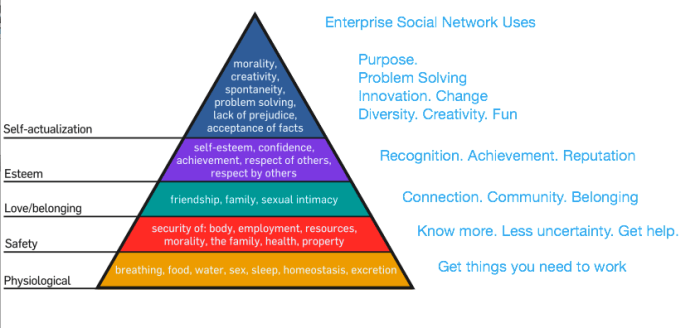
There is something in common between John Stepper’s great questions and my iceberg metaphor.  There are parallels as shown above between the uses of a social network and Maslow’s Hierarchy of Needs.
Social networks are about human connections and are sustained by human needs being met. People begin use with one need, often quite simple. The first challenge in building the community is to find a common use for people to work together to solve. Over time people explore more needs across the hierarchy creating new use cases in the community as they do. In this way, it is no surprise there is a parallel to Maslow’s attempt to document a structure of human needs.

Purpose & Practice grow together

Purpose beats entropy. Adaptive leadership practice renews.

Most learning experiences fade. Some fade very quickly. In general only a small proportion of any experience is retained. Even less makes it into sustained practice.

Almost seven years ago, I had my first experience of a learning program that introduced me to adaptive leadership. That amazing experience, the Accelerate Program at NAB, involved work inside and outside the organisation on complex issues.  These issues required the practice of the skills of a different type of leadership than traditional transactional and expertise based command and control leadership. That leadership experience has been one that has grown every day since.

What makes the power of adaptive leadership lessons grow in practice?

Purpose & practice.

Entropy is the normal process of decay in systems.  Negentropy, or syntropy, is its opposite where things grow in strength over time. My experience is that purpose is a great way to beat entropy.  The Wikipedia for negentropy notes that even scientists see power in purpose:

Indeed, negentropy has been used by biologists as the basis for purpose or direction in life, namely cooperative or moral instincts.

My first experience of adaptive leadership in the Accelerate Program forced a great deal of personal reflection on purpose. That clarity drove new action in a range of different domains. Purpose is an incredible force for energy and drives the desire to see these new skills in practice. Naturally I began tentatively and with a great deal of discomfort.

In all the years since, I have learned that continued Adaptive leadership practice refines the clarity of personal purpose. I have become more aware of my effect on others and on the importance of collaborative solutions that engage many people in the system. Those interactions reinforce the growing energy. The purpose sustains you through the challenges of practice. A continuous iteration of purpose and practice, grows the effectiveness of your leadership.

The purpose is in the work. Adaptive leadership work especially.