Working Out Loud is The Lean Startup of Knowledge – a one-minute video of the blog post.
(Source: https://www.youtube.com/)
Innovation, Collaboration, Learning & Leadership
Working Out Loud is The Lean Startup of Knowledge – a one-minute video of the blog post.
One-minute video on 3 Simple Steps to Create a Habit of Working Out Loud.
And there is a Poster too.
A key role for leaders is to authorise discussion in organisations. Leaders need to foster frank and authentic discussions by all employees. The best way to signal willingness to discuss the real issues is to start that conversation yourself and to show you will take action on the outcomes.
How do you invite questions?
I was recently asked what was my favourite aspect of a YamJam was. A YamJam is a Q&A session in Yammer usually by a leader or other authority figure. My answer was that my favourite element is that a YamJam authorises employees to question leaders and role models. This starts to create the kind of leadership that employees want: open, authentic and responsive.
Working out loud by leaders has the same positive impact. By openly sharing the work in progress with all its doubts, flaws and uncertainties, leaders invite others to engage them on that work. They make transparent their personal work processes for the benefit of others. The sharing authorises others to engage and respond to the leader’s work. This is a powerful tool to cut through hierarchy and change leadership interactions in an organisation. Change the interactions and you change the culture.
Authorise the debate
The greatest barriers to human potential are the things we think we cannot do. Too often we look for others to authorise us to act. For many people and organisations, questioning leaders falls into the category of some we can’t do without permission. The role of leaders in realising potential is to release this constraint and authorise the kinds of generative conversations that enable organisations to be responsive.

The story is too common in the modern organisation: a team has a member who is not contributing but they go on being a part of the team for months or even years. Waste, frustration and disengagement mount in the team. Despite the negative impacts and length of time the manager responsible does nothing to rectify the underperformance.
We have more performance data than ever. We have more sources of information than ever. We interact in more ways than ever. We live in an age of increased performance transparency.
How Can Sustained Underperformance Be Common?
All that data, information, interaction and transparency brings more for managers to do. Complexity is the fundamental challenge of the modern manager and without careful husbanding of their attention the time of the manager can be subsumed into busy work.
Continuous partial attention has crept into management practice. Challenged to keep up managers are constantly skimming across the top of the work. Interactions with employees are staccato bursts. Busy managers spend less time understanding what is actually going on. Flitting in and out of observation of their employees, managers can be lulled into a false sense of confidence if the numbers look good.
For an under-performing employee that means the ability to escape action continues as long as the deadline has not yet arrived, the numbers look acceptable and underperfomer has an answer for the first quick query from a manager. The commonest trick is for the under performing employee to send their busy manager an email asking for a complex decision. Likely overlooked or deferred, it becomes an instant performance excuse. Instead of asking for help the employee uses the pressures on their manager as a chance to hide their performance issues. Time, pressure and waste mount up.
In rare cases, managers may see the problem situation but the pressure of other demands means that they do not prioritise action. They trust in the systems, the employee’s peers or the reporting to correct the underperformance or hope that the employee’s lack of action is temporary. These managers prioritise the work and the system over their people to the detriment of everyone.
Refocus the Attention of Management on the Process of Work
Psychological studies show that multitasking & continuous partial attention don’t work. People who practice these approaches feel that they are more effective but aren’t. We need managers to get off the treadmill and reconsider their approaches to performance:
Great managers shape the process and performance of the team. Great managers enable every member of their team to realise their potential and contribute to creating a more responsive organisation. They are not slaves to the reporting, information and decisions that flow through them. Managers must step out of continuous partial attention to the ongoing work process and get involved in the design of the work.
The work of leadership is to realise the potential of people. Leaving someone stuck in a rut of continued underperformance is failing that individual’s potential.
Start where you are. Use what you have. Do what you can – Arthur Ashe
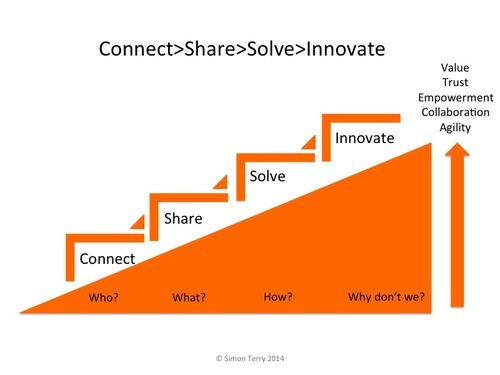
The difference between a network and community is a culture of collaboration. Collaboration doesn’t just happen. It is grown through the action of leaders.
Markets are Value Networks
The markets we use when we exchange financial value today are networks. Networks of connected agents exchange value in our stock exchanges, banks and risk markets. These networks did not arise simply because people connected. Financial markets are facilitated by practices that help transform connection into valuable interactions.
When the networks of merchants in coffee houses became stock exchanges, they relied on the role of brokers and market makers to help build a valuable marketplace. These roles helped people:
The same leadership work to build value, trust and new ways of working is found in the history of banking, insurance or other exchanges.
The value created in these networks did not occur because the network existed. It occurred because of the work of people to build a collaborative culture in the network. People need to build a sense of how to use these new exchanges and to build trust in that they would deliver more value than risk.
Your Network Needs Market Makers
Any collaborative network will need leaders to help facilitate the creation of value in the network. This leadership will be a combination of technical support from community managers and change leadership support from change champions in the organisation and the organisation’s senior management.
The Value Maturity Model highlights the way that collaboration’s market makers need to work to facilitate the value creation in your network:
To maximise the value of the networks in your organisation, you will need to develop the leadership capabilities that can take advantage of networks.
If you would like to create greater value in your enterprise social network or discuss how the Value Maturity Model applies to assist your organisation to create strategic value, please get in contact. I am available through @simongterry or Linkedin or www.simonterry.com

For forty years you heard from my predecessors on this day different variations on the same theme: how our country was flourishing, how many million tons of steel we produced, how happy we all were, how we trusted our government, and what bright perspectives were unfolding in front of us.
I assume you did not propose me for this office so that I, too, would lie to you. – Vaclav Havel, New Year’s Address to the Nation, 1 January 1990,
The pressure to share good news and to conform within organisations can resemble that within a tyranny. Senior management in organisations is often under intense pressure to maintain a good news to customers, to shareholders and to the community. Without genuine dialogue, discussion of the present and the future in organisations can resemble a hallucination. It is not unusual that everyone knows the corporate line is spin and discusses their frustrations in private.
Vaclav Havel’s first address as President of Czechoslovakia after the Velvet Revolution is a reminder of the role each individual must play to engage with reality and to protect our humanity. Everyone can play a role to create the conversations that bring forward an honest dialogue. That will take a willingness to act to make change from everyone in an organisation.
Pretence Corrodes Reality & Humanity
The worst thing is that we live in a contaminated moral environment. We fell morally ill because we became used to saying something different from what we thought. We learned not to believe in anything, to ignore one another, to care only about ourselves.
Pretence is the expression of a view without regard to its reality. Pretence is what happens when you telling your boss, a customer or a shareholder what they want to hear. Pretence leads inevitably to a messy situation when you do that is you get stuck answering a question or defending a position. The next step is an out and out lie to maintain consistency or preserve what remains of your dignity. After life rarely rewards those who share the bad news late.
Go too far down this path and organisations begin to lose their perspective on the creative potential of humanity. Almost everything is sacrificed to maintain the illusion:
The previous regime – armed with its arrogant and intolerant ideology – reduced man to a force of production, and nature to a tool of production.
We Must All Lead Conversations Grounded in Reality
In other words, we are all – though naturally to differing extents – responsible for the operation of the totalitarian machinery. None of us is just its victim. We are all also its co-creators.
It takes two people to not engage in a conversation that should be had.
Senior leaders play a role in setting realistic direction and fostering a culture that faces reality. They use power and can leverage rewards to influence the behaviours of others to be constructive or destructive.
However, culture is an expectation as to patterns of interactions. Employees in any role can play a part to raise the facts that demand attention and to begin to change the patterns of interactions in the organisation. Authentic and public dialogue in public is highly viral and highly influential.
Cultures that cannot face the truth and seek to control individuals to prevent the shattering of the carefully constructed illusions are unhealthy and surrender the opportunity to leverage the exponential potential of human collaboration. We must all reserve ourselves the right to be a little unreasonable in defence of reality and our humanity.
On the contrary, we have to accept this legacy as a sin we committed against ourselves. If we accept it as such, we will understand that it is up to us all, and up to us alone to do something about it.
We all can benefit from regular reflection on the lessons from Havel’s speech for leadership in our organisations.
Photo Source: http://commons.wikimedia.org/wiki/File:Václav_Havel.jpg
You know the gesture. Put your hand up in the air and wait to be called.
Keep your hand down. Don’t do it again. Even the version where only you know that your hand is raised. Nobody knows you are waiting eagerly to be called to contribute.
We learned the gesture in childhood. At school, it was the way we asked permission to speak and permission to act. It became the way we interrupted the decision making adults.
We might no longer put our hand up. However the expectation remains that we must wait for permission to speak and permission to act. We wait for the decision making adults.
A parent-child relationship belongs in a family. It doesn’t belong in the workplace or in our social relationships.
Don’t wait for others to give you permission to say what needs to be said or to do what needs to be done. We are the adults now. The decisions are ours.
Keep your hand down and act.
The more any quantitative social indicator (or even some qualitative indicator) is used for social decision-making, the more subject it will be to corruption pressures and the more apt it will be to distort and corrupt the social processes it is intended to monitor – Campbell’s Law
Traditional management often seeks to reduce complex human behaviour to a single measure to manage. This approach works well for unthinking machines but it struggles with the complexity of human ability to shape behaviour on expectations.
People aren’t Widgets
Economists have been looking at the impact of human expectations on policy decisions for centuries. However, too little of this thinking has made it into industrial models of management thinking.
Traditional industrial models of management treat human beings on the same basis as other elements of machinery in the manufacturing process. This approach does not allow for the difference between a machine and a human’s ability to alter performance based on their own expectations and as result of interactions with others. The creative potential of collective human intelligence quickly outstrips this approach.
John Maynard Keynes highlighted in 1936 how expectations can make even the simplest choices quite complex when interactions of other human actors are involved. His simple example of a prize for nominating the best looking six faces in a beauty contest:
It is not a case of choosing those [faces] that, to the best of one’s judgment, are really the prettiest, nor even those that average opinion genuinely thinks the prettiest. We have reached the third degree where we devote our intelligences to anticipating what average opinion expects the average opinion to be. And there are some, I believe, who practice the fourth, fifth and higher degrees.
The impact of expectations is found in many work activities. The expectations of peers can increase or decrease performance. Expected rewards shape behaviour, whether they are financial, status or emotional. Many highly skewed incentive schemes fail to achieve expected performance change because humans form a view of the likelihood or value of the returns for effort on offer. In some cases, a combination of human creativity, expectations and collaboration between employees & others will even produce totally unintended results.
Human expectations of the future change the behaviour of people now. The accuracy of expectations does not matter. A critical role for leaders is to be a part of the conversations that are shaping the ongoing expectations in a team. Designing an incentive scheme and tracking the measures is not enough.
Networks Accelerate the Making and Sharing of Expectations
In our increasingly networked world, it is much less likely that any individual in an organisation will behave like a machine that has no choice but to optimise performance. The networks inside and outside the organisation will create new expectations and accountabilities on individuals in the organisation. Expectations are just one part of the collective sense-making that will go on as people work to create value. No individual or organisation is an island any more.
Leaders need to prepare to engage with this increasing complexity and to join the conversations to shape the expectations that will drive human behaviour. Creating a collective vision, building trust, realising human potential and fostering collaboration can all contribute positively to the expectations of individuals in a network.
If you leave the conversation to the network, you are losing your influence as a leader. You are also surrendering the potential for better performance.