Orderly Processions are Over

Hierarchy likes order. Networks manage complexity.
Hierarchy walks in an orderly procession. Networks hustle.
Hierarchy wants projects to go from a through to z. Networks experiment across the alphabet.
Hierarchy wants a clean status. Networks solve for problems & mess.
Hierarchy reinforces status. Networks value results
Hierarchy manages stocks. Networks manage flows.
Hierarchy likes secrets. Networks share.
Hierarchy approves, authorises and allocates. Networks learn, enable and do
You can wait for your spot in the orderly procession. However the orderly procession might never reach you or might pass you by blind to your talents to walk in lockstep.

Join the network of doers instead.

Leaders Can Authorise Debate by Working Out Loud

A key role for leaders is to authorise discussion in organisations. Leaders need to foster frank and authentic discussions by all employees. The best way to signal willingness to discuss the real issues is to start that conversation yourself and to show you will take action on the outcomes.

How do you invite questions?

I was recently asked what was my favourite aspect of a YamJam was. A YamJam is a Q&A session in Yammer usually by a leader or other authority figure. My answer was that my favourite element is that a YamJam authorises employees to question leaders and role models. This starts to create the kind of leadership that employees want: open, authentic and responsive.

Working out loud by leaders has the same positive impact. By openly sharing the work in progress with all its doubts, flaws and uncertainties, leaders invite others to engage them on that work. They make transparent their personal work processes for the benefit of others. The sharing authorises others to engage and respond to the leader’s work. This is a powerful tool to cut through hierarchy and change leadership interactions in an organisation.  Change the interactions and you change the culture.

Authorise the debate

The greatest barriers to human potential are the things we think we cannot do. Too often we look for others to authorise us to act. For many people and organisations, questioning leaders falls into the category of some we can’t do without permission. The role of leaders in realising potential is to release this constraint and authorise the kinds of generative conversations that enable organisations to be responsive.

Who Helps Creates Value in Your Organisation?

image

The difference between a network and community is a culture of collaboration. Collaboration doesn’t just happen. It is grown through the action of leaders.

Markets are Value Networks

The markets we use when we exchange financial value today are networks. Networks of connected agents exchange value in our stock exchanges, banks and risk markets. These networks did not arise simply because people connected. Financial markets are facilitated by practices that help transform connection into valuable interactions.

When the networks of merchants in coffee houses became stock exchanges, they relied on the role of brokers and market makers to help build a valuable marketplace. These roles helped people:

  • to build trust in the new market,
  • to create liquidity that enabled activity when demand and supply from participants was not perfectly matched,
  • to share information,
  • to develop new ways of working
  • to help the new markets to enforce the rules and standards of the exchange.

The same leadership work to build value, trust and new ways of working is found in the history of banking, insurance or other exchanges.  

The value created in these networks did not occur because the network existed. It occurred because of the work of people to build a collaborative culture in the network. People need to build a sense of how to use these new exchanges and to build trust in that they would deliver more value than risk.

Your Network Needs Market Makers

Any collaborative network will need leaders to help facilitate the creation of value in the network.  This leadership will be a combination of technical support from community managers and change leadership support from change champions in the organisation and the organisation’s senior management.

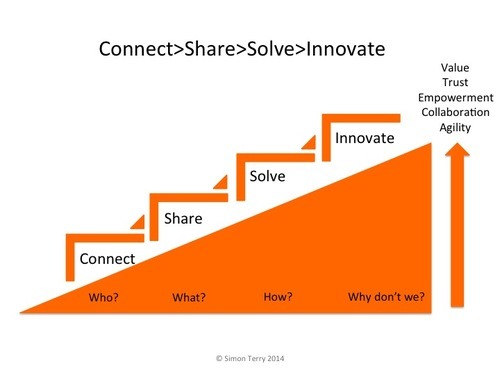
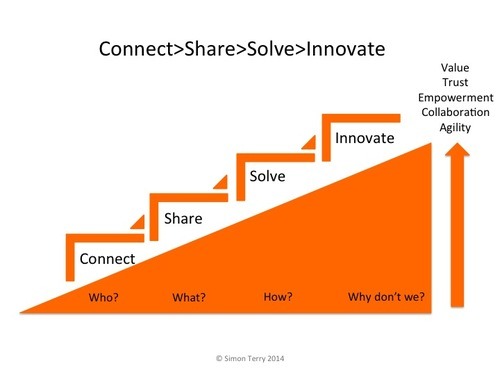
The Value Maturity Model highlights the way that collaboration’s market makers need to work to facilitate the value creation in your network:

  • Connecting relevant people to the network and into groups
  • Sharing information that may not have reached its necessary audience
  • Helping to solve issues by matching needs and capabilities, finding other resources or information and even holding a problem or information until there is a match of demand or supply.
  • Providing the systems and support to enable innovation experiments to be fostered until they are proven or fail.
  • Experiment and lead adoption of new ways of working
  • Helping lead the change in the culture of the organisation to allow the development of further cultural change.

To maximise the value of the networks in your organisation, you will need to develop the leadership capabilities that can take advantage of networks.

If you would like to create greater value in your enterprise social network or discuss how the Value Maturity Model applies to assist your organisation to create strategic value, please get in contact. I am available through @simongterry or Linkedin or www.simonterry.com

Integrate at Goals, not at Process

image

How do you integrate open network conversations into closed linear processes? Integrate social conversations by integrating at the purposes and strategic goals. No organisation wants its collaboration constrained by processes or systems.

Organisations, vendors and analysts are touting the advantages of integration of enterprise social networking into legacy processes in organisations. Enterprise social networking needs to be come a part of the everyday work in organisations as it is another set of tools to foster conversations and collaborations that create value. Without connection to the daily work of individual employees, enterprise social conversations won’t deliver the value we need. However, far too many of our existing work processes aren’t set up to accommodate creative, agile and productive social conversations. Patterns of allowed conversation in a process based integration rarely changes that.

Don’t Integrate through the Current Process

Existing legacy processing systems are designed for efficiency. They constrain choice. They automate steps and narrow discretions. The goal is to simplify tasks, remove errors and ensure repeatable activities can be achieved with the minimum in investment in human talent.

These systems achieve significant efficiency gains with a cost of human potential, agility and effectiveness. However, they are not designed for conversation about work. One only has to reflect on everyday poor customer experiences to see that these systems gain efficiency by handling poorly the exceptional, unusual case or situations requiring a response to change. Conversations, change and collaboration do not fit the industrial model of work that these process systems are designed to fulfil. They are not designed to leverage the potential of talented knowledge working employees connected in networks.

Collaboration is not a layer that can be integrated into existing fixed processes designed for efficiency. Collaboration offers the opportunity to enable people to change and improve the process and the work. Collaboration creates choices with a view to increasing agility, improving effectiveness and realising human potential.

A conversation that must integrate into a process system will become a conversation about the constraints of the system at some point.

Integrate by Creating a Purpose-oriented Conversation

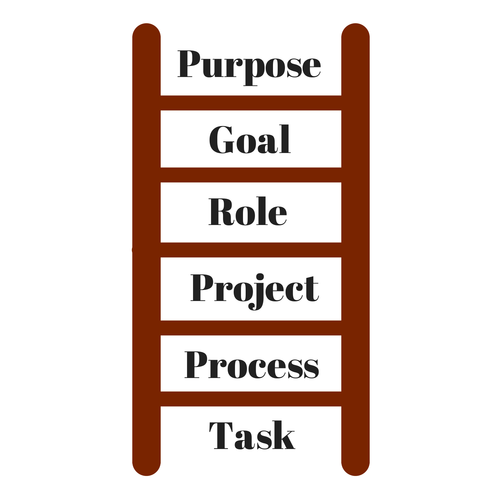
Offer people autonomy, purpose and an opportunity to develop mastery and you will offer them an ability to fulfil their potential. If you want to integrate social conversations into your work, integrate the conversations at this level. The key to reinforcing human potential is to offer people a way to discuss how their work aligns and creates value for the purpose and goals of the organisation, not its processes.
image

An employee who is challenged to integrate his or her work at the level of the goals of the organisation has an opportunity to stop, change or transform the process. That employee can respond to the situation before them, use their discretion and use the talents of their colleagues. The employee can look to deliver greater value than the current process allows. That liberty reinforces their accountability and validates the organisations confidence in the potential of the employee. A key barrier to engagement in many organisations is that an employee can struggle to find the connection between their work and the goals of the organisation. Goal-oriented conversations can play a critical role to surface that connection.

Another advantage of reinforcing a connection at the level of enterprise-wide purpose and goals is that it acts as a reminder that collaboration is an enterprise-wide experience in work. Collaboration is not constrained to the customer management systems or work process systems. A collaborative ecosystem and the social conversations that support it should reach throughout the organisation to achieve its goals and purpose.

Leverage human potential to help realise goals

Telling people what to do and shaping how they might be allowed to have a discussion seems easy and seems efficient. However, it comes at a significant cost of human potential. Leadership in networks demands more of employees, leaders and their organisations. To maximise the opportunities for networked ways of working, allow people the opportunity to find integration of their social conversations at the level of the organisations purposes and strategic goals, not constrained by its processes.

If you would like to create greater value in your enterprise social network or discuss how the Value Maturity Model applies to assist your organisation to create strategic value through enterprise social networking and other forms of collaboration, please get in contact. I am available through @simongterry or Linkedin or www.simonterry.com
Value is a fractal

image

Enterprise social networks are made up of individuals who form their own groups and networks and the community is an aggregation of each of these components. We need to remember this structure when we start to think of value in enterprise social networks.

From Top-Down to Every Scale

One resulting characteristic of value in enterprise social networks is that they resemble a fractal, a mathematical shape that shows similar characteristics at any scale. Value in an enterprise social network does not only occur at the aggregate level.

Smaller scale activities are more important to sustain and grow the development of value across the whole network. There is less opportunity to order or impose value creation in a network than in traditional hierarchies where top down value is the priority and individual value is rarely considered.

Value For Users and Groups Makes a Network

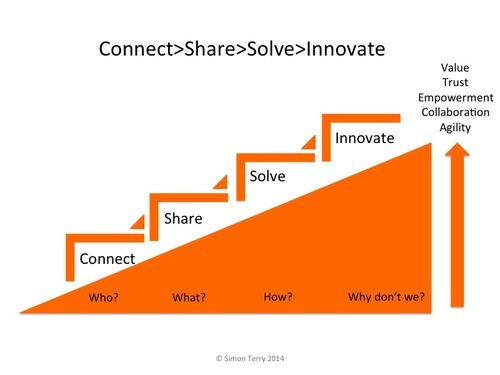
Individual and group practices that create value are the underpinning of value for the whole network. Value comes from connection, sharing information, solving problems and innovating for an individual or the whole community. Without this value to the individual or group, no value creation at the network level will sustain itself.

Individuals and groups must understand and see the value being created to continue to work in new ways in the network. Developing the maturity of a network means building this sense of how value is created and how it aligns to strategic goals.

Create a Sense of Value at Every Scale

The power of the Value Maturity Model is that it is designed to take advantage of this characteristic. The method can be shared with users, with groups and with the whole community to help them make sense of how value is created for them and for the network.

Secret tools of community managers or organisational leaders won’t help individual users and groups find their own path forward to value. The power of value creation in an enterprise social network is the ability to leverage people’s potential to help

If you would like to create greater value in your enterprise social network or discuss how the Value Maturity Model applies to assist your organisation to create strategic value through enterprise social networking and collaboration, please get in contact. I am available through @simongterry or Linkedin or www.simonterry.com