Recently I was discussing that the experience of working with the evolution of an enterprise social network. I remarked that it is a little like an iceberg. One idea or use is visible to you and draws you initially. However, as with the seven questions, over time the uses grow and develop as the sense of community builds. Over time we discover more under the water as we develop our conception of what an enterprise social network can be and the role we can play in it.
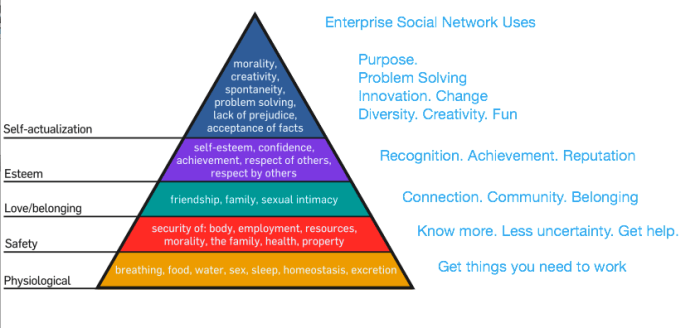
There is something in common between John Stepper’s great questions and my iceberg metaphor.  There are parallels as shown above between the uses of a social network and Maslow’s Hierarchy of Needs.
Social networks are about human connections and are sustained by human needs being met. People begin use with one need, often quite simple. The first challenge in building the community is to find a common use for people to work together to solve. Over time people explore more needs across the hierarchy creating new use cases in the community as they do. In this way, it is no surprise there is a parallel to Maslow’s attempt to document a structure of human needs.

Be prepared for social change

Our mental models of how things work are often a barrier to our adaptation to new capabilities.  Digital disruption will stretch our thinking in many new ways.

When railroads were first invented they were designed to be a powered form of wagon for bulk goods.  Only later did people develop the potential for railway travel, changes in communications and accelerate the distribution of fresh foods and other consumer goods. The introduction of railway travel created significant social change, demands for new resources and infrastructure, and ultimately innovation in business & society. After a start as a powered wagon, innovators changed the mental model of a railway developing its potential and its impact on society as a whole.

We are in the midst of digital mobile and social revolution that is so new and widereaching we can face the same challenges in adapting our mental models. Yesterday I attended the New Economy Conference in Melbourne. The audience and speakers who had chosen to attend the event were very aware of the digital & social transformations beginning to be realised.  

A key theme of the day was the impact of digital, mobile and social processes in creating dramatic improvements in connection and speed of information sharing.  This has major ramifications for markets and for corporations as they see their offerings atomised to services, boundaries becoming porous and competition expanding in speed and global reach.  Even consumers are getting into the act of being producers through collaborative consumption. These ideas resonated strongly because they connect directly with the short-term transactional focus of our industrial age mental models of production, markets and competition.  They involve the exploration of relatively simple changes to current models (who, where, what, volume or speed).

Harder for everyone to grasp are the changes to social systems which come with these new technologies and the need for new physical, legal and social infrastructure.  To run their cross-continental networks, railroads needed and inspired new social infrastructure.  An example was that railroads required society to adopt a precise concepts of time to manage their schedules.  Railroads determined the implementation of the continental United States four time zones and largely became the arbiter of time in the communities that they connected. 

There is already evidence that these broader social changes are being created. Work is shifting rapidly towards creative knowledge work in many parts of the world with new demands for leadership and organisation. The acceleration of social activism was discussed on the day and the consequences of eBay, the many task allocation and collaborative consumption organisations in changing natures of trust & work.  We also discussed the social infrastructure required to measure value creation and waste in a broader more human way than just dollars (and the odd bit of avoided carbon).  We need to innovate as hard in this social infrastructure as in that to support the transactions.

As much as we create new ways of transacting, we also need to create new forms of community to supply the social infrastructure to support the transactions.  We need to support the short term interaction with a social fabric that can supply a longer human relationship.  Just as the railroads need a precise sense of time, our new economy demands new precision in ideas like collaboration, work, trust, community and value. 

When we think of the future of digital disruption, we need to allow both for how it will change the mental models we use every day but also how it may demand of us entirely new models, such as new concepts of organisations, jobs, reputation, social relationships and new measures of success.   Success in the new digital era will take both adaptation to a new transactional environment but also adaptation of a new infrastructure of community, trust and long term relationships.  New models of leadership and new social innovations will be required to achieve both.
Plural

Community is plural – Robert Safian (via “What I’ve Learned” in Fastcompany)

Community is plural. Culture is plural. Collaboration is plural. Purpose is plural. Talent is plural. Career is plural. Customer experience is plural.

No matter how much we would like to unite each of these in a single approach they remain as diverse as life, as diverse as the humans who come together to make each happen.

We love to simplify. The easiest simplification is an abstraction. From a stereotype to an 80:20 rule to a segment to an average, we lose something in the translation of a human activity into that abstraction. We lose its rich and diverse humanity. Remember this each time you would like people to fit in convenient boxes or to behave in predictable ways. They won’t.

Work with the overlaps and the alignments. Leverage the diversity to maximise engagement. Deaverage your numbers. Plan for options, opt-ins and opt-outs. Deliver richer outcomes by designing for a wider range of purpose and people. Most of all be open to be surprised. Accept the human diversity in people, customer and community.

We all know there is an economic benefit to simplification. Just make sure you are not missing an economic benefit of the diverse and the marginal. Your biggest threat is probably where you are not looking because you cannot see beyond the average.

Embrace the chaos. Embrace the plural. Your experience will be richer for it.

The social enterprise must be social

A rush of social enterprise technologies is happening led by start-ups and major technology vendors. Everyone is racing to capitalise on the application of social technology into their application or process. Businesses are starting to realise the opportunity of social business processes with their people, customers and other stakeholders. Suddenly ‘social business’, the ‘social enterprise’ and ‘the future of work’ are hot topics.

In this hype and rush, one thing might just get lost – the creation of real community. The social enterprise must be social.

If you think this is an exaggerated concern, remember that technology does not create value. The value comes from how we use it. I have spent a lot of my time working with customer relationship management systems. In too many cases around the world, these projects are often cited as classic examples of failed technology implementations. Why? Most customer relationship management implementations have little relevance to customers and customer relationship employees. The efforts of vendors and businesses to wrap customers in process, data, leads and insight misses the opportunity to manage customers in a real vibrant profitable relationship. Business objectives get in the way of customer objectives and these systems fail their objectives and their users.

So how do we ensure that the social enterprise remains social?

Here are three thoughts:

  • Encourage real interaction: Questions and answers, back chat, push back, small talk, sports conversation, rapport building, jokes, laughter, entertainment, cynicism and mischief making are all part of the interactions that we have every day. Attempts to build systems or encourage use that exclude this ‘noise’ will fail to engage users. This ‘waste’ often has a real social purpose of creating engagement, enhancing productivity, building trust, sharing insight into others and deepening relationships. These are the gains that most vendors and businesses are looking to achieve by adding social features to their applications. 
  • Embrace community (that means culture, two-way communication, creativity, concerns and occasional chaos): Successful social technologies are built on real community. Successful community is what draws in users and allows the sytem to create value. The community will reflect the common culture of the organisation, the common ways of interacting and doing things. Working with community and culture demands that communication is two-way, creativity in the users is encouraged, community concerns are promptly addressed and the community embraces diversity and occasional chaos. You can treat people like children and lock-out these things with features, policy and tight control. However you will get a community culture that is sterile, users who follow orders and the productivity & engagement of a dictatorship. It is far more powerful to treat the community as adults and guide the culture of your organisation to the benefit of the business and community. 
  • Be part of society and social concerns: The best & most engaging social activity connects to a broader purpose. We all live and work in a broader society that makes decisions on what they think of us and our business. One of the powers of social enterprise solutions is the ability to bring that conversation into the workplace. Make the social enterprise one that can deliver social value beyond the bottom line. The employees, customers and other stakeholders who use the system are looking for this opportunity. 

Social enterprise solutions will need to deliver to business goals to have a continuing role in business. However, ensuring that these solutions create community by remaining human and social is critical to their success.