Description of ANZ’s journey of launching an ESN with some contribution on the value of working out loud.
Tag: Collaboration
What Kind of Community Do You Have?
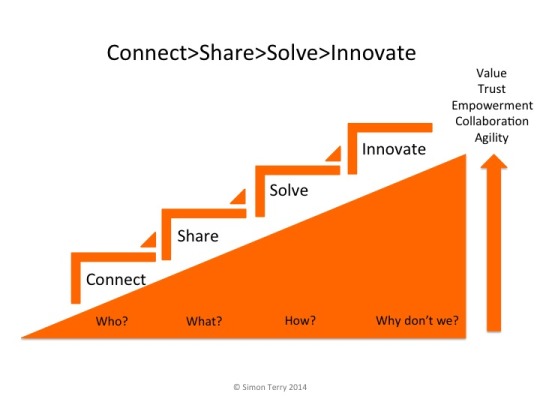
Enterprise Social Networks reflect the organisation’s culture and the maturity of collaboration in that organisation. As collaboration matures, different modes of engagement arise. Higher levels of engagement aligned to the strategic objectives of the organisation are fundamental to the growing value of collaboration for any organisation.
Connect: The Directory
Many organisations don’t create much community in their networks. Networks or collaboration features imposed without thought or support will often languish. Without clear strategic rationale for collaboration in the organisation, their efforts create a new directory of employees (In many cases, a directory of only those who adopt). The collaboration features are used to create a social profile for individuals and to help people find others using the knowledge of those in the network.
Share: The Salon
When people are freely sharing ideas & their work, the level of engagement in the network rises. The community begins to resemble a salon. A salon can be an inspiring place filled with insightful knowledge and witty repartee. However, it can also be dominated by personalities, expertise and narrow schools of thought. Sharing knowledge is an important step on the journey of collaboration and a foundation for greater connection but posts with links is only an entry level for the human potential of social collaboration.
Solve: The Universal Genius Bar
When trust and engagement is high enough, people will see a community as a place to solve their work and personal challenges. Like a Genius Bar, the community brings now just expertise and ideas, but solutions in the form of resources, processes and other ways to help drive change in the organisation. Well managed communities will be universal in their ability to reflecting the strategic intent of the organisation and the breadth of its people’s interests and purposes.
Innovate: The Platform
Successful cultures of innovation are those where people have a platform to which they can take ideas for development and trial. They also leverage the value of that platform as a way to track, understand and refine new ideas and those in development. When you have an innovation platform built on a rich level of engagement of all your employees, then the value and pace of change, innovation and continuous improvement is accelerated.
Questions to consider:
- Where does your organisation sit today in terms of the nature of the activity in your enterprise social network or other collaboration platforms?
- What level of collaboration fits the culture of your organisation and its strategic goals?
- What are the modes of collaboration that will help your organisation best achieve the value it seeks from bringing its employees together?
- How have you authorised and enabled people to drive change and to collaborate in your community?
- How can you move your organisations network from a Directory or a Salon into more valuable levels of engagement?
- Do you have the leadership, community management and the change agents necessary to build trust, role model change and develop engagement?
The Value Maturity Model and its supporting tools are ways to help organisations plan and execute the development of strategic value in collaboration through enterprise social networks and other communities. For more information on the Value Maturity Model and how it can help you develop collaboration, please contact Simon Terry.
2016 – Tackling Reality
We may doubt that we’re up to being a warrior-in-training. But we can ask ourselves this question: “Do I prefer to grow up and relate to life directly, or do I choose to live and die in fear?
– Pema Chodron
Welcome back old friend. I’m glad you’re here. Now, let’s get to work
– Carl Richards “Learning to Deal with Imposter Syndrome”
It may be cheaper and easier in the short run to ignore failures, schedule work so that there’s no time for reflection, require compliance with organizational norms, and turn to experts for quick solutions. But these short-term approaches will limit the organization’s ability to learn.
– Francaseca Gino and Bradley Staats “Why Organisations Don’t Learn”
Let’s add one more detail to the picture
the much longer,
much less visible chains that allow us freely to pass by.– Chains by Wislawa Szymborka trans. Clare Kavanagh and Stanislaw Baranczak
Leading into year end, I have been reflecting on what I learned in 2015 and what it means for 2016. All of the quotes above appeared in things that I read today. Reading these quotes clarified for me one of the key insights of 2015 that I had been considering (but perhaps was ducking) – life is far better when you are dealing directly with reality.
Tackling Reality Personally
Life as a solo consultant has its challenges. Over two years into that journey I have come to better understand, accept and deal with its ups and its downs. Work isn’t always consistent or predictable. The point at which you need to give up is usually when things change. The best work arrives all at the same time. There are human limits in time and capabilities. Some times you have to say no. You don’t get to do everything you want or need to do. Others will do differently. Things never go quite as planned. Big risks are essential to progress and so are the small (& big) failures.
Accepting these realities has made me far more comfortable in my practice. Accepting these some times harsh realities has made me more ready to take advantages of the opportunities that are created. These opportunities might be the chance to play a larger role in Change Agents Worldwide or another community, the new work that comes unexpectedly or the ability to leverage down time for reflection, connection and new projects, rather than panic.
I have found too that a better & richer focus on what is really going on for others and for me has strengthened both the personal and work relationships in my life. Taking the time to really understand reality of the situation matters more to me than ever. Confronting reality isn’t always easy. Engaging with some perceptions and beliefs can be painful, some of these are deeply hidden and it can take a long time to accept some of the more difficult realities. However, reality will not and cannot be ignored.
My lessons from applying this effort with others have been equally insightful. So many times in our busyness, we assume we know what is required, we rely on expertise and miss the opportunities to really engage, to really help and to make a real difference. Our ability to work and collaborate with others depends on a rich shared context based in reality. Don’t accept things at face value. Take the time in 2016 to probe and to query the reality of the situation. Without feet planted firmly in reality, we have no way to step forward alone or together.
2016 will be another year of working deeply connected in reality for me.
Helping Organisations Tackle Reality
In 2015, I blogged in a number of different ways about the need for organisations to better engage with reality. I called our hierarchical organisations dumb. I talked about hierarchy as filter failure. I highlighted that these organisations ignore complexity and even need satire to prick their bubbles some times. Change Agents need a good grip on reality and pragmatic skills to move organisations forward. There are many more examples of the battle to hold organisations accountable to the reality of their situation in the blog posts this year.
The future of work demands organisations step out from their cloisters and engage the reality and the pressures of the world inside their organisation and the world around them. Effectiveness of purpose demands that we look to the real human costs and benefit of that which we do. Internal efficiency or narrowly defined success metrics are no longer enough. Global networks and dynamic disruptive global competition will hold us to account for our failure to confront and leverage reality.
The better organisations are learning how to use the reality of their people, their capabilities and their networks. They leverage the human capabilities of the people, their networks and their capabilities to continuously create change to grow and be more effective. These organisations recognise the reality that they are a human organisation, that they must base their actions on real conversations and real human capabilities for success. The future of work must be much more human to deliver their purposes.
The need to tackle reality more effectively is why I focus on learning, leadership and collaboration as core enablers of the future of work. I believe that these three are essential to my personal purpose of making work more human. 2016 will be a key time helping organisations improve their effectiveness and better deliver that purpose in the real world.
ICYMI: 2015 Top 10 Posts by Popularity
The over 10,000 people who have visited this blog in 2015 enables us to review 2015 by popularity of each post. This blog has covered a lot of ground in 2015 in 206 posts so it is interesting to see what rises to the top of the social sharing. The practice of learning, leadership and collaboration for the future of work top the lists as they are the focus of my work and my interests:
- Competency or Capability Mindsets Matter: I am a little surprised to see this post do so well. When I wrote it I thought of it as more of a technical post dealing with a key HR and management issue. Clearly the need in the future of work to focus on capability and move from strict competency resonates deeply.
- The Last Thing We Need is an Enterprise Social Network: This rant of a post from 2014 continues to circulate, educate and amuse
- Working Out Loud 3 Tiny Habits: The growth of Working Out Loud in 2015 with the release of John Stepper’s book and two Working Out Loud Weeks has made this post from 2014 (and its various forms of content: posters and videos) enduringly popular
- Big Learning: I see this post as another pillar of this blog ongoing. The idea of organisations needing to arrange systems to accelerate learning and capability development remains as urgent as ever. Big Learning is the next big challenge. In 2016, I am looking to bring Big Learning further to light with clients.
- Beyond Adoption to Value Creation: The foundational post of my work in collaboration and probably the most linked post within this blog. Also widely used by others to explain the development of collaboration in organisations.
- Why Hierarchical Management Survives: Institutional Filter Failure Struck me in a flash. Still surprises. As long as our organisations are deliberately dumbed down we will miss out.
- The Growth Mindsets of Collaboration: I love Carol Dweck’s work on Growth Mindsets. Let’s hope more managers are inspired to consider & encourage them.
- Double Loop Learning of Working Out Loud: This world has got to complex for single loops. Let’s help people to reflect on whether they are doing things right and even in a triple loop whether they are doing the right things. Working out loud will continue to be a key focus of my work in 2016
- The Lean Startup of Me: If the circulation that this post received on Linkedin was added to its stats, this likely would have been #1 post of the year. It is certainly the post I get most questions about. This is still the way I approach my practice and life. It has been invaluable to me and to those I coach on following the independent path.
- The Future of Work is the Future of Leadership: Another foundational post from 2014 that benefited from a lot of links in 2015. Leadership work will be a big part of 2016. We need change and we need leaders at every level to get us there.
If I take out the 2014 posts, the next most popular 2015 additions would be:
- Superheroes and Change Agents: Who doesn’t love being compared to a Superhero? A change agent.
- Create a Reputation Economy: Reputation helps manage accountabilities.
- Four Capabilities of a Social Leader: The pair to my post about mindsets of a social leader and the backbone of my CMI Disrupt talk.
- What Matters for the CEO: Another post of personal philosophy. Let’s hope more CEOs considered this. Trust me on this I once was a CEO.
This list of posts is a wonderful encapsulation of the focus of my work in 2015 and the areas that I will be focusing on growing in 2016. There are a few much beloved posts that failed to make these lists. There are also many posts on the blog that probably should never have been written. That’s the journey of blogging consistently and working out loud on your practice and learning.
Thanks for your support in 2015 and I look forward to sharing more posts in 2016 and being involved in the great conversations that they inspire.
One minute introduction to the Value Maturity Model: Connect>Share>Solve>Innovate
(Source: https://www.youtube.com/)
The Four Capabilities of a Social leader
Senior executives need new mindsets and new capabilities to be effective in the networked work of the future. Four capabilities will help e executives make the most of their networks:
Personal Knowledge Management: Personal Knowledge Management gives executives the personal learning skills to manage the flow of information and to deepen their personal networks. As executives personally learn to Seek>Sense>Share they develop critical digital skills for network leadership.
Working Out Loud: Working out loud is a practice that helps surface the value of work and learning in networks. Leaders are already the focus of attention. Making their work in progress visible to others is a highly valuable step because it accelerates trust and learning.
Leading in Networks: Network leadership requires leaders to surface shared purpose, build trust and influence and enable collaboration. Expertise, rank and orders are replaced with adaptive leadership techniques that manage learning, tension & alignment.
Creating Value in Networks: Leaders need to be able to set a strategy for their and their team’s engagement with networks. They need to be able to accelerate the maturity of value creation in those networks as they develop through Connect>Share>Solve>Innovate.
Developing leader’s practice of these key capabilities will enhance their effectiveness in enterprise social networks and the future of work.
Anti panel 3.0: the personal urgency to act #disruptsyd
We have choices in the future we want. To ensure a better future, we need to create it. We can begin now together.
Our annual experiment in disrupting the conference panel format occurred again at the Disrupt Sydney conference last Friday. The anti panel followed an extraordinary morning of inspiring speakers and provocative discussion of the impacts of disruption for good and for evil.
The anti-panel was reinvented again for its third appearance at Disrupt Sydney. This year the panellists set the teams in the room three activities on the theme of disrupting Sydney as a place, community and City:
– create a collage of your inspirations from the morning for the future of Sydney
– develop a newspaper headline on a vision of Sydney in 2050
– build a model in Lego of an intervention to move Sydney to a positive future.
The power of an anti-panel is to leverage the ideas, insights and interactions of the whole room. Using exercises individually and in groups enables people to work in parallel. Challenging people to communicate in other ways and to be hands on changes the nature of ideas. We had an incredibly broad ranging discussion driven by the creative potential in the room.
We experienced a different panel to previous years. The interaction between participants was far greater. The depth of discussion was less due to the physical challenges to be met but the breadth of ideas increased. The panellists learned from the energy in the room that we had one design flaw. The newspaper exercise was too narrow a constraint for the middle of a Friday afternoon. Luckily, we adapted timings to shorten that exercise and moved on to a coffee break and Lego to restore momentum.
The themes of the debrief were clear:
– people enjoyed the opportunity to interact through shared creative tasks
– we need time to reflect and to create new ideas and approaches
– ideas flowed from doing
– one person’s utopia is another’s dystopia
– the power of storytelling and metaphors
– whether we were pessimists or optimists, it was clear we could not sit passively with the range of change, opportunities and threats. The future needs to be created.
That final insight was a wonderfully generative outcome from an afternoon of purposeful play. Let’s create our future. A great place to start is leveraging the creative potential of many people.
The anti-panellists were Kai Riemer, Matt Moore and Simon Terry. Thanks again to the DDRG for the opportunity to deliver the anti-panel.
Speaking to Senior Managers
Senior leadership engagement in change is a hot topic. Social collaboration makes the absence of leader engagement obvious. I’m often asked to speak on collaboration, learning and leadership to senior executives. As I used to be one, people want me to share a little of my passion for these topics. Here are some suggestions to guide you in your senior leadership engagement.
It’s not a priority
Collaboration, leadership and learning is unlikely to be a priority for your senior leaders. Sure they’ll discuss it but they don’t want to do it. They don’t know anyone who got made a CEO because his team was the most collaborative or the most agile. There is always a bigger business or customer problem that is on their mind.
Rather than engage in an argument as to why this mindset is wrong (it is – see Big Learning), I start with understanding the real business problems that they want to solve. Once we understand the business problems we can connect collaboration, learning and leadership as solutions to that problem.
Avoid Capitalised Nouns
Senior executives are busy and distracted. They don’t want jargon and hype. They are allergic to empty captalised nouns. The more you use words like Collaboration, Leadership, Engagement etc without making them tangible the less credible you are. The more it sounds like a futuristic vision or a quixotic quest the less relevant you are to their world.
Tell Stories
Stories make change tangible to busy & smart people. Ben Elias of ideocial.com remarked to me recently that it is hard for people to conceive of how their organisation could be highly collaborative. They have never seen it, so the ideas and practices don’t connect with their reality. Specific stories make that connection. Tell rich and engaging stories of how things can be and how to get there.
Ask for something specific
There’s nothing worse that taking the time of senior leaders, winning their support and not being able to define exactly what you want them to do. Always have a specific ask of them ready to go. Have two in case they say yes to the first. Better yet have a personal ask that is framed as something simple that they can agree to do to sustain change. The 3 simple habits of working out loud was designed as one such example.
When you are done, Stop. Leave.
Senior executive time is precious. Give it back to them. Tempting as it may be to bask in the glory of a good meeting and deepen rapport, you will win more credit by leaving when you have done your job. Remember when something is not a priority you are always on borrowed time.
Dumb by Choice – Foreword to ‘Collaborating in a Social Era’ by Oscar Berg
The following is my foreword to Oscar Berg’s ’ Collaborating in A Social Era’. The piece was inspired by the themes of the book, particularly on how organisations need to better use information. It was an honour to be able to contribute a few words to Oscar’s great work.
Dumb by Choice
Traditional hierarchical organizations are designed to make us dumb. These organizations work to deliver the predictable execution of a stable, proven business model. We have designed these organizations to exclude information from decision-making and isolate employees to focus on efficiency, predictability, and control. Without better ways of distributing and filtering information, we chose to create the many layers of management, channels of communication, and decision making processes. Each of these familiar elements of organizations limit the information we use and the way we work. The consequence was an improvement in efficiency, but limited adaptability to exceptions, challenges, and change. Our employees and our customers feel the costs of these limits. We have created organizations that treat people, whether customers or employees, as a cog in the machine of value-creation.
In the last century, with the opportunities presented by expanding global consumer markets, our dumbness, loss of human potential, and inflexibility were small prices to pay. There were real financial barriers to better use of information. The lost opportunities were overwhelmed by the ever-growing market opportunity. Most organizations used the same operating model and faced the same economics of information, so the threat of disruptive competition was muted.
As Oscar Berg highlights in this book, the competitive marketplace for organizations has now fundamentally changed. Information networks and digital capabilities have reduced the cost of creating and sharing information and expanded the access to information of businesses, consumers, and communities. Increasingly, organizations are dealing with knowledge work and complex situations. The cost of a dumb process and the missed human potential is rising. Organizations can see competitors better leveraging the potential of their people to learn, to adapt, and to collaborate.
The challenge for managers and for employees in this new world, is how to change our ways of working and how we create, share and make use of information. We need our organizations to make us smarter. We need our organizations to help us to learn and to realize our collective potential. This book sets out to equip us all with some key tools to begin this redesign of the way we work.
Getting Smarter
Work has always involved people coming together to achieve more than one individual can do on their own. The most effective organizations enhance the knowledge, capabilities, and potential of their employees. Changing our ways of working to better use information and foster new forms of collaboration is a critical design element to the future of work. Rather than being passive participants in a process, employees can become a crucial element in the way our organization gathers, shares, and creates value from information.
In this book, you will find a number of key concepts and tools that will help your organization to realize the opportunities and the value offered by new models of social collaboration. Change is not easy. New capabilities will need to be learned and practiced. New mindsets will be required to foster effective communication. Ultimately, teams will need to mature their practice to work in increasingly valuable and visible ways. This book highlights these concepts, provides examples of the new approaches, and supports each of us to put them into practical use.
If we want to work in smarter ways and to see our organizations prosper, leadership is required. These changes to established ways of working won’t happen on their own. We can’t rely on technology to change established practice in our work communities. We will need change agents and leaders to take on the role of building new capabilities, advocating for new mindsets, and role modeling new practice. Adaptive leaders, collaborating in and beyond their organizations, will change established practice and help organizations experiment with the potential of new ways of working.
Take up the challenge of this book and experiment with new ways of collaborating in your organization. You have the opportunity to be well equipped to begin leading the change and making your organization smarter and more effective. Most of all, you will be contributing to making the future of work that much smarter and more human.
To order the book in a variety of formats see Oscar’s launch announcement today
The Problem is Everywhere
The peculiar character of the problem of a rational economic order is determined precisely by the fact that the knowledge of the circumstances of which we must make use never exists in concentrated or integrated form but solely as the dispersed bits of incomplete and frequently contradictory knowledge which all the separate individuals possess. The economic problem of society is thus not merely a problem of how to allocate “given” resources—if “given” is taken to mean given to a single mind which deliberately solves the problem set by these “data.” It is rather a problem of how to secure the best use of resources known to any of the members of society, for ends whose relative importance only these individuals know. Or, to put it briefly, it is a problem of the utilization of knowledge which is not given to anyone in its totality. – Friedrich A Hayek “The Use of Knowledge in Society”
Yesterday I met with an organisation that wanted some of my help as they sought to solve a problem. The organisation was developing a new knowledge sharing system to enable is staff to be better informed about products and processes. There was one slight issue with this problem. The organisation already had multiple systems to enable its staff to be better informed about products and processes: intranets, social networks, training, help & support tools, automation, etc.
Problems Everywhere
As we asked why these other systems didn’t work it became clearer that the project team’s issue was that it was solving a problem for others, rather than with others. The explanations for needing a new system did’t stack up and suggested there was more that needed to be learned from the users:
- ‘Most of the learning is peer to peer. We need to give them better options’: Why do they prefer to learn from peers who might be inaccurate or unavailable? Why will they change this if you offer a new system?
- ‘They won’t use a collaboration system because they say they don’t have the time’ : if time is a question of priority, why isn’t it a priority? To what extent is the culture, leadership and performance management of the team driving this lack of priority? If they won’t collaborate why will they have the time to use something else? What is there time actually spent on? What do they do instead?
- ‘Those system don’t give them the answers they need so we are building a new one’: If the last system didn’t understand what was required, how do you? What does relevance look like to each user? What does relevance look like to their customers?
- ‘They want help with process X, but we are building something innovative for all processes’: Why do they want help with that process? What’s innovative about ignoring the demand?
The Answer is Everywhere
The answers to these questions are dispersed in a wide range of people beyond the project team. They draw in questions of culture, of practice, or rational and irrational behaviour by real human beings doing real work under the daily pressures of customers and a large organisation. There’s a lot of learning to do.
We have the tools to solve this dispersion and gather insights into what needs to be done in the practices of Big Learning:
- we can actively collaborate with the users and other participants in the system to get under the pat answers and explore the deeper reasons and problems
- we can use the practices of design thinking to better understand and shape employee behaviour & the systems involved in action
- we can analyse data to understand in greater detail what is going on
- we can experiment and iterate to ensure that proposed changes work the way that we expect
- we can enable and empower the users to create changes to their work
- we can accelerate the interactions and the cycles of learning to move faster to better solutions
These aren’t parallel techniques to be applied independently. The practices of Big Learning work best as an integrated system that draws together the insights from all of these approaches to help organisations learn and work. Big Learning enables organisation to work with and through its employees to deliver change. Change does not have to be done to them.
The reason organisations need to develop systems to facilitate Big Learning is elegantly described by Hayek in the conclusion to his essay “The Use of Knowledge in Society”. Hayek was critiquing the schools of economists who thought that centrally planned interventions designed by experts would be effective. The context may differ but organisations still use forms of central planning by experts to create change. These changes fall short for a fundamental reason – experts can’t know enough alone:
The practical problem, however, arises precisely because these facts are never so given to a single mind, and because, in consequence, it is necessary that in the solution of the problem knowledge should be used that is dispersed among many people
The practices of Big Learning help bring people together to share insights, learn and work as one.