Forward Deployed Entrepreneurs – the Capabilities and the Questions

Realising the value of AI in your organisation is going to require more than technology skills. Are you planning for the entrepreneurial capabilities required to maximise the strategic value for your business?

A conversation about AI yesterday with Scott Ward, a long time collaborator, helped me to further flesh out my recent post on Forward Deployed Entrepreneurs. Scott and I were discussing the need to shape AI investment to realise strategic value and the importance of breakthrough business model transformation as cost out becomes more marginal for many organisations as token costs rise.

The Three Roles of the Forward Deployed Entrepreneur

The literature of Entrepreneurship has done a good job of describing the combination of skills required for disruptive innovation at scale. That formula has resolved to:

  • Hustlers – the strategists, business model, growth and commercial experts who help realise the value of the solution
  • Designers (or for alliteration Hipsters) – the human insights and the ability to construct human friendly experiences and narratives into a product, process or experience
  • Hackers – the wranglers of the technical components of product, process and experience

In many start-ups these are three separate functions but many entrepreneurs combine elements of each to drive their solutions forward at an early stage. Successful AI initiatives are going to require all three capabilities in teams or more rarely in a single individual.

These three capabilities describe what your Forward Deployed Entrepreneurs must do.

Why these capabilities?

Let’s look at each capability in turn in the context of the strategic value of AI:

Hustler: The capabilities of the hustler are important to your AI initiative because they help shape the value that you are pursuing by answering questions like:

  • How does this initiative help fulfil our strategy?
  • What value are we seeking to create?
  • How might we release constraints in our business with AI?
  • Do we need to transform our business model or value chain?
  • How are we going to leverage this new capability with our customers and what are the implications for our commercial models?
  • What are the likely reactions from current and future competitors and imitators?

To address these questions either directly or to experiment and iterate to answers, hustlers need deep commercial savvy, strategic nous and an ability to understand and reshape business models and economics. Linda Grattan recently noted that AI demands CEO level skills and attention. Hustlers also need the resilience and the energy to continue to advocate, sell and grow gage customers and other stakeholders.

Designer: The AI challenge for business is not a technical one. It must also be a human one because we expect AI to co-exist with colleagues, customers and other stakeholders. AI’s role must be designed to reassure reluctant users and allow for real human emotions which are often much more critical in processes than pure rational calculations. Designers can answer questions like:

  • What do we want people to feel in this experience and how might we support that?
  • How do we build trust in this experience?
  • What are the moments where we allow for a human to override or escape the AI conclusions if they disagree or have concerns?
  • How do we shape the processes and experiences to achieve all of the outcomes we are seeking?
  • What proprietary elements will we add to the experience of a generic LLM to reflect our unique brand, voice and desired experience?
  • What are the regulatory and compliance obligations we need to meet as we use AI in this context?
  • How do we make sure that the workload left for humans is not overwhelming in terms of volume or complexity?

Designers help our the AI use cases in a human context to achieve the desired outcomes and to make sure that the experience remains attractive to customers and other employees.

Hacker: AI is rapidly changing technology and you are going to need excellent technology skills to tame it, shape it safely and to ensure that any advantages you accrue are for your business and not to the benefit of the model. Your hacker, or Forward Deployed Engineer, will need to address questions like:

  • How do we retain flexibility to avoid becoming hostage to one LLM provider or one model?
  • How do we prevent unwanted access to our data and our confidential information?
  • How do we ensure that the model works consistently as expected through platforms, harnesses and other guidance to the calls upon the model?
  • How do we work across the silos of our current legacy technology architecture to leverage AI for experiences that bridge them all?
  • How do we monitor, test and maintain the complex and new infrastructure that will be required?
  • How do we keep the costs of our new tokens under control?

There’s evidently a lot for the technology capabilities to do as they bridge legacy and new technology to achieve business outcomes and keep everyone safe in a radical new world.

More than one Person

Realising radical transformation using AI is much more than a technical challenge. As noted above, it likely involves more than one person’s capabilities and the skills across the breadth of the organisation. You may be lucky to have one magical Forward Deployed Entrepreneur but you are likely to need a squad.

AI offers the potential to change business models, do things that haven’t been possible before, and release constraints in current businesses. You will need a diverse range of capabilities on your teams to see and realise these opportunities. Start by leveraging the skills of Forward Deployed Entrepreneurs – Hustlers, Designers and Hackers.

Embracing Abundance

The art of management is mostly a story of efficiency and alignment. We have optimised the exercise of managing within tight time, labour and capital constraints so fully it is what we routinely consider as management itself. Any other thinking is routinely dismissed or at least huffed at in the corridors of power where the question returns often to “growth is uncertain, efficiency is much more manageable”. Aside from rare entrepreneurial moments, we aren’t used to thinking in terms of abundance. The new wave of AI gives us an opportunity to reconsider where the bounds of our business opportunities lie. That will demand new skills of all managers. Our path to those skills is new questions to ask.

But thou, contracted to thine own bright eyes,
Feed’st thy light’s flame with self-substantial fuel,
Making a famine where abundance lies,
Thyself thy foe, to thy sweet self too cruel.

William Shakespeare, Sonnet 1

Exploring AI Practice

When I highlighted four clusters of use cases of AI, I finished noting that AI offers a generative opportunity to rewire business models by breaking constraints and transforming value chains. As I have expanded conversations with entrepreneurs and AI practitioners, these are the stories that are most intriguing and captivating because they push hard against our management expectations.

Here are some examples (anonymised to focus on the general implications):

  • the start-up that is struggling to hold a product backlog as their engineers productivity lifts and the non-engineers vibe code
  • the CEO who deployed a new interactive website in an afternoon of experimentation
  • an enterprise transformation where data mapping that normally takes months happened in minutes and suddenly the ability to explore that data map became a generative opportunity rather than a drudge
  • organisations considering whether traditional enterprise software models get in the way of AI value creation because these systems are built to lock in both the data and the process
  • using AI to turn a depth of unused historical data into a competitive moat for the proposition
  • bringing hours of analysis, insight and preparation to bear on interactions, conversations and decisions in minutes
  • organisations breaking historical constraints of budgets, resources, capital or time using AI powered approaches and suddenly seeing new possibilities

When the AI conversation starts to become about the cost of tokens and the returns on the massive investment in data centre infrastructure, we may be starting to see new constraints. Yet each of the examples above highlights, ways organisations are creating new value from AI by removing constraints of time, labour, or capital from their historical value chain.

To you the earth yields her fruit, and you
shall not want if you but know how to fill
your hands.
It is in exchanging the gifts of the earth
that you shall find abundance and be satisfied.

Khalil Gibran, On Buying and Selling

Embracing Abundance

A number of books, blogposts, and articles have argued that the implications of these changes offer us the opportunity for a new wave or even an age of abundance. Yet to pursue these opportunities we need to move beyond the constraints of managements traditional efficiency mindset. We need Forward deployed entrepreneurs pursuing abundance with new questions.

To pursue these clusters of AI Use case, we need to embrace new management questions and learn new skills. Questions that arise include:

  • What more can we do today with what we have?
  • What would be do if traditional labour or time or capital constraints didn’t exist?
  • What would happen if we didn’t have to queue for coding capabilities, or data access, or analysis, or processing steps to happen?
  • How can we deliver more faster?
  • What’s the most we can do?
  • What will our customers or competitors do with AI around our propositions?

The need to embrace an abundance mindset is driven in most part by the competitive dynamic. Consumers are already working out what they can do for themselves. Your competitors will soon follow on the path to abundance.

Thinking this way is not something you do in an AI strategy team, a skunkworks, a silo or any one technical function. AI efficiency projects might work that way but abundance demands more. Realising transformative opportunities in your value chain takes cross functional collaboration to bring the best of all your resources to bear and to see the whole of the opportunity.

Are you ready to discover where the new constraints really are?

but now—and now—one old,
abundant flower just screws up the room.

Graham Foust, Time I'm Not Here

After experiencing a number waves of technology innovation, Simon Terry is seeking to understand a new wave of AI capabilities and put its opportunities and challenges into context. This blog is where he works out loud on what he learns from reading, conversations with practitioners and experiments.

Five Clusters of AI Use Cases

AI presents a unique transformational opportunity for organisations. Hand wringing has begun about potential job losses as a result of the implementation of AI capabilities. However, it is already clear that AI goes beyond the potential of efficiency. The purpose of this piece is to provide a framework for AI options that might grow organisations and opportunities for your people. 

In periods of rapid technological change, shared sense making is important so that we can build on the experiences of others. This post doesn’t seek to provide answers or even exact models, just some signposts to where your organisation might want to go next. It is important to note that one organisation may pursue one or more of these clusters of use cases at any time

I shall be telling this with a sigh
Somewhere ages and ages hence:
Two roads diverged in a wood, and I—
I took the one less traveled by,
And that has made all the difference.

Robert Frost, The Road Not Taken (because you may travel all roads with AI)

Five Clusters of AI Use Cases

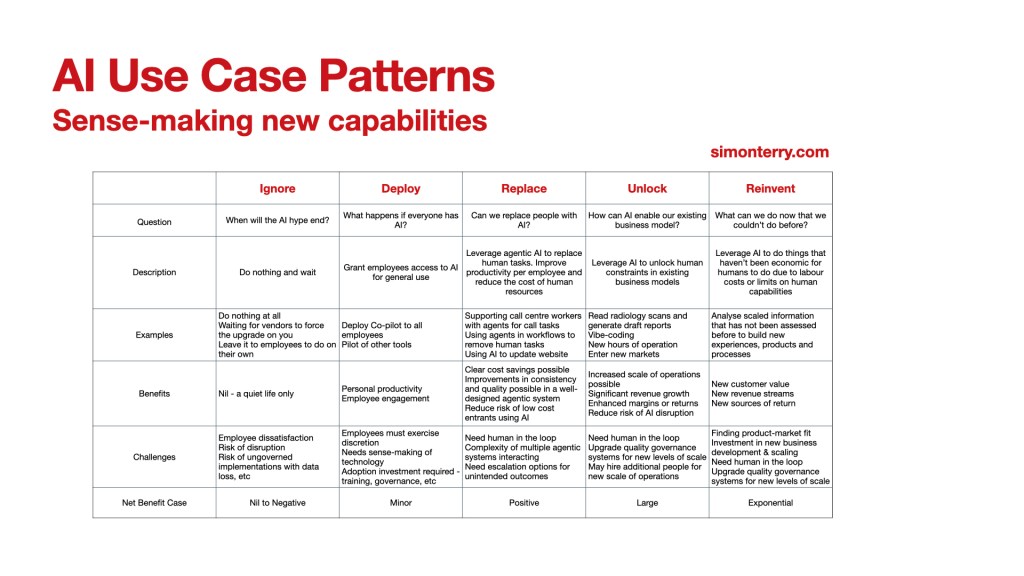
Work so far around the world by organisations implementing AI highlights five different use case clusters that have wildly varying benefits and implications for organisations. 

These clusters are

  • Ignore – do nothing and wait for more information or capabilities
  • Deploy – rollout AI to one or more employees
  • Replace – leverage AI to replace human tasks
  • Unlock – Use AI to unlock constraints in current business models
  • Reinvent – Use AI to do something new, different or innovative

Here is each of those AI Use Case Clusters described in a handy table:

Till even the comforting barn grows far away
And my heart owns a doubt
Whether ’tis in us to arise with day
And save ourselves unaided.

Robert Frost - Storm Fear

Observations on these Patterns

Doing Nothing is Not An Option: New technology takes time to be mastered. Making sense of the capabilities requires testing and learning and making sense of its application and risks in your context. Without experimentation you are likely to be at the mercy of disruption by others or only benefit from generic capabilities that flow to everyone.

Reducing People is Not Inevitable. Changing what People Do is: The Unlock and Reinvent use cases may both lead to increased level of people in your organisation supporting expansion of new levels of activity and new work. However, it is likely that simple, repetitive tasks, content creation, and review, transcription, and analysis of information will be automated using AI. Human activity will move to higher value and likely higher paid tasks involving governance, discretion and person-to-person interaction.

The Highest Value is the Hardest Work & Risk: Not surprisingly, the greatest return comes from exercises to explore the uncertainty created by the opportunities of new technology. That means great risk of failure but also greater potential returns. Realising greater returns is going to require investment, governance and effort. Accidental success is always possible but systemic effort produces better consistent outcomes.

All at once: While there are different capabilities required to execute each of the clusters above, this is not a maturity model. As noted above your organisation is likely to need to consider a little bit of everything from the use case patterns above. There will be areas where wait and see is wise. You may also have areas where it is urgent today to unlock your business model or reinvent it. What is clear is that almost everyone will explore the opportunities to remove tasks that are mundane and repetitive using AI.

Get ready to be surprised: New technology offers entrepreneurs new ways to explore business processes, value chains and business models. Every industry will have some form of new entrant and new model to consider. Not all of these models will succeed but there are likely to be shocks and adjustments along the way. Organisations need to invest in their capabilities to learn, experiment, adapt and react.

Best of luck with your adoption of AI in your organisation. I hope you found these clusters useful in your efforts to make sense of AI adoption. Let me know your thoughts in the comments. Particularly, let me know what I missed.

The woods are lovely, dark and deep.
But I have promises to keep,
And miles to go before I sleep,
And miles to go before I sleep.

Robert Frost - Stopping by Woods on a Snowy evening

Simon Terry is a consultant, advisor, and non-executive director who focused on how organisations can better leverage technology, collaboration, leadership and learning to achieve innovation and business growth, particularly in financial services, healthcare and education.