Pondering the End of Newtonian Management

The current generation of artificial intelligence is probabilistic, not deterministic. After more than 60 years of digital technology and over a hundred years of management, we’re about to grapple with the end of Newtonian management

Probabilities Astray

I have the misfortune to be both short-sighted and long-sighted. As a result, I have a pair of glasses for each. My main glasses are for shortsightedness, which makes texting on the phone something of a random experience at times. Everything works thanks to autocorrect until the phone guesses wrong. I usually don’t discover until a confused correspondent replies seeking to clarify. While autocorrect mostly accelerates our work, the ‘thanks autocorrect’ meme is a reminder probabilities can go astray.

Our new Artificial Intelligence founded on the predictive power of large language models extends this probabilistic approach much deeper into the world of work. Our management philosophies have not yet adapted to the differences to the systems we traditionally manage. We will need new systems and governance for this world of work. In critical arenas we may need regulation to define where and where not we are comfortable with putting our processes in the hands of probabilities.

Newtonian Management

Our modern management philosophy is driven in large part by machine metaphors. Inputs lead directly to outputs. Processes are predictable, inspectable, and repeatable. This is the simplicity of Newtownian physics.

When we began to build software systems at scale in the middle of the twentieth fentury those systems follow the same predictable Newtonian principles. Code was lean and ran to achieve the same outcomes from the same inputs every time. We could let it run on its own because we simply had to put assurance over the processes. We know how to do this very well. Newtonian physics fits easily in our head because we can imagine it easily.

Now, although he knew no more than before, his intensity and verbal glitter bore the likeness of knowledge, seeming to prove that his earlier doubts had been mistaken, and so for him and others his ignorance passed for wisdom,...

Stephen Dobyns, [It was the lack of certainty]

The Mysteries of Quantum Systems

Quantum physics is built around probabilistic wave functions. Suddenly the straightforward outcomes we expect aren’t always those we get. Inspection of the process can even change outcomes (as per the Schrödinger’s cat thought experiment). Mostly, we need not worry about the probabilistic nature of quantum mechanics because much of our lives and systems operate at a Newtonian scale. You don’t need to guess which of several wave functions is your car driving on the road. You have a pretty good idea of where it is.

Which brings us back to our new probabilistic Artificial Intelligence functions. They give us answers faster and better than ever. These models are very powerful at distilling the next most likely token in each scenario, but they do so probabilistically in ways that defy inspection to most. Like my autocorrect, it may not provide the desired outcome if in its view a new option is more likely.

I, at any rate, am not convinced God is playing at dice - Albert Einstein to Max Born (he was wrong on quantum physics)

The very strength of these models in prediction means that they can be challenging to govern. They fill gaps that they shouldn’t fill. They work around constraints put on them in seeking to achieve goals. They downright critical information in their multi-layered calculations. Outcomes may not be repeatable or may not be predictable because seemingly insignificant variations in starting states can produce different outcomes.

Every system perfectly designed to get the results that it gets - W Edwards Deming
…I have
no feather to weigh. I have no
bubble to burst. I am less
to myself, a character in a drama,
a drumbeat, a benevolence, a
blight...

Jennifer Militello, Mansplaining

New Management Skills

New Probabilistic systems will require new management skills to leverage them. This is even more important now AI is being built into everything and in some cases may be deeply embedded and the probabilistic volatility will be less transparent to users. The Australian Government’s Robodebt fiasco is a stark warning of the problem when prediction systems make mistakes while being urged on by enthusiastic champions with inadequate governance.

A few basic things will need to change:

  • Management and governance can no longer rely on a single test or a single run. We need to understand the whole distribution of outcomes across a wide range of trials. We need to know the expected outcomes and the variability that we need to guard against. Critically we need to understand the risks that the model varies so far from our expectations to get outside our desired outcomes. This understanding needs to apply to every step in an AI-enabled process as the variation can be cumulative.
  • Separating what variation can be managed from what must be accepted. Some of the variation is the model exercising its powerful tools. Much of it is buried in processes that are not capable of being inspected or varied by users. We will need to better sift out what variation in the outcomes can be managed and what must just be accepted and reassure ourselves we are happy with the latter. That uncertainty might be very uncomfortable for Newtonian managers and in legal systems with expectations of greater certainty than systems allow.
  • Be very careful where and how we use these capabilities given their probabilistic nature. Obsess about starting states and inputs to ensure the system is not sent awry from the beginning? What harnesses do we need for AI processes? What are the activities that will add additional noise to the system and can they be excluded? What are the domains in which we need great predictability of results and may have to rely on something less powerful, less efficient and more Newtonian. If uncertainty is at unacceptable limits then you may need to manage another way or around this capability. These may become areas for stricter governance or even regulation.

We will learn even more things as we continue to experiment and evolve these systems. That will be particularly the case as we start to deal with complex webs of AI-enabled and AI-embeded systems interacting on behalf of organisations, their employees and their consumers. Without close scrutiny and new levels of understanding, unintended but highly probable outcomes will abound.

...i saw lands going back to sleep and doors opening both ways. i saw escape buttons pressed into bodies stacked behind your dinner party. i saw sunlit sidewalks. i saw no sign of decaying bags anywhere. i saw signs of decaying bags everywhere...

Paul Martinez-Pompa, lit

Living with Uncertainty.

Newtonian approaches to management have meant we have developed an intolerance for uncertainty. We have engineered it out of our systems as much as humanly possible. That simplifies management down to a few standard sets of concerns around inputs because outputs are predictable from their inputs. We have limited assurance on processes once they are confirmed as repeatable.

Continuing down our current path on large language model Artificial intelligence will test us to live with more uncertainty to get the benefits of the model. It will also test our management skills to consider a wider range of interventions and understand in ongoing processes to ensure we can be comfortable with that uncertainty. When may even choose arenas where we prefer the friction of more predictable but less capable systems. As we race to quantum computing, we may yet need a more quantum form of management.

I suggest moving forward we use two sets of glasses in management – our comfortable set looking for predictability and a new set that looks to understand the uncertainties and volatility of our new AI tools. Life will be much better with both views.


Value the Friction

Friction is an inevitable part of work. We grapple with constraints and challenges to invent new paths forward, to test our abilities and to learn with new skills. In an age of AI, it might be time to value the friction a little more. Sometimes the obstacle is the work.

Frictionless Solutions

The NY Times published a piece yesterday which was a critique of Open AI’s announcement that its AI had solved the Navier-Stokes problem in fluid dynamics, a mathematical problem that qualified as so hard it was one of the Millennium challenges. The opinion piece is sceptical of the value of this as yet unvalidated solution because it involves skipping all the hard grind of mathematics to get there, even if one overlooks the potential plagiarism concerns around the model’s work. Others have commented that scientific journals are now so flooded by quickly produced scientific papers that sifting them for real valuable scientific progress is becoming a challenge in itself. A frictionless race to outcomes risks losing the value of the journey.

This place is an impression
left by the friction-ridges
of a human battle.

Kiersten Bridger, Treaties and Monuments: The Whim of Ephemeral Contracts, or A War Department Map Looks like the Fingerprint of All My Relations

The Value of Friction

Much of human progress and invention is a consequence of a pursuit of other goals. We stumble across things as we try to solve the problems our goal puts in front of us. The list of everyday items that were invented as the Apollo Moon project sought to meet President Kennedy’s injunction to ‘put a man on the moon and bring him back’ within a decade is long. In many sense, this progress has had much greater and more enduring impact than grainy images of a flag set in moondust, as romantic as that destination may be. The astronauts themselves were focused on the challenges not the magical destination.

My God, I never thought of all this bringing peace and tranquillity to anyone. As far as I am concerned, this voyage is fraught with hazards ... and that is about as far as I have gotten in my thinking. Peace and tranquillity indeed; I wish I had time to digest that, and decide in my own mind whether it’s true or not; in the meantime, I am proprietor of this orbiting men’s room and there are other demands on my time.

Michael Collins, Apollo Astronaut after speaking to Richard Nixon

We don’t learn much in our comfort zone simply because we aren’t very challenged putting one step after the other. More concerningly our comfort tends to reduce the thinking and scrutiny that we might otherwise apply to our work. Work that comes easily can be mundane over time and far more prone to mistakes as our attention wavers. Being forced to reflect and change course when stumped is a critical moment that can enable a change of direction, a breakthrough or better yet a new collaboration. Often the best creations are when two people pursuing different goals discover the intersection of their challenges.

A common fallacy is to see the work we do as only measurable in outputs and outcomes. Management’s machine metaphor can tend to treat all human work as mechanics with inputs leading to outputs. Human work is rich not just because of its destinations. The process to get there builds capabilities, allows for human interaction and provides a rewarding sense of personal value. The grind of work and the challenges overcome often matters much more than the flag at the end of the race. We would be wise to remember this as work accelerates and becomes ever more overwhelming with AI.

Barring a catastrophe, the AI transformation will continue apace. We will not fail to take the advantages that AI offers us in acceleration of work. However, as we design our systems of work in the new world we would do well to remember that obstacles can be the work and that there is a lot to gain on the journey itself. Quick leaps to answers can lose us important parts of the process, especially if the outcomes are black boxes that do not contribute to human potential or capabilities.

...the shank fixing us
together in this world my mother could trust
only so long as everything was done right, only
when she didn't forget to check that I was buttoned up
proper, buttoned up tight.

Sally Green, Shank

It’s Never The Technology

Across the last few weeks, I have been involved in a range of conversations about technology in different domains. Many of those conversations were about the risks. challenges and opportunities of fast moving AI. A number were about how to leverage technology transformation to harness benefits and mitigate the risks. In all the conversations, one theme kept resurfacing: It’s not about the technology. As I wrote a long time ago about social collaboration, there is a lot to get right before you start buying and implementing technology and too many people assume that they are ready to go.

Photo by Firos nv on Pexels.com

By dint of having started my career as the commercial application of the internet exploded, I have spent most of it involved in the strategy and value creation of technology from early ecommerce to digital experiences, to mobile, cloud, social collaboration and now into the AI era. In every domain the same issues arise, people get excited about what they can do, what they can buy and what they can implement. Over and again, the questions that matter more are:

  • What is our goal or purpose and how will we know we have succeeded?
  • What do our customers want?
  • What is our strategy to deliver for our customers and to succeed?
  • What business model and capabilities do we need to support that strategy?
  • What roles do we need our people and partners to play in those capabilities?

The similarity between these questions and the Lafley & Martin Playing to Win strategy framework is intentional and clear. All technology investment is a strategic action seeking advantage as part of a process of increasing value creation. Lack of clarity on the strategy, the goals, the required customer experiences, people experiences and the capabilities are why organisations fail when they implement technology. The issues and risks that will strike a project down, delay it significantly, cause cost overruns and destroy value are all help in the margins of ambiguity on those decisions.

Technology is not a realm where you can trust a vendor’s greater experience or even their proven case studies. Strategies vary. Even within the same strategy capabilities, processes and business model economics change. Every vendor has to implement an 80:20 rule to make sure the product fits across clients that are always more diverse than expected. Fitting your organisation to a vendor’s average process might work well in areas of low criticality but can break strategies. Small misfits lead to customisation, poor experiences, and integration issues.

These demands are why it is wise to treat even the smallest technology changes as a full transformation with a wide enough scope to deliver real value through change. You are never just bolting something on or swapping one system for another. To often the ‘change and adoption’ work that people perceive as a step at the end, needs to be an entire stream of creating strategic clarity, developing a plan for value and aligning the project and the organisation’s processes around that value. Doing that work before you start spending money on vendors will deliver a lot greater clarity and better shape the technology delivery than hoping it will happen through a process of technology change.

If you are struggling with the business case of your technology investment or you are struggling to finish an implementation, there’s a really good chance the problem doesn’t exist in the technology. The challenges and clarity you missed are in purpose, strategy, capabilities and the work of your people. Start there and you’ll discover a new path.

Forward Deployed Entrepreneurs – the Capabilities and the Questions

Realising the value of AI in your organisation is going to require more than technology skills. Are you planning for the entrepreneurial capabilities required to maximise the strategic value for your business?

A conversation about AI yesterday with Scott Ward, a long time collaborator, helped me to further flesh out my recent post on Forward Deployed Entrepreneurs. Scott and I were discussing the need to shape AI investment to realise strategic value and the importance of breakthrough business model transformation as cost out becomes more marginal for many organisations as token costs rise.

The Three Roles of the Forward Deployed Entrepreneur

The literature of Entrepreneurship has done a good job of describing the combination of skills required for disruptive innovation at scale. That formula has resolved to:

  • Hustlers – the strategists, business model, growth and commercial experts who help realise the value of the solution
  • Designers (or for alliteration Hipsters) – the human insights and the ability to construct human friendly experiences and narratives into a product, process or experience
  • Hackers – the wranglers of the technical components of product, process and experience

In many start-ups these are three separate functions but many entrepreneurs combine elements of each to drive their solutions forward at an early stage. Successful AI initiatives are going to require all three capabilities in teams or more rarely in a single individual.

These three capabilities describe what your Forward Deployed Entrepreneurs must do.

Why these capabilities?

Let’s look at each capability in turn in the context of the strategic value of AI:

Hustler: The capabilities of the hustler are important to your AI initiative because they help shape the value that you are pursuing by answering questions like:

  • How does this initiative help fulfil our strategy?
  • What value are we seeking to create?
  • How might we release constraints in our business with AI?
  • Do we need to transform our business model or value chain?
  • How are we going to leverage this new capability with our customers and what are the implications for our commercial models?
  • What are the likely reactions from current and future competitors and imitators?

To address these questions either directly or to experiment and iterate to answers, hustlers need deep commercial savvy, strategic nous and an ability to understand and reshape business models and economics. Linda Grattan recently noted that AI demands CEO level skills and attention. Hustlers also need the resilience and the energy to continue to advocate, sell and grow gage customers and other stakeholders.

Designer: The AI challenge for business is not a technical one. It must also be a human one because we expect AI to co-exist with colleagues, customers and other stakeholders. AI’s role must be designed to reassure reluctant users and allow for real human emotions which are often much more critical in processes than pure rational calculations. Designers can answer questions like:

  • What do we want people to feel in this experience and how might we support that?
  • How do we build trust in this experience?
  • What are the moments where we allow for a human to override or escape the AI conclusions if they disagree or have concerns?
  • How do we shape the processes and experiences to achieve all of the outcomes we are seeking?
  • What proprietary elements will we add to the experience of a generic LLM to reflect our unique brand, voice and desired experience?
  • What are the regulatory and compliance obligations we need to meet as we use AI in this context?
  • How do we make sure that the workload left for humans is not overwhelming in terms of volume or complexity?

Designers help our the AI use cases in a human context to achieve the desired outcomes and to make sure that the experience remains attractive to customers and other employees.

Hacker: AI is rapidly changing technology and you are going to need excellent technology skills to tame it, shape it safely and to ensure that any advantages you accrue are for your business and not to the benefit of the model. Your hacker, or Forward Deployed Engineer, will need to address questions like:

  • How do we retain flexibility to avoid becoming hostage to one LLM provider or one model?
  • How do we prevent unwanted access to our data and our confidential information?
  • How do we ensure that the model works consistently as expected through platforms, harnesses and other guidance to the calls upon the model?
  • How do we work across the silos of our current legacy technology architecture to leverage AI for experiences that bridge them all?
  • How do we monitor, test and maintain the complex and new infrastructure that will be required?
  • How do we keep the costs of our new tokens under control?

There’s evidently a lot for the technology capabilities to do as they bridge legacy and new technology to achieve business outcomes and keep everyone safe in a radical new world.

More than one Person

Realising radical transformation using AI is much more than a technical challenge. As noted above, it likely involves more than one person’s capabilities and the skills across the breadth of the organisation. You may be lucky to have one magical Forward Deployed Entrepreneur but you are likely to need a squad.

AI offers the potential to change business models, do things that haven’t been possible before, and release constraints in current businesses. You will need a diverse range of capabilities on your teams to see and realise these opportunities. Start by leveraging the skills of Forward Deployed Entrepreneurs – Hustlers, Designers and Hackers.

Embracing Abundance

The art of management is mostly a story of efficiency and alignment. We have optimised the exercise of managing within tight time, labour and capital constraints so fully it is what we routinely consider as management itself. Any other thinking is routinely dismissed or at least huffed at in the corridors of power where the question returns often to “growth is uncertain, efficiency is much more manageable”. Aside from rare entrepreneurial moments, we aren’t used to thinking in terms of abundance. The new wave of AI gives us an opportunity to reconsider where the bounds of our business opportunities lie. That will demand new skills of all managers. Our path to those skills is new questions to ask.

But thou, contracted to thine own bright eyes,
Feed’st thy light’s flame with self-substantial fuel,
Making a famine where abundance lies,
Thyself thy foe, to thy sweet self too cruel.

William Shakespeare, Sonnet 1

Exploring AI Practice

When I highlighted four clusters of use cases of AI, I finished noting that AI offers a generative opportunity to rewire business models by breaking constraints and transforming value chains. As I have expanded conversations with entrepreneurs and AI practitioners, these are the stories that are most intriguing and captivating because they push hard against our management expectations.

Here are some examples (anonymised to focus on the general implications):

  • the start-up that is struggling to hold a product backlog as their engineers productivity lifts and the non-engineers vibe code
  • the CEO who deployed a new interactive website in an afternoon of experimentation
  • an enterprise transformation where data mapping that normally takes months happened in minutes and suddenly the ability to explore that data map became a generative opportunity rather than a drudge
  • organisations considering whether traditional enterprise software models get in the way of AI value creation because these systems are built to lock in both the data and the process
  • using AI to turn a depth of unused historical data into a competitive moat for the proposition
  • bringing hours of analysis, insight and preparation to bear on interactions, conversations and decisions in minutes
  • organisations breaking historical constraints of budgets, resources, capital or time using AI powered approaches and suddenly seeing new possibilities

When the AI conversation starts to become about the cost of tokens and the returns on the massive investment in data centre infrastructure, we may be starting to see new constraints. Yet each of the examples above highlights, ways organisations are creating new value from AI by removing constraints of time, labour, or capital from their historical value chain.

To you the earth yields her fruit, and you
shall not want if you but know how to fill
your hands.
It is in exchanging the gifts of the earth
that you shall find abundance and be satisfied.

Khalil Gibran, On Buying and Selling

Embracing Abundance

A number of books, blogposts, and articles have argued that the implications of these changes offer us the opportunity for a new wave or even an age of abundance. Yet to pursue these opportunities we need to move beyond the constraints of managements traditional efficiency mindset. We need Forward deployed entrepreneurs pursuing abundance with new questions.

To pursue these clusters of AI Use case, we need to embrace new management questions and learn new skills. Questions that arise include:

  • What more can we do today with what we have?
  • What would be do if traditional labour or time or capital constraints didn’t exist?
  • What would happen if we didn’t have to queue for coding capabilities, or data access, or analysis, or processing steps to happen?
  • How can we deliver more faster?
  • What’s the most we can do?
  • What will our customers or competitors do with AI around our propositions?

The need to embrace an abundance mindset is driven in most part by the competitive dynamic. Consumers are already working out what they can do for themselves. Your competitors will soon follow on the path to abundance.

Thinking this way is not something you do in an AI strategy team, a skunkworks, a silo or any one technical function. AI efficiency projects might work that way but abundance demands more. Realising transformative opportunities in your value chain takes cross functional collaboration to bring the best of all your resources to bear and to see the whole of the opportunity.

Are you ready to discover where the new constraints really are?

but now—and now—one old,
abundant flower just screws up the room.

Graham Foust, Time I'm Not Here

After experiencing a number waves of technology innovation, Simon Terry is seeking to understand a new wave of AI capabilities and put its opportunities and challenges into context. This blog is where he works out loud on what he learns from reading, conversations with practitioners and experiments.

Forward Deployed Entrepreneurs

Forget Forward Deployed Engineers. The real challenges of your most valuable AI projects aren’t in the engineering. The most complex AI use cases to realise will demand Forward Deployed Entrepreneurs in your organisation who are able to identify, test and learn and transform business models. Brace yourself for an onslaught of intrapreneurs redesigning your business models, value chains and business processes powered by AI. This activity will challenge your organisation to govern learning at scale.

Are you ready to redesign your governance to enable the investments, the exponential value creation and the new risks this creates for businesses based on stable economic models?

From Engineers to Entrepreneurs

The Australian Financial Review had a great piece today on how the AI vendors are assisting clients to leverage their models with Forward Deployed Engineers. This takes the technical expertise into the client to enable them to better leverage the power of AI models in organisations. The Engineer joins into client teams to help them see and execute the potential to do better.

As noted in my recent piece on Clusters of AI Use Cases, the Unlock and Reinvent phases realise significant value because they leverage AI to start tackling change to business models, value chains and customer propositions. Your team members who work with a Forward Deployed Engineer need to be Forward Deployed Entrepreneurs to be able to make the changes required to transform your organisation.

The Entrepreneur part of this is relatively easy. Most organisations can find the creative and motivated individuals who want to test and learn a better way of doing business. Hiring them and keeping them is a much bigger issue. It’s not the capabilities or the challenge of the work. Entrepreneurs get a buzz from learning and overcoming challenges.

Lifting the valleys of the sea
my father moved through griefs of joy;
praising a forehead called the moon
singing desire into begin

ee cummings. my father moved through dooms of love

Entrepreneurs change things a lot

The biggest barrier to success of a Forward Deployed Entrepreneur and the key issue with their retention is whether you will let them make the changes needed.

The single biggest blockage is likely to be your long standing static, safety first, no loss, plan-based internal governance processes. The Forward Deployed Entrepreneurs need to be able to make changes to systems, processes, business models, customer relationships, products and more. They need to make those changes fast, iteratively and with a willingness to fail. They need investment, access to specialists and supportive stakeholders who are willing to take a risk to find much better.

Business model transformation happens iteratively. The business part of this adventure is far harder than the technology part because it involves not just doing something but all the considerations that your organisation makes any change work its way through such as implications on other lines of business and customers, risk considerations, sustainability considerations, IT security, financial business cases, investment hurdles and many many more. All these are designed around incremental changes like launching a new product or fixing a broken process. The work required to pass through these for a fast moving and transformational change driven by new AI technology is likely to be exhausting, especially if every iteration has to follow through every step.

If you want Forward Deployed Entrepreneurs to work on the big issue of Unlock and Reinvent then you need to support them with investment for the learning required, the autonomy to make big changes iteratively and also a governance process that adapts to the very different challenges that come from entrepreneurship.

csince feeling is first
who pays any attention
to the syntax of things
will never wholly kiss you;

ee cummings, [since feeling is first]

Redesigning Governance for Entrepreneurs

I was asked recently the biggest difference between governance in a fintech and governance in a large organisation. My response was that the governance in a fintech was all focused on the lessons from the activities and how they informed decisions to pivot or persevere and what those lessons were revealing about the future opportunities and value of the organisation.

Because there was an expectation of learning the governance understood that a lot might change from one governance meeting to the next. Autonomy was baked into the way the organisation ran and was an expectation in all roles. Risk was an accepted part of this learning process and the risks were managed actively. The plan was a guide to that learning experience and a measure of runway.

In most cases, large organisations use governance as a backwards looking exercise to understand variances to plan, reduce volatility, and what that means for the forecast. Risks were to be mitigated or avoided. Autonomy is within agreed plans. Investments and business decisions were slow and long processes designed around an annual planning cycle. This difference in governance makes test and learn business model transformation a challenge and will drive Forward Deployed Entrepreneurs (& their Engineering colleagues) to despair. Because your existing business model is proven and relatively stable you have built governance to secure that stability, not for rapid learning.

To explore the opportunities to Unlock and Reinvent your business models, value chains and customer propositions, you need to have entrepreneurship and an environment in your organisation for that learning to thrive. How are you enabling your people to learn at scale, to make the changes required for success and how are you changing your governance to support them?

For whatever we lose(like a you or a me)
it’s always ourselves we find in the sea

ee cummings, maggie and milly and molly and may

Simon Terry is a consultant, advisor, and non-executive director who focused on how organisations can better leverage technology, collaboration, leadership and learning to achieve innovation and business growth, particularly in financial services, healthcare and education.

Five Clusters of AI Use Cases

AI presents a unique transformational opportunity for organisations. Hand wringing has begun about potential job losses as a result of the implementation of AI capabilities. However, it is already clear that AI goes beyond the potential of efficiency. The purpose of this piece is to provide a framework for AI options that might grow organisations and opportunities for your people. 

In periods of rapid technological change, shared sense making is important so that we can build on the experiences of others. This post doesn’t seek to provide answers or even exact models, just some signposts to where your organisation might want to go next. It is important to note that one organisation may pursue one or more of these clusters of use cases at any time

I shall be telling this with a sigh
Somewhere ages and ages hence:
Two roads diverged in a wood, and I—
I took the one less traveled by,
And that has made all the difference.

Robert Frost, The Road Not Taken (because you may travel all roads with AI)

Five Clusters of AI Use Cases

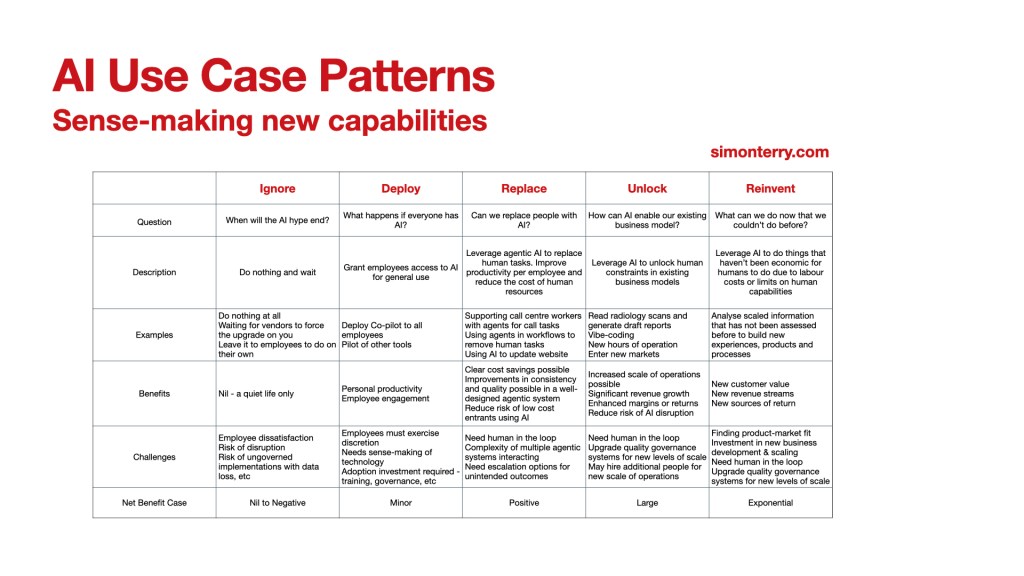
Work so far around the world by organisations implementing AI highlights five different use case clusters that have wildly varying benefits and implications for organisations. 

These clusters are

  • Ignore – do nothing and wait for more information or capabilities
  • Deploy – rollout AI to one or more employees
  • Replace – leverage AI to replace human tasks
  • Unlock – Use AI to unlock constraints in current business models
  • Reinvent – Use AI to do something new, different or innovative

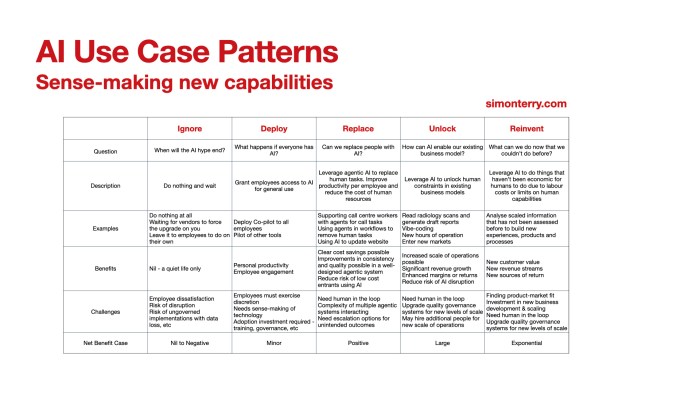
Here is each of those AI Use Case Clusters described in a handy table:

Till even the comforting barn grows far away
And my heart owns a doubt
Whether ’tis in us to arise with day
And save ourselves unaided.

Robert Frost - Storm Fear

Observations on these Patterns

Doing Nothing is Not An Option: New technology takes time to be mastered. Making sense of the capabilities requires testing and learning and making sense of its application and risks in your context. Without experimentation you are likely to be at the mercy of disruption by others or only benefit from generic capabilities that flow to everyone.

Reducing People is Not Inevitable. Changing what People Do is: The Unlock and Reinvent use cases may both lead to increased level of people in your organisation supporting expansion of new levels of activity and new work. However, it is likely that simple, repetitive tasks, content creation, and review, transcription, and analysis of information will be automated using AI. Human activity will move to higher value and likely higher paid tasks involving governance, discretion and person-to-person interaction.

The Highest Value is the Hardest Work & Risk: Not surprisingly, the greatest return comes from exercises to explore the uncertainty created by the opportunities of new technology. That means great risk of failure but also greater potential returns. Realising greater returns is going to require investment, governance and effort. Accidental success is always possible but systemic effort produces better consistent outcomes.

All at once: While there are different capabilities required to execute each of the clusters above, this is not a maturity model. As noted above your organisation is likely to need to consider a little bit of everything from the use case patterns above. There will be areas where wait and see is wise. You may also have areas where it is urgent today to unlock your business model or reinvent it. What is clear is that almost everyone will explore the opportunities to remove tasks that are mundane and repetitive using AI.

Get ready to be surprised: New technology offers entrepreneurs new ways to explore business processes, value chains and business models. Every industry will have some form of new entrant and new model to consider. Not all of these models will succeed but there are likely to be shocks and adjustments along the way. Organisations need to invest in their capabilities to learn, experiment, adapt and react.

Best of luck with your adoption of AI in your organisation. I hope you found these clusters useful in your efforts to make sense of AI adoption. Let me know your thoughts in the comments. Particularly, let me know what I missed.

The woods are lovely, dark and deep.
But I have promises to keep,
And miles to go before I sleep,
And miles to go before I sleep.

Robert Frost - Stopping by Woods on a Snowy evening

Simon Terry is a consultant, advisor, and non-executive director who focused on how organisations can better leverage technology, collaboration, leadership and learning to achieve innovation and business growth, particularly in financial services, healthcare and education.

AI Effectiveness

Routine tasks have been automated for centuries. Achieving greater efficiency with AI is an inevitable outcome of the ongoing automation of routine work. The greater challenge that few organisations are organised to realise is leveraging AI for greater effectiveness of purpose by serving more customers, doing so better than ever before or through innovation.

Human Limitations

Humans are terrible at forecasting in times of non-linearity. Our mental models do not cope well with the pace of change and the discontinuities that flow from rapid changes in scale. One can see that inability to predict in a recent set of scenarios from the US Federal Reserve shared in the Financial Times. AI is either going to deliver nirvana, destroy us or deliver 2% better growth. Within that range lies all of human history. The Federal Reserve economist are doing their best but with unpredictable non-linear outcomes forecasting is not much value. Remember this when you see any AI forecasts.

When our mental models don’t stretch to imagine a non-linear future, we are tempted to revert to safe and secure heuristics. One reason so much of the AI discourse has been around job losses is that many managers default to ‘new technology = efficiency = job losses’. For organisations that have long believed the goal of business is to deliver a consistent repeatable process and then remove cost through efficiency, at first flush, AI looks like a potential massive cost efficiency. There will undoubtedly be significant cost efficiencies to be realised.

The recent McKinsey State of AI Global Survey highlights that effiency is in the forefront of management considerations. 80%+ of respondents are setting efficiency targets for their organisations in the US of AI. The reality is that the automation of routine work began in the Industrial Revolution and the use of AI to automate even more complex routine tasks is inevitable.

The AI Effectiveness Challenge

The same McKinsey report notes that the best performing organisations in realising value from AI are setting goals beyond efficiency. They are also pursuing AI’s role in Growth and Innovation. Oraganisations can leverage their current cost base to achieve more, though management’s preference for the predictable certainties of cost saving can mean this gets lost in discussion.

A key point to remember is that the model of driving scale efficiencies in a predictable process is one that began long before the internet, let alone AI. Much of the gains of that model came as consumer capitalism spread scale of distribution to global markets. Routine work was in decline in growing mature economies well before AI. With the arrival of a connected global market with real-time information, many organisations have found an efficiency only model more challenging to sustain, either having to re-engineer themselves offshore to lower cost markets or building complex supply chains from global vendors. With these actions comes new threats, such as new distruptions come from those scaled global supply chains or new competitors leveraging global supply in new ways using digital technology. AI is going to drive new levels of threat to the disruption and disaggregation of those predictable business models. Financial services executives are already pondering the implications of consumer AI agents moving money and arranging services at the speed real time finance. No steady scaled franchise is safe in that world. Threats like this one will develop over time into all industries. Just cutting cost won’t be enough to survive. Winning organisations will leverage AI to rethink their customer experiences and their entire value chain using the new economics of AI.

Aaron Levie, CEO of Box, in a long tweet on 7 November 2025 highlighted that an opportunity he is seeing in Box’s client base is leveraging AI to pursue opportunities that organisations would not have seen as economic to pursue with labour. Organisations have let assets like data, content, channels and relationships lie fallow because they were uneconomic to pursue with traditional labour intensive models. Constrained management made people choose the obvious high value use cases to pursue. The rest were deprioritised and simply ignored. That ignored long tail of opportunities is now more in reach for innovation using AI’s capabilities to analyse, sythesize, predict, recommend decisions and automate actions.

What was once uneconomic to do for customers, employees or partners, will slowly become expectations, particularly as other organisations drive expectations of service by deploying AI against those opportunities. AI will drive new competition at new pace, whether startups nipping at corporate heals, international organisations developing solutions with the new economics for the Bottom of the Pyramid or competitors using Clayton Christensen’s disruption to attack from the tail.

Organising for Effectiveness

Being aware of the opportunity or threat is one thing, being able to respond to an opportunity to be more effective is another thing entirely. Most organisations have made it almost impossible for employees or executives to prioritise increasing effectiveness through innovation and growth. Budgets don’t exist for that work as we are used to funding investment through the safety of efficiency. Employees don’t have the freedom to radically redesign business processes or policies to leverage the new capabilities of AI. Even organisational structures (and their power bases) established around existing customer segments and processes will get in the way.

Innovation, growth and effectiveness require agility, entrepreneurship, experimentation and change, not stable consistent scaled processes. To meet the coming AI Effectiveness challenge organisations are going to have to build new capabilities, learn new skills, change systems and unlearn a great deal of ‘modern management theory’. Organisations that do not challenge themselves to be more effective for their customers, communities, employees and partners will find themselves left behind. No matter how few employees they have in their efficient organisations, a more effective organisation will take their customers away with innovation and enhanced experiences.

The time to start radically rethinking propositions, the value chains and priorities of your organisation around the capabilities is now while your competitors are pursuing efficiency. Efficiency is fast follower territory. You can always copy what works later and technology vendors will eagerly assist you to do so by building the easy common use cases into platforms. What is much harder and takes new and unique organisational capabilities are the innovations and growth you will drive with AI. Start the experiments to explore that work today. Investment into this non-linear innovation will yield valuable insights and potentially enduring advantage. Your success will be much harder to replicate and may even be invisible to competitors stuck in traditional management mindsets.