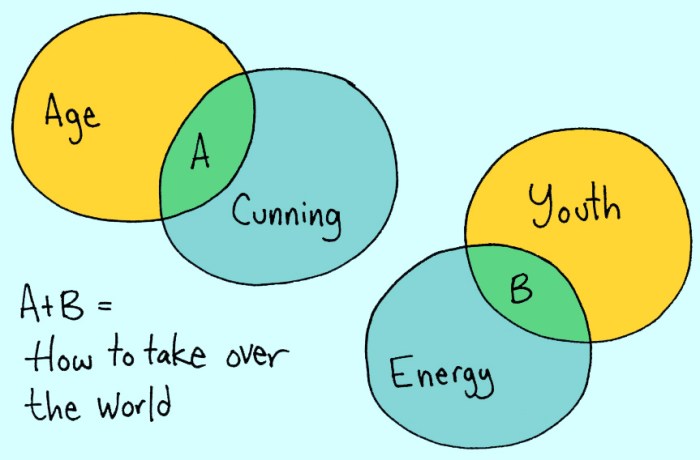
Interesting people engage outside their peer group.
Innovation, Collaboration, Learning & Leadership

Many years ago I pitched an initiative to a senior executive group. The presentation went without a hitch. There were no hard questions and no push back. I walked out of the meeting pleased until a wise mentor of mine asked a devastating question:
What level of engagement was there in the room?
My mentor went on to point out that without pushback it is unlikely anyone in the room actually turned much of their mind to my initiative. The lack of pushback was bad news because it meant that support would fade quickly and little follow through would occur. Sadly, he proved right.
That day I learned a lesson to bring on questions, debate and conflict to generate engagement. No matter how compelling your case for change, you need debate to get people to consider the options, risks and issues. Without debate, people don’t agree. They just acquiesce.
Debate, questions and conflict are an essential part of how knowledge gets attention, currency and is shared in organisations. You can’t advance a meaningful agenda without them.
If it feels like you lack opposition, then there’s a good chance you are inadvertently playing to the safe ground. Platitudes might win unthinking support. That might work for a while, but there’s a risk you will lose your support when real challenges arise.
If others aren’t bringing debate, then start the debate yourself. Raise the hard questions and doubts. Provoke your likely opponents. A real discussion upfront is always better. Knowing where you stand as a change agent is critical. It will give you valuable information on what to do next to move forward.

The best way to change the future of work is to change how we interact.
The Responsive Organisation Manifesto recognizes that there are fundamental changes afoot in the nature of work and calls for action to make our organisations more purposeful, responsive, more engaging, more empowering, more networked, more mobile and more community oriented. Groups like Change Agents Worldwide are working to help organisations with services and solutions to navigate these big changes.
Hacking Organisations is Hard
There’s lots of enthusiasm for big change. Big change is hard. There is a lot yet to be worked out. The decision making processes take time. Experiments are required. Not all of us feel we have the power to make big change.
There are things we each can do now. In our control. Today.
Hack Yourself First
Organisations are made up of individuals. The pattern of interactions of those people determine purpose, processes, decisions, use of resources & ultimately culture. Changing these interactions is more important than changing roles, hierarchy and many of the other formal organisation trappings. There are too many companies that changed their hierarchy and found things still work the same way as ever.
We can each have an impact on the future of work by changing our own behaviours first. If we change our own interactions that contributes to change. View each new interaction as an experiment. Is it worthwhile enough to inspire others to copy it?
Six Personal Behaviour Hacks for a More Responsive Organisation
Here are some simple triggers of our common organizational life where we can adopt new responsive habits
These small changes can have a significant impact on the responsiveness of your work and your leadership. You might even inspire a movement of others to copy you.
These actions alone are not enough. What other hacks or changes can we make? Please post your thoughts in the comments
Uniting the like-minded agents of change is a common first step in creating change. Too much unity of the like-minded is also a path to failure.
Undoubtedly change agents benefit from connection, collaboration and collective force. The life of a change agent can be a lonely one. Having others to share the load matters.
Building an overly united collective of people equally oriented to change has its dangers for the success of any change:
– Shared Context: People embrace ideas when they share sufficient context to understand them. Uniting a group of change agents can rapidly accelerate the sharing of knowledge within the group. Soon that group will have lost some shared context with those that need to embrace change.
– Us & Them: Silos are inevitable in any attempt to draw a ring around a group united in purpose. Without great care, unity will also come at a cost of factionalism as people seek out those who hold views of those closer to their own. All of this connection is in the opposite direction to the external engagement that drives change.
– Grand Plans: United we dream. We plan lots of steps without engaging those who must join us in the changes. United we dream. Dreams inspire, but don’t deliver.
– Power of Conflict: Interaction, debate and conflict helps keeps ideas evolving and relevant. Flaws appear when ideas are challenged and when ideas are tested by diverse views. Unity will reduce conflict. No change prospers by talking only to the converted.
– Compromise: Surrounded by those equally convinced, compromise can feel weak. Standing ground against the system looks like an option and is commonly raised. This gesture of pulling rank on the system may come with a giddy sense of opportunity but is actually a failure, alienating others and preventing further progress to change. Opting back-in later is always challenging.
So how do you get the benefits of greater connection without the risks?
– Share your story: Work out loud. Keep putting ideas out and discussing them widely
– Keep the doors open: Constantly engage with new people, both like-minded, neutral and opponents. Any time your ideas are not being disturbed once a day you are in an echo chamber.
– Favour unity of purpose & action over dogma: People only need to be agreed enough on the direction to work together. The change agents don’t need to agree each last point of implementation yet. Details will come in time.
A plurality should not be asserted without necessity – Occam’s Razor
We complicate things. We like big words, big aggregations & abstract ideas. We love a topdown & system view. These conversations make us feel like leaders. Then we find it hard to make the conversations at this level deliver even the smallest amount of traction to our goals.
Focus instead on the smallest unit of impact or action. Apply Occam’s Razor and only add to these units when needed. A lot of waste, confusion, interpretation and distraction is quickly cut away. Suddenly we are see impacts at a human level and can focus on changes and impacts that have real traction.
Here’s a list of a few small units that aggregate to deliver the impacts we discuss and debate.
The smallest unit of:
– a customer experience, sales or service is one customer interaction
– productivity is one task
– profitability is one sale
– branding is one customer decision
– communication is one message received
– leadership is one interaction
– purpose is one task
– learning is one skill applied
– employee engagement is one question
– trust or reputation is one interaction
– work is one task
– change is one new action
– innovation is one experiment
Each of these little actions or interaction aggregate to form their impacts. Most are controlled by others not you. Change at this level is more powerful. Piled on top of each other these small units create the measures we treasure. If we want better outcomes, we need to make sure our plans work at this tangible level.
What is the smallest unit in the challenges you face? What would be different if you focused on only changes at that level?
Change movements fascinate me. People coming together to create change that is beyond the power of one individual, is how all of our greatest social accomplishments have been made. I have started a few myself, both successfully and unsuccessfully. I have studied lots of others hunting for ideas that can be reused.
I have learned that there is no perfect formula. However, these things help movements to success:
Purpose: Defining why the movement exists matters most. This is the reason people will give up their time and effort to be involved. Failure to agree on common purpose will result in factions, disruption and failure later
Engaged champions: A few engaged champions is worth thousands of passive members. Find your champions and treasure them. Finding them is usually as simple as letting them approach you. The ones you want will have a bias to act. You are often better cutting the freeriders and focusing only on the engaged users in the early stages. Exclusivity, a strong sense of the other and deep personal relationships helps build energy and resilience in the movement.
A small secretariat: A movement usually needs some group accountable for shaping and maintaining direction. A small secretariat of the most engaged champions can play that role. The secretariates does not need to be hierarchical but they do need to play a role as custodian of the purpose and a node for actions across the network.
Cellular structure: Networks are more resilient & more engaging than hierarchies. Small group structures engage people and build personal connections within the network. The groups also provide local support, back-up for missed communication and solve issues locally where required. Action by small groups requires less coordination.
Stories: Successful movements have rich storytelling traditions. Myths, tales and anecdotes help share their messages and make purpose tangible to the community and others. Stories share abstract ideas in tangible ways making them more human and personal.
Continuous communication: Driving change is only one element in people’s lives. You cannot overcommunicate. Share stories, successes and challenges. Make sure there is a vibrant connection across your network.
Sense of community: Great movements build strong senses of community. That is usually evident in the support and sharing that occurs within the community beyond its core purpose.
Symbols of change: To understand the movements vision, you need defining symbols that people can understand and relate to their own world. A few common values can be part of a powerful symbol of the change. The more human, personal and individual the symbols are the easier they are to live and share.
Consistent action & confrontation: Action builds movements. Action inevitably involves confrontation with opponents. A regular cycle of action and confrontation is required to keep engagement of the movement. Action and confrontaction creates new stories to share and can bring the movement’s symbols and purpose to life for a wider audience. Progress may be slow but action must be continuous.
Reflection & adaptation: Successful movements adapt to changing circumstances, responses and to the needs of the system in which they operate. Processes to foster reflection and development of new adaptations matter to enable this.
Gathering: Human beings are tribal. We like to gather. Whether it is gatherings of the cells or gatherings of the whole movement, the people involved need to come together and feel part of the tribe from time to time. Gatherings are where the informal story sharing occurs. It is where trust and connection is built, knowlede is exchanged and new innovations are started.
This list is a starting point on my studies and experience. What are your ideas? What have a left out? What of the above is wrong?
Today I saw a conversation on twitter between two people who inspire me with their passion and ability to make change, Maria Ogneva and Susan Scrupski. I also saw a moment in that conversation that represented an insight into change leadership I see again and again. I paraphrased that moment in this tweet.
How leaders make change happen MT @themaria: @ITSinsider me too. I’ve been meaning to…for a while, but… because….Then I just did it.
— Simon Terry (@simongterry) September 20, 2013
Here’s what struck me about this tweet and what makes it a template for all change leadership:
Almost everyone can see changes that they want in the world. Many many people don’t think that they are ready to lead change and have doubts. Everyone knows change is hard.
Change still gets made. Why?
Because people with passion and energy, just start. They find the way forward and find their purpose in the hard work.
When you look at the lives of great change leaders, again and again you find the same comment. They weren’t the best placed. They weren’t the most powerful or most capable. They weren’t given authority.
Change agents are the ones who see a need, challenges and take action anyway. Everything else comes with solving problems, drawing others to help and having success.
Great change leaders are the ones who start work regardless.
So when are you starting? Today?

One individual & the organisation
Manifestos are the narratives that pull the future towards us as we lean into the unknown – Eddie Harran (@eddieharran)
The hardest part of disruption is disrupting yourself – R Ray Wang.
As the Industrial revolution changed society and new communication technologies were born, the western world experienced an age of revolution. Manifestos flew from the printers as advocates for changes in society sought to draw people to their causes and changes to society and economic activity. The passion for manifestos quietened after the shocks of two world wars. By then massive change had occurred to the level of social support, to the structure of the economy and to the power of social classes. Society had adjusted to new social models that mitigated (or in the case of totalitarian states suppressed) issues of the prior disruptions, our corporate business models were relatively static and a long boom drove western and global economies.
A new age of manifestos
We could be entering a new age of manifestos. With new communication technologies, disruption to traditional corporate models and the economic activity, change is required but we are not yet clear on what that change means. In recent weeks we have seen
The new manifesto is personal
If we learn one thing from that last age of manifestos, it should be that nobody should surrender themselves unthinking to a cause. The quote above captures the challenge of this new adaptive age. We need to disrupt ourselves as much as we need to disrupt the organisations, economies and societies we make up.
So what is your manifesto? Your changes are unique. You have a unique purpose. The changes you will drive will need to be social but before you join a movement be clear on what you want to see done. Make sure you are shaping the movement to your causes.
Take some time to reflect but start to write down your own personal manifesto. Feel free to beg, borrow and steal. Practice your new manifesto. Live your new disrupted self.
Adapt and change your manifesto as you learn from the work. Adaptation is not just a challenge for organisations it is a personal challenge. Will you have the capabilities required for the future of work? Will your role and your passions survive the changes ahead? You won’t know unless you adapt, experiment and change yourself.
The more you live your manifesto the clearer it will be, the more power it will have and the better guide it will be for others.
Start today. Others are waiting to see your contribution to the new age of manifestos.