
Are you a leader? We are waiting.
Don’t Wait. Lead. Change.
If you are waiting for a leader, who is waiting for you to lead yourself?
Innovation, Collaboration, Learning & Leadership
Are you a leader? We are waiting.
Don’t Wait. Lead. Change.
If you are waiting for a leader, who is waiting for you to lead yourself?

Whatever power you have today, you have the power to influence change. You have the power to lead and inspire.
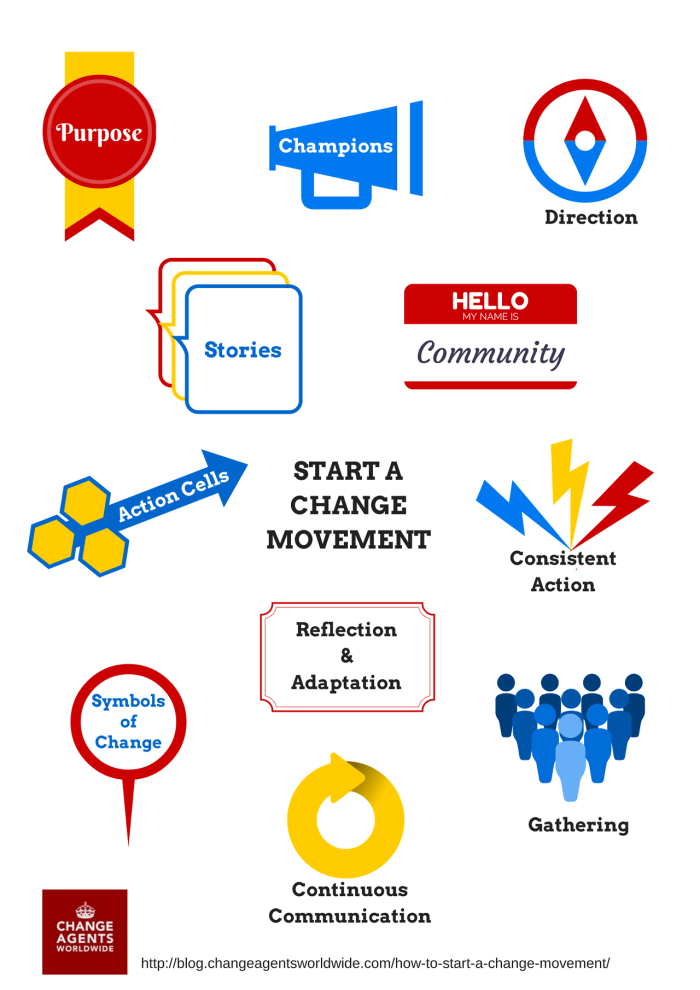
One of the busiest posts on this blog is How to Start a Change Movement. People are increasingly recognising and preparing to adjust to the increasing pace of change in the world.
However, there is a bigger issue that is also surfaces when we reflect on the need for people to collaborate to bring about change:
Our organisations only exist to drive change.
Organisations exist to fulfil a purpose, to make a difference, to better meet a need, to help customers and communities and to make more from less. These are all change.
There is no successful product or service that does not deliver change for the customer. The bigger the changes created for customers and the community the more likely the organisation will succeed.
We can lose the change focus of our organisations in the complexity of our goals, processes, structures, budgets and day-to-day challenges. We can assume that doing our job, doing the same things and surviving to the weekend is the point of the organisation.
Every organisation must be a change movement. We need to use the elements of great change movements to make our organisations more responsive. Without continuously creating some better form of change for its customers and community, an organisation quickly loses its reason to exist.
Next time someone suggests that an organisation doesn’t need to change, ask them to reflect on what it is that the organisation does in the world.
Describing the problem is a beginning
Most people believe change begins when you describe the problem. Describing the problem clearly is the beginning. David Whyte described it well:
See, even if you’re stuck in life, if you can describe just exactly the way you’re stuck, then you will immediately recognise that you can’t go on that way anymore. So, just saying precisely, writing precisely how you’re stuck, or how you’re alienated, opens up a door of freedom for you.- David Whyte
Beginnings aren’t endings
Then again, there is Dilbert.

Scott Adam’s strip has been ruthlessly skewering corporate life for years. We see these moments and recognise them immediately. We share them and discuss them. The appeal of the scenarios are that we know they still happen every day in organisations just like our own. In fact, Adams is overwhelmed with suggestions by email for new strips.
So we look at Dilbert, know change is needed in our organisations and do what exactly?
Describing the problem, gossiping about it quietly or complaining to one’s friends over a beer is a small start. Too many small starts become false starts, repeated over and over with no progress.
From false starts to progress
Once you have described the problem, you need to act to make it different. Act. Make one little thing different. Today.
Don’t do it alone. Start or join a movement.

Change in large organisations is frustrating. Leaps forward are followed by periods when change is either gradually or dramatically undone. Here’s how to ensure you are making progress & stay sane.
I met a traveller from an antique land
Who said: “Two vast and trunkless legs of stone
Stand in the desert. Near them on the sand,
Half sunk, a shattered visage lies, whose frown
And wrinkled lip and sneer of cold command
Tell that its sculptor well those passions read
Which yet survive, stamped on these lifeless things,
The hand that mocked them and the heart that fed.
And on the pedestal these words appear:
`My name is Ozymandias, King of Kings:
Look on my works, ye mighty, and despair!’
Nothing beside remains. Round the decay
Of that colossal wreck, boundless and bare,
The lone and level sands stretch far away”.
Ozymandias – Percy Bysse Shelley
A Story of Change Unwound
I know the feeling. No outcomes of change projects endure. The world moves too fast. There’s too much uncertainty. Iteration is required. Change overtakes change. Always.
Launch a product and it will be shuttered sooner or later. Put in a new process, policy or system and the need for further changes begins to rise. Change behaviours or culture and more change will be required.
I remember earlier in my career taking on a role with an agenda and personal purpose to create a specific set of changes in that organisation. For the first 18 months, great progress was made. Then things changed. I watched as most of the change we had created was unwound. Why it unwound matters little. It was eroded piece by piece.
The Slinky of Change
Not surprisingly, I was disappointed. It seemed so much progress had been lost. It had felt like we were close to the end. I did not relish starting again.
Change takes determination and commitment. I started pushing again for the needed changes. To my surprise, I discovered what I had seen as a rollback was actually a spiral. We rolled back, around and up. The new efforts to drive change began further back than we achieved. However we had made progress. We began again higher up as if we had ascended a spiral, a slinky of change.

Why were we higher? The stakeholders had now experienced the first change. Some things worked. Somethings didn’t. We all learned from the experience. New language and experiences had been created that were the basis for the next effort. Moving forward again built on the experience of the first change. We did better this time. We moved a little further forward. We lost a little less but we still circled up the slinky again.
From that moment on my expectations of change progress changed. A few times you will have the joy of a straight line. Most of the time you are circling up a slinky. Iteration is part of the process for sustainable change.
Keeping on the tension
So how do you maintain your sanity and keep spiralling up a slinky? Make sure you are stretching the slinky with tension.
Keep tension with purpose: Give up your determination to drive change and you are going to go round and round on the spot. Keep your purpose clear and use that to push on with change. The effort ensures you go higher and forward.
Keep tension with new conversations: The signal you have gone higher is that you are having new conversations and new ideas are in play. Complacency and been here before are the enemies. When you are pushing into new issues and better ideas of progress, then learning is taking place. The tension of that learning is the platform for your next progress. If this tension is not in your conversations, then you need to bring it.
Keep tension with speed: The faster you go around the cycle the higher you will rise. Accept some iteration. Learning is part of the process and you don’t know all the answers. Accelerating the cycle, speeds your learning and that of your stakeholders.
Keep tension by stretching for more: Continuous improvement has to be the goal. There is no summit. When you get close to your goal, stretch it further forward again. Your stakeholders will now be more ready to go further. If you started trying for customer focus, make your next play for customer experience management, then holistic design thinking, then…learn and move up. You might be surprised how far this leads in time.
Keep tension by sharing work and lessons: The more people are paying attention as the change and rollback happens, the more learning occurs. If sharing creates a little conflict or discussion it helps. You will get attention. The more people watching the bigger the potential movement for the next change. Work out loud and spread any new ideas and lessons as widely as possible. You are seeding the tension that will help create the next lift.
If you are lucky enough to have a straight line of continuous progress to your goal that is great. If you despair at the process of rollback and iteration, look at it differently. The only enduring changes are the ideas and human potential created by the change process. Every thing else is going to be thrown away someday anyway.
The enemy of the conventional wisdom is not ideas but the march of events. – John Kenneth Galbraith
In life we are given lots of advice by well meaning friends and colleagues. Rarely is this advice formed from reflection, experience or debate. This common advice is the conventional wisdom passed on to us.
Conventional wisdom is usually a distillation of the way things used to be or how people think it should be. Conventional wisdom tells us how the system wants us to behave. Advice like this is full of platitudes and an implicit message not to rock the boat:
Conventional wisdom is rarely wise. Here’s why:
Don’t Judge the Future on the Past: Change is happening faster than ever. Look around. There is extensive discussion of how rules are changing and the future requires different behaviours. Basing your behaviour on advice from the last century may not be much value.
Great Advice is Tested by Conflict, Reflection and Experience: Ask people why they are giving you the advice. If the answer is ‘I heard it somewhere’ or ‘everyone knows’ then take it with a grain of salt. Conventional opinions rarely get challenged. They live long beyond their expiry date. Great advice is the result of personal experience and insight, usually where it has been tested against opposing views in conflict. Conflict, reflection and experience keeps advice relevant. Make sure you are not someone else’s guinea pig.
Conventional Wisdom Conflicts: Should I ‘Not draw attention to myself’ or ‘Take the Credit’? Conventional wisdom reflects the complexity and conflicts of the system. This advice can be used to support any personal opinion. It has not been reconciled for your circumstances.
What Reflects the Average, Does not Reflect You: You circumstances are different to that of the average. You may well be trying to make yourself even more unique. Advice that reflects your unique purpose, strengths and opportunity will rarely be conventional wisdom.
Value the people who give you unconventional wisdom. Go gain some yourself in debate, reflection and experience.
I love the Muppets. As someone who has grown up with Jim Henson’s creations, from Sesame Street to today, I have seen this song performed many times. Every time it gets stuck in my head. Mahna Mahna has its own place in pop culture. Slate Magazine even profiled its origins, history and is influence.
The lesson…
The magic of the Muppets is the ability to capture moments of human nature and make us laugh.
There is a lesson in this little performance for any leader or person pushing change. When Mahna Mahna collaborates, others follow along. When Mahna Mahna becomes absorbed in his own scat singing, he gradually loses the interest of his followers. The Snowths stop singing and wait for him to finish. When he returns to the collaboration, they engage again.
We have all seen leaders pushing change who get overly excited by their message. They end up talking to themselves about change.
Never forget the goal is to take others along. This can require frustratingly small steps of collaboration and a focus on engagement, so that others don’t get lost or you don’t appear self absorbed.
And like Mahna Mahna, never give up and keep having fun!
The boy stood on the burning deckWhence all but he had fled;The flame that lit the battle’s wreckShone round him o’er the dead.– Casabianca by Felicia Dorothea Hermans
That boy didn’t jump ship. Never again use the phrase ‘burning platform’ to describe motivation for change.
A Bad Metaphor
Spend much time creating change and someone will ask ‘but is there a burning platform?’ This question is usually asked:
(a) to demonstrate their knowledge of change management jargon and
(b) to insinuate there is no compelling rationale for the change.
The burning platform metaphor comes from a story of oil workers in the North Sea who confronted with certain death by fire, jumped to a likely death by freezing water. It is often attributed to the fire on the Piper Alpha. That specific burning platform was made much worse by a belief that employees on another platform had that they were not allowed to stop the flow of oils and gas into a fire that was killing their colleagues. They lacked the discretion to do the obvious.
Need I go on. It is a really bad metaphor. Now never use it again.
The Wrong Mindset
The mindset behind the burning platform metaphor is no way to view real change. The assumption is nobody will change without something akin to threat to their life and the best anyone need offer is a slight improvement.
Burning platform is embedded in a view of the world where smart management needs to get dumb employees to do something they don’t want to do. Like the boy in the poem above, employees loyally await orders before acting (& need prodding even then). The same logic drives many performance management and incentive schemes.
Real Urgency Comes from Choice
A burning platform is often described as the first of Kotter’s 8 steps of change. It is not. The first step is ‘Create a sense of urgency’. A change imperative matters. However, there are far better and more constructive senses of urgency than a risk appetite bending fear of certain death. Constructive urgency comes from choice and requires an active and creative engagement. Examples of constructive imperatives include:
Start with a Conversation
However, to advance a change using any of these motivations you will need to engage people in conversation, to address their views, questions and concerns and connect them personally & collectively to change. You need to respect that people agree to change. You don’t get to change them. That’s hard work and it respects their intelligence, effort and contribution. Unfortunately, that’s how change usually works.
Stop dreaming you can light a fire under your people. You can’t. They are smart enough to leave before you get the chance to play arsonist.
A simple conversation about change is far more powerful. People are fired by respect, accountability and opportunity.
Put down the matches.

Organisations are full of people who tell you to stop.
We are told to stop:
Don’t stop. Momentum is a critical resource in a time of rapid change.
Change agents need to be more agile than their organisation. You can’t steer if you are not moving. Don’t let the organisational molasses slow you down. You can be sure that your opponents or competitors are not waiting for approval to proceed.
Momentum addresses support, proof and evidence. Momentum builds clarity, inevitability and alignment. Momentum surfaces and addresses risks. Momentum gets things done.
Waiting achieves none of these things.
Conserve momentum. Momentum will conserve you.