Start small. Start now.

Each journey of a thousand miles, begins with a single step – Lao Tsu

If you have time to email, then you have time to work out loud. Find one email to reply out loud instead. Repeat.

If you have time to talk, then you have time to lead. Find one person to influence. Repeat.

If you have time to do, then you have time to experiment. Find one hypothesis to test in action. Repeat.

If you have time for a meeting, then you have time to start a movement. Find a group to engage in a purpose and action. Repeat

If you have time for a coffee, then you have time to learn. Find one moment to reflect on how to do better. Repeat.

If you have time to fix, then you have time to make change. Find one way to make the system better. Repeat.

Small scale changes accumulate given the time. Small interactions reinforce change and build community.

You have the time and the work. Start now. Start small. Repeat.

No Fine Print in Leadership

image

Stuck at the lights next to this car insurance billboard I had occasion to read the fine print. The fine print, which is illegible in the photo, explained:

  • That the actor in the photo is not the identified customer
  • That the saving may not be replicated in another customer situation
  • That standard underwriting terms and conditions apply i.e. the insurance may not be available to a customer
  • That the car insurance is not provided by Coles but by Wesfarmers Insurance, the underwriter
  • That a customer should read the product disclosure statement to determine whether the insurance is right for them.

Lawyers will have demanded these disclaimers to make the messages safe and to rule out risk. No marketer ever wanted a disclaimer on an ad. As a result of this legally required list of disclaimers the proposition of the billboard is solidly undermined, if anyone ever reads them. No wonder the print is hard to read from a distance.

Don’t Rely on Fine Print in Leadership

Noble intentions in leadership are often undermined by the safety of fine print. Some leaders communicate with hidden disclaimers:

  • I want this team to be open and honest* (*until there is uncomfortable conflict, particularly with me)
  • I am not hierarchical* (*until it involves my status)
  • My focus is success of the team* (*until I’m told otherwise)
  • We need to be more innovative* (*as long as it is guaranteed to succeed)
  • We need to engage all our stakeholders* (*until I have a view)
  • We need to move faster and be more agile* (*until it is my decision)

Like the ad above, these disclaimers undermine if not subvert the message of the leader. Many of these leaders genuinely mean these statements when they are made. Their intentions and desire to change are noble. For others, these are just the kinds of statements that leaders make. They are leadership platitudes.

However change takes more than the safety of good intentions or platitudes. Change needs people to stick out the hard times. Leaders who opt for disclaimers take the safe route.  Often, they just failed to think their comments through and were surprised by the hard decisions that they entail.  By failing to reconcile their statements with likely eventualities or their own personal reactions when particular situations arise, they end up escaping through the silent disclaimer when things get tough.

Leaders need to understand that their public statements are seen by their teams as commitments. There is no division of ‘core and non-core’ promises. These are not indications of present intent subject to disclaimers. They are commitments to other people who need to rely on them to manage their uncertainty, trust & support to go through change. With this focus, it pays to think through the commitments and to accept that delivering against those commitments made will be hard and involve challenges.

If you are going to say it, be prepared to back it up. Leadership is hard work and means taking risk. Leave the safety of disclaimers to the lawyers.

Who Helps Creates Value in Your Organisation?

image

The difference between a network and community is a culture of collaboration. Collaboration doesn’t just happen. It is grown through the action of leaders.

Markets are Value Networks

The markets we use when we exchange financial value today are networks. Networks of connected agents exchange value in our stock exchanges, banks and risk markets. These networks did not arise simply because people connected. Financial markets are facilitated by practices that help transform connection into valuable interactions.

When the networks of merchants in coffee houses became stock exchanges, they relied on the role of brokers and market makers to help build a valuable marketplace. These roles helped people:

  • to build trust in the new market,
  • to create liquidity that enabled activity when demand and supply from participants was not perfectly matched,
  • to share information,
  • to develop new ways of working
  • to help the new markets to enforce the rules and standards of the exchange.

The same leadership work to build value, trust and new ways of working is found in the history of banking, insurance or other exchanges.  

The value created in these networks did not occur because the network existed. It occurred because of the work of people to build a collaborative culture in the network. People need to build a sense of how to use these new exchanges and to build trust in that they would deliver more value than risk.

Your Network Needs Market Makers

Any collaborative network will need leaders to help facilitate the creation of value in the network.  This leadership will be a combination of technical support from community managers and change leadership support from change champions in the organisation and the organisation’s senior management.

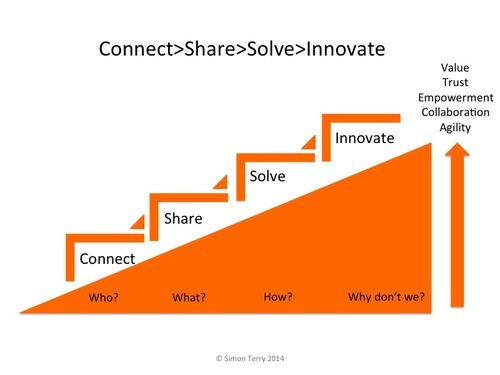
The Value Maturity Model highlights the way that collaboration’s market makers need to work to facilitate the value creation in your network:

  • Connecting relevant people to the network and into groups
  • Sharing information that may not have reached its necessary audience
  • Helping to solve issues by matching needs and capabilities, finding other resources or information and even holding a problem or information until there is a match of demand or supply.
  • Providing the systems and support to enable innovation experiments to be fostered until they are proven or fail.
  • Experiment and lead adoption of new ways of working
  • Helping lead the change in the culture of the organisation to allow the development of further cultural change.

To maximise the value of the networks in your organisation, you will need to develop the leadership capabilities that can take advantage of networks.

If you would like to create greater value in your enterprise social network or discuss how the Value Maturity Model applies to assist your organisation to create strategic value, please get in contact. I am available through @simongterry or Linkedin or www.simonterry.com

A Little Bit of Rebel

image

Most rebels start small.

At the end of Richard Martin’s wonderful discussion of the power of rebel within organisations there is a reference to starting small. It reminded me that ‘from little things, big things grow’  

Many change agents start out in a small and quite compliant way. They only want to make a little change for the better. They see something that needs fixing and try to fix it. These rebels start out making change for the system. They want to make the system work just a little better.

Systems don’t like little changes. Systems push back. Small fixes are crushed.

At this point, many people seeking change stop discouraged. The rebels go on. Rebels move from a small change to making bigger changes to the system. They start to see that their small problem is a symptom and that changing the system is part of the solution. Now they want to make changes to the system.

Systems don’t like changing. Systems push back. Big changes are opposed.

Many first-time rebels stop at this point. They don’t like the ostracism, the opposition and the risk. Only the dedicated rebels go on. Now the rebels want to fundamentally change the way that the systems in the organisation handles change. They want their organisations to have a better culture, to be more responsive, to be more human and to pursue bigger and more important purposes than purely financial return. These rebels are working for a change of system.

Systems don’t like change. Systems push back. Transformative change is fought. 

The few remaining rebels just keep aiming bigger. Now they step outside the system and connect with others from other systems trying to make similar change. They start to work across organisations, industries and society to learn how to be more effective and more influential in creating responsive and human organisations.

These rebels are changing the world.

image

How do you help your rare and precious rebels grow faster?

  • Do you have a culture of continuous improvement based on external performance measures that helps your people start the journey of change?
  • Do you have the room for experimentation to try new approaches?
  • Do you have a culture that fosters challenge to the big systems and processes and that supports and rewards the rebels?
  • Do you take time to discuss the culture and systems that lie behind the symptomatic problems that you face repeatedly?
  • How do you connect and engage your rebels, internally and externally, to help them stay the distance in the face of opposition?

The Cold Dark Path

image

Two Competing Loops

This week at the first meeting of the League of Social Intrapreneurs in Melbourne I was introduced to the Berkana Institute two loops theory of change. The model of change in complex systems resonated immediately.

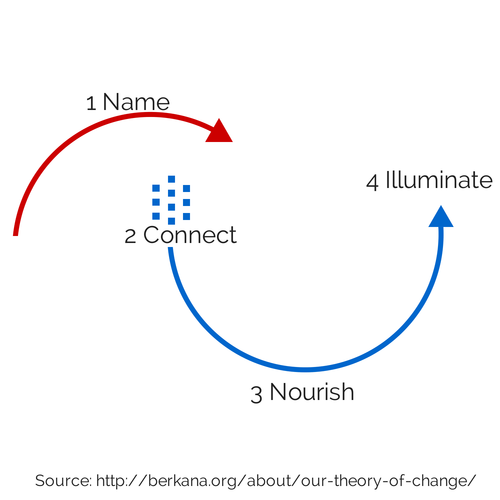
When a system nears its peak, change agents identify the need for alternatives and drop out.  They connect and begin to explore alternatives nourishing a new system through experimentation. Eventually the stories of their success illuminates the change to those who remain in the old declining system.

A four step model with four simple verbs seems clear and straightforward. Why is it that the path of change is such a cold dark path?

Nobody Warns You about the Dip

Stepping out of a warm and comfortable ongoing system with its present day rewards is a daunting uncertain choice however bleak the future of that system may look. Those with most to gain will oppose the agents of change who name the issues and start to work on alternatives. Opposition will not always be fair or balanced.

//platform.twitter.com/widgets.js

Most difficult of all is that dip in the diagram above. The uncertainty and the need to build a new complex future means the alternative system starts along way back and with a great deal more risk. Selling another path even to yourself can be a challenge in this scenario.

All the discussions about collaboration, requests for advice and stories shared among change agents at the League of Social Entrepreneurs, in Responsive Organisation, in Change Agents Worldwide or in other conversations that I have with unreasonable people belong at the bottom of the loop where people struggle nourishing new alternatives.

We must embrace the fact that the road to change is a road with dips and uncertainties. Proceeding any other way does not prepare people for the work ahead.

Nourishing Change Takes Hard Work

Most change fails after the connect stage.  Declaring a need for change is initially easy and exhilarating. Manifestos are thrilling. Connecting with other like minded people has a wonderful effect for the spirits and is a great way to reinforce the need for change.

Then nothing happens for a really long time. It grows cold and dark on the path of change.

Lots of drudgery dogs those walking the cold dark path of change. Meetings need to be organised and venues found. Compromises need to be negotiated between people who are 99% aligned. Factions and fragmentation occurs and saps the energy of everyone. More change agents need to be recruited, especially for the work. Experiments need to be agreed, funded and run. Failed experiments need to be cleaned up. New experiments agreed, funded and implemented. Success needs to be found. Someone needs to find money or work out the details of the new model. Communication materials don’t write themselves. Just when success seems inevitable the dying system finds a way to set you back.

Change falls apart when the connected agents of change won’t work the experiments long or hard enough to nourish the success of the new system. If they won’t invest the time to build new connections, share successes, to solve the daily issues and to innovate a path forward then the nourish stage will never offer an opportunity to others to join in the change.

If the organisers of the first meet up about a change end up with all the actions, then a change initiative has work to do to find others to nourish the change. Engaging others in the work matters more than engaging them in the idea of the change.

Join in the Work

Lots of people want to join change at the exhilarating beginning and again at the celebratory end. Traditional management focus only on the beginnings and the endings but leadership is found in realising the collective potential of the journey.

The question is who is willing to walk the cold dark road. Those change agents who do the leadership work of nourishing new experiments shape the future. That path is hard but the work is the most purposeful and rewarding

The Art of the Unreasonable

image

Every day I deal with unreasonable people. I wish there were more of them.

Unreasonable clients

The unreasonable people I meet are those executives, entrepreneurs and other change makers who are trying to change their organisations, to create new products or who are trying to make the world more human. These individuals don’t want to hear that it is hard, or that success is unlikely or that they are unlikely to see rewards.

These individuals are purposeful and all they want is help to bring their unreasonable visions into being. Willingness to persist is what ensures that they will succeed. They want to know they are not alone and that there are people to help them deliver their visions of the future.

Unreasonable partners

In addition to conversations with my clients and prospects, I am exposed to the unreasonableness of Change Agents Worldwide.  It is entirely unreasonable to believe that you could form an effective consulting and thought leadership network full of smart, highly capable and rightfully busy people without any traditional forms of central coordination.  However, Change Agents Worldwide delivers, constantly challenges itself to do better and the community is prepared to engage because the purpose of a better future of work is unreasonable, but necessary.

My respect for that group and others like it is huge because the network views spreading unreasonableness as part of the mission.  You only have to look at the extraordinary Executive Change Agents who are trying to make change in some of the largest corporations in the world, often solely on their personal authority.

If your organisation does not have people like these, why not? What are you doing to champion them, enable them or hire more?

Unreasonable inspiration

Unreasonableness inspires me. Do Lectures Australia was full of people willing to believe that they could deliver the extraordinary if they just started small and they started now. Social enterprises are another haven of the unreasonable as people seek to use the levers of business to address the challenges of the world. Social movements, like Change Day, inspire me, because they ask people to seek to make a difference and are led by unreasonable people, like Helen Bevan and Mary Freer. Artist are another inspiring source of an unreasonable view of the world.

What is inspiring you to be more unreasonable? What in your organisation shows others that more is possible, new thoughts are allowed and that more can be done?

Unreasonable change

We can’t change settled management practices without unreasonableness.  We can’t create more customer centred organisations within the bounds of what we define internally as acceptable or our accountabilities. We can’t make our organisations better for customers and society on the sensible practices of the past. If we want to be more responsive, we need to be a little unreasonableness.

If we want to lead, we need to be a little unreasonable in our expectations and actions.

There are more than enough forces in our world to encourage the normal, the static, the secure and the stable. Most people find it hard enough to win the support of their boss. Let’s foster the unreasonable.

Go find someone who wants to be unreasonable. Help them. Spread the contagion. That unreasonable purpose is the best engine of change.

//platform.twitter.com/widgets.js

Note: GBS = George Bernard Shaw. 

//platform.twitter.com/widgets.js

Every Conversation Counts

Leadership is how we realise human potential. Leadership is conversation. Every conversation counts. Don’t miss your chance.

Maya Angelou: …I mean, I mentor you. Everything I have learned, everything I’ve done, is at the ready when I talk to you. And in a way, you will never forget me.

Interviewer: Believe me, I won’t.

Maya Angelou: What I mean is you may forget how and where you got it, but in a few weeks, a few months, years from now, you will say something and think, Oh, I’m glad that came to me.

from a Maya Angelou interview in the Harvard Business Review

Leadership occurs or fails to occur in every interaction we have with others. Either we contribute to enabling that person to find purpose, to take action or to build capability or we miss an opportunity. Opportunities missed do not recur. The interaction that happens leaves a mark for good or leaves the other person with a query over the relationship

Realising human potential takes many conversations. You can’t impose purpose, commitment to action or learning on another. Talking at someone is the surest way to lose any opportunity to for any of these three critical elements of human potential. The fastest, simplest and most effective ways to undermine your leadership are failing to engage fully, having a surface level discussion or failing to authentically share all of your ability to assist.

In networks, where communication may be bound by looser ties of relationship and mediated by technology, mindful, purposeful and authentic conversation is an even more important practice. Leading in networks demands influential and insightful conversations to draw out and realise human potential. Human potential and the value it can create will only be realised where your conversations lead another person to learning, trust and commitment to act differently. You need to bring your whole self to have a chance of achieving that kind of change.

Follow Maya Angelou, bring everything to your next conversation and every conversation thereafter. Help another find a path to their potential. The impact of each conversation is the mark of your leadership.

How are you going to bring everything to your next conversation?