Change does not roll in on the wheels of inevitability, but comes through continuous struggle. And so we must straighten our backs and work for our freedom. A man can’t ride you unless your back is bent – Martin Luther King Jr.
Category: Uncategorized
Beware of sprezzatura
An perception trails the highly productive. Others can doubt their achievements on the basis that success comes too easily or that other forces are at play.
High personal productivity is usually an outcome of shaping your work to deliver where you are most effective. When you apply your strengths, work with capable people and are powered by your life’s purpose, you are in the sweet spot of performance. Results often come at a pace, further connections are built easily and challenges are quickly addressed.
The support of others, your personal productivity and the swift outcomes can make the difficult look easy. Some modest souls even deliberately encourage the notion that their personal productivity is not as challenging as it looks. In either case, the actual amount of effort can be lost. Thanks to Renaissance Italian courtiers, we have a term for the art of making the artful look artless, sprezzatura.
As occurred in Italian courts, a consequence of sprezzatura is that people begin to doubt the nature of your actions. Three doubts are particularly dangerous for those who appear to deliver with ease:
- doubt as to your authenticity – if people start to see you performance as unnatural or effortless they will begin to doubt your authenticity. Often this will be combined with doubts as to your intent and or the basis for your success. Over time these doubts can be highly damaging.
- doubt as to the achievement – people can under value achievements, reassessing your contribution on the basis that it can’t be as hard as it first looked. At its most extreme, people may not notice at al because you deliver without the usual dramas.
- doubt as to effort being concealed – if people do concede the difficulty, they can form a view that you are hiding the effort involved. For example assuming that like the duck gliding serenely there must have been a lot of paddling out of sight. When the activity is perceived to be discretionary, this assumed effort might also be regarded to be at the detriment of your core responsibilities.
Four simple steps help everyone gain more accurate recognition for their efforts and continue to build the trust and collaboration that is a platform for future success:
- Describe your sweet spot: Knowing where you best deliver and being able to describe the conditions that make you highly productive to others helps them assess you and your contributions. Authentic sharing of purpose and strengths builds support and connection. It also helps you get more of the work that you do best.
- Collaborate– engage other key stakeholder in the process and the work so that they can contribute and inform themselves on your intent and approaches. Collaboration helps make you a magnet for the work that you do best.
- Work out loud – narrate your efforts as they occur so that a broader community can learn and contribute. Sharing the journey with others allows them to better understand and engage with your work.
- Promote the value of your achievements – don’t just promote your work. Promote its value. External benchmarks, external recognition, the contribution to execution of strategy are all important in addressing doubts.
Sprezzatura can be disarming. Make sure it is not a challenge to your future productivity.
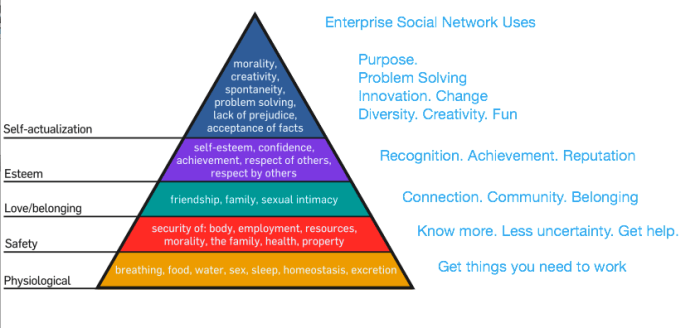
John Stepper recently posted a fantastic description of the evolution of social networks in organisations by documenting the seven questions that are asked across the journey.
Recently I was discussing that the experience of working with the evolution of an enterprise social network. I remarked that it is a little like an iceberg. One idea or use is visible to you and draws you initially. However, as with the seven questions, over time the uses grow and develop as the sense of community builds. Over time we discover more under the water as we develop our conception of what an enterprise social network can be and the role we can play in it.
There is something in common between John Stepper’s great questions and my iceberg metaphor. There are parallels as shown above between the uses of a social network and Maslow’s Hierarchy of Needs.
Social networks are about human connections and are sustained by human needs being met. People begin use with one need, often quite simple. The first challenge in building the community is to find a common use for people to work together to solve. Over time people explore more needs across the hierarchy creating new use cases in the community as they do. In this way, it is no surprise there is a parallel to Maslow’s attempt to document a structure of human needs.
Be prepared for social change
Our mental models of how things work are often a barrier to our adaptation to new capabilities. Digital disruption will stretch our thinking in many new ways.
When railroads were first invented they were designed to be a powered form of wagon for bulk goods. Only later did people develop the potential for railway travel, changes in communications and accelerate the distribution of fresh foods and other consumer goods. The introduction of railway travel created significant social change, demands for new resources and infrastructure, and ultimately innovation in business & society. After a start as a powered wagon, innovators changed the mental model of a railway developing its potential and its impact on society as a whole.
We are in the midst of digital mobile and social revolution that is so new and widereaching we can face the same challenges in adapting our mental models. Yesterday I attended the New Economy Conference in Melbourne. The audience and speakers who had chosen to attend the event were very aware of the digital & social transformations beginning to be realised.
A key theme of the day was the impact of digital, mobile and social processes in creating dramatic improvements in connection and speed of information sharing. This has major ramifications for markets and for corporations as they see their offerings atomised to services, boundaries becoming porous and competition expanding in speed and global reach. Even consumers are getting into the act of being producers through collaborative consumption. These ideas resonated strongly because they connect directly with the short-term transactional focus of our industrial age mental models of production, markets and competition. They involve the exploration of relatively simple changes to current models (who, where, what, volume or speed).
Harder for everyone to grasp are the changes to social systems which come with these new technologies and the need for new physical, legal and social infrastructure. To run their cross-continental networks, railroads needed and inspired new social infrastructure. An example was that railroads required society to adopt a precise concepts of time to manage their schedules. Railroads determined the implementation of the continental United States four time zones and largely became the arbiter of time in the communities that they connected.
There is already evidence that these broader social changes are being created. Work is shifting rapidly towards creative knowledge work in many parts of the world with new demands for leadership and organisation. The acceleration of social activism was discussed on the day and the consequences of eBay, the many task allocation and collaborative consumption organisations in changing natures of trust & work. We also discussed the social infrastructure required to measure value creation and waste in a broader more human way than just dollars (and the odd bit of avoided carbon). We need to innovate as hard in this social infrastructure as in that to support the transactions.
As much as we create new ways of transacting, we also need to create new forms of community to supply the social infrastructure to support the transactions. We need to support the short term interaction with a social fabric that can supply a longer human relationship. Just as the railroads need a precise sense of time, our new economy demands new precision in ideas like collaboration, work, trust, community and value.
When we think of the future of digital disruption, we need to allow both for how it will change the mental models we use every day but also how it may demand of us entirely new models, such as new concepts of organisations, jobs, reputation, social relationships and new measures of success. Success in the new digital era will take both adaptation to a new transactional environment but also adaptation of a new infrastructure of community, trust and long term relationships. New models of leadership and new social innovations will be required to achieve both.
Don’t
One word of advice you hear far too often trying to drive change is “don’t…” Both friends and foes are full of advice on what not to do.
Everyone wants to set boundaries on the actions of change agents. Your opponents will want to set a boundary that is short of your goal or fundamentally frustrates your path forward. Your allies will set boundaries to shape your actions to their needs, to constrain the threat of change and make change seem safer.
A prohibition like “don’t” sounds like a solid boundary. It may not be. When you hear “don’t”, ask yourself these questions:
- Ask why? Are you being told “You cannot”, “You should not” or “Your action is inconvenient”? Getting to the point of the speaker will enable you to shape your next step.
- If “Don’t” means “You cannot”, what would happen if you try anyway? Many barriers have been overcome by an open mind, persistence and experimentation.
- If “Don’t” means “You should not”, seek to understand who is affected and what values are at stake. Too often the speaker is unclear. If so, clarify the issues with those affected. It may well be that others don’t share the speaker’s view or would be willing to compromise to see other values & outcomes achieved
- If “Don’t” means “Your action is inconvenient”, acknowledge the inconvenience, mitigate where you can, but push on. Change inevitably includes some risk and inconvenience.
- Most important of all, turn from the negative to the positive. Ask for advice on what you can and should do instead or in addition. Be open to new options, new ideas and include them in you consideration of new steps.
Helpful and unhelpful advice is everywhere for those driving change. Any advice including “don’t” needs careful scrutiny. It may not be either the advice or the obstacle that it purports to be.
Purpose & Practice grow together
Purpose beats entropy. Adaptive leadership practice renews.
Most learning experiences fade. Some fade very quickly. In general only a small proportion of any experience is retained. Even less makes it into sustained practice.
Almost seven years ago, I had my first experience of a learning program that introduced me to adaptive leadership. That amazing experience, the Accelerate Program at NAB, involved work inside and outside the organisation on complex issues. These issues required the practice of the skills of a different type of leadership than traditional transactional and expertise based command and control leadership. That leadership experience has been one that has grown every day since.
What makes the power of adaptive leadership lessons grow in practice?
Purpose & practice.
Entropy is the normal process of decay in systems. Negentropy, or syntropy, is its opposite where things grow in strength over time. My experience is that purpose is a great way to beat entropy. The Wikipedia for negentropy notes that even scientists see power in purpose:
My first experience of adaptive leadership in the Accelerate Program forced a great deal of personal reflection on purpose. That clarity drove new action in a range of different domains. Purpose is an incredible force for energy and drives the desire to see these new skills in practice. Naturally I began tentatively and with a great deal of discomfort.
In all the years since, I have learned that continued Adaptive leadership practice refines the clarity of personal purpose. I have become more aware of my effect on others and on the importance of collaborative solutions that engage many people in the system. Those interactions reinforce the growing energy. The purpose sustains you through the challenges of practice. A continuous iteration of purpose and practice, grows the effectiveness of your leadership.
The purpose is in the work. Adaptive leadership work especially.
Sales and service are a continuum
Every interaction is a moment of sales and service to a customer. Sales and service exist on a ever shifting continuum, not as discrete functional experiences. Organisations treat these two functions differently because often the capabilities and the measures of performance differ. However for a customer, sales and service are just ‘getting what I need’.
Recently I was trying to make a change to an account with a provider. This should have been a simple service request to better align the product to my needs. However the provider clearly took the view that my request made me a retention risk. Instead of offering to help me meet my needs, they started to frustrate my efforts to make the change delaying matters with additional requests. Unfortunately the team wasn’t trained to ask the simplest sales question -‘why was I making the change?’. Had they asked, the change was a precursor to an additional purchase, not departure.
There is no surer way to lose a customer and miss additional business than to make it hard for the customer to get their needs met in any channel. Every interaction is an opportunity to find out what the customer needs and to make it happen now. The best way to keep a customer is to work to meet their needs to the best of your capabilities every chance you get.
Service processes that don’t facilitate a sales opportunity for customers miss huge opportunities. Sales channels that can’t fix other issues leave customers doubting your interest in their business. Creating a continuum can be as simple as helping service teams to ask a few key questions and supporting sales people with service issues. Theere are big opportunities in leveraging a moment that a customer is asking for your help.
Customers don’t wait. Customers don’t come back. Customers aren’t interested in your process complexity or functional model. Making sure you treat every customer moment the way they want. Meet customer needs as best you can offering a continuum of sales and service.
Employee Engagement: Adam Pisoni
NAB uses enterprise social networking for a continuous improvement culture. In Capgemini Digital Transformation Review #4.
Who wouldn’t want to improve their work and impact on others?