Don’t Hit the Trees. Hit the Hole

How often in life to you achieve an outcome by trying to avoid it?

I am a poor golfer. Quite often during a round, I will be well off the fairway and there will be a tree in the immediate vicinity of my ball.  I have learned one truth about these experiences:

If I line up to play a shot thinking about ‘not hitting the tree’, I will drive my shot straight into it

Stop Trying to Avoid Something

Fear of failure is pervasive in many organisations. Because of our industrial management model and natural human psychological biases we often manage to avoid the downside. Just like on the golf course, the direct result is that we achieve that downside:

  • If you fear losing revenue and won’t play in innovation that might change the composition of revenue, you will be disrupted by someone who is prepared to work on a different model and takes your revenue away.
  • If you worry of the dangers of giving employees too much information, you should consider that poorly informed employees likely end drive your organisation to the same dangers
  • If you don’t trust decision making in your organisation and impose lots of controls on accountability, the exercise of decision making and the accountability in the organisation will be degraded
  • If you micromanage your employees because they might slack off, they will definitely slack off when every you blink or are distracted.

We could go on with the formula of “if [avoidance of X], then [unintended outcome of X]”

Worry Less

Success is not the avoidance of failure. Mediocrity is the avoidance of failure. Mediocrity is the place where you get stuck, unable to learn and grow. Mediocrity is the place where you wait to be impacted by forces beyond your control.

Worry less. Worry and stress is just a present expectation of negative outcomes in future.  All you are doing is ruining the present moment by bringing forward a chance. You are also ruining your confidence and ability to execute.

Focus on the positive elements. Define what success looks like. Be realistic, but inspire yourself with what can be.

Do Something

Avoidance of failure also leads to avoidance of action.  There is a temptation to play safe, to wait and to be sure.

Just Do. The only way to learn is to do. The only way to move forward is to do. Take your definition of success and make the next best move forward to it. Now.

Risk=Reward. You have to start swinging for something. The best time is now.

Learn these skills

Follow an unusual career paths and you will pick up a diverse set of skills. Later in life it will be that unusual skillset that enables you to make a mark when others get stuck in the pack.

In a rapidly changing world, diversity of personal skills is as important as the diversity of the teams that you join. Nobody is tied to a job. Everyone can learn something new. Make it your challenge to learn another skill every year at a minimum. Pursue opportunities that broaden your skills, knowledge and experience. We are all increasingly working in portfolio careers. The challenge is to be prepared.

Here are some skills & capabilities that I’ve found critical:

  • Persist: life throws challenges. The obstacles are the work and the reward. Learn how to push on to your goals and sustain the journey. Knowing why and understanding your own needs is critical here.
  • Listen: a completely underrated skill. Learn to listen between the lines. Learn to listen to what is not said. Listen actively questioning for understanding and learning. Don’t compose your reply. Listen deeply for insight.
  • Learn a new language: Jargon is everywhere. Learn the new language quickly. The faster you speak the lingo the better you build rapport. Plus understanding the grammar of the new business language tells you what matters in a business.
  • Tell a story: a story is not a list of events. A story engages with challenges, conflict and drama. You need to be able to share your passion for the story. The ability to tell a genuinely engaging story with passion is an art. Practice it every day.
  • Influence: before you can lead, you must influence others. Study and practice the art. Understand how to find the alignment of others’ agendas and your own. Learn how to hustle and to sell. Remember listening is more important than talking in influence.
  • Construct an argument: understanding how to communicate an argument quickly and effectively to an audience is key. Whether you are writing an email, preparing a PowerPoint or having a debate in a meeting know how to argue to influence. That’s different to arguing to win.
  • Negotiate: everything is negotiable. Learn how to negotiate effectively.
  • Learn to say no: Often and early. Priorities and values are a key to success. You will need a polite no to preserve them.
  • Use visual images: visuals work. The better your visual grammar the better you will understand how to engage others.
  • Run a project: the basics of project management help get stuff done. Most failed projects break simple rules. Learn how to manage simple project to delivery.
  • Risk everything (aka swim in the deep end): you are not learning if you are doing something you can already do. Risk=Reward.
  • Patience: no matter how young and brilliant you are you will have to wait at some point. Timing is everything in life and a career. Some times things just need to line up first. Make sure you have patience for when it is needed.

What are the Ethics of Work?

A great discussion on the ethics of working out loud broke out yesterday across my social streams prompted by a thoughtful blog post by Kandy Woodfield. The post and the many discussions it prompted have been insightful and a few key points have arisen for clarification in my strong advocacy of the benefits of working out loud:

  • While I have not been explicit on this, like other forms of social collaboration, working out loud is in my view a voluntary practice. It is not meaningful to describe an activity that involves forcing someone to work out loud as a learning experience or as social collaboration.  
  • Kandy’s call for support for learners through the vulnerability of the learning experience is critical. The objective is to better realise people’s potential and that takes a supportive culture, the right systems and the focus of leadership.

This last point for me was the clue to a broader issue that began to be discussed with many colleagues: 

What are the ethics of work?

If we are right to subject working out loud to an ethical investigation, then perhaps we should extend the same challenge to work. Many of the risks and vulnerabilities that occur in learning experiences are magnified in daily work, but occur with little consideration of the impact on the individual. Worse still work experiences are often designed by managers to exaggerate these vulnerabilities in the name of motivation or performance.

Culture creates an Environment of Support or of Risk

As young children we learn and we make mistakes freely and publicly. It is our approach to the world. As children, we mostly laugh as we learn. At times this process may be frustrating for child and parent.  Either might experience the odd temper tantrum but this learning process is expected of children. As a result, they are supported and encouraged in learning by a family and social environment. Their pace of learning is phenomenal becuse they are free to make sense, to experiment, to observe, to ask questions, to get into new environments and to try.

By the time we reach the workplace, things are not always as supportive. Mistakes are frowned on. Questions can be discouraged. Experimentation is dangerous. People have a status, a job and a place. Failure to learn adequately fast and accurately is treated a performance issue. Public sharing of shortcomings is common with leader boards, rankings, status and accreditation levels, gamification, etc. None of this has anything to do with working out loud or even learning. These practices are widely adopted as best practices from our traditional industrial management model. It is how we work.

Many of the dangers that Kandy raises for working out loud arise not because of the work is out loud, but because it is work. Traditional workplaces using industrial management thinking are often unsupportive of learning and the learner. 

To extend the argument of the blogpost, the way we work presents ethical issues. The danger comes not because of the visibility of working out loud. Mistakes will always happen. People will always be vulnerable if they are doing. The danger comes from the lack of a supportive work environment that encourages learning.

When the majority of learning is unstructured and on the job, this is a much more dangerous situation.  Everyday on the job individuals are trying to improve their performance by learning to work better.  The organisation must be hoping to see the growing benefits of an employee’s work. If we don’t support learning, all of this is at risk.  

Professional learning managers are ensuring that the 10% and the 20% of learning is managed ethically. Who is responsible for the 70% on-the-job learning? 

Leadership is the Technology of Human Potential

We need to ensure our approaches to learning and the development of the potential of people are effective and ethical wherever they occur.  Leaders at all levels in organisations need to work to create an environment that supports learning and supports learners.

We don’t need more of empty platitudes of declaring a learning organisation. The leadership hard work is considering how all the systems in the organisation support or encourage learners, learning, the sharing of knowledge and the development of personal & community potential. That is a great and highly rewarding ethical challenge for leaders in organisations everywhere.

We can start simply:

  • we can support people to learn and discuss the value of learning
  • we can coach people through the challenges of learning
  • we can encourage people to experiment with new and better ways of working
  • we create a voluntary community that shares the vulnerability of the learning experience and supports the learner with peers
  • we can support all of this with fun

A key to the rapidly changing environment of our networked economy is that organisations need to get better at learning and leveraging the potential of our people.  If we take Kandy’s query to heart in respect of on-the-job learning & the very nature of our work, organisations will be better at managing this challenge.

Our organisations will be more responsive.

To Shape Change, Start Leading Change

image

“If we want things to stay as they are, things will have to change.” (spoken by Tancredi) from ‘The Leopard’ by Giuseppe Tomasi di Lampedusa

Times of disruptive change are difficult for those in power and those who benefit most from the current way of things. Many of these people prefer to ignore the rising changes in society. In effect, they abandon their leadership role in shaping change in the system.

Enduring disruptive change demands an engaged form of leadership. The future in disruption is not written. Leaders should seek to engage, lead and shape change to the benefit of their organisations. 

The Networked Economy is Here to Stay.

Many leaders of organisations have a lot of power, status and wealth tied up in the way things are now.  They are the masters of the current system, adept in its ways and confident in managing the current model of work and the organisation.  They have both personal and professional reasons for hoping that nothing changes.

Change doesn’t work that way. We are now part of a global ecosystem of actors connected in digital networks.  Access, visibility and transparency have increased driven by the new connectivity.  Change that enters this new system is magnified, spread and developed by the action of agents all around the world.

Lead or Let others Decide The Future

The connected digital networks of global actors means the future of work won’t be ignored, stopped or reversed. Others will go on to develop better ways of working whether you and your organisation participate or not. The less you participate, the more you appear a candidate for disruption by one of these actors.

Organisations face a leadership challenge in this environment.  Effective leadership, continuous learning and a vibrant culture is required to take effect of the advantages of the new approaches.  Senior managers need to play a critical role helping organisations adjust and maximise the benefits from these changes.

However, managers face changes in the future of work that change their power, status and potentially their financial position.  Networks can operate with less layers of management and roles that were once managements prerogative are being delegated to frontline employees or automated in systems. New two-way conversations with engaged and enabled employees, customers and other staked holders can require leaders to deal with new complexity. In this case, it can be tempting for a senior leader to sit on the sidelines hoping the changes are a fad or that they might pass over the organisation.

You Can’t Lead a Community if You are Not Engaged

A simple case study of this mindset comes when you consider the level of management attention to stakeholder activism in social and digital media. Because this activism is now more visible and empowered by digital and social networks, management can see resentment that once was hidden. Bear in mind the resentment is not new.  It just has a bigger audience and influence than before.

Many of these social activist activities have large impacts on organisations because the activist have a community and the organisation has only a network.  

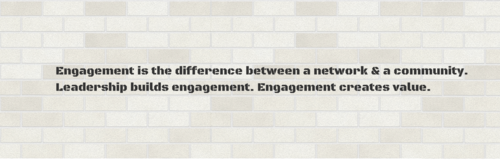
The critical difference between a network and a community is how engaged the participants are. That engagement arises as a result of acts of leadership to create common purpose, to shape an agenda of action and to influence others to act. Leaders who ignore the burgeoning networks around the organisation allow others to shape the communities, their purposes and their influence.

Senior leaders of organisations need to engage with the networks around their organisation.  The opportunity to create productive communities far exceeds the risks. Listening and acting on feedback of networks of stakeholders is one of the better mitigants of risk. Failure to engage and to understand the needs of the networks creates an opportunity for others to lead. 

The Continuous Partial Attention of Management

image

The story is too common in the modern organisation: a team has a member who is not contributing but they go on being a part of the team for months or even years. Waste, frustration and disengagement mount in the team. Despite the negative impacts and length of time the manager responsible does nothing to rectify the underperformance.

We have more performance data than ever. We have more sources of information than ever. We interact in more ways than ever. We live in an age of increased performance transparency.

How Can Sustained Underperformance Be Common?

All that data, information, interaction and transparency brings more for managers to do. Complexity is the fundamental challenge of the modern manager and without careful husbanding of their attention the time of the manager can be subsumed into busy work.

Continuous partial attention has crept into management practice. Challenged to keep up managers are constantly skimming across the top of the work. Interactions with employees are staccato bursts. Busy managers spend less time understanding what is actually going on. Flitting in and out of observation of their employees, managers can be lulled into a false sense of confidence if the numbers look good. 

For an under-performing employee that means the ability to escape action continues as long as the deadline has not yet arrived, the numbers look acceptable and underperfomer has an answer for the first quick query from a manager. The commonest trick is for the under performing employee to send their busy manager an email asking for a complex decision. Likely overlooked or deferred, it becomes an instant performance excuse. Instead of asking for help the employee uses the pressures on their manager as a chance to hide their performance issues. Time, pressure and waste mount up.

In rare cases, managers may see the problem situation but the pressure of other demands means that they do not prioritise action. They trust in the systems, the employee’s peers or the reporting to correct the underperformance or hope that the employee’s lack of action is temporary. These managers prioritise the work and the system over their people to the detriment of everyone.

Refocus the Attention of Management on the Process of Work

Psychological studies show that multitasking & continuous partial attention don’t work. People who practice these approaches feel that they are more effective but aren’t. We need managers to get off the treadmill and reconsider their approaches to performance:

  • Shared Purpose & Goals: In many of these situations the underperformance is simply because the busy manager has not set, clear goals for the employee and the employee has no rationale for their work. Engage employees upfront on the purpose and goals of their work.
  • Enable and Empower: If managers don’t have the bandwidth to guide and manage, organisations must ensure that employees have the ability to manage themselves and their work. That takes an investment in skills and the freedom to make decisions without waiting for a busy manager to respond.
  • Targeted Fast Agile Delivery: Ask an employee to work on a lots of  things for months and they will be as bamboozled by the status & priorities of the project as their manager. Instead ask an employee to deliver a few focused things in a short cycle of delivery. The need for reporting, status updates & chatter goes down as observable delivery increases.
  • Real conversations: Any genuine one-on-one conversations with an employee & their peers of more than 10 minutes will begin to surface the real issues in a team. Asking good questions and listening to hear between the lines of the answers is critical in management. Managers must prioritise this to enable their teams to succeed.
  • Act now: The busy nature of work is not an excuse to defer needed actions or to defer complex decisions. If something triggers a suspicion, then dive in.

Great managers shape the process and performance of the team. Great managers enable every member of their team to realise their potential and contribute to creating a more responsive organisation. They are not slaves to the reporting, information and decisions that flow through them. Managers must step out of continuous partial attention to the ongoing work process and get involved in the design of the work.

The work of leadership is to realise the potential of people. Leaving someone stuck in a rut of continued underperformance is failing that individual’s potential.