Realising the Potential of People

One experience in my career is consistently the most rewarding. That experience is helping someone to discover their potential.

Many people realise that they have the potential to challenge themselves, to learn and to develop new skills through their schooling years. Some people never meet a teacher who inspires them and do not receive support from parents, friends or other community members to extend themselves. The first time some people encounter a purposeful supportive and challenging learning environment is in the workplace.

I have met so many people who can describe the effect of the first manager who believed in their potential. Someone took an interest in their work and their capabilities and encouraged them to do more. Often this moment of transition came around their first promotion when they were picked over others because of untapped potential. With the encouragement of a supportive environment and the push to do more, these individuals can go on to discover extraordinary talents. I know people who took up their university studies midcareer and went on to do PhDs or into the heights of new occupations as a result. I know people who never took formal study, but became the smartest and wisest CEOs in the business through practical experience, understanding of people and a keen intelligence sharpened by life experience. A few people get there on their own. Most require challenge, support and encouragement to start the journey of self-improvement.

We can all play a role in helping others to realise their potential. Sometimes all it takes is a simple act of recognition of potential to spark people. At other times, we can play a role to show people a possibility and begin coaching them into action. Even realising a small amount of potential can transform a person’s outlook, experience and life. This is work we can do as parents, managers, peers and community members.

What small step can you take today to help someone see their potential?

The Art of Conversation – The Animated Middle

We know our positions. There’s no value in a stand-off. The value of conversation is the generative conversation. 

We have conversations every day. We aren’t very good at them. Too many of our conversations are determined by positions fixed before they begin. If 2017 highlights anything it is the need for richer and more generative conversations. 

I recently saw the phrase ‘the animated middle’. It was used by Poet Ann Lauterbach 

“The crucial job of artists is to find a way to release materials into the animated middle ground between subjects, and so to initiate the difficult but joyful process of human connection.”

When I saw that phrase it resonated deeply with me. The Art of Conversation is finding the animated middle ground and enhancing human connection. Great conversations aren’t always easy. Many are difficult and challenging for all involved. They generate new perspectives, new options and a new relationship between parties as they come to a better understanding and find shared ground in people’s purposes, concerns and circumstances. 

If our conversations aren’t doing this work, then we are just chatting. We are pushing information and positions at each other. Chatting can influence another to change their view but it is their action, not an outcome of co-creation by the two parties to a conversation. The other party to a chat is just as likely to dig in to their position or get the wrong impression. 

Seeing the work in the animated middle ground of Conversation as art also brings to the fore that we are engaged in collaborative co-creation. Something new is generated by the discussion. Nobody escapes from a real conversation with their perspective intact. Like art, some times what arises in that middle ground is difficult and provocative but essential. The more change we want from the conversation the greater the co-creation required. 

Our work and our civil society depends on better conversations. We need to explore the art of Conversation in Ann Lauterbach’s animated middle ground. 

Working Out Loud for Engineers

Working out loud has become a very popular change initiative in engineering organisations around the world. The practice of working out loud plays key roles to nudge the traditional perfectionistic expertise-oriented engineering culture in productive directions towards the agile, customer-centred, collaborative future of work.

Engineering is a rigorous discipline of expertise. It has to be. Mistakes and errors in a design can have dramatic, devastating and long term consequences for the business & its customers. For this reason, engineering expertise is highly valued. That expertise can focus down into very narrow domains of the design of engineering solutions. Solutions are heavily worked, pushed to perfection and at times gold-plated for safety. The demands and focus of this work can mean that attention shifts to the area of engineering expertise itself and less to the environments, systems and other contexts around the work.

As a result, engineering organisations can at times struggle with customer focus. Engineers understand the design far better than the customers. They know the materials, systems and technologies involved better than anyone else.

Engineers can also find collaboration difficult. If there is one expert on a particular solution in the organisation, why would there be any discussion around a design to that solution. Focus primarily on demanding engineering considerations, that expert may be less concerned about the input from sales, marketing or manufacturing into the consequences of design choices.

Working out loud is the practice of sharing work purposefully with relevant communities while the work is still in progress. Sharing ideas, drafts and other progress helps other to be more aware of your work, provide input to that work and to learn from the work that is going on around the organisation. Nudging a culture to be more open, more outcome oriented and more collaborative through the practice of working out loud can deliver significant benefits for individuals and the organisation.

Encouraging engineering teams to work out loud can contribute to nudging the culture in a number of constructive ways:

  • Do we really understand the problem? The business challenge may need engineers to deliver a solution but that doesn’t mean the problem is an engineering problem. Asking teams of engineers to work out loud as the define the problem to be solved can help them to gather inputs to better understand the outcomes needed, the constraints and other systemic issues through the input of the wider organisation or other stakeholders.
  • What ideas might we take into the design process? Many creative solutions are cross-disciplinary or even involve a complete reframing of the problem. Opening up the ideation can allow non-technical experts or experts from other areas to put forward ideas that might inspire a new direction of work. Innovative and effective solutions can be the result of new inspirations.
  • What other considerations matter? Narrating the process of the design and sharing the considerations that went into it opens up a discussion on other considerations that may be missed or might be relevant. Suggestions on things that the engineers might consider can come from anywhere in the organisations.  Some times it is those who know least who ask the best “emperor’s new clothes” questions.
  • Whose support do we need to put this design into practice? To the immense frustration of many engineers, their designs need the support of other stakeholders to be put into practice. Engaging those stakeholders throughout the process of the work through a constructive process of sharing work as it develops will help with the awareness and buy-in of stakeholders in the organisation.
  • How do we learn from implementation for our next work? Henry Petrovski’s To Forgive Design is a book that studies the lessons from major engineering failures. One of the key insights is that failure often happens when a new technology is pushed beyond limits that have not yet become obvious. The technology overcomes a previous limitation but its own limitations are not known yet. These kind of failures can be prevented if the engineers can stay close to the issues arising from the implementation of their work. For example, signs of stress or other unusual outcomes on an existing bridge may be a signal that a new longer bridge with that same design may have an undetected failure point.
  • How do we develop our own mastery? Teams that are rightly proud of their expertise should be seeking to develop a culture of ongoing improvement and gradual development of mastery. This learning culture requires people to seek feedback and coaching from others, to study the work of others and to be challenged by others to learn and work in new ways.

If your organisation can benefit from a more agile, customer-centred and collaborative work, then consider leveraging the practice of working out loud to help nudge those changes.

Chats, Conversations, Collaboration and a note on Communication

Three things have become obvious to me in 2016 and on reflection they offer insights into how we can think about the ongoing culture change and challenges of enterprise collaboration:

People Love Chat: The rise of Slack, Hipchat and a raft other chat tools, the passion for chatbots and the advent of Microsoft Teams all signal the value of chat communication solutions. These tools (and their integrations) appeal to our need for instant gratification, the demands of an agile workplace, our wish for connection in a mobile world and the need for a little entertainment in the ongoing pressures of work. Whether this way of working appeals to you or not, it is a rich pattern of human behaviour and we recognise it from the way we use consumer tools like iMessage, WhatsApp, Facebook messenger, Line, etc. The growth challenges of Twitter can be traced to chat behaviours shifting to more controlled community oriented solutions like group messaging or to more engaging solutions like Snapchat and Instagram.

People Hate Meetings More: Of all the blogposts I wrote in 2016, the ones that discussed changing meetings exploded. People hate email but they are prepared to live with the pain because email feels like process work, they are accustomed to the burdens or email pushes responsibility to others. People hate meetings and they really want to change them. (Makes me wonder if Sartre had a point about ‘hell is other people’) Email can be a way out of interacting with others because we don’t interact with other people, just formal rituals around their words and artefacts. Meetings do require interaction with the messiness of real people. For many organisations, meetings are the dominant form of conversation and collaboration. For too many meetings, no choices are made to explicitly managed the pattern or optimise its benefits for attendees.

The Untapped Value of Collaboration is Huge: Surprisingly few organisations with collaboration solutions have a strategy to realise value from new ways of working. Fewer still have resources that strategy to ensure that they have managers working to realise the productivity benefit and the transformation of work outcomes. Often the collaboration solution is implemented for an abstract capitalised noun or seen as a platform for enterprise communications objectives. Organisations have a huge opportunity to work more effectively when they explicitly engage in shaping the nature of collaborative work underway.

Human Behaviour

Changing the nature of work is hard. We love to focus on the technology as if it will transform the human behaviour. However, from all the work I’ve done and read on adoption, one thing is clear to me. Technology enables new patterns of work. Human behaviour and decisions shape what patterns get used and how in organisations. At times, human behaviour gets lost under the features and functionality of the technology and we forget to focus on the enduring patterns. Many times the implementation of technology is not asking people to adopt a new human behaviour, it is just asking them to switch to another deeply human pattern.  Let’s look at the insights above in that context.

Chat (Share Information): We walk through the halls of our activity based office spaces to get a coffee and we chat with our colleagues. We ask our work colleagues for a quick chat to resolve an issue. We make a phone call (average call length is now well under two minutes).  These are short interactions. They are an exchange of information. A chat is fast, incidental and pointed.  A chat is far more likely to be lighthearted than a more considered form of interaction. The accumulation of chats contribute to a deepening of relationships even if the content of the conversations are not particularly significant or useful because they act as acknowledgement, share context and develop trust and social capital.

Conversation (Shared Understanding): Often in our work places we need a conversation to get deeper in our understanding of an issue. We need to reconcile divergent information and divergent views of the situation. We may need to make a decision either together or alone but in a way that engages others that are impacted. Conversations take time.  They can stretch from an intense 10 minutes to a gruelling 10 hours or weeks and weeks of cumulative interactions. Conversations need us to work through a process of aligning purposes, concerns, context and actions (as Conolly and Rianoshek explain in the Communications Catalyst).

Collaboration (Shared Work): Our work is increasingly dependant on the work of others. We don’t work as an island turning inputs into outputs. We need to manage complex scenarios, dynamic processes, the interplay of our work with the goals and processes of others and we need to interact with others to discover, design, deliver or deploy our solutions. We do this work in an environment of a rapid flow of information, high levels of uncertainty and continuous change. Many organisations see collaboration as a long meeting with lots of people, debate and sticky notes. The need for the pattern of collaboration in our organisations is far more extensive. We may need to collaborate with our team, a project team, a group of stakeholders, the whole organisation or even people well beyond the organisation to achieve our objectives.

Sidebar: On the Thing We Call Communication (Shared Narrative)

Communication is a term we use a lot in business. It is embedded in business vernacular because most organisations have teams responsible for communication. However, it is less common that communication is a two-way exchange of information in this usage. Communication is the broadcast of information to audiences in the organisation through email, intranet or social channels.  The pattern of human interaction that best matches to communication is story telling. A narrator holds the attention of others usually for a while to recount some important information to the group in the form of a narrative. Stories can be told in as little as 30 seconds (think a TV ad) but usually we take 30 minutes to an hour (TV show) or 2-3 hours for a saga with lots of conflict and many phases of action (think a movie) When communication teams start to engage in two-way exchange in an organisation, the pattern of interaction tends to be a chat, a conversation or a collaboration.

Lessons For Meetings:

What is the point of your meetings? Is your meeting a chat, a conversation, a collaboration or communication?

One of the key meeting pain points is that we call one hour meetings for a chat. That’s about 59 minutes of time wasted. We also call meetings to narrate stories (usually with slides). Narration by slide deck is another time waster, particularly if we forget to make sure that the story has enough value, conflict or action to engage people’s attention. The audience sits passively and lacks the emotional engagement in the narrative to feel their time is being rewarded.

Meetings work as a place for conversation and collaboration when run to achieve those explicit purposes. Aligning the attendees, purpose and facilitation of a meeting to this goal is critical. In a busy working life, people expecting one pattern of interaction will not sit happily through another.  There are also other options that might work better, particularly if you are unsure of your purpose, looking to work out loud and you aren’t exactly sure who would value and add value being in the room. In these cases, there is probably more value working out loud in an enterprise social network, even if only to shape the work to be done in a later meeting.

Lessons On Choice & Adoption of Technology Tool:

IT and business executives focused on efficiency of effort and investment long for the one tool to rule them all. These demands often push tools to stretch across multiple patterns of human interaction. The complexity of features that result as tools endeavour to cover chat, collaboration, conversation and communication patterns can add to the adoption challenges for users. The nature of real social human interactions in relationships means that even if we choose one tool for each pattern, people will still mix their behaviour into other tools. If you get frustrated that people chat in your social network or hold long conversations in your chat channels, get over it and then help the users how to work in more effective ways.

Human behaviour also reminds us that we know how to switch between chats, conversations and collaboration. In every day parlance we even signal these changes to each other with “this needs further discussion” or “we should meet to work on this”. We happily switch tools when we move from phonecall to meeting to application. Instead of worrying about too many tools, let’s focus on realising the value in each pattern of work with the new tools available and encouraging a better match of pattern and tool.

To add to this we now see vendors increasing the diversity of their tools to match to these different patterns. If you’ve ever seen the infographics of all the brands of cloud marketing automation solutions, I think that’s where vendors are headed for productivity and collaboration solutions. This is not an era for one perfect solution. The competitive landscape is a raft of different solutions, that meet a single point use case to every use case under the sun.  Leading vendors like Microsoft will try to crowd out most of that space with offers that appeal to the enterprise IT buyer and offer some form of stack integration. It’s the marketing strategy of Nestle, Unilever and P&G of the 60s/70s. Take the shelf space. Smaller vendors will make their solution appeal to a niche.

The patterns of human behaviour aren’t going away. The technology doesn’t change them. What is important to organisations and users is to understand what patterns of human interaction are needed now, what patterns are desired for future strategy and how to nudge behaviour from one to the other to make work more effective. If a team depends on a high volume of chat to manage agile digital product development, turning that off won’t increase engagement or productivity. If a team needs to interact widely across the organisation with stakeholders and work out loud with uncertain stakeholders, then forcing a chat tool is not likely to deliver the required benefits for adoption.  If your digital team is working in a chat tool effectively but regarding as alien by the rest of the organisation, how can you help both parts of the organisation to communicate and collaborate more effectively. Work in your organisation, now and in the future, has its tempos and patterns and the tools need to align to those patterns.Not the other way around.

Lessons for Team Structure:

Harold Jarche recently published a blog post exploring three contexts for work of self-governing teams, inspired by his Personal Knowledge Mastery work and the insights of Valdis Krebs and Patti Anklam.  The discussion in Harold’s post of a Productivity Network, an Alignment Network and a Connectivity Network has a very close relationship to the human behavioural patterns Collaboration, Conversations and Chats.

We need to recognise that network connectivity, the transparency possible in networks and the have permanently changed the options for how teams manage collaboration, conversations and chats and offer new contexts for leadership and self-leadership. As discussed in my 2017 work roadmap, key organisational challenges are developing the models of team structure, management and organisation to be able to leverage this work.

Simon Terry provides consulting, advice, speaking and thought leadership to global clients through his own consulting practice, and as a Charter Member of Change Agents Worldwide, a network of progressive and passionate professionals, specializing in Future of Work technologies and practices.  The focus of Simon’s practice is assisting organizations to transform innovation, collaboration, learning and leadership. 
Tall Poppy Podcast with Tathra Street

I recently did a podcast with Tathra Street on making leadership safe for humans.  Tathra has an series of interviews on the idea of Human Centred Leadership. In our 30 minute conversation, we discussed my leadership lessons, how work is changing, the demands of digital culture, working out loud and more.

The discussion was great but sadly the audio quality did not hold up to the content of the discussion.

From Gigs to Purpose: The Purpose Economy & Portfolio Roles

Mindsets shape our perception. – A large sign that needs to be placed in all workplaces

The changing nature of work is growing greater attention in the business press and in the strategy teams of large and small organisations.  New ways of working and new platforms of work are gaining traction and much handwringing is going on about the potential “post-job” future of work.

Many organisations see the changing nature of work as an opportunity to use transactional platforms to lower employment costs and deliver a greater flexibility of resources. They see platforms that offer a highly competitive pool of temporary and flexible labour as solely an efficiency play. Much of the investment and energy behind these platforms have been driven by the idea that they can take advantage of a struggling and transforming post-crisis global economy, digital technology and new work patterns of work to deliver real cost savings to organisations. That focus on the transactional efficiency benefits of Gig Economy reflects the prevailing mindset on the purpose of work and organisations. These organisations often can’t see that there is another way.

I was recently asked why I wanted to work in the Gig Economy. My answer was that I don’t. I work in the Purpose Economy. A traditional organisation might see an opportunity for efficiency and flexibility through a pool of transactional gig workers. I am looking for flexibility, purpose, relationships, collaboration and learning through a diverse portfolio of rewarding work.

I don’t join large scale platforms that atomise participants, commoditise work, create competitive dynamics and are designed for value capture to the platform (for more read Harold Jarche’s excellent description) . The transactional efficiency mindset of business is strong and deeply embedded. For many people, this has become the only way of business. It is all that they can see. However, there are other more purposeful, more valuable and more human ways of working. Breaking this mindset and setting out in a different pattern can be richly rewarding.

What impressed me as an adviser to Sidekicker was the team’s focus on relationships with both their workforce and their clients. They are looking for skills, talents and a better way of working with benefits to both workers and clients in areas of the market like event management staff where that is a rare mindset. The mindset of doing repeatable high quality business in a relationship for mutual gain is a valuable proposition in a world of atomised marketplaces.

I recently blogged about becoming an adviser to Peer Academy. This platform focuses on helping participants to collaborate, work and learn as peers. The learning and collaboration focus of this platform makes it a far more valuable and purposeful solution for organisations and participants.

I am a participant in Change Agents Worldwide because first and foremost it is a network about relationships, collaboration and learning. Change Agents Worldwide seeks to create value through scaling the efforts of individual Change Agents, but it recognises that it must first deliver value to the individual, cannot compete with them and must allow them to shape their participation and their work. A true network needs remarkably few rules to help individuals pursue their purpose, learn from others and to deepen relationships.

Ultimately, my work is driven by my purpose of making work more human. I write, speak, consult and coach towards this end. The portfolio nature of my work enables me a diversity of projects that contribute to this goal. My future success depends on what work I do, what relationships I build and what I learn. I have an entrepreneurial drive to improve my proposition to better fulfil my purpose. I get to build relationships that shape what I work on, what I learn and with whom I work.

A purposeful portfolio also helps diversify my risk and ensures a more consistent flow of rewards. I’ve been subject to far greater income risk and far more atomisation as an employee than I have ever experienced as an independent worker. Critically the nature and amount of those rewards remain in my control and are agreed through relationship conversations, not market place bidding, bell-curve performance processes or restructures. Not all the rewards are cash, I shape the value that I share in my work.

Before your organisation considers a new model of work for its efficiency gains, consider whether there is a wider benefit in exploring the potential of deeper relationships, richer purpose and more responsive work. Leveraging these opportunities will require you to consider many new areas of organisational work in 2017, but particularly:

  • What do you offer the purposeful worker? Is your organisational purpose clear enough to shape your work?
  • Is your employee & worker experience good enough to attract, to retain and to leverage the contributions of those working in the purpose economy? Are you treating temporary labour as an equal member of your teams or as second class citizens?
  • How does your organisation onboard, collaborate and learn at scale, especially with those who may not care for your processes or be seeking a career in your organisation?
  • Are your team structures and work processes agile enough to incorporate and benefit from the inputs of your new workforce?
  • Can your management capabilities, models, policies and systems handle the networked organisation and a purposeful workforce?


PS: An example of the limiting power of mindsets is that we now need to clarify the meaning of ‘gig economy’.  Language that came out of the creative professions to reflect their flexibility in pursuit of purpose becomes redefined in a corporate mindset to transactional efficiency.

When the Cavalry Arrives

This morning I was reading about a high profile group of business leaders who are supporting a change I want to see in business and advocate through my work. For a moment, I felt a wave of relief. I thought to myself ‘The cavalry have arrived to save us’. Then I reflected again on what the arrival of the cavalry means to Change Agents working to bring about change. 

As someone who has been an organisational Change Agent and a consultant to Change Agents, I have seen the cavalry arrive many times in fights for change. Like the cavalry in old films they arrive late, but bringing the power to drive organisational change. In some cases, just like the films, the cavalry can be a saviour of a beleaguered team of Change Agents on the losing end of a battle. Unfortunately, even when they succeed in forcing change, the organisational heavy hitters arriving can have downsides. Here’s why:

Everyone stops when the cavalry arrives: when the official forces arrive, everything stops. Your supporters stop work expecting a quick resolution. Opponents hide out waiting for this to blow over. Nobody wants to discuss the change anymore because the cavalry will sort it. 

The cavalry take charge of the battle: the cavalry are used to being powerful. They are used to winning their way. Usually they will tell the change agents to stop while they make the change happen. They don’t like distraction or initiative. 

The cavalry fights a different battle: The cavalry have power. They arrive with a thunder of hooves and lots of weapons. They fight hard and fast and take no prisoners. A quick transactional solution suits their temperament. They aren’t interested in sustainability or buy-in. With power, it isn’t needed. They will definitely tell you everything you are doing is wrong. 

The cavalry eat your supplies: all those men and horses are hungry. The goodwill, the momentum and resources of your change efforts will be commandeered by the cavalry. These precious resources will be put to work on the cavalry’s charge. They will also follow the cavalry to its next battle. 

The cavalry win their battle but not the peace: the big surprise is to discover that the battle is soon over. You learn that the cavalry is not fighting for the same goal. They just look aligned and when their goal is achieved they declare peace. Sometimes they declare a new goal just to win and declare peace. 

The cavalry charge elsewhere: Cavalry are always on the move. Trench warfare or a long resistance is not their style. They sweep people from the field and move on. When you need help to consolidate the fragile peace that they declared they will mount up and ride away. 

So if you are a change agent, take care when the cavalry arrives. Use the opportunity wisely to advance your cause. Retain the power to make change and keep your relationships. 

If you are a leader, ask yourself whether your efforts to help change agents feel like the interventions above. How are you building the capability to make change?

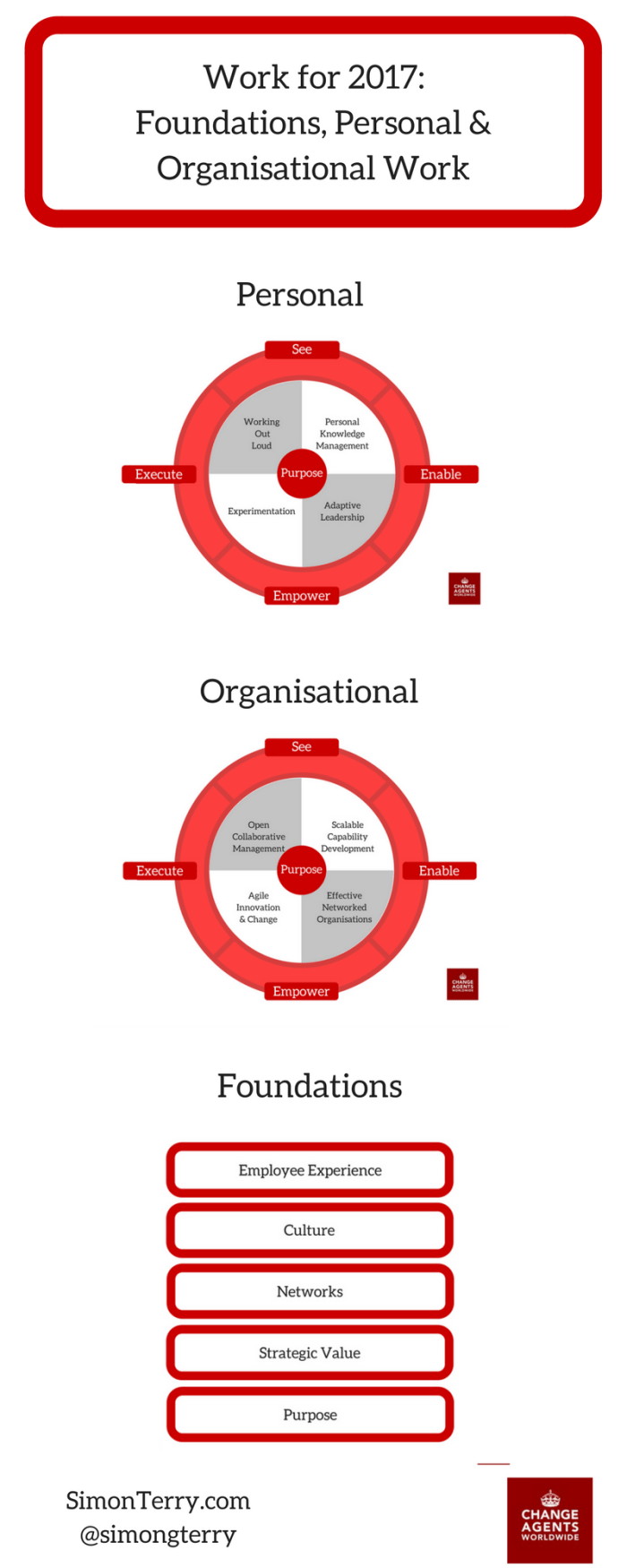
Infographic for 2017 Work: Foundations, Organisational and Personal.

workload-for-2017_-foundations-personal-organisational-work

This infographic is a visual summary of Work Ahead for 2017: Foundations, Personal & Organisational Work

Simon Terry provides consulting, advice, speaking and thought leadership to global clients through his own consulting practice, and as a Charter Member of Change Agents Worldwide, a network of progressive and passionate professionals, specializing in Future of Work technologies and practices.  The focus of Simon’s practice is assisting organizations to transform innovation, collaboration, learning and leadership. 

Work Ahead for 2017: Foundations, Personal & Organisational Work

directory-235079_1280

As the end of November approaches, that time has come again when we must consider whether we have the right initiatives in place for ourselves and our organisations as we get ready for 2017.  How are you transforming the capabilities and work practices in your organisation to make sure that your teams are more effective in their work?

Why is Work Changing?

The way we work is fundamentally changing under the influence of five main drivers:

  • Pervasive Global connection: As internet connectivity has gone mobile, we now have the ability to connect with, to converse with and to see the whole system of our stakeholders any time anywhere.
  • Automation: Digital technology has enabled us to automate simple tasks and string together increasingly complex processes and systems.
  • Data and Analytics: As digital connection and digital automation expands so does our ability to gather data and analyse that data to provide insight and run complex algorithmic processes.
  • Changing Consumer Expectations: As consumers are exposed to the potential of digital through consumer technology and consumer services, the businesses must meet disruptive and exacting standards for convenience, service, value and speed.
  • Accelerating Pace of Change: Disruption, greater responsiveness to change and ever-shortening cycles of feedback are the new norm for business and our work practices must adapt to enable our businesses to keep up.

We have already seen great change in digital transformation.

Further dramatic changes in the nature of work are here but ‘not yet widely distributed’ to borrow the phrase of William Gibson..

2017 Future of Work Recommendations

With these pressures on the way we work, every business should have a focus on how it is changing the way its people work and the practices that will support ongoing transformation of work. Here are my recommendations on what work you should have on your backlog for the new year:

Foundations:

These five are in place in your organisation today. However, they may not be well understood, managed or serving your purpose.  As you look to 2017 it is always worthwhile to ensure that the foundations are sound and well aligned.

2017-foundations

Purpose: Be clear on your personal purpose. Look for that purpose in the work you do. Clarify the shared purpose in your organisation. Don’t impose a purpose designed around the leadership table. Discover the purpose through the stories and the work that bring your organisation together.

Strategic Value: What value are you trying to create to fulfil your purpose? What kinds of value matter most to your stakeholders? When do they know you are creating value? What measures tell you that you are achieving your goals?

Networks: To compete in the network era, your organisation must be networked. How are you bringing people together to connect, to share, to solve problems and to respond to the networks around your organisation? The technology matters less than the connection, the behaviours and the shared purpose. Are you clear on the strategic value of your communities, are they well supported with sponsorship, investment and community management so as to accelerate their value creation?

Culture: Move beyond words on a poster. Move beyond generic platitudes. Move beyond an agglomeration of individual team cultures. What specific values are shared across your organisation? Why do these help fulfil your purpose? How do those values translate to expectations about behaviours in and across your teams? Is the culture in your organisation effective for your purpose and the value you are seeking to create? How do you personal role model the behaviours you expect from others?

Employee Experience: Are you working somewhere that values the employee experience and is adapting it to changing work and changing roles in the organisation? How have you aligned your employee experience to your desired customer experience? Does your workplace create rich value for employees and enable them to express their potential in fulfilment of purpose? Does your employee experience work as well for the one-hour temporary contract worker as the long term employee? Does it work equally well for all levels of the hierarchy and all corners of your network?

Personal Effectiveness:  Four Key Future of Work Practices

These four personal practices are enablers of the future of work. They enable an individual employee to deliver greater value in their work by responding to the opportunities and information in their environment. Agile and adaptive they empower employees to continuously improve and innovate.

1

Working Out Loud: Sharing work in progress in a purposeful way with relevant communities will accelerate learning, sharing and feedback cycles. Start working out loud now.

Personal Knowledge Management: Learn how to turn the personal information flood into effective sense making, learning and sharing. A critical skill to make sense of complexity and to leverage networks for learning.

Adaptive Leadership: Enabling the rebel and the change agent to lead more effectively in any system. Improving understanding, influence and the increasing the breadth of leadership techniques to create collective change in any system.

Experimentation: Move beyond the limits of your expertise. Learn by doing. Resolve uncertainty through action. Shorten cycles of decision making and feedback to increase personal effectiveness.

Organisational Effectiveness: Scaling & Accelerating Change

Organisations are made up individuals. These four practices of organisational effectiveness scale and accelerate the personal practices through a focus on design of systems for connection, learning and adaptation.

2

Open Collaborative Management: Middle managers are often those who find a change to digital ways of working most threatening and disrupting. Open up the work of management. Move management from planning, allocation and control to facilitation, alignment and coaching. Shorten cycles and improve the performance value of feedback. Foster the role of managers as network navigators and brokers. Management can be a critical point of leverage in achieving more open, more collaborative and more effective work.

Scalable Capability Development: Turn each employee’s learning into a contribution to scalable system for delivering strategic value. Create Big Learning systems that scale learning around strategic capabilities for the organisation’s success. Coordinate your learning agenda as an agile change program. Curate the capability building of your teams, leveraging learning from peer communities and leverage social learning to bring 70:20:10 and a performance-oriented approach to learning to life at scale and in the workplace.

Effective Networked Organisations: Take advantage of the networks in and around your organisation to rethink your business model and organisational design choices. Break the centralised/decentralised binary and move beyond hierarchy. Enable autonomy, foster alignment and improve effectiveness for purpose. Skill your teams to achieve effectiveness in the wirearchy. You don’t need to purchase a new management system. You need to adapt your approach to managing knowledge, trust, credibility and results to your purpose, culture and community.

Agile Innovation & Change: Adapt to the changing needs of the environment and stakeholders to deliver new value. Accelerate innovation and change through new approaches and by putting in place the systemic support for employee-led innovation, change and transformation to a more responsive organisation.

Simon Terry provides consulting, advice, speaking and thought leadership to global clients through his own consulting practice, and as a Charter Member of Change Agents Worldwide, a network of progressive and passionate professionals, specializing in Future of Work technologies and practices.  The focus of Simon’s practice is assisting organizations to transform innovation, collaboration, learning and leadership. 

Keep Asking for What You Want

Our connected world is great at supplying solutions. However everyone needs to know what problems you want to solve. Ask for what you want. Don’t stop asking until you get it. 

I was raised to be grateful for whatever life brings. My life has been overwhelmingly positive. I have received so many blessings it is hard to be thankful enough. However the flip side of a pattern of success and an attitude of acceptance is that it can cause me to forget to ask explicitly for what I want. Waiting quietly can replace a public hustle.   

Let’s be blunt. The universe respects hustle. The return doesn’t come to the five minute version of hustle. The universe rewards persistent and public effort. Success is driven by continuing to build relationships, sticking at a plan, learning from experience and working hard at clear goals. Overnight success is usually a seven year effort. 

How does our connected world deliver its help? When you are clear what you want and go after it, you are more likely to succeed. Focus helps you and helps others to help you. Just publicly putting your Purpose into the world can start to attract people, resources and efforts of help. The support of others, their help and opportunities will help you stay focused and persist. Persistence will attract more people and more opportunities to solve your challenges and meet your needs. 

If you don’t ever express what you want, then you are missing out. Give yourself the time and the opportunity to get what you want. Keep publicly pushing for your goal. Our connected world will reward your intent & persistence in time. 

Thanks to Eddie Harran for the inspiration