Trust is Precious

Trust

One of the challenges is the modern economy and its new far-flung connectedness is that there can be a tendency to presume trust in relationships. We need to be clear that trust is a vital part of our commercial and social activities. The role of leaders is to help create, sustain and grow trust in their networks and communities.

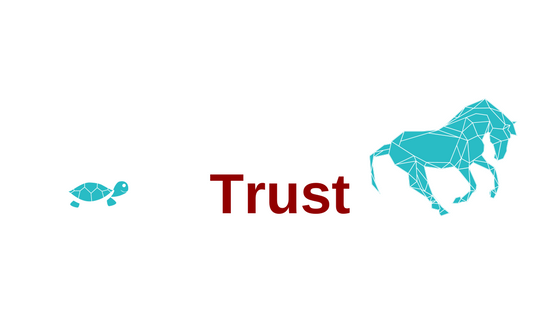
Trust Arrives on a Tortoise and Leaves on a Horse – Proverb

I start with a high degree of trust in people. I always presume a positive intent and I am willing to be generous with my time and efforts. A recent experience caused me to reflect on how important that trust is in a relationship and how we need to continue to invest in building trust in our relationships.

An social network acquaintance asked me many months ago to help their new product by letting them use some of my content. I laid out some simple terms of that use, in particular that they take some actions to let me approve the content in context. Nothing happened for months. Suddenly, last week I was told that the product was going live. My trust in my acquaintance collapsed and our relationship became very difficult quickly.

Without trust, the interactions took on different colour for both parties and matters became tense. Everything eventually fell apart. What had begun as a good natured collaboration ended up as a frustrating and angry experience in the absence of trust. Did I overreact? My acquaintance seemed to think so. However, the simple step of acting promptly on an agreement could have maintained trust and avoided the issue. Failure on a relatively small issue can often have the biggest impact on trust, because we want to trust those who look treat the small things seriously too. What is a small thing to you, may well be critical to me. Little doubts are warnings of larger concerns.

Trust in the API Economy

We have grown used to the API Economy, extending trust to remote connections and even starting to leverage trustless ways of interacting and working. In this context, we can forget the vital role that trust plays in frictionless commerce and interactions.  Without trust, costs and the emotional burden of interactions increase.  Those additional costs might be the costs of coordination, management of performance, sharing of information, monitoring or verification. The emotional toll of lack of trust is seen in interactions coloured by doubt, suspicion, self-centred thinking and a raft of negative emotions from fear to anger. We can absolutely execute standardised transactions without trust, particularly when they are supported by a robust API-like platform to help manage the quality, transparency, accountabilities and risks required.  However, we cannot achieve our best complex, collaborative or creative work together without trust. The costs of lack of trust are too high and the potential opportunities are lost as people focus on self-interest and self-preservation.

APIs are just like my reaction to a change in the terms. An API rejects anything that doesn’t meet the agreed parameters. APIs are not designed for flexibility, novelty or agility. They are designed for seamless transaction. They don’t rely on trust to bridge gaps as things change.

As we focus more of our economic and social relationships into the API Economy and its network of platforms, it is important to remember that trust always resides in the human brain. Platforms can provide tools to support human trust and they can provide proxies for human trust.  They cannot deliver it.  The role of network participants and in particular leaders is to create, foster and develop trust. This work is what helps turn a network into a community.  Leaders play a critical role in making trust an expectation in a network and their work influencing others can shape behaviours and their consequences across the network.
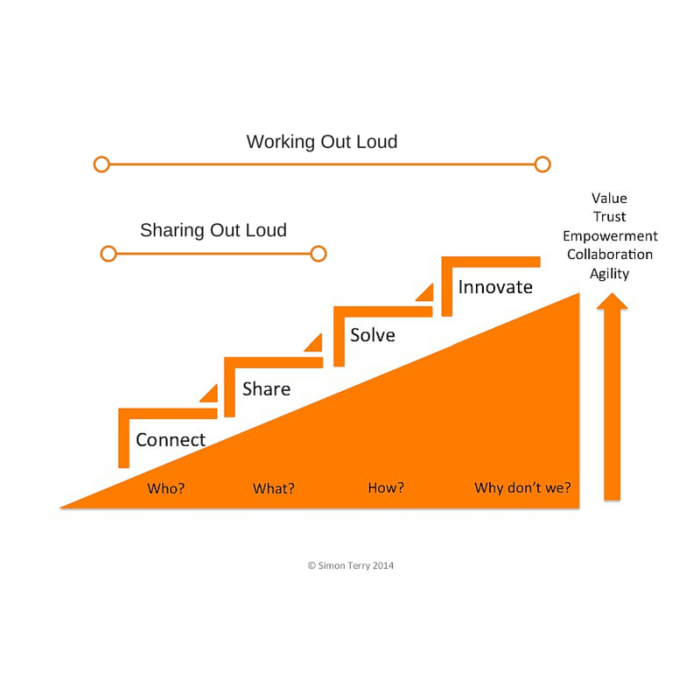
 

Working Out Loud: It’s not who you know. It’s who you don’t.

Working out loud is a way to discover new network connections and new capabilities in your existing network. The value of working out loud is in who and what you don’t know.

Collaboration is straightforward if you know someone and know that they have the ability to help. You have to get over the inconvenience of asking for help. You might have to negotiate a little to win their support. Either way, it is a straight line from need to outcome.

When you don’t know who can help, finding a partner for collaborative work or learning is less simple. Searching for help is time-consuming frustrating and daunting. The power of working out loud is it enables you to break the traditional networking mantra:

“It’s who you know”.

Working out loud opens up a wider network of partners for collaborative work and learning because it changes the dynamic from “who you know” to “what the network knows about you”.  Working out loud leverages the value of what you don’t know:

“It’s not who you know. It’s who you don’t know and what they know about you.”

Sharing work in progress with a relevant community is a step towards discovering new people who can help your work or learn together with you.  When your goals, status, and current efforts are narrated openly for others to follow, word gets around.  Intermediaries can start to make connections between you and those who can help. Your close network ties will find the weak ties who can add value to your work for you.

The unique value of working out loud as a way to engage your network is that for both you and your network it opens opportunities to create new connections based on new understanding of your work.  Don’t be discouraged that you don’t know those in the know.  Work out loud and let them find you instead.

International Working Out Loud week is from 5-11 June 2017.  See wolweek.com for more details.

The Essential Ingredient is Trust

When we think about our organisations we often fail to notice the essential role of trust. Trust enables or disables our work, structures, or processes. As we move more into the future of the network economy we need to make trust explicit again.

What We Don’t See

We forget about trust because the process of trust is second nature to us.  Trust is deeply engrained in the way we manage relationships, transactions and exchanges.  This role of trust makes it critical to the way we organise our work, the way we exchange information and the decisions we make. Any organisation that is not explicitly managing the level of trust in the organisation and with its stakeholders is losing value.

Trust plays an outsized role in my work. Customers pay a premium when they trust an organisation. That customer trust is directly related to the internal trust relationships inside an organisation. They won’t give an organisation greater trust than its own employees. When Change Agents Worldwide wrote its first book, my chapter was on the need for organisations to trust their employees to enable the benefits of the future of work.  A critical underpinning of the Value Maturity Model is its ability to develop the mutual trust in organisations that facilitates effective collaboration and supports execution of strategy. Trust is key to any complex and uncertain challenge in leadership, learning or innovation.

What We Work Around

Much of business history back to the beginnings of time has been managing trust.  Ancient businesses of the Phonecians and Greeks, operating in the era of an absence of information used family relationships to ensure trust. Over time businesses built processes to enable wider networks of trust in trade, in banking, in record keeping and in management of businesses. Our organisations are built of thousands of individual interventions to manage trust in relationships.

Organisations are often tempted to see the goal as creating a trustless environment.  Build the processes & structures such that you no longer care. Blockchain promises a trustless ledger for example. The gig economy promises to make employees fungible units of production where trust in the individual is irrelevant. We trust platforms, not people. We undoubtedly can continue to build more transparency, processes & accountability to extend work relationships further down the curve of trust.

The Cost of Trust

When we engineer trust out of our relationships, it does not go away. We continue to evaluate trust in our work because that instinct is a deeply human one. When we engineer trust out of our relationships, we accept a new set of stresses and new set of demands on performance.

  • We worry about the effectiveness of our trust-replacement solutions. We stress about the quality of our human relationships. Absence of trust is a high stress situation for humans.
  • We over-invest in these systems and bear an unnecessarily high cost to performance.  Look at any compliance regimes where risk avoidance dominates thinking.
  • We are reticent to share information which results in suboptimal decision making
  • Those who don’t receive trust, don’t give it. Trust is reciprocal and an absence of trust in one direction will result in customers, employees and other stakeholders who don’t trust.

Organisations that want to perform effectively in the future of the work cannot place all their faith in processes, structures and platforms to manage trust for them. They need to remember the human relationships of trust. Create and manage an organisational culture that is rich and generous with its trust.

Three Levels of Co-Creation

As we begin to explore the collaborative potential of connection, co-creation is becoming increasingly important solution to problems. Organisations are increasingly looking to employees, partners and suppliers to be a part of efforts to co-create solutions to complex problems. Collaborative co-creation is a key part of the Solve phase of the Value Maturity Model. As we practice co-creation, we discover bigger opportunities to create value.

Co-Creating Ideas

Most co-creation begins with some kind of crowd-sourcing of ideas to solve problems. Diversifying the sources and inputs into the creation of a solution can enable big steps forward. Often new stakeholders have solutions to hand, see potential to reuse capabilities or bring opportunities to do things in new ways. Crowd-sourcing can be a fast and effective way to gather inputs from a large group of people towards a solution.

Efforts at crowd-sourcing solutions need to plan for two main challenges:

  • Lack of Connection: To contribute meaningful solutions, people need to feel connected to the problem and to each other.
  • The Volume of ideas overwhelms Execution: ideas are great but the exercise to sift and integrate diverse ideas can be a drain on execution. This is why many efforts at crowd-sourcing turn into a show of ‘engagement’ with no traction on the ideas submitted.

Co-Creating the Work

The next level of co-creation is when people come together to take a solution and execute it. The challenges of a problem don’t stop when you have an idea. People need to solve all the little issues and manage the idea until it is successfully implemented.

Make sure the expectation in you co-creation community is that work will be done to solve the problem.  Give the community the autonomy to follow their ideas. People will contribute better ideas if they think that they have to see them through.  Co-creation is more meaningful to a community that has been asked to work the problem together. Challenge them to take their ideas and see them through to implementation.

Co-Creating the Problem

The final level of co-creation goes back to the start and looks at the system from a higher view.  This level removes the constraint that the problem definition is externally imposed on the community. At this level of co-creation, the community has responsibility to find, create and implement its own solutions. To do this the community is going to need to start to ask questions about Purpose, the scope of the system and what goals they have for the system.  Bring a diverse group of stakeholders in to shape the problems and you may discover new problems and that some of your current problems aren’t such a big issue. The third level asks the community to own co-creation from Purpose, through Diagnosis, and then to the Design and Execution of any solutions.

From Sharing to Solving

Sharing Out Loud

A recent conversation with Cai Kjaer and Laurence Lock Lee of Swoop Analytics about the Value Maturity Model highlighted a key point that is at the heart of many organisation’s struggles to get value from enterprise social collaboration. Too many organisations are stuck below the Share>Solve boundary. Once you connect enterprise social collaboration to work, the benefits for users and the organisation expand exponentially.

Sharing Out Loud

The first reaction in many organisations to an enterprise social network is to see it as a chance to share out loud. What people see first is the potential for status updates, sharing of articles, links and other stories of interest.  This is natural human behaviour and it will be heavily influenced by the culture of social media use in your employee base.

As we have discussed in previous posts, sharing adds value in helping provide transparency, shared context, reducing duplication and enabling better alignment. If Sharing Out Loud is as far as the Working Out Loud goes then it can add value. Sharing is the core concept behind the knowledge worker productivity case for benefits of enterprise social collaboration. Share information and it is findable. Findable information can be reused.

Any organisation that does not move beyond Sharing will face a number of key challenges.  Sharing is where there is a lot of noise. Filtering the sharing with groups and other approaches becomes important. Users get frustrated that there is so much information and so little value. Networks can alienate users because a few loud or extroverted voices dominate the traffic and shape perceptions of what an enterprise social network can contribute. Senior executives will quickly lose interest in a network that does not reflect their work and their strategic priorities. A network that is only sharing will need sustained energy from community management or passionate users to survive.

The Launch Point: The Sharing-Solving Boundary

When an enterprise social community crosses the boundary from Sharing to Solving, the dynamic changes. Bringing work into the community provides a momentum and new benefit cases for all users. The purpose of the community and the benefits it can provide begins to clarify and the distinction between an enterprise social and other forms of social media can clarify for people. The work itself begins to provide the energy, rhythm and momentum of the community.

We can help users to turn a Sharing Out Loud community into a Working Out Loud community through strategic community management. We can provide the right context and strategy for the use of collaboration. We can structure the opportunities for Connection, Solving, and Sharing around the key interactions and challenges of the work of the organisation. We can focus on the culture of collaboration and generosity in helping others. All of this helps users to sustain their activity in the Solving domain.

One other benefit of focusing on moving above this boundary is that you are building key foundations for innovation.  Employees who develop confidence in an enterprise social collaboration solution as a place to solve their problems will begin to explore how to fulfill their new ideas there. People move easily from How? to What if? Employees who learn to create agile teams to solve problems can apply those same teaming skills to new ideas. The growing wirearchy of work can be reused to provide an engine to innovation work in your organisations.

Creating an environment where employees (& others) can work out loud on real business problems and challenging customer opportunities is the work of strategic community management. The value created beyond the Sharing-Solving Boundary is exponentially greater than that before.  If you want the attention of the business stakeholders to support your community, you will need to Work Out Loud.

If you are interested in exploring further how to the Collaboration Value Canvas, enables organisations to conduct a two-hour workshop with business stakeholders to ensure that the business has an integrated plan for its community management and adoption work.  Contact Simon Terry to discuss how this could be applied in your organisation.

For suggestions on how Swoop Analytics can help you measure this transition see Cai Kjaer’s post on Linkedin.

A Conversation About Norms

We live between norms and force. When norms lose their power, force becomes the alternative option. For effective organisations and civil society, we need an ongoing conversation about expectations of behaviour.

Noticing Norms

David Foster Wallace’s Kenyon College commencement address begins with a story

There are these two young fish swimming along, and they happen to meet an older fish swimming the other way, who nods at them and says, “Morning, boys, how’s the water?” And the two young fish swim on for a bit, and then eventually one of them looks over at the other and goes,
“What the hell is water?”

Social norms are often like water to the young fish. In the Oxford dictionary, norms are defined as:

A standard or pattern, especially of social behaviour, that is typical or expected

We don’t even notice they exist. They are simply baked into our expectations of social interactions. We follow the most common norms without reflecting on their existence. Often the first time we focus on them is in our outrage at a breach of a norm.

Norms shape group and individual behaviours. Norms that are undiscussed, and in some cases undiscussable, can have real consequences for individuals and societies ability to manage and change. These norms are also a critical component of group connection. Loss of shared norms will impact cohesion, sharing and collaboration in a group.

While many norms are taken as given, they are not fixed. Our expectations are constantly adapting based on our experience of the behaviour of others. Sustained violation of norms can and will cause change. This is one reason that so many protesters violate social norms. They want to disrupt a range of expectations to gain notice and to influence people to reflect on the need for change. Where change has been driven by social change movements, the changes are largely positive for society with new norms being more inclusive, equitable and better able to support civil society.

The Power of Norms

‪We live between norms and force. When norms lose their power, force becomes the alternative option to regulate social behaviour. The functioning of our organisations and our civil society depends on effective norms.

Over summer I read Jared Diamond’s The World Until Yesterday, a book that examines the lessons from traditional societies. The book explores how many tribal societies experienced life that involved continuing violence. The violence was an outcome of the challenges of sustain norms between tribal groups, leadership within tribes depending on authority and because disputes were often resolved by force. Many of the mechanisms we expect to prevent violence, such as peaceful acceptance of strangers, were not norms in these societies, because they represented real dangers to individuals and the group.

Change movements often seek to smash existing norms. Equally important is the need to foster and develop the new behavioural expectations that will follow. In the absence of shared expectations, any group will increasingly have to use force to maintain behaviour in a group or fail in its shared endeavours.

Let’s consider an example of the justice system. What makes our laws effective is not the courts or a constitution. The first element is a community expectation that we will follow the law, respect the courts and honour those decisions.  When individuals fail these norms, the executive branch of government has a range of force to bring to bear on social behaviour and enforce the law. We simply expect that the courts and the executive will collaborate to maintain the law. The history of the breakdown in civil societies around the world shows us that this is one of the first norms to fail.

Norms in Organisations

In organisations, the equivalent force is the power of exclusion. Few organisations have the power to use force against their employees except to show them from the premises. Misbehave persistently and you will be sacked and denied an ability to remain in the community. Exclusion presents a cost to the individual and a loss of capability to the organisation. Exclusion of large groups can be incredibly disruptive as strikes and lockouts show.

Organisations depend on norms to keep the peace and to foster cohension and collaboration. A few of those norms are on posters. Many are inherited from the society in which the organisation operates. As our organisations involve more temporary workers and as they become more open to the networks around them, managing these group norms becomes more important.

Most of those norms are never discussed. Some are seen as undiscussable. Rather than force people to exit when they have an issue with norms, we have offer people the alternative of voice. Exit is too easy in our networked era. Voice should be the easiest option. Encourage people to discuss their issues openly, especially those seen as hardest to raise. Celebrate resistance as a form of engagement. When norms are often invisible, it can also be a great learning experience to leverage the insights of those who can see.

The functioning of our society depend on explicit and implicit norms of behaviour and interaction. Let’s invest in the conversations and actions in community necessary to sustain norms and keep the use of force at bay. ‬

Keep Reconnecting: The Value of Strategic Community Management

Organisations need to invest in strategic community management for the life of collaboration. The process of reconnecting keeps relationships relevant as the organisation changes. Maintaining the connection of human relationships is the foundation of strategic value in collaboration.

slide1

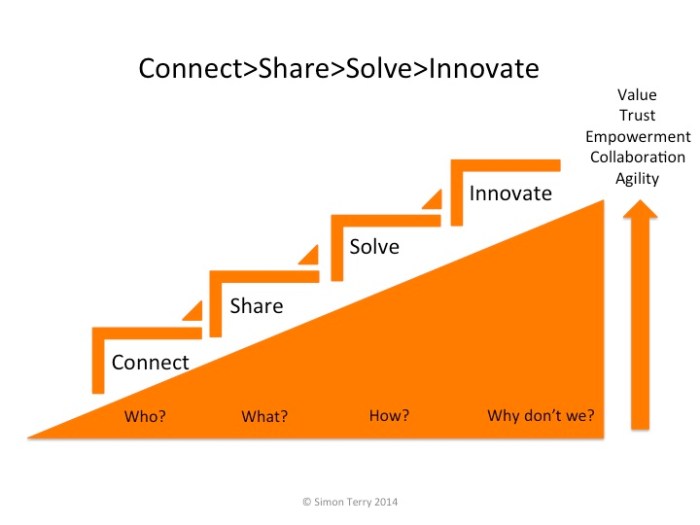
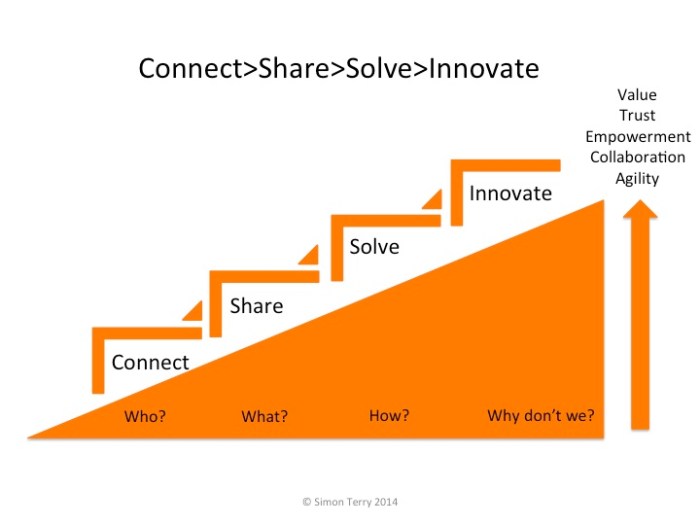
One of the consequences of representing a maturity model as a stepped process is that people interpret the steps as linear process – do connection then move on to do sharing.  The reality of collaboration in any organisation is that all four processes are going on at the same time. Even the most immature networks can have spots of sharing, solving and innovation. The model helps organisations develop the conditions to make those spots consistent, sustainable and predictable.

Keep Connecting

Connecting continues throughout the four phases. Perhaps a better representation would have horizontal bars or waves to show a continuity of each step in the model. The model reflects an ongoing development of capabilities and the main emphasis of each phase of development, not a series of linear exclusive activities. It also means that failing to maintain investment in any step can lead to the collaboration across the organisation slipping backwards in maturity. Let the relevance and effectiveness of relationships fail in your network and you will soon see a decline in the value created.

A corollary of this is that the most mature networks are also those that are most sophisticated at connection. In these networks, the process of connection is a task embraced by most users, is inherently a part of work and reaches well beyond the organisations boundaries to leverage all the relationships needed to make work better. Innovative organisations leverage relationships effectively, look beyond a role to leverage organisational capabilities and look outward to their networks to execute on innovation opportunities. Enabling this takes sustained effort and the development of new mindsets, capabilities and work practices in your teams.

Don’t Forget Reconnecting

Reconnecting is as important as the initial phase of establishment. Why? Connections get broken over time. Things change every day in your organisation. People join and leave. Businesses are reorganised. New strategies are developed. Projects form and close. Policies change. Technologies change. Without continued adaptation to all this change and without the creation of new relationships, the network will begin to wither and die.  A lack of ongoing connection and relevance to work is the reason most big bang marketing launches of collaboration fade away. Maintaining connection to support better ways of work is an ongoing exercise in any organisation.

The elements that I outlined on my last post on Connection need to be maintained, repeated and periodically refreshed. That is a role of strategic community managers. Organisations need to maintain an investment in community management long beyond launch to shape this ongoing adaptation of the networks of relationships across the organisation. Remember the relationships create the value, not the technology.

If you are interested in exploring further how to reconnect your organisation, the Collaboration Value Canvas can map an an integrated plan for the community management and adoption work required in a two-hour workshop with business stakeholders.  Contact Simon Terry to discuss how this could be applied in your organisation.

Start with Connection

Are your employees really connected through your Collaboration platform? Many who are members of your platform aren’t actually connected in human relationships. Perhaps it is time to check that your organisation is ready to begin the journey of adoption to realise strategic business value.slide1

A Missed Connection

When I explain the Value Maturity Model, many listeners skip over the first stage of the model and want to rush into the heady territory of sharing, solving and innovating. “Connection. OK. We have our employees on our network,” they say, “We are connected already. What’s next?” I am not alone in this experience. In a recent conversation with James Tyer of Togetherwise, a collaboration & learning consultant in the UK and Canada, James explained that he often has to take people back to the beginning to pick up missed connections and build a solid foundation for the work of realising business value.

Cai Kjaer of Swoop Analytics has also pointed out in a recent Linkedin post that having a network solution and employees being able to access that solution are precursors to realising value from social collaboration.  However, those steps on their own aren’t enough to create the human relationships that are necessary to work more effectively in organisations.

Experts in collaboration have been stressing for some time that a platform is not enough to deliver the benefits of collaboration. We can’t rely on “Build it and they will come”.  Most vendors now stress the need for adoption but what they often mean is “people on a platform” to ensure their revenues. ‘People on a platform’ is not enough to generate meaningful work and business value. Random crowds roaming your enterprise social network will get you nowhere you want to go. The potential wisdom of crowds of employees must first be shaped by strategic community management. We need to help employees to connect new relationships to be able to benefit from new opportunities for social collaboration.

Connecting Human Relationships

Community managers are the agents of strategic value in social collaboration. Their work translates human connection into the specific business value that realises an organisation’s strategy. The first role of community management in an enterprise social network is to connect new human relationships. Those relationships, not the platform, are the foundation of new value.

Think for a minute about the best work relationships that you have. What are the characteristics of those relationships? Features of great working relationships include a shared understanding, context and goals, reciprocal value, trust, mutual support, and learning. The first work of community managers in organisations that are using a social collaboration solution is to put in place the conditions that will foster these kinds of connections.

The Work of Connection

Let’s look at some critical elements that deliver connection for business value in a social collaboration network:

  • Connecting Understanding: For many of your employees, the use of social collaboration tools at work is new. Kai Riemer of the University of Sydney has demonstrated in his research into ESNs that sense-making is a critical early phase of network development. We need to help employees to make sense of the use and benefits tools in the work context.
  • Connecting Purpose: Work is busy. There’s already too much to do. People need reasons to use a new platform. Real people love their tasks to have meaning. Connecting those reasons to shared purpose in the organisation is an important benefit to users and a benefit in communicating and reinforcing purpose.
  • Connecting Strategic Value: Your organisation’s strategy outlines the most important work that needs to be done and the value that the organisation is seeking to achieve. Ensure that this value is clear to your community and that they can help drive what the organisation needs to be done.
  • Connecting Work: Not every employee and business will be able to find the connection between their own work and the broader business strategy. Help individuals and teams to make the connections of their work into broader businesses, processes, and projects.
  • Connecting Groups: Groups (or the related concept of Channels) are the home of work in any effective social collaboration solution. Make sure you have the groups you need to start the right work. Make the groups findable for new employees. Help these groups form, storm and norm on their way to performing. You don’t want names in a group. You are aiming for a team built on real human relationships.
  • Connecting Capability: Human capability is variable. Not everyone will have the capabilities they need to understand how to use the platform, to work or to lead in these new complex relationships. Make connections for people to ways to build their capability to be more effective.
  • Connecting over Barriers: Every organisation has legacy rules, mindsets, processes and approaches to work that will get in the way of effective collaboration. Help your teams to fix, avoid or work around these barriers.
  • Connecting Leaders and Champions: Real people are influenced by the behaviour of others. Leaders and champions will help shape the work, the norms and the value created in your network.
  • Connecting Governance: Budgets come with expectations and organisations come with norms. Connect a governance team that can help the community managers to drive the right strategic outcomes in ways that best suit your organisation.
  • Connecting Data: Value realisation requires measurement. Put in place a plan to measure the data you need and gather the tools that you will need to do the measurement.
  • Connecting Resources: Nothing is free. Great work needs the right level of resources. Make sure your community management team and platform has a sustainable level of resourcing for the strategic value that you want to create.

If you skipped the Connection stage in your collaboration solution, some of these elements might have been missed. Even if you picked up these steps, are these elements integrated to ensure that the foundations for future business value are in place?

Realising the strategic value of social collaboration requires a focus on the human relationships in work. Any good relationship begins with a strong connection.

If you are interested in exploring further how to the Collaboration Value Canvas, enables organisations to conduct a two-hour workshop with business stakeholders to ensure that the business has an integrated plan for its community management and adoption work.  Contact Simon Terry to discuss how this could be applied in your organisation.

Addendum

In a discussion on Facebook around this post, Mark LeBusque added this insightful comment:

Another reason why BEING comes before the DOING. I often come across coaching clients who have been frustrated when projects hit a hurdle and it’s always because they haven’t created a meaningful connection with their cohort before the project begins. Instead of sitting in a room on Day 1 of the project talking about what they need to DO they should spend time in a less sterile environment talking about how they need to BE. The key element there is how to really be connected.

Mark’s comment highlighted to me the one missing connection:

Connecting Self: Busy people tied up in work, status, fears, dreams and other mindsets can struggle to connect to their feelings, fears and sense of self. Any relationship must be based on a strong sense of who you are and want to be. We need to help people connect with and leverage their authentic self as part of their work.

Working Out Loud: Chat, Conversation & Collaboration


Working Out Loud can generate a lot of confusion for people who are new to the term. Being clear on whether your goals are best advanced by a Chat, a Conversation, or a Collaboration will help the effectiveness of your working out loud.

The Many Interactions of Working Out Loud

Working Out Loud involves sharing work purposefully with communities that can help your work or can learn from it. The concept is deliberately a broad one. The concept covers a lot of different kinds of interactions.

There is no one right way to work out loud. John Stepper has written a fabulous book on one approach to working out loud to achieve personal and career goals. Jane Bozarth has an equally great book full of examples of people showing their work in many and varied ways and for many reasons. The WOLWeek website has a range of interviews with Working Out Loud practitioners and many practices are described. There are more approaches.

Working Out Loud is inherently adaptive. There is no one perfect way because nobody else has exactly your situation, your needs, and your network.  Learning how to navigate networks through generosity, transparency, and collaboration is a big part of the challenge and the source of the benefits of working out loud.

Chats, Conversations, and Collaborations as Working Out Loud

One way to reduce the confusion around working out loud and to improve the effectiveness of your practice is to be clear on what it is that you are looking for when you work out loud.  Are you looking for a Chat (shared information), a Conversation (shared understanding), or a Collaboration (shared work)? Each of these kinds of interactions involves a different level of engagement and add a different amount of value to your work. Each of these will require you to have a different relationship with and deliver different value to the other people involved in the interactions.

Understanding which interaction will best support your goals will help you choose the community and the approach. Many people get disappointed when they work out loud on twitter and they don’t get an immediate response that advances their work. Others get frustrated that people working out loud use twitter and appear to be engaging in self-promotion. In both cases, we are seeing a misalignment between the individual and the expectations of their networks.

More Effective Interactions

Reflecting on the desired interactions and the best communities to support them can help you improve your working out loud. After alll omproving the effectiveness of your Working Out Loud is an ongoing adaptive exercise:

Look for Shared Goals: If someone doesn’t share your goals then even a Chat is a distraction. Both Conversations and Collaborations require strong goal alignment. Look for individuals and communities who share your goals.

Invest in Relationships First: People are more likely to give if they see you as equally generous. People are more likely to care if they think you care. People are more likely to notice if you have noticed them. Use Chats, Conversations, and Collaborations to build relationships in your networks. Remember that in transparent networks people see not just your interactions with them but with others as well. You will have a reputation that is the sum of your interactions.

Choose Networks that Suit the Interaction You Want: Communities each have a dominant mode of interaction. Is it chatty? Do people help each other or engage in long debates? Pick communities that are suited to the interaction that will best suit your work. If you are looking for a richer interaction, such as a collaboration to solve a difficult work challenge, then choose networks where the relationships will support that interaction or where people share common approaches to interaction.  No community is 100% one mode but aligning to the dominant approach first will help you be most effective and allow you to branch out later.

Be Clear on the Purpose of Your Working Out Loud: Ask for the help you need. Be clear on the kind of responses that will advance your work. Help others to best help you and also reduce the likelihood of misunderstanding or embarrassment.

Start Small and Experiment: The adaptive nature of Working Out Loud means that it will take some experimentation for you to develop your own approach, develop relationships and to find the networks and interactions that best foster your work. Start small and experiment to learn how best to leverage working out loud in your work.