Dear CEO: This Enterprise Social Network Doesn’t Work For You

Dear CEO

Re: This Enterprise Social Network Doesn’t Work For You

The purpose of this note is to clarify our most recent discussion in the executive leadership team about our enterprise social network. Thanks to your help we have now clarified that the enterprise social network is the last thing we need.

However our discussion on executive engagement in the network was again challenging. Initially there was a great deal of division in the executive leadership team as to how executives should use the network and their willingness to be involved. We did not get to explore your perspective on the role of executives in using our network when you left the room for another commitment declaring ‘this enterprise social network thing doesn’t work for me’.

We must admit we were initially disappointed by the comment. However, the remaining members of the executive team spent some time considering your insightful remark. We set out below the outcomes of that discussion:

Employee Engagement will deliver our Strategy

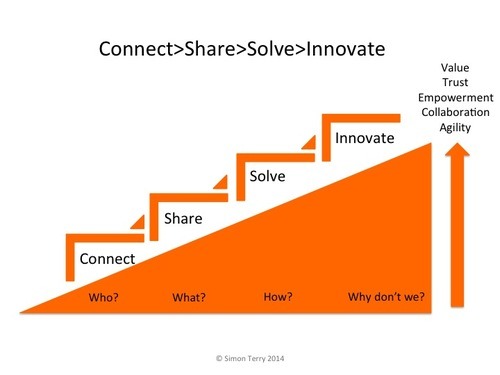
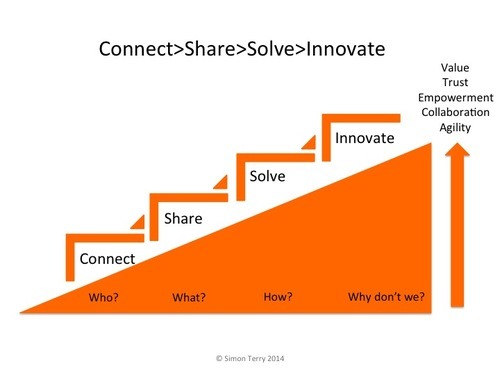
We realised that employee engagement, leveraging new ways of working in every role and discretionary effort to achieve our strategy is what will deliver better results. We believe that building a community in our enterprise social network will be another way for our employees to connect, to share, to solve problems and to innovate. The critical question we should consider is ‘Does this new approach to work deliver value for employees?’. The views of executives are less important than the value created for this community of value creators. All the evidence to date is that the network does work for our employees. Employees are more engaged and working more effectively.

This helped us understand that this enterprise social network doesn’t work for you but it works for our employees.

Leadership Helps Create Employee Engagement

We realised that employees need help to make sense of how to use the network, need help to solve problems and make change occur. That means employees need the support of leadership in networks. Importantly, that leadership does not have to come from the most senior executives. Leadership is a role not a job. We had hoped our most senior executives would play that role to ensure that the activity in the network aligned to strategy and best realised the potential of our people. However, we are already seeing new leaders rise up to fill the gap. The senior leaders who are involved can do more to foster this.

This enterprise social network doesn’t work for you. A strong community works for leaders who will help it achieve its potential and the community will surface new leaders to help shape and foster engagement.

Attitude & Capability are a Question of Leadership

We realised that much of the discussion in the room about lack of time, doubts about effectiveness of managing in networks or lack of skill were problems of attitude or of capability. These issues can be solved because they are the kind of challenges our executive leaders solve every day in other domains when required. People learn new skills, they work in new ways to fulfil the strategy and we ask people to be more efficient and better prioritise their time to do what matters. We ask exactly the same from our employees when we want them to achieve more. We don’t accept their refusal to change.

Towards the end of that discussion an interesting question was asked ‘If engaging in the community that creates value in our organisation doesn’t work for you, why are you a leader here?’. We wanted to share this question with you. 

Conclusion: Our Enterprise Social Network Doesn’t Work For You

We didn’t see at first. We now have come to agree with you that this enterprise social network won’t work for you. 

As a result, we have started a thread in the network asking our employees to contribute to the choice of who should takeover as CEO. That conversation is currently favouring the CMO. The community value her authenticity, respect her authority and trust her leadership. We aren’t surprised that the board seems to agree. Sorry leadership of this organisation’s community did not work out for you. We wish you the best in your future endeavours. You may find some useful suggestions as to what to you can do next in the thread that has started with advice on that topic.

Thanks for contributing so much to our efforts to engage the community, realise our strategy and improve performance.

Engage an executive in your enterprise social network. A great chance for executives to get involved is International Working Out Loud Week from 17-24 November 2014. Help an executive to see the leadership potential of working out loud. Find out more at wolweek.com

Celebrate Outcomes

The process is just a process. Often the process is one of many competing paths. Outcomes matter more.

In a recent conversation about customer experience, we were discussing the way people fixate on processes. Processes appeal to our industrial management mindsets. Processes are an engineering challenge of neat inputs and defined steps delivering an outcome in a mechanical fashion. Processes are so easy and alluring.

As a result we see troubling signs:

  • people compete for the beauty of their customer journey map. Have a look at Pinterest there are hundreds that are so gorgeous they reflect no real customer experience ever
  • organisations obsess about adoption over value creation because adoption is far more susceptible to a process
  • change management becomes an exercise of templates and measures rather than a series of changes in human relationships and mindsets
  • leadership is discussed an exercise in steps or processes to be managed rather than work to realise of the potential people in real complex circumstances 
  • measures, averages and other abstractions of the process mindset take precedence over human considerations.

Raising process to an exalted state devalues the complexity of humanity. The computer does not need to say no. Putting process over outcome leads to the outrage economy as people try to fight their way out of a narrow industrial mindset.

We need to focus on real human relationships. We need to allow for the mess and power of human emotions. We need to consider networks with learning, change and feedback, not just linear processes. Importantly, we can allow for human scales, learning and flexibility. Most importantly, we can allow for human conversations. That is the path to achieving the real messy and complex outcomes that we need.

Our organisations, our customer experiences and our relationships will be better for a broader more human approach.

Standing In: The Future of Work

image

What are you doing to cut through the challenges of attention in the future of work?

Attention Discriminates

Yesterday a client found me in a busy activity-based workspace by my colourful socks. There were too many dark suited males sitting at desks but only one was wearing loud socks. A distinctive trademark cut through the challenges of attention.

Our attention discriminates. We deliberately focus to exclude distractions. When humans lived on the African savannah there was already too much information and attention was a way to economise.

When we enter the future of work that issue of attention explodes. Streams of updates, flat networks of relationships to follow and complex rapidly changing environments create a load on our attention. If you want to be recognised for your efforts in this environment you will need to stand out.

Wearing colourful socks won’t cut it. Socks don’t scale. The traditional response of the extroverts among us just adds to the noise. One pair of colourful socks is a discriminator. Many are noise. We see the same with the ‘look at me’ cries on social media.

The future of work might not be about standing out. Perhaps it is about standing in.

Standing in

The way to get noticed in a network is to be a valuable node. Your goal is not to push yourself to isolation at the edges, it is to contribute to value creation at the core. In short, you need to stand in (networks).

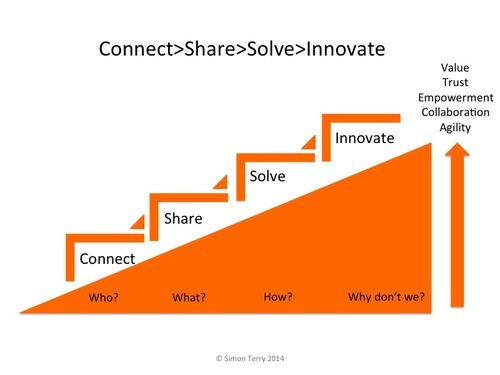
How can we stand in more effectively? The Value Maturity Model offers us a guide:

  • Work for a purpose and gather those around you who share that purpose
  • Make connections between people to improve the efficiency of the network
  • Share relevant information, add new information to your networks and don’t pass on the dross. Working out loud is a great practice that helps others and John Stepper has described how working out loud works for introverts.
  • Help solve problems of others in your network
  • When you see an ability to make a unique difference, take that chance. Innovative opportunities don’t happen often. Take a risk and leverage your network to make something unique happen.

To fight the discrimination of attention in the future of work, focus on standing in (networks).

image

Who Helps Creates Value in Your Organisation?

image

The difference between a network and community is a culture of collaboration. Collaboration doesn’t just happen. It is grown through the action of leaders.

Markets are Value Networks

The markets we use when we exchange financial value today are networks. Networks of connected agents exchange value in our stock exchanges, banks and risk markets. These networks did not arise simply because people connected. Financial markets are facilitated by practices that help transform connection into valuable interactions.

When the networks of merchants in coffee houses became stock exchanges, they relied on the role of brokers and market makers to help build a valuable marketplace. These roles helped people:

  • to build trust in the new market,
  • to create liquidity that enabled activity when demand and supply from participants was not perfectly matched,
  • to share information,
  • to develop new ways of working
  • to help the new markets to enforce the rules and standards of the exchange.

The same leadership work to build value, trust and new ways of working is found in the history of banking, insurance or other exchanges.  

The value created in these networks did not occur because the network existed. It occurred because of the work of people to build a collaborative culture in the network. People need to build a sense of how to use these new exchanges and to build trust in that they would deliver more value than risk.

Your Network Needs Market Makers

Any collaborative network will need leaders to help facilitate the creation of value in the network.  This leadership will be a combination of technical support from community managers and change leadership support from change champions in the organisation and the organisation’s senior management.

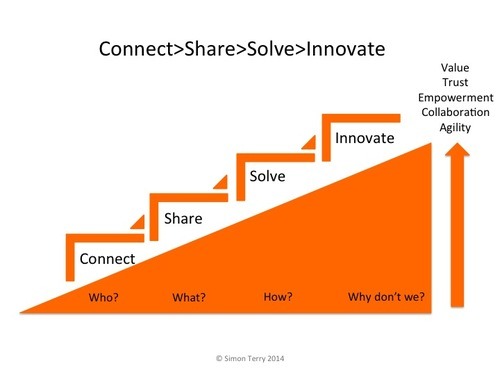
The Value Maturity Model highlights the way that collaboration’s market makers need to work to facilitate the value creation in your network:

  • Connecting relevant people to the network and into groups
  • Sharing information that may not have reached its necessary audience
  • Helping to solve issues by matching needs and capabilities, finding other resources or information and even holding a problem or information until there is a match of demand or supply.
  • Providing the systems and support to enable innovation experiments to be fostered until they are proven or fail.
  • Experiment and lead adoption of new ways of working
  • Helping lead the change in the culture of the organisation to allow the development of further cultural change.

To maximise the value of the networks in your organisation, you will need to develop the leadership capabilities that can take advantage of networks.

If you would like to create greater value in your enterprise social network or discuss how the Value Maturity Model applies to assist your organisation to create strategic value, please get in contact. I am available through @simongterry or Linkedin or www.simonterry.com

Why #responsivecoffee?

Yesterday was another great responsive coffee event in Sydney. The event began with my short talk about creating value with social business and working out loud. I shared some insights from the Enterprise Social Collaboration Value Maturity Model as a framework for developing a more responsive culture in an organisation. Then the group dived into a vibrant conversation sharing challenges and opportunities as people work to make their organisations more responsive.

One question I am often asked is ‘what is the value of a Responsivecoffee event?’ Here’s my response:

Connection matters:

People working in change can feel isolated. Simply meeting others doing similar work can make it feel more possible. Connection is the foundation of community. After the session yesterday there were all sorts of new connections established that will support people to do more work faster.

Connection is also important because of the diversity of Responsive Organisation challenges. People attending the event were considering the Responsive organisation approaches from the mindsets of consulting, communications, learning, knowledge management, technology, change, property management and many more functional areas. The connections cut across the boundaries of organisations, products, industries, roles, functions and ambitions of the organisations. All those diverse connects help expand the range of possibilities and enable clients to implement change faster.

Sharing Matters:

The conversation was a treasure trove of insights and shared experiences. That sharing encourages people and enables fast change. Many people are just starting out in the journey of being more responsive and more social. Hearing the stories others shared have them confidence to start and a sense of the possibilities and challenges ahead.

Problem Solving Matters:

Many people brought a practical problem to the table and over coffee leveraged the collective insights of the group to move forward and move faster.

Innovation Matters

Responsive coffee remains an agile experiment in value creation. The formats change to create value for those who are attending from session to session.

We are even seeing new intercompany collaborations and experiments being spun off these events. Participants are going away to work together to create new products and services to help accelerate change and address challenges shared. If you don’t bring people together to explore what might be possible you will never see the next horizon.

The Value of Responsive Coffee is Accelerated Maturity

The benefits of Responsive Coffee reflect that of the Value Maturity Model because a purposeful cup of coffee with other change agents is an act of social collaboration. We need more and richer connection to accelerate change in our organisations and the adoption of new ways of working for value. Value occurs in the rich conversations of social collaboration.

Long live #responsivecoffee.

Image credits: 

Coffee: http://pixabay.com/en/coffee-cup-time-meditation-talk-14662/

Photo of Responsive Coffee: Luke Grange

Integrate at Goals, not at Process

image

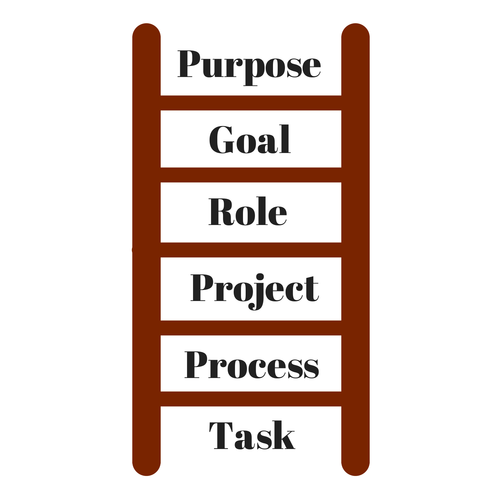
How do you integrate open network conversations into closed linear processes? Integrate social conversations by integrating at the purposes and strategic goals. No organisation wants its collaboration constrained by processes or systems.

Organisations, vendors and analysts are touting the advantages of integration of enterprise social networking into legacy processes in organisations. Enterprise social networking needs to be come a part of the everyday work in organisations as it is another set of tools to foster conversations and collaborations that create value. Without connection to the daily work of individual employees, enterprise social conversations won’t deliver the value we need. However, far too many of our existing work processes aren’t set up to accommodate creative, agile and productive social conversations. Patterns of allowed conversation in a process based integration rarely changes that.

Don’t Integrate through the Current Process

Existing legacy processing systems are designed for efficiency. They constrain choice. They automate steps and narrow discretions. The goal is to simplify tasks, remove errors and ensure repeatable activities can be achieved with the minimum in investment in human talent.

These systems achieve significant efficiency gains with a cost of human potential, agility and effectiveness. However, they are not designed for conversation about work. One only has to reflect on everyday poor customer experiences to see that these systems gain efficiency by handling poorly the exceptional, unusual case or situations requiring a response to change. Conversations, change and collaboration do not fit the industrial model of work that these process systems are designed to fulfil. They are not designed to leverage the potential of talented knowledge working employees connected in networks.

Collaboration is not a layer that can be integrated into existing fixed processes designed for efficiency. Collaboration offers the opportunity to enable people to change and improve the process and the work. Collaboration creates choices with a view to increasing agility, improving effectiveness and realising human potential.

A conversation that must integrate into a process system will become a conversation about the constraints of the system at some point.

Integrate by Creating a Purpose-oriented Conversation

Offer people autonomy, purpose and an opportunity to develop mastery and you will offer them an ability to fulfil their potential. If you want to integrate social conversations into your work, integrate the conversations at this level. The key to reinforcing human potential is to offer people a way to discuss how their work aligns and creates value for the purpose and goals of the organisation, not its processes.

image

An employee who is challenged to integrate his or her work at the level of the goals of the organisation has an opportunity to stop, change or transform the process. That employee can respond to the situation before them, use their discretion and use the talents of their colleagues. The employee can look to deliver greater value than the current process allows. That liberty reinforces their accountability and validates the organisations confidence in the potential of the employee. A key barrier to engagement in many organisations is that an employee can struggle to find the connection between their work and the goals of the organisation. Goal-oriented conversations can play a critical role to surface that connection.

Another advantage of reinforcing a connection at the level of enterprise-wide purpose and goals is that it acts as a reminder that collaboration is an enterprise-wide experience in work. Collaboration is not constrained to the customer management systems or work process systems. A collaborative ecosystem and the social conversations that support it should reach throughout the organisation to achieve its goals and purpose.

Leverage human potential to help realise goals

Telling people what to do and shaping how they might be allowed to have a discussion seems easy and seems efficient. However, it comes at a significant cost of human potential. Leadership in networks demands more of employees, leaders and their organisations. To maximise the opportunities for networked ways of working, allow people the opportunity to find integration of their social conversations at the level of the organisations purposes and strategic goals, not constrained by its processes.

If you would like to create greater value in your enterprise social network or discuss how the Value Maturity Model applies to assist your organisation to create strategic value through enterprise social networking and other forms of collaboration, please get in contact. I am available through @simongterry or Linkedin or www.simonterry.com

Value is a fractal

image

Enterprise social networks are made up of individuals who form their own groups and networks and the community is an aggregation of each of these components. We need to remember this structure when we start to think of value in enterprise social networks.

From Top-Down to Every Scale

One resulting characteristic of value in enterprise social networks is that they resemble a fractal, a mathematical shape that shows similar characteristics at any scale. Value in an enterprise social network does not only occur at the aggregate level.

Smaller scale activities are more important to sustain and grow the development of value across the whole network. There is less opportunity to order or impose value creation in a network than in traditional hierarchies where top down value is the priority and individual value is rarely considered.

Value For Users and Groups Makes a Network

Individual and group practices that create value are the underpinning of value for the whole network. Value comes from connection, sharing information, solving problems and innovating for an individual or the whole community. Without this value to the individual or group, no value creation at the network level will sustain itself.

Individuals and groups must understand and see the value being created to continue to work in new ways in the network. Developing the maturity of a network means building this sense of how value is created and how it aligns to strategic goals.

Create a Sense of Value at Every Scale

The power of the Value Maturity Model is that it is designed to take advantage of this characteristic. The method can be shared with users, with groups and with the whole community to help them make sense of how value is created for them and for the network.

Secret tools of community managers or organisational leaders won’t help individual users and groups find their own path forward to value. The power of value creation in an enterprise social network is the ability to leverage people’s potential to help

If you would like to create greater value in your enterprise social network or discuss how the Value Maturity Model applies to assist your organisation to create strategic value through enterprise social networking and collaboration, please get in contact. I am available through @simongterry or Linkedin or www.simonterry.com