The Blocking Boss

image

Obstruction is everywhere

The commonest question I am asked when talking to potential change leaders is:

What do I do when my boss doesn’t support my work, my change agenda or my leadership approach?

That challenge is one I am personally very familiar with it. I am not alone. Recently in conversation with Geoff Aigner one of the authors of The Australian Leadership Paradox we were both reflecting on how commonly change agents experience this challenge. The topic came up repeatedly in conversations the authors had exploring Australian leadership in preparation for that book. Many of the reasons for the conflict are tied to the four paradoxes that the Australian Leadership Paradox book outlines. If your boss prefers the other side of paradox, you are unlikely to agree on a way forward. However, both Geoff and I agreed that overcoming a blocking boss likely deserves a book of its own. Instead, here’s a short post from my personal experience.

In this post, I refer to a boss because it is the concept most experience. However, the person in a hierarchical position of power may not be your direct boss or even in your line of management. In other cases the blocking may be more abstract to pin down with distant committees or an abstract ‘they’ opposing your work. In these latter cases, it is essential to first separate the myth from the reality and find real people with whom discuss the work. One can’t argue with a perception.

Here is some lessons from my experience working with a unsupportive or blocking boss:

  • Be wary: Aware
  • Embrace your power: Ignore 
  • Change the conversation: Influence
  • Work the system: Evade 
  • Flee the system: Escape 

Be Wary: Aware

Before you continue with any change that is opposed by the hierarchy you need to be aware. You will need to check your motivations. You will need to understand your own strengths, weaknesses and resilience (each will be tested). You will need to be clear on your change, its impacts, risks and consequences. You will need to understand the landscape incredibly well. You will need to see the networks in the organisation, the political agendas, the personal agendas, the influence, the strategy and much much more.

If you are simply in the flush of enthusiasm for an idea, stop. If your ego is bruised by rejection or you don’t like criticism, ostracism or exclusion, then don’t continue. If it has become a power game to continue, then stop. Important change is not about you. Leading important change is about delivering better outcomes for everyone. Leading this kind of change takes enduring commitment and purpose to deliver for others. A bruised ego is a warning sign that this is personal. 

Only continue if you can see the landscape, the benefits and risks to others and your own motivations clearly. Only continue if you know that the journey will be rough and unrewarding and you have the strengths and the resilience to persevere. The experiences you have in this difficult leadership journey will demand continuing self-awareness and system-awareness. You will need to manage this carefully and know when to protect your self (see Flee the System: Escape)

Embrace Your Power: Ignore

The simplest technique is to ignore your boss and continue on. Of course, this is rarely the safest. It also misses the opportunity to understand whether your boss might be right (see Change the Conversation: Influence)

When you understand the difference between your job, the role you are playing and your authority, you may discover you don’t need your boss to endorse your work to achieve the change that you want. We often have far more influence and resources at our disposal than we expect or understand. Remember we have a uniquely human capacity to constrain our power to act. These constraints are insidious. Thinking you need support of your boss or organisation for action is one artificial self-constraint.

Without formal support from the hierarchy there is much you can do by taking on new roles and leveraging your authority in your networks. If you do this in a community with others, then you will magnify your influence. (see Work the System: Evade)

Sadly, you may find this also means you will receive no recognition for your work from your boss. You may even see your performance discounted for having engaged in activities that were not required or were seen as a distraction. Ultimately you might lose your job for insubordination or the threat you pose to the authority of your boss.

Most people are not comfortable with this level of risk. Therefore it is advisable to use this approach in combination with the others below. Remember if you believe enough in the change, losing your job when you can’t bring about change might not be such a bad thing (see Flee the System: Escape)

Change the Conversation: Influence

Every leader needs to have hard conversations to influence change in action. You should seek to engage your boss in conversation about the change, if only to understand their perspective more deeply. Prepare for this conversation.

How well do you understand your boss’ goals and drivers? What reasons does your boss have for blocking you? Does the strategy of the organisation or the bigger system give you any levers to change their perspective? Are there facts that you know that your boss does not or vice versa? What is it that you see that you may not have discussed adequately with them?

Before you begin this conversation recognise that the conversation will go best from a position of strength. Prepare. Find others who can help you with your change and to influence your boss (see Work the System: Evade).

Choose your timing. Make sure you have done all that you need to do on the other areas that you boss has asked of you. You don’t want this conversation to become a feedback session on how you fall short of your role’s performance expectations.

Prepare for the conversation.  Seek to find alignment on goals & purpose first. Only then move on to the implications and finally to agreeing new actions.

Hard conversations are not easy and may not be appreciated. The difficult conversations might lead you to further insight into changes required or to see change is impossible (see Flee the System: Escape). However, change will not come about without continuing to have hard conversations.

Work the System: Evade

Not all change uses official channels. Not all change is public and approved. There will be times when you might need to run a rebellion or even a revolution to make change happen, particularly in large organisations or large systems. At worst, you are going to have to play the politics of power and influence to at least continue your work or at best find someone more influential to release your constraints.

To continue to work on change when it is opposed, you will need to become well aware of how to lead in the networks in your organisation. You will need to use networks to avoid the obstructionist managers and build a coalition that can continue your work. This may even enable you to stop completely, if a coalition of others takes up your work.

You may need to even go into the networks outside your organisation and push change back in with influence from external sources. External networks, like customers and community, can validate the reasons for change. That can help you find new ways to influence your boss (see Change the Conversation: Influence) or more confidence & strength to continue (see Embrace Your Power: Ignore).

A boss who is asking you to stop work on change will not appreciate activity to perpetuate that change in this way. If you are working at the boundaries of the organisation take care that you are not jeopardising both your goals and the organisation. However, it is almost always required that you work the system and its rules to advance your cause when your boss is opposing needed change. The risks you are taking might lead straight to Flee the System: Escape.  Running an evasive strategy is rarely fast or effective first time. You will need to prepare for a long campaign and many setbacks. Be ready to persist.

Flee the System: Escape

Not all change succeeds. Sometimes persistent & effective opposition is a warning signal to leave. Your organisation may not want to become the organisation you would like it to be. 

Sad as it may be, in this case the best option is to get out fast. Staying will only lead to the organisation rejecting your changes and you.

Leave and take your leadership elsewhere. You will find greater reward working elsewhere and you might even find a way to make the change later.

Conclusion: Be Aware. Lead. Continue.

Be aware first and foremost. Maintain that awareness as circumstances change.  If you have a purposeful & needed change to lead, the only option that you have is to continue. When you stop, you lose your authority to lead. You will become part of the blocking mechanism of the manager who opposed you – by your actions, by your words or by your example.

Networks route around obstructions. You should too. Keep going. Be aware. Persist. Learn. Change your approaches but above all continue until you succeed or must escape.  

Good luck for safe and successful change leadership.

image

Networks Demand Leadership. Make Your Choice. Act.

image

Leadership in networks is less about the position you are assigned. The opportunity is the role you choose and the challenge is building authority. The job might be assigned, but the role is chosen and your authority is earned. The networks in and around your organisation are waiting for you to act. If you don’t act, they will move on without you.

Networks solve obstructions

Networks route around obstructions. One potential source of obstruction is the formal roles in an organisation, the hierarchy and the resulting silos.  What results is a wirearchy which Jon Husband has described as

a dynamic two-way flow of power and authority, based on knowledge, trust, credibility and a focus on results, enabled by interconnected people and technology

Think about your organisation. There is a formal process to get a decision made, but everyone knows that the real decisions don’t follow the process. There is informal lobbying. Often someone who is not the decision maker is hugely influential. People chat casually testing positions. Additional information is shared. Deals are done. Trust and credibility play a key role in influencing the ultimate decision, often more than the facts on the table.

These actions are all examples of a network working around the potential obstruction of a hierarchical role or process. These conversations are all examples of how ‘two-way flow of power and authority’ is shaped by people’s actions to demonstrate ‘knowledge, trust, credibility and a focus on results’.

You are a potential obstruction

If you aren’t results focused, aren’t performing the roles required or the network doesn’t have confidence in your actions, a network of people working together will start to route around you.  Your failure to lead others becomes an obstruction. No matter how fancy your title or your place in the hierarchy the network will start solving for the obstruction that you represent. The network in and around every hierarchy is what makes the hierarchy functional.

To avoid being an obstruction, you need to focus on your authority and fulfilling the roles that advance the needs of the organisation and its networks. Your job won’t save you.

Authority takes Action

Leadership in networks is not an abstract and exalted status. Every person in a network is connected. Leadership is demonstrated when people take on needed roles and others move to action.

Leadership is the technology of realising human potential. Leadership is the technology that inspires and enables others to action. That takes a decision to embrace a role, action, influence and authority.  In networks, including the networks wrapped around your hierarchy, that authority comes from action, not position.

The differences in influence and ability to create value come through action.  Action is what builds authority.  The best way for someone to assess your ‘knowledge, trust, credibility and focus on results is to experience it’.  Authority grows influence with other people in the network and that accelerates further action. 

Networks and Network Leadership is not Bounded

If a network needs to go around or outside the hierarchy to solve a problem it does. All it takes is a connection for your network to extend further. Network leaders need to ensure that their leadership goes outside their hierarchies as well.

Customers, community, other stakeholders all influence your knowledge, credibility, trust and focus on results. Sharing the voice of the customer or the community can be a significant part of influencing change. Try to have influence internally without influence externally and you will find over time that your credibility erodes. Celine Schillinger has described how change agents can find that they need to build credibility externally to be more influential in their internal networks.

Leadership is a Choice. A Choice to Act.

Taking on a leadership role is a choice. It is a choice to help others make something happen and enable them to realise their potential. Whether you are in a hierarchy or a network matters little. The same rules apply. The choices that you make, the knowledge that you gather, the influence you build through credibility and trust determine your authority as a leader and whether others will follow.

Nobody has to follow you. Our hierarchies are a fiction that supports our need for status, order and clarity. The networks in and around your organisation know that and work around the hierarchy every day.  

That same network is waiting for your choices and the actions that follow.

SCNOW Webinar Series from Socialcast and Change Agents Worldwide

Change Agents Worldwide and Socialcast have now completed four great webinars on the future of work, enterprise social networking and collaboration:

Recordings of these webinars are available at the Socialcast webinar centre.

Every Conversation Counts

Leadership is how we realise human potential. Leadership is conversation. Every conversation counts. Don’t miss your chance.

Maya Angelou: …I mean, I mentor you. Everything I have learned, everything I’ve done, is at the ready when I talk to you. And in a way, you will never forget me.

Interviewer: Believe me, I won’t.

Maya Angelou: What I mean is you may forget how and where you got it, but in a few weeks, a few months, years from now, you will say something and think, Oh, I’m glad that came to me.

from a Maya Angelou interview in the Harvard Business Review

Leadership occurs or fails to occur in every interaction we have with others. Either we contribute to enabling that person to find purpose, to take action or to build capability or we miss an opportunity. Opportunities missed do not recur. The interaction that happens leaves a mark for good or leaves the other person with a query over the relationship

Realising human potential takes many conversations. You can’t impose purpose, commitment to action or learning on another. Talking at someone is the surest way to lose any opportunity to for any of these three critical elements of human potential. The fastest, simplest and most effective ways to undermine your leadership are failing to engage fully, having a surface level discussion or failing to authentically share all of your ability to assist.

In networks, where communication may be bound by looser ties of relationship and mediated by technology, mindful, purposeful and authentic conversation is an even more important practice. Leading in networks demands influential and insightful conversations to draw out and realise human potential. Human potential and the value it can create will only be realised where your conversations lead another person to learning, trust and commitment to act differently. You need to bring your whole self to have a chance of achieving that kind of change.

Follow Maya Angelou, bring everything to your next conversation and every conversation thereafter. Help another find a path to their potential. The impact of each conversation is the mark of your leadership.

How are you going to bring everything to your next conversation?

A leader sees greatness in other people. You can’t be much of a leader if all you see is yourself. Only equals make friends. A man or woman who sees other people as whole and prepared and accords them respect and the same rights has arranged his or her own allies

Maya Angelou whose leadership, works and wisdom with be with us forever.

Fine Words

//instagram.com/p/nSvvGyqAsH/embed/

Hannah Cutts’ photo of welcome to country at Payne’s Hut, home of Do Lectures Australia.

Do Lectures Australia was a forceful reminder that fine words are pretty but that action counts. Thanks to Luke Pearson attendees at Do Lectures Australia were asked to reflect on Australia’s relationship with its indigenous people and what we may need to unlearn.  

The history of Australia’s relationship with its indigenous people highlights that the words are occasionally fine. Too often the actions fall short or the outcomes we seek escape us. We need to move from talking at each other to working together to make things better.

Fine Words

Last weekend I saw a reference in an article on speech making to Paul Keating’s speech at Redfern in 1992. I didn’t recall the speech but I looked it up to learn more. The missed potential of that speech and curiosity to learn more led me to a short review of other speeches on the topic.

There is no shortage of fine words in the history of Australia’s relationship with its indigenous people. To select only from notable speeches of recent Prime Ministers:

One can quibble with the politics and the policies but all the words are elegant and heartfelt. There are many more words from Prime Ministers and others. Sadly, not all of them qualify as fine words. Where there were actions associated, there was a bigger difference. Whatever the words, there is more to do.

Action

The answer is not more fine words. The answer is not found speaking at the indigenous people of Australia with elegance. The answer will not come from convincing the people of Australia from a podium. No one speech or one action is likely to address the complexity of people, history and systems.

We need to listen. We need to learn from each other. I don’t have answers, but I have questions. We all have questions. We might benefit from asking more questions of each other. A much less elegant, but more engaging conversation might be productive of new understanding and new actions.

Most of all we need to act together. Those actions will help us to improve understanding, to better relationships, to reduce disadvantage and to improve the lives of our indigenous and all Australians. Perhaps questions asked in new conversations will help lead us find a way from fine words to better and more action.

What are your questions? Who do you need to ask to learn their answers? What actions might make a difference?

26 May is National Sorry Day and 27 May-3 June is National Reconcilation week. For a chance to learn more about Luke Pearson’s work to share the diversity of indigenous voices, follow Indigenous X on twitter.

Working Out Loud Creates Value

image

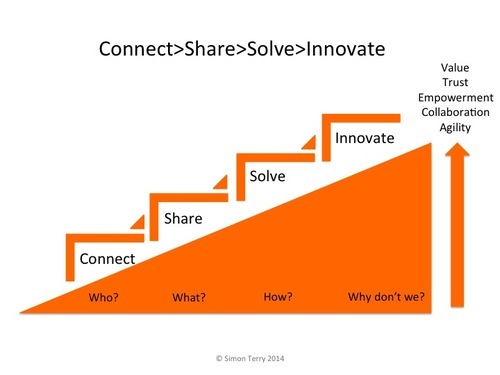
Working Out Loud is one of the most crucial practices for value creation in an enterprise social network. For many, it is also the least comfortable. We need to work at this new practice to deliver value.

Working out loud is the core new practice as sharing grows in an enterprise social network. When the conversation moves from sharing personal information to sharing work, value for the individual and organisation rises dramatically. That sharing is critical to the maturity of value creation in an enterprise social network. Without sharing of work, you hold back the benefits from other forms of work collaboration.

Working out loud creates great value in a network because:

  • working out loud gives a work purpose to the connection that has been formed in the network
  • working out loud invites community to form around people and their work enabling others to help, share knowledge and make work easier.
  • working out loud is not natural to many in the traditional workplace, but when people overcome hesitation and practice it they start to see the benefits of new forms of collaboration, that it makes work much easier & the culture much richer – a core driver of personal adoption
  • working out loud is the transition point to much wider collaboration across the organisation and particularly collaborative sharing and problem solving – work that is open is work that can be made better 
  • working out loud exposes the work which allows for better strategic alignment, reduced duplication and importantly recognition of the great work underway.
  • working out loud enables role modelling of transparency, vulnerability, learning, agility and experimentation.
  • working out loud by leaders can change the leadership dynamic from one based in control and expertise to one that leverages networks and collaboration.

Some great resources are available to help you with working out loud:

If you would like to create greater value in your enterprise social network or discuss how the Value Maturity Model applies to assist your organisation to create strategic value, please get in contact. I am available through @simongterry or Linkedin or www.simonterry.com

One minute video on How to Build a Responsive Organization

The Slides used in this video are available here: http://www.slideshare.net/simon_g_terry/building-the-responsive-organization

Credits:

Hacked from The Responsive Organization slideshare: http://www.slideshare.net/responsiveorg/the-responsive-organisation-a-framework-for-changing-how-your-organisation-works

Book: http://pixabay.com/en/open-book-page-pages-books-163975/

Music: B-roll by Kevin Macleod http://incompetech.com/music/royalty-free/

A one-minute video on The Responsive Organisation. We need to lead the changes in the future of work to make our organisations more responsive to customers and community and to realise human potential.

The video is hacked from The Responsive Org slide deck. Why don’t you hack your own?  

Additional credits:

Dinosaur: http://pixabay.com/en/dinosaur-allosaurus-skeleton-bone-60588/

S&P 500 Charthttp://www.technologyreview.com/view/519226/technology-is-wiping-out-companies-faster-than-ever/

Supermarket aisle: http://commons.wikimedia.org/wiki/File:Supermercato_vuoto.jpg

No Frills Cumbia – Kevin Macleod: http://incompetech.com/music/royalty-free/