Every Conversation Counts

Leadership is how we realise human potential. Leadership is conversation. Every conversation counts. Don’t miss your chance.

Maya Angelou: …I mean, I mentor you. Everything I have learned, everything I’ve done, is at the ready when I talk to you. And in a way, you will never forget me.

Interviewer: Believe me, I won’t.

Maya Angelou: What I mean is you may forget how and where you got it, but in a few weeks, a few months, years from now, you will say something and think, Oh, I’m glad that came to me.

from a Maya Angelou interview in the Harvard Business Review

Leadership occurs or fails to occur in every interaction we have with others. Either we contribute to enabling that person to find purpose, to take action or to build capability or we miss an opportunity. Opportunities missed do not recur. The interaction that happens leaves a mark for good or leaves the other person with a query over the relationship

Realising human potential takes many conversations. You can’t impose purpose, commitment to action or learning on another. Talking at someone is the surest way to lose any opportunity to for any of these three critical elements of human potential. The fastest, simplest and most effective ways to undermine your leadership are failing to engage fully, having a surface level discussion or failing to authentically share all of your ability to assist.

In networks, where communication may be bound by looser ties of relationship and mediated by technology, mindful, purposeful and authentic conversation is an even more important practice. Leading in networks demands influential and insightful conversations to draw out and realise human potential. Human potential and the value it can create will only be realised where your conversations lead another person to learning, trust and commitment to act differently. You need to bring your whole self to have a chance of achieving that kind of change.

Follow Maya Angelou, bring everything to your next conversation and every conversation thereafter. Help another find a path to their potential. The impact of each conversation is the mark of your leadership.

How are you going to bring everything to your next conversation?

A leader sees greatness in other people. You can’t be much of a leader if all you see is yourself. Only equals make friends. A man or woman who sees other people as whole and prepared and accords them respect and the same rights has arranged his or her own allies

Maya Angelou whose leadership, works and wisdom with be with us forever.

Fine Words

//instagram.com/p/nSvvGyqAsH/embed/

Hannah Cutts’ photo of welcome to country at Payne’s Hut, home of Do Lectures Australia.

Do Lectures Australia was a forceful reminder that fine words are pretty but that action counts. Thanks to Luke Pearson attendees at Do Lectures Australia were asked to reflect on Australia’s relationship with its indigenous people and what we may need to unlearn.  

The history of Australia’s relationship with its indigenous people highlights that the words are occasionally fine. Too often the actions fall short or the outcomes we seek escape us. We need to move from talking at each other to working together to make things better.

Fine Words

Last weekend I saw a reference in an article on speech making to Paul Keating’s speech at Redfern in 1992. I didn’t recall the speech but I looked it up to learn more. The missed potential of that speech and curiosity to learn more led me to a short review of other speeches on the topic.

There is no shortage of fine words in the history of Australia’s relationship with its indigenous people. To select only from notable speeches of recent Prime Ministers:

One can quibble with the politics and the policies but all the words are elegant and heartfelt. There are many more words from Prime Ministers and others. Sadly, not all of them qualify as fine words. Where there were actions associated, there was a bigger difference. Whatever the words, there is more to do.

Action

The answer is not more fine words. The answer is not found speaking at the indigenous people of Australia with elegance. The answer will not come from convincing the people of Australia from a podium. No one speech or one action is likely to address the complexity of people, history and systems.

We need to listen. We need to learn from each other. I don’t have answers, but I have questions. We all have questions. We might benefit from asking more questions of each other. A much less elegant, but more engaging conversation might be productive of new understanding and new actions.

Most of all we need to act together. Those actions will help us to improve understanding, to better relationships, to reduce disadvantage and to improve the lives of our indigenous and all Australians. Perhaps questions asked in new conversations will help lead us find a way from fine words to better and more action.

What are your questions? Who do you need to ask to learn their answers? What actions might make a difference?

26 May is National Sorry Day and 27 May-3 June is National Reconcilation week. For a chance to learn more about Luke Pearson’s work to share the diversity of indigenous voices, follow Indigenous X on twitter.

Working Out Loud Creates Value

image

Working Out Loud is one of the most crucial practices for value creation in an enterprise social network. For many, it is also the least comfortable. We need to work at this new practice to deliver value.

Working out loud is the core new practice as sharing grows in an enterprise social network. When the conversation moves from sharing personal information to sharing work, value for the individual and organisation rises dramatically. That sharing is critical to the maturity of value creation in an enterprise social network. Without sharing of work, you hold back the benefits from other forms of work collaboration.

Working out loud creates great value in a network because:

  • working out loud gives a work purpose to the connection that has been formed in the network
  • working out loud invites community to form around people and their work enabling others to help, share knowledge and make work easier.
  • working out loud is not natural to many in the traditional workplace, but when people overcome hesitation and practice it they start to see the benefits of new forms of collaboration, that it makes work much easier & the culture much richer – a core driver of personal adoption
  • working out loud is the transition point to much wider collaboration across the organisation and particularly collaborative sharing and problem solving – work that is open is work that can be made better 
  • working out loud exposes the work which allows for better strategic alignment, reduced duplication and importantly recognition of the great work underway.
  • working out loud enables role modelling of transparency, vulnerability, learning, agility and experimentation.
  • working out loud by leaders can change the leadership dynamic from one based in control and expertise to one that leverages networks and collaboration.

Some great resources are available to help you with working out loud:

If you would like to create greater value in your enterprise social network or discuss how the Value Maturity Model applies to assist your organisation to create strategic value, please get in contact. I am available through @simongterry or Linkedin or www.simonterry.com

One minute video on How to Build a Responsive Organization

The Slides used in this video are available here: http://www.slideshare.net/simon_g_terry/building-the-responsive-organization

Credits:

Hacked from The Responsive Organization slideshare: http://www.slideshare.net/responsiveorg/the-responsive-organisation-a-framework-for-changing-how-your-organisation-works

Book: http://pixabay.com/en/open-book-page-pages-books-163975/

Music: B-roll by Kevin Macleod http://incompetech.com/music/royalty-free/

A one-minute video on The Responsive Organisation. We need to lead the changes in the future of work to make our organisations more responsive to customers and community and to realise human potential.

The video is hacked from The Responsive Org slide deck. Why don’t you hack your own?  

Additional credits:

Dinosaur: http://pixabay.com/en/dinosaur-allosaurus-skeleton-bone-60588/

S&P 500 Charthttp://www.technologyreview.com/view/519226/technology-is-wiping-out-companies-faster-than-ever/

Supermarket aisle: http://commons.wikimedia.org/wiki/File:Supermercato_vuoto.jpg

No Frills Cumbia – Kevin Macleod: http://incompetech.com/music/royalty-free/

Beyond Adoption to Value Creation

Slide1

A great deal of attention in enterprise social networking has gone into ‘driving adoption’. A focus on adoption can distract organisations from the real challenge of any business activity, creating value in fulfilment of the organisation’s strategy.

Adoption is an intermediate goal

Adoption is a means to an end. Adoption is a tool of value creation. It is not the result. The desired outcome is the value created by an engaged community that allows for the fulfilment of a strategic goal through outcomes like better alignment, innovation, adaptation, better customer & community focus, greater agility or improved efficiency.

The desire to move beyond adoption is growing. Luis Suarez recently argued that the language of driving adoption is missing the mark. Joachim Stroh has also highlighted ways in which we need to move beyond traditional adoption.

The logical next step from adoption is the end goal of work. Business and people work to create value in line with a strategy. We need our use of enterprise social networking to create value for each users and for the business as a whole.

Adoption as a goal alone can lead us astray

Our focus on adoption is often reflected with concerns from our traditional hierarchical ways of working. For example I have been asked the following questions about adoption that indicate something is going astray:

  • If we don’t have universal adoption, how will people get our messages?: If you are focused on one-way communication, there’s a good chance they don’t listen to your messages already.
  • Can’t we just mandate adoption? You can, but it rarely works to create an engaged & valuable community. Incentives may be a transitional tool to help people engage with the solution but take care that they don’t make participation an end in itself.
  • Won’t our people resist adopting this new solution? If the solution offers no value or is seen as a distraction from real work, they should resist. If it creates value for users and they see its value to the organisational strategy then this is an issue that we will overcome.
  • What’s the right number of users to adopt a social network? There is no magic number. The right answer is enough of the organisation to create enough valuable conversations for users and the organisation. That can be a surprisingly small percentage of the organisation, provided they are well connected into the larger organisation.
  • We have lots of users. Nobody knows what to use it for. What do we do now? You have users but it is likely you don’t have a community that understands how to do things together to create value for your strategy.

Most importantly of all, enterprise social networks are infrastructure, not tools. Employees need to make sense of a new enterprise social network and integrate it into their work. There is no pre-ordained usage that people can adopt like many other technology systems. Adopting a network as another conversation tool may be interesting but rapidly loses relevance in a busy workplace with many high volume channels for communication. The best guide to employees is to direct their sense-making into how it will create value for their work and strategic value for the organisation.

Often adoption drives demand a lot of overhead and effort. They are pushing something into a community. Where this effort goes to creating niche use cases with easy adoption, selling a uniqueness event in an enterprise social network or investing all the time in unusual campaign activities it can backfire. Employees who come to think of the enterprise social network as being used only for a special activities may not consider the opportunities for every day value creation. In these networks, there is a dramatic difference in utilisation between when adoption is being driven and every day use limiting the potential of the platform. Use caution that your efforts to drive use reinforce the connection to value in daily work and strategy.

Importantly adoption is rarely a goal that makes sense to the managers and leaders whose support is needed to foster a collaborative culture and role model usage. Conversations advocating adoption of social collaboration and other future of work practices can seem abstract and a side issue to the work of the organisation to many managers. Managers are looking for how enterprise social networks contribute to value creation.

Personal and Strategic Value

Value is different for every organisation as organisation’s purpose, strategies and goals differ. Value need not be a hard dollar return on investment. ROI can rarely be calculated in the abstract for infrastructure. From an organisation’s perspective defining a contribution to a strategic goal is often more effective.

Value is different for each individual depending on their goals, their role, their work preferences and their needs. Individuals will need to change their work practices in ways that make sense to them. Role modelling and storytelling will assist this journey but they will make their own sense of value.

There are 5 key elements of the work to moving the focus of enterprise social networking to value creation:

  • Create Strategic Alignment: Make explicit the connection between social collaboration and the strategic goals of the organisation. At a minimum, these conversations will educate your employees on the purpose, strategy and goals.
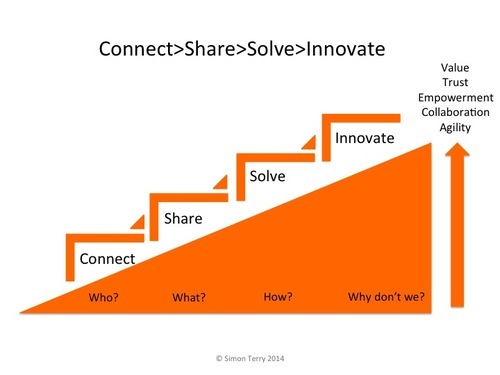
  • Guide Personal Value Creation: Guide employees to understand how the enterprise social network creates value in their work. In my work with organisations, I use a Value Maturity Methodology based on users maturity through 4 stages Connect>Share>Solve>Innovate.
  • Experiment & Learn: Create an environment for employees and the organisation where the enterprise social network fosters experimentation to create new forms of value in work. Encourage sharing and solving challenges.
  • Foster A Learning Community: An engaged and aligned community of employees working together for business goals is the greatest opportunity for value creation in organisations. Focus on how community accelerates value creation and the key roles required in any community. Understanding the roles of champions and leaders is critical.
  • Discuss Value Creation: Social networking accelerates double loop learning. Discuss value creation in the network as the work conversations occur. Celebrate lessons and successes. Back innovations with corporate muscle. Use these new learning conversation to foster alignment with strategic goals and encourage people to find new personal value.

If you would like to create greater value in your enterprise social network or discuss how the Value Maturity Model applies to assist your organisation to create strategic value, please get in contact. I am available through @simongterry or Linkedin or www.simonterry.com

When Circumstances Change, Change Your Approach

image

Changing circumstances demand changes in approach. Clinging to the old ways can be dangerous.

The Praying Mantis in the Schoolyard

When confronted with a threat, a praying mantis has a set program of responses to take advantage of the advantages of excellent camouflage: freeze & blend in, sway like a leaf, run to the nearest tree. All these strategies work well in the normal circumstances of a praying mantis, the leafy greenery of trees.

However when the wind is blowing strongly and a praying mantis finds itself blown to the unfamiliar circumstances of schoolyard asphalt, none of these strategies work. It can’t blend in. Freezing exposes it to risk of being stomped. What it runs towards is not a tree. It is the leg of a small curious boy. In the end, it need a generous young girl to carry it back to the bushes to escape the growing crowd.

Change Your Approach

A praying mantis can’t change its approach immediately. Evolution will take a while to catch up with asphalt. It will eventually adapt as a species, but that doesn’t help any individual insect.

Your organisation isn’t programmed by genetics. When circumstances change, your organisation and its people can adopt new approaches, experiment to find new ways and learn how to succeed in the new environment. If your organisation is still responding to the new network economy with the same approaches and practices that worked in the industrial era, it can be as dangerous as outdated practices were to the mantis. Nobody will be generous enough to return your organisation to its preferred environment.

There is No Formula – Just Learning

Many managers find this discussion deeply unsettling. Advocates of the future of work are calling for change, but they are often either highly conceptual or discussing concepts that seem very alien to the circumstances in an organisation.

The abstraction has a reason. The future of work is being driven by a network economy where the right strategies are often emergent and adaptive. Adopting a new fixed formula is as dangerous as the last one. While we would like a formula (and many offer to sell one), the future strategies need to be learned for each organisation in its own circumstances in the network.  Change can’t be imposed it needs to be led one conversation at a time.

Creating a responsive organisation that can leverage the human potential to learn and experiment a way forward will take new techniques and new ways of organising.  Many of these techniques that are rising to the fore in discussion of the future of work and responsive organisations are ways to foster the emergence of a new better approaches for organisation using networks, rather than fighting them.  That’s why much of the conversation comes back to enabling people to learn and act in new ways:

  • Leadership: fostering the leadership capabilities of each person to leverage their insights and their potential to lead change from their unique position
  • Experimentation: Moving from exercising the power and expertise of a few to experimenting to learn together
  • Learning: improving the ability to understand the environment by focusing on tools to better seek out, share and make sense of information.
  • Work out Loud: aligning the organisation and bringing out latent human capabilities using techniques like ‘working out loud
  • Collaboration & Community: Networks route around barriers. Therefore you need to bring down the barriers within and around your organisation. Isolation is not a winning strategy in a period of rapid change.

Accelerating Trust

image

At the recent DoLectures Australia, many of the attendees remarked on the high levels of trust that had been built between the attendees over the four days. The high trust environment was such that speakers rewrote their talks to share more and some big dreams and surprising admissions were shared on both the stage and around the campfire.

A few key factors helped foster that environment of high trust:

Share a goal: Everyone attended the event to learn and to share in stories of actions that are changing the world. People wanted to become more effective at driving change and often to find a new path in the world. Those common goals fostered connections and trust.

Select for behaviour – especially giving: The event selected for people who were action oriented, passionate and interested in others. These are not abstract values. They come out in action, especially giving. There were a lot of givers in the community. Adam Grant’s Give and Take was a fitting gift for all the speakers (a unexpected gesture by Andy Hedges of Westfield, an event sponsor). From the first night people were sharing ideas and sharing networks in an effort to enable others to move forward. Nothing builds trust like the gift of help.

Strip away the status: when you are camping, sharing communal activities and it gets cold, it is hard to hold on to the trappings of status. Nobody looked their best and everyone’s warm clothes looked alike levelling status that might hold back conversation and connection. 

Build connections: Like any group there were some networks present among the group, but no exclusive cliques. Open networks became a way to accelerate connections as people introduced others and referred people to those who shared an interest or an ability to help. The sense that everyone could talk and understand each other fostered trust. The group left the event deeply connected as a result.

Be present: When nobody has internet or a phone connection, everyone is more present. When almost everyone is staying the whole event, including the speakers, there is time for deeper conversations. People gave themselves over to the event and the company. That presence and the mindfulness it brings gave everyone the chance to truly listen and engage in the event and the activities.

Share stories: Storytelling is a way to learn of others’ experiences, capabilities, goals and actions. Telling stories whether on stage or around a fire enables people to get a richer understanding of the other person.

An environment of trust and concern: Payne’s Hut where the event was held is a place of beauty but more than that it has been constructed and run with a concern to create a wonderful experience. The hosts of Do Lectures added to that experience by taking care to design for the little moments of the event. Trust is reciprocal and reciprocated. When you feel others trust you and show concern for you, you are inclined to follow the role model.

Trust is a critical capability for the future of increasing agile networked organisations. Fostering trust with techniques like these above is critical for the future of work in our organisations.

This post was inspired by a conversation at the event with Col Duthie, the insightful MC of Do Lectures Australia